Pulse Flours (Lentil, Pea & Fava): Nutrients, What Research Shows and Safety
Lentil, pea and fava flours as food: values from the dry seeds (no USDA flour entry), a small blood sugar study, fava and G6PD deficiency, allergy and raw-flour safety.
Content last updated . This page has not been medically reviewed.
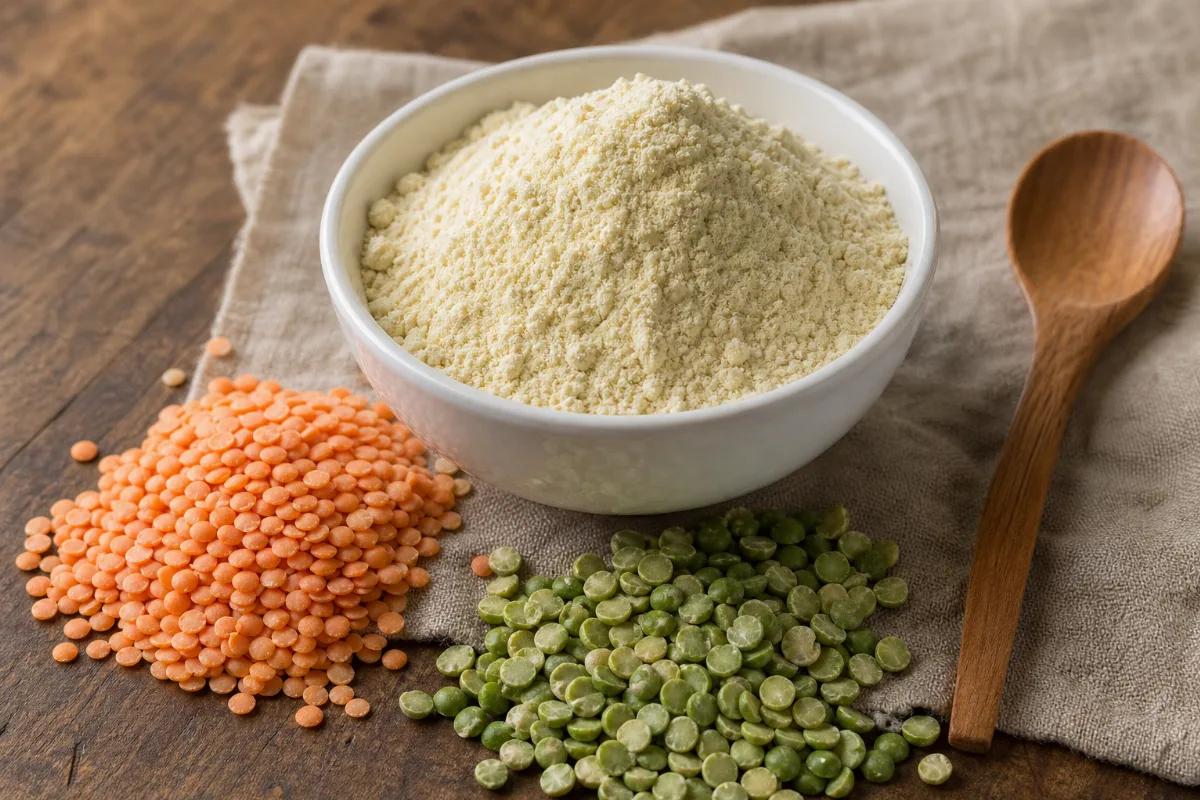
Pulse flours are made by grinding dried lentils, dried peas or dried fava (broad) beans into a powder. They show up in gluten-free breads and pasta, pancakes, baby foods, snack bars and "high-protein" baking mixes, and they can be sold on their own. People choose them for plant protein and fiber. This page covers lentil, pea and fava flour as foods. It keeps them apart from isolated protein powders (see pea protein), from chickpea flour (see chickpea flour) and from hype.
Read this first
- Fava flour is a problem for people with G6PD deficiency. Fava beans can set off hemolytic anemia (red blood cells breaking down) in people with this inherited condition, [10] [11] Fava flour is made from the same beans, so check blends for it.
- Cook the flour. The CDC says most flour is not treated to kill germs, and baking or cooking is what kills them. [12] Official lectin advice for legumes covers whole beans; we found no official guidance that raw pulse flour is safe to eat. [8] [9]
- Evidence in one line: in one small 2025 study, pea and lentil flours raised blood sugar more than the same pulses eaten whole, and all pulse meals were lower than a glucose drink. [3] We found no long-term trial of pulse flours as a food.
- Allergy: lentil and pea allergy are the most common legume allergies in one 2026 children's study, and most children reacted to several legumes. [13] For trouble breathing or swelling of the face or throat after any food, call 911 (or your local emergency number). [14]
- No USDA entry. USDA has no item for these flours in the files we used, so the nutrition table below uses the dry whole seeds the flours are milled from, and says so.
What is in it (USDA values for the dry seed)
USDA FoodData Central has no item for lentil, pea or fava flour in the files we used. The table gives the dry (raw) whole lentils (item 172420, SR Legacy) [1] and dry (raw) fava beans (item 175205, SR Legacy) [2] per 100 g. A flour made from the whole dried seed has the same starting material, but flour from dehulled seeds or milled in other ways can differ, and the table is not a measurement of any flour. A 2020 data set milled dried lentils and fava beans into whole-meal flour for analysis, but the numbers were in files we could not read. [17] The last two columns scale the lentil numbers to 30 g, a stated amount we chose because USDA lists no flour portion. A pea flour value is not in the table because we did not have a USDA entry for dry peas in our file.
| Nutrient | Dry lentils, per 100 g | Dry fava beans, per 100 g | Lentils, per 30 g | % Daily Value per 30 g (lentils) |
|---|---|---|---|---|
| Energy | 352 kcal | 341 kcal | 106 kcal | no DV |
| Total fat | 1.06 g | 1.53 g | 0.318 g | 0% |
| Carbohydrate | 63.4 g | 58.3 g | 19 g | 7% |
| Total sugars | 2.03 g | 5.7 g | 0.609 g | no DV |
| Fiber | 10.7 g | 25 g | 3.21 g | 11% |
| Protein | 24.6 g | 26.1 g | 7.39 g | 15% |
| Folate (DFE) | 479 mcg | 423 mcg | 144 mcg | 36% |
| Thiamin (B1) | 0.873 mg | 0.555 mg | 0.262 mg | 22% |
| Manganese | 1.39 mg | 1.63 mg | 0.418 mg | 18% |
| Copper | 0.754 mg | 0.824 mg | 0.226 mg | 25% |
| Iron | 6.51 mg | 6.7 mg | 1.95 mg | 11% |
| Zinc | 3.27 mg | 3.14 mg | 0.981 mg | 9% |
| Magnesium | 47 mg | 192 mg | 14.1 mg | 3% |
| Potassium | 677 mg | 1062 mg | 203 mg | 4% |
| Sodium | 6 mg | 13 mg | 1.8 mg | 0% |
% Daily Value uses the FDA 2016 Daily Values (per 30 g this is the 100 g percentage scaled by 0.3). USDA lists no Daily Value for energy or sugars. Values vary with variety, growing place and processing. Protein-enriched flours made by air classification or wet extraction are concentrates, not whole-seed flours: one 2025 study of fava, chickpea and red lentil fractions reported 58 to 84 g protein per 100 g in the wet-extracted fractions. [4]
Plant compounds: legumes contain resistant starch and oligosaccharides that ferment in the colon. [15] Raw legumes also contain antinutrients such as phytates, tannins and trypsin inhibitors, which bind minerals or block digestive enzymes; a 2026 scoping review of lab studies reports that fermentation can break down much of them. [7] That is lab and food-science evidence, not a trial in people.
What research says
| Health goal | What the sources found | Strength of evidence | What was studied |
|---|---|---|---|
| Blood sugar after a meal | A 2025 study gave 19 adults (11 with type 2 diabetes, 8 with metabolic syndrome) meals with 50 g of available carbohydrate from whole pulses or from the equivalent pulse flour. All pulse meals lowered the glucose response compared with a glucose drink, and whole pulses gave a lower response than the flours. The study was funded in part by a pulse industry council. [3] A fava-flour bread study found starch digestion rose with particle size in the lab, while particle size had less effect on digestibility of the bread (84% on average). [5] | Promising but limited | Small acute meal study; lab digestion tests |
| Replacing wheat flour in baked goods | A narrative review reports legume-based bakery products have a glycemic index of about 40 to 50 versus 55 to 80 for cereal-based ones, and that adding legumes can lower glycemic index by up to 25%. [16] | Mixed (review, not a trial) | Review of bakery studies |
| Mineral absorption | Fermenting legumes degrades 90% to 100% of phytates and tannins and roughly doubles the bioaccessibility of iron, zinc and calcium in lab digestion models. [7] | Lab or animal only | Scoping review of lab work |
| Protein quality and baking | Dry-fractionated flours kept more fiber but more antinutrients than wet-extracted ones; in a fava bread study finer particles gave better foaming and gelling. [4] [5] | Not a health outcome | Food-science studies |
| Heart, weight and gut health from the flours | Proper evidence not found in the sources we read. Evidence for these outcomes comes from whole pulses, not flours. See legumes as food. | Insufficient evidence | n/a |
Eaten as flour in food vs. whole pulses or protein isolates. Most health research on pulses is on whole cooked beans and lentils. The only human study of flours we read was small and short, and it found the flours worked less well for blood sugar than the whole seeds. [3] Processing steps such as heating, germination and fermentation change flour properties. [6]
How much is a normal serving
We did not find an official serving size for pulse flours. USDA lists no flour portion, so the table scales to a stated 30 g. In the 2025 blood sugar study, each flour meal supplied 50 g of available carbohydrate; that describes the study, not advice. [3] Whole cooked pulses have an NHS portion guide and a USDA household portion; see the sibling pages lentils and fava beans. This page gives information, not a prescription.
Safety, allergy and medicines
- Fava flour and G6PD deficiency. MedlinePlus Genetics says roughly 400 million people worldwide have G6PD deficiency and that fava beans can trigger hemolytic anemia in affected people, as can breathing the plant's pollen. [10] A 2023 review of favism case reports found severity highest in pregnant women and infants, most cases resolved without lasting effects, and hospitalization and transfusion were often needed. [11] We did not read a source on how much fava flour is safe or whether processing removes the risk. See fava beans.
- Raw or undercooked legumes. Health Canada says lectins occur in many legumes including soybeans, lentils and lima beans, with dry red kidney beans the main concern. [9] Ireland's FSAI says a low but steady number of illnesses in the EU are tied to raw or uncooked beans, and that legumes such as lentils and peas have the most lectins. [8] Neither page mentions flour. We found no source on raw pea or lentil flour; cook it. See lectins in beans.
- Raw flour hygiene. The CDC says baking or cooking is what kills germs in flour and advises against raw dough or batter. [12] We did not find a microbe survey of pulse flours.
- Allergy. In a 2026 Italian study of 55 children with legume allergy, pea (70.9%) and lentil (69.1%) were the most common, 74.5% reacted to more than one legume, and 25.5% also had peanut allergy. [13] Some "gluten-free" or "high-protein" products contain pulse flours, so read ingredient lists. MedlinePlus lists peanut and soy among major food allergens and says anaphylaxis is an emergency (call 911). [14] See food allergy basics and emergency signs.
- Digestion. Oligosaccharides and resistant starch can cause gas, bloating and cramps in some people. [15] See beans, gas, FODMAP and digestion.
- Kidney disease, medicines, pregnancy, children: USDA lists 677 mg of potassium (lentils) and 1062 mg (fava) in 100 g of the dry seeds. [1] [2] We did not read a source with limits for pulse flours, or on medicines or pregnancy. See foods, kidney disease, potassium and oxalates, food and medicine interactions and foods in pregnancy, and ask a clinician.
Choosing, storing and food safety
- Read the ingredient list. Look for fava, lupin, peanut or soy in blends if you have an allergy or G6PD deficiency.
- Cook all dishes fully. Only cooking or baking kills germs in flour. [12]
- Flavor. A 2025 study of pulses and pulse flours found that cultivar, harvest year and processing (boiling, roasting, milling) change the volatile compounds, which are linked to off-flavors. [18]
- Store flour dry and sealed; we did not read a source on pulse flour shelf life.
Related pages
Health connections for Pulse Flours (Lentil, Pea & Fava)
What research links to eating or drinking this food, and how strong the evidence is. Many studies are observational or use juice, powder, oil or extracts rather than the food as eaten; each card says which.
Nutrients in pulse flours (values from the dry seeds)
Established roleUSDA has no entry for lentil, pea or fava flour. Dry whole lentils have 24.6 g protein, 10.7 g fiber and 479 mcg folate per 100 g; dry fava beans 26.1 g protein and 25 g fiber. Flours differ with the seed part and milling.
Supplements: The numbers are for the seed the flour is made from, not for a measured flour.
Pea and lentil flours versus whole pulses and blood sugar
Preliminary or mixedIn a 2025 study of 19 adults with type 2 diabetes or metabolic syndrome, pulse meals lowered the glucose response compared with a glucose drink, and whole pulses gave a lower response than the equivalent flours. The study was funded in part by a pulse industry council.
Supplements: A small acute study comparing whole pulses and flours.
Legume-based baked goods and glycemic index
Preliminary or mixedA narrative review reports legume-based bakery products have a glycemic index of about 40 to 50 versus 55 to 80 for cereal-based ones. Fava flour particle size changed starch digestion in the lab.
Supplements: Review of bakery studies and lab digestion tests, not a trial.
Fermentation, antinutrients and mineral absorption (lab)
Lab or animal research onlyRaw legumes contain phytates, tannins and trypsin inhibitors; a 2026 scoping review of lab studies says fermentation can degrade much of them and improve iron, zinc and calcium bioaccessibility in digestion models.
Supplements: Lab digestion models, not people.
Connected topics
Open a group to see how each topic connects and how strong the evidence is.
Root causes (1)
- Nutrient DeficiencyEstablished role
The dry seeds are sources of protein, fiber, folate and iron per USDA; flour values were not measured.
Biomarkers (1)
- HemoglobinDocumented risk
In G6PD deficiency, fava beans can cause hemolytic anemia (falling hemoglobin); fava flour comes from the same bean.
Conditions & symptoms (4)
- FavismDocumented risk
Fava beans can trigger hemolytic anemia in people with G6PD deficiency; fava flour is made from the same beans.
- Food AllergyDocumented risk
Lentil, pea and fava allergy occur and often involve several legumes.
- FlatulenceDocumented risk
Legume oligosaccharides can cause gas.
- Food PoisoningDocumented risk
Raw flour can carry germs and raw legumes contain lectins; cook all flour dishes fully.
Documented risks and interactions (5)
- Fava flour and G6PD deficiency (favism). In G6PD deficiency, fava beans can trigger hemolytic anemia; severity is highest in pregnant women and infants, and most cases resolve but often need hospital care. Fava flour is made from the same beans; we did not read a source on flour or on processing.
- Raw or undercooked legumes (lectins) and flour. Health Canada and the FSAI describe lectin illness from raw or undercooked legumes (kidney beans the main concern; lentils and peas also contain lectins). Neither mentions flour. We found no official statement that raw pulse flour is safe.
- Raw flour and food poisoning. The CDC says most flour is not treated to kill germs, and baking or cooking kills them. A UK survey found Salmonella and STEC in some flour products. We found no survey of pulse flours.
- Lentil, pea and fava allergy. In an Italian study of 55 children with legume allergy, pea (70.9%) and lentil (69.1%) were the most common, 74.5% reacted to more than one legume and 25.5% had peanut allergy. Call 911 for trouble breathing or swelling.
- Gas and digestion. Legumes contain oligosaccharides and resistant starch that ferment in the colon and can cause gas, bloating and cramping in some people.
Frequently asked questions
Is lentil or pea flour safe to eat raw?
We found no official source that says so. Official advice on lectins concerns whole beans and says to cook them. [8] [9] The CDC says baking or cooking is what kills germs in flour. [12] So cook it.
Can people with G6PD deficiency eat pulse flours?
Not fava flour without a clinician's advice: fava beans can trigger hemolytic anemia in G6PD deficiency. [10] [11] We did not read a source on lentil or pea flour and G6PD.
Do pulse flours raise blood sugar less than wheat flour?
A review reports lower glycemic index for legume-based bakery products. [16] In a small 2025 study, pea and lentil flours raised blood sugar more than the same whole pulses, though all pulse meals were lower than a glucose drink. [3]
Is pulse flour the same as pea protein powder?
No. Pulse flour is the whole ground seed. Protein concentrates and isolates are extracted fractions with much higher protein (58 to 84 g per 100 g in wet-extracted fractions in one study). [4] See pea protein.
Can I be allergic to pulse flours?
Yes. Lentil and pea allergy are common among children with legume allergy, and many react to several legumes. [13] Call 911 for trouble breathing or swelling. [14]
References
- U.S. Department of Agriculture. FoodData Central: Lentils, raw (SR Legacy, FDC 172420). April 2018 release. Read 2026-10-24.
- U.S. Department of Agriculture. FoodData Central: Broadbeans (fava beans), mature seeds, raw (SR Legacy, FDC 175205). April 2018 release. Read 2026-10-24.
- Pea and Lentil Flours Increase Postprandial Glycemic Response in Adults with Type 2 Diabetes and Metabolic Syndrome. Foods 2025 (abstract read via Europe PMC). Read 2026-10-24.
- Industrial-scale fractionation of fava bean, chickpea, and red lentil: A comparative analysis of composition, antinutrients, nutrition, structure, and functionality. Curr Res Food Sci 2025 (abstract read via Europe PMC). Read 2026-10-24.
- Impact of Particle Size on the Physicochemical, Functional, and In Vitro Digestibility Properties of Fava Bean Flour and Bread. Foods 2024 (abstract read via Europe PMC). Read 2026-10-24.
- Innovative Emerging Technologies for Pulse Flour Functionalization: A Comparison With Conventional Thermal and Biological Techniques. Compr Rev Food Sci Food Saf 2026 (abstract read via Europe PMC). Read 2026-10-24.
- Biotechnological Modulation of Legumes via Fermentation: Impacts on Nutrient Bioaccessibility, Glycemic Index, and Antinutrients - A Scoping Review. Foods 2026 (abstract read via Europe PMC). Read 2026-10-24.
- Food Safety Authority of Ireland. FSAI provides precautionary advice on uncooked or undercooked beans. Dated 2024-07-23. Read 2026-10-24.
- Health Canada. Lectins in Dry Legumes. Page details dated 2017-05-04. Read 2026-10-24.
- MedlinePlus Genetics. Glucose-6-phosphate dehydrogenase deficiency. Last updated 2023-04-12. Read 2026-10-24.
- Favism: Clinical Features at Different Ages. Nutrients 2023 (abstract read via Europe PMC). Read 2026-10-24.
- Centers for Disease Control and Prevention. Raw Flour and Dough. Page dated 2025-11-24. Read 2026-10-24.
- IgE-Mediated Legume Allergy in Children: Insights from a Single-Center Experience in Italy. Nutrients 2026 (abstract read via Europe PMC). Read 2026-10-24.
- MedlinePlus. Food allergy. Last updated 2025-11-19. Read 2026-10-24.
- Harvard T.H. Chan School of Public Health. The Nutrition Source: Legumes. No update date shown on the page. Read 2026-10-24.
- Glycemic impact of cereal and legume-based bakery products: Implications for chronic disease management. Food Chem X 2024 (abstract read via Europe PMC). Read 2026-10-24.
- De Angelis D et al. Data on the proximate composition, bioactive compounds, physicochemical and functional properties of a collection of faba beans and lentils. Data in Brief 2020 (numbers in supplementary files not read). Read 2026-10-24.
- Effect of Processing, Cultivar, and Crop Year on Volatile Composition in Pulses and Pulse Flours Analyzed by HS-SPME GC-MS. J Food Sci 2025 (abstract read via Europe PMC). Read 2026-10-24.