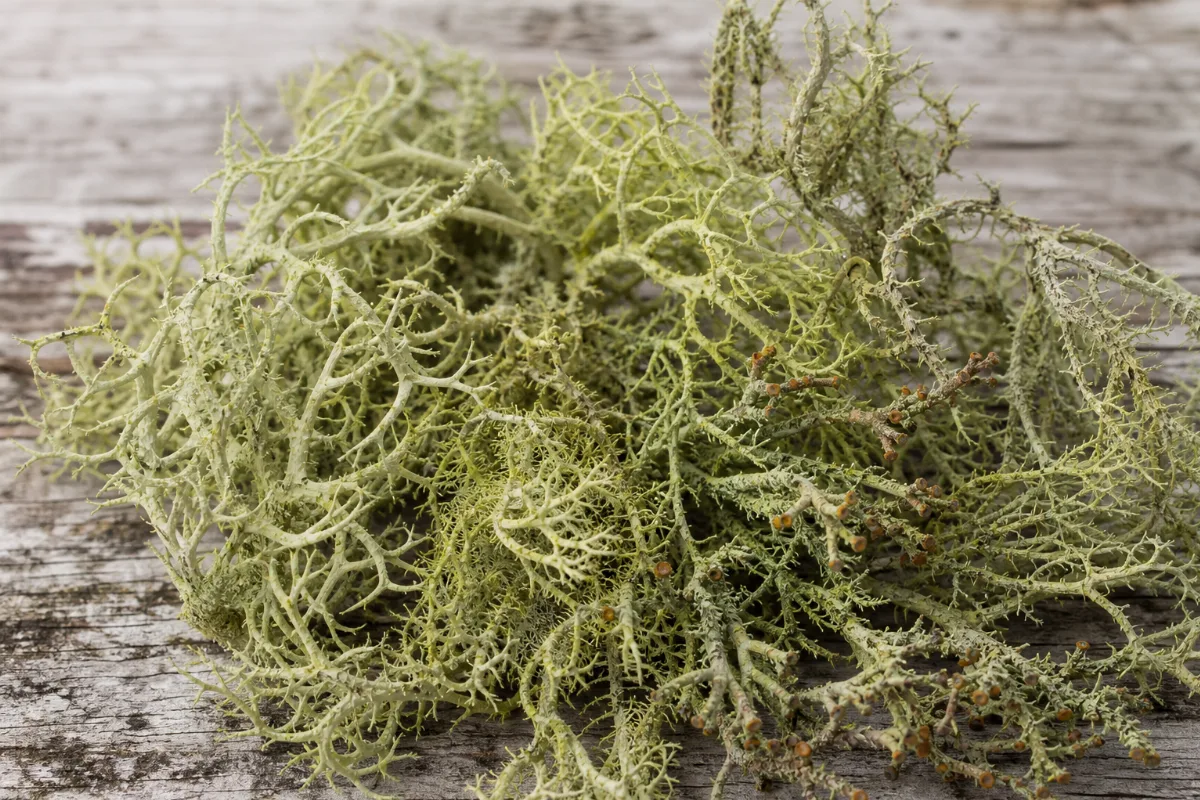
Herbs & Botanicals · Lichen with a liver warning
Usnea
Usnea barbata · also called Old man's beard, beard lichen
Usnea is a lichen, not a plant, used in traditional medicine and sold in capsules and tinctures. Its main compound, usnic acid, was sold as a weight-loss aid. No human trial shows it works. The key caution is the liver: usnic acid supplements have been linked to liver failure and transplants.
General information, not medical advice. Last substantive update · Not medically reviewed. A named clinician has not signed off on this page. How this page is made
About Usnea
Usnea is a lichen whose main compound, usnic acid, has been linked to serious liver injury. Human evidence of benefit is missing. Lichen allergy and pregnancy are other cautions.
What it is
Usnea, or old man's beard, is a stringy lichen that grows on trees. A lichen is a fungus living together with an alga, so it is not a plant. Usnea barbata and related species have been used in traditional medicine for pain, fever and wounds.
Its best-known compound is usnic acid. In the early 2000s, usnic acid and Usnea extracts were sold in the US as weight-loss supplements.
How it may work
In the lab, usnic acid slows bacteria and disrupts energy production in cells. The same effect in liver cells may explain the liver damage. Usnic acid also blocks some medicine-handling liver enzymes in the test tube.
None of this has been shown to help people.
What the research shows
We found no controlled human trial of Usnea or usnic acid. MSK says evidence for weight loss is lacking. A few small old Chinese studies for bronchitis and tuberculosis are mentioned by a review, with little detail.
Everything else is lab or animal work, such as effects on cancer cells and bacteria.
At a glance
Traditional uses history, not proof
- Traditional remedy for pain, fever and wound healing
- Used in Traditional Chinese Medicine, per a review
Studied for research
- Weight loss, insufficient
- Antibacterial action (lab only), insufficient
- Bronchitis and tuberculosis (small old studies), insufficient
- Cancer cells, inflammation and antioxidant effects (lab), insufficient
Main compounds
- Usnic acid (PubChem CID 5646), the main safety concern
Common forms
- Dried lichen
- Capsules and tinctures
- Isolated usnic acid
- Creams, toothpastes and deodorants
Research links: Guo 2008: Review of usnic acid and Usnea barbata toxicity (PubMed) · Croce 2022: Toxicity of usnic acid (PubMed) · Durazo 2004: liver failure after pure usnic acid (PubMed) · Memorial Sloan Kettering: Usnic acid · Research Library · Genes & Biomarkers Library
The plant and its history
- Accepted scientific name
- Usnea barbata (L.) Weber ex F.H.Wigg (GBIF ACCEPTED, exact match, confidence 97)
- Naming authority
- (L.) Weber ex F.H.Wigg
- Common names
- Old man's beard (English); Beard lichen (English); Usnea (English / Latin genus name)
- Botanical family
- Parmeliaceae (a lichen family, not a plant family)
- Classification
- Fungi (a lichen: a fungus living with an alga or cyanobacterium) > Not pulled > Not pulled > Lecanorales > Parmeliaceae > Usnea > Usnea barbata
- Native range
- Not covered in the sources read.
- Habitat
- Lichens grow on trees, soil and rocks (per a dermatology paper); not otherwise covered.
- What the plant looks like
- Roots: Not applicable: lichens have no roots.; Stems: Not described in sources read.; Leaves: Not applicable.; Flowers: Not applicable.; Fruit: Not applicable.; Seeds: Not applicable.; Cultivation: Not covered in the sources read.
- Harvest and processing
- Not covered in the sources read.
- Look-alikes and adulterants
- Name: Other Usnea species and other beard lichens; Note: Our earlier summary says products may be other Usnea species; usnic acid content varies. No identification study was read.
- Sustainability and conservation
- Not covered in the sources read.
Traditional use and history history, not clinical proof
| Tradition or era | Documented use | Source |
|---|---|---|
| Traditional medicine in several regions, including Traditional Chinese Medicine | Lichens were used for pain, fever and wound healing (MSK); our earlier summary says Usnea was used in Chinese medicine per a review. | s-msk-usnic |
| Modern supplements, about 2000 onward | Marketed in the US as a weight-loss or bodybuilding fat burner; FDA warning in 2001. | p19034791 |
Traditional use shows how a plant was used. It does not show that a supplement works or is safe today.
What is inside, and how it may work
What the plant contains and how those compounds act in cells and animals. Laboratory and animal mechanisms are not proven effects in people.
Main compounds
| Compound | Family | Where it is concentrated | Activity studied | Level of evidence |
|---|---|---|---|---|
| Usnic acid PubChem 5646 | Dibenzofuran (lichen acid) | Whole lichen body (thallus) | Antibacterial in the lab and linked to liver toxicity. Exists as (+) and (-) forms with different lab activity (per MSK). 12 10 3 | Lab and human case reports |
Mechanisms, receptors and pathways
| Target or pathway | Gene or receptor | What was found | Level |
|---|---|---|---|
| Liver cell energy production (mitochondria) and oxidative stress | Not detailed in the sources read | MSK says usnic acid can induce oxidative stress and inhibit mitochondrial function in liver cells, which may explain the toxicity. 10 2 | Lab |
| Drug-metabolising enzymes CYP1A2, UGT1A1, UGT1A3, CYP2C19, CYP2C9 | CYP1A2; UGT1A1; UGT1A3; CYP2C19; CYP2C9 | Usnic acid is metabolised by CYP1A2 and UGT1A1/1A3 and strongly blocks CYP2C19 and CYP2C9 in the test tube. 5 | Lab |
| Antibacterial and antiproliferative effects | Not detailed | Seen in cells and animals only. 10 | Lab and animal |
Absorption, metabolism and elimination
- Absorption
- Not found in people.
- Distribution
- Not found.
- Metabolism
- In human lab systems, mainly CYP1A2 oxidation and glucuronidation by UGT1A1 and UGT1A3.
- Elimination
- Not found.
- Bioavailability
- No human blood-level study was found.
Isolated compounds versus whole extracts
Our earlier summary of the 2008 review says Usnea preparations were more toxic in animals than pure usnic acid at the same usnic acid content, so the whole lichen cannot be assumed gentler.
Nutritional composition
Usnea is not a food or nutrient. It is a lichen, a partnership of a fungus and an alga, not a plant. No vitamin or mineral role was found.
6 not enough evidence
What is Usnea good for?
The studied uses and how strong the human evidence is for each. For Usnea, none is established, and the liver risk is real.
Benefits, one by one
Each card is a research question, not a promise. Tap a goal to filter. Open a card to see the studies, doses and limits.
Weight loss
Not enough evidenceUsnic acid was sold as a fat burner. No controlled trial shows it works, and it has been linked to liver failure.
3 studiesProducts varied; some were pure usnic acid and others mixed products.
Studies, doses and limits
What the trials found
No controlled human trial for weight loss was found. MSK says evidence of benefit is lacking, and our earlier reading of the 2022 review found no controlled human trials.
Results
Nothing to report: no trial results exist. Instead, case reports describe liver failure and transplants after usnic acid slimming products.
Effect sizes as reported
No numbers: no trial.
Why this rating
There is no controlled human evidence of benefit and there is documented harm.
Form and dose studied
Products varied; some were pure usnic acid and others mixed products.
Who was studied
Adults who bought slimming products; case reports mostly in young women.
Limits
Product mixtures (stimulants, green tea) make blame hard to separate, but one case involved pure usnic acid.
Why researchers looked
Usnic acid and Usnea extracts were marketed in the US as weight-loss supplements.
Traditional use
None documented for weight loss; Usnea is a traditional lichen medicine.
Proposed mechanism Lab and animal
Lab work suggests usnic acid disrupts how cells make energy, which is one reason it was promoted as a fat burner. This also helps explain liver damage.
A proposed mechanism does not show that the effect happens in people.
Usnic acid products have caused serious liver injury. See the Safety tab before any use.
Fighting germs (lab only)
Not enough evidenceUsnic acid kills some bacteria in the lab and is used as an ingredient in some creams and toothpastes. This has not been shown to treat infections in people when swallowed.
1 studiesNot applicable.
Studies, doses and limits
What the trials found
No trial of Usnea or usnic acid for treating an infection in people was found, except one small zinc plus usnic acid HPV study that MSK mentions and we did not open.
Results
MSK lists antimicrobial effects in lab and animal models only.
Effect sizes as reported
Not given.
Why this rating
Test-tube and animal findings only.
Form and dose studied
Not applicable.
Who was studied
Not tested in people.
Limits
We read a regulator-style summary, not the underlying lab papers.
Why researchers looked
Lichen compounds have antibacterial activity in test-tube work, and Usnea has been used traditionally for infections and wounds.
Traditional use
Lichens have been used in traditional medicine for pain, fever and wound healing (per MSK).
Proposed mechanism Lab
Usnic acid slows bacterial growth and biofilm formation in the lab.
A proposed mechanism does not show that the effect happens in people.
Usnic acid products have caused serious liver injury. See the Safety tab before any use.
Bronchitis and tuberculosis (small older Chinese studies)
Not enough evidenceA review mentions a few small older studies in China, with few design details. They also reported stomach pain, raised liver enzymes, dry mouth, dizziness and nausea.
1 studiesNot stated.
Studies, doses and limits
What the trials found
Our earlier summary of the 2008 review says it mentions small older Chinese studies with little design detail. We did not open the original papers.
Results
Reported side effects included raised liver enzymes. No benefit data are available to us.
Effect sizes as reported
None.
Why this rating
Details were not read; the studies are described as small and old.
Form and dose studied
Not stated.
Who was studied
People with bronchitis or tuberculosis in China (as described secondhand).
Limits
Secondhand description only; do not use Usnea in place of tuberculosis treatment.
Why researchers looked
Usnea has a traditional role in Chinese medicine for lung and infectious disease.
Traditional use
Used in Traditional Chinese Medicine per a review.
Proposed mechanism Human (low quality reports)
Not established.
A proposed mechanism does not show that the effect happens in people.
Usnic acid products have caused serious liver injury. See the Safety tab before any use.
Creams, toothpastes and deodorants
Not enough evidenceUsnic acid is used in some creams, deodorants and oral-care products for its antibacterial action. Use on the skin can cause rash in people who become allergic to lichen.
3 studiesTopical products; the exact lichen in the deodorant case was not test…
Studies, doses and limits
What the trials found
The 2022 review calls topical use generally well tolerated, mostly from animal data, per our earlier reading. Four people got allergic rashes from a lichen deodorant.
Results
No trial of benefit. Patch tests confirmed lichen allergy in the four deodorant cases.
Effect sizes as reported
None.
Why this rating
No trial shows a skin benefit. Allergy is the documented human finding.
Form and dose studied
Topical products; the exact lichen in the deodorant case was not tested.
Who was studied
Four patients with rash.
Limits
Small case series.
Why researchers looked
Usnic acid is used as a preservative and antibacterial ingredient in cosmetics (per MSK).
Traditional use
Lichens were used for wound healing (per MSK).
Proposed mechanism Lab and case reports
Antibacterial activity in the lab.
A proposed mechanism does not show that the effect happens in people.
Lichen contact allergy is documented. Stop use if a rash develops.
Cancer cells, inflammation and antioxidant effects (lab and animal only)
Not enough evidenceIn cells and animals usnic acid slows cancer cell growth and calms inflammation. There is no evidence of this in people.
1 studiesNot applicable.
Studies, doses and limits
What the trials found
No human trial of Usnea or usnic acid for cancer or inflammation was found.
Results
Not applicable.
Effect sizes as reported
None.
Why this rating
Lab and animal only.
Form and dose studied
Not applicable.
Who was studied
Not tested in people.
Limits
A lab effect on cancer cells is not a treatment.
Why researchers looked
Lab screening of lichen compounds.
Traditional use
Not documented for these uses.
Proposed mechanism Lab and animal
MSK describes antiproliferative, anti-inflammatory and antioxidant effects in cells and animals. The same oxidative stress effects occur in liver cells and are tied to toxicity.
A proposed mechanism does not show that the effect happens in people.
Usnic acid products have caused serious liver injury. See the Safety tab before any use.
Genital HPV lesions (one small study of a zinc and usnic acid product)
Not enough evidenceMSK mentions one small study of a zinc plus usnic acid product as an extra treatment for genital HPV infection. We did not read it, so we cannot rate it.
1 studiesCombination of zinc sulfate and usnic acid, applied locally (not a su…
Studies, doses and limits
What the trials found
Mentioned secondhand on the MSK page. The paper was not opened.
Results
Favourable effects reported by MSK; no numbers read.
Effect sizes as reported
Unknown.
Why this rating
Not read, combination product, small study.
Form and dose studied
Combination of zinc sulfate and usnic acid, applied locally (not a supplement).
Who was studied
Women with genital HPV lesions after surgery.
Limits
Secondhand; combination product.
Why researchers looked
A combination product used after surgery on genital lesions.
Traditional use
Not traditional.
Proposed mechanism Human (small, not read)
Not established.
A proposed mechanism does not show that the effect happens in people.
Usnic acid products have caused serious liver injury. See the Safety tab before any use.
Connections to the rest of health
How Usnea connects to the rest of our health knowledge graph. Every link says what kind of connection it is. A safety link (for example to the liver) is a warning, not a benefit. A study that merely mentions a topic never creates a benefit link.
Explore every connection: goals, body systems, organs, symptoms, genes
A. Wellness goals
| Connected to | Kind of connection | Evidence status | Context | Studies |
|---|---|---|---|---|
| Weight Management | Not enough evidence | Weight loss: Usnic acid was sold as a fat burner. No controlled trial shows it works, and it has been linked to liver failure. | 10 3 4 | |
| Immune Support | Preliminary mechanism | Not enough evidence | Fighting germs (lab only): Usnic acid kills some bacteria in the lab and is used as an ingredient in some creams and toothpastes. This has not been shown to treat infections in people when swallowed. | 10 |
| Respiratory Health | Traditional use | Not enough evidence | Bronchitis and tuberculosis (small older Chinese studies): A review mentions a few small older studies in China, with few design details. They also reported stomach pain, raised liver enzymes, dry mouth, dizziness and nausea. | 6 |
| Healthy Skin | Not enough evidence | Creams, toothpastes and deodorants: Usnic acid is used in some creams, deodorants and oral-care products for its antibacterial action. Use on the skin can cause rash in people who become allergic to lichen. | 10 8 1 | |
| Inflammation Balance | Preliminary mechanism | Not enough evidence | Cancer cells, inflammation and antioxidant effects (lab and animal only): In cells and animals usnic acid slows cancer cell growth and calms inflammation. There is no evidence of this in people. | 10 |
| Immune Support | Not enough evidence | Genital HPV lesions (one small study of a zinc and usnic acid product): MSK mentions one small study of a zinc plus usnic acid product as an extra treatment for genital HPV infection. We did not read it, so we cannot rate it. | 10 |
B. Body systems
| Connected to | Kind of connection | Evidence status | Context | Studies |
|---|---|---|---|---|
| Metabolism Weight | Biological association | Not enough evidence | Studied for: Weight loss | 10 3 4 |
| Immune System | Biological association | Not enough evidence | Studied for: Fighting germs (lab only) Studied for: Cancer cells, inflammation and antioxidant effects (lab and animal only) | 10 |
| Respiratory | Biological association | Not enough evidence | Studied for: Bronchitis and tuberculosis (small older Chinese studies) | 6 |
| Skin | Biological association | Not enough evidence | Studied for: Creams, toothpastes and deodorants | 10 8 1 |
E. Health conditions
| Connected to | Kind of connection | Evidence status | Context | Studies |
|---|---|---|---|---|
| Acute liver failure | Adverse effect or risk | Case report | Several case reports with transplants. Preparation or compound: Usnic acid supplements |
4 7 |
J. Genes, receptors and enzymes
| Connected to | Kind of connection | Evidence status | Context | Studies |
|---|---|---|---|---|
| CYP2C19 / CYP2C9 | Preliminary mechanism | Lab | Strongly inhibited by usnic acid in the test tube. | 5 |
K. Biological pathways
| Connected to | Kind of connection | Evidence status | Context | Studies |
|---|---|---|---|---|
| Mitochondrial function and oxidative stress in liver cells | Preliminary mechanism | Lab | Proposed route to liver injury. | 10 |
L. Active compounds
| Connected to | Kind of connection | Evidence status | Context | Studies |
|---|---|---|---|---|
| Usnic acid | Biological association | Lab and human case reports | Antibacterial in the lab and linked to liver toxicity. Exists as (+) and (-) forms with different lab activity (per MSK). Preparation or compound: Whole lichen body (thallus) |
12 10 3 |
Each connection is stored with the ingredient, the connected record, the kind of connection, the evidence status, the supporting studies, the preparation or compound involved, and a review date (last reviewed October 25, 2026).
The evidence
The research centre for Usnea. Every record here was checked against PubMed or the publisher's page; we never list a study we have not verified.
Evidence by outcome
Bars show how many studies we found for each outcome, not how well it works. People are added up across trials only (reviews are not added, to avoid double counting).
How we rate evidence
High certainty
Several well-run trials or reviews agree; further research is unlikely to change the picture much.
Moderate certainty
Good trials point the same way, but some doubt remains.
Low certainty
Small, short or inconsistent trials. The finding could change with better research.
Very low certainty
Very little or very weak human data. Treat as a possibility only.
Mixed findings
Trials or reviews disagree with each other.
Not enough evidence
Not enough human research to say either way.
Evidence against
Good research found no benefit, or found harm.
We take the reviewers' own risk-of-bias and GRADE statements where they exist, and otherwise judge from study size, design, consistency, directness and whether a product matches what is sold. Many publications do not make evidence high. Method note: We started from our existing Usnea summary, re-checked its PubMed items and added case reports, a metabolism study and skin-allergy reports. Names were checked in GBIF and NCBI Taxonomy and the compound in PubChem. LiverTox could not be read.
Study library: every study we checked 13
| Study | Design | People | Product, dose, length | Result |
|---|---|---|---|---|
| Aalto-Korte 2005 Occupational allergic contact dermatitis from lichens in present-day Finland. Contact Dermatitis · PMID 15701128 · DOI |
Case series |
4 Four forestry and garden workers in Finland |
Lichens on bark and wood (skin contact) Whole lichen Not stated in the abstract Not stated in the abstract · vs None |
Lichens contain usnic acid and other lichen acids that are contact allergens. The paper describes four workers with allergic contact dermatitis from lichens; three also reacted to fragrance mix and oak moss absolute. It notes lichens can also cause hives, rhinitis and asthma. Not stated in the abstract Methods, limits and fundingOutcomes: Skin allergy Limitations: Four cases; occupational exposure, not supplements. Funding and conflicts: Not stated in the abstract Read: abstract |
| Chen 2025 Hepatotoxicity of usnic acid and underlying mechanisms. J Environ Sci Health C Toxicol Carcinog · PMID 38904414 · DOI |
Narrative review human (reports) and lab |
Published literature on usnic acid liver toxicity | Usnic acid in supplements Isolated compound / crude lichen extract Not stated in the abstract Not stated in the abstract · vs Not stated |
The abstract says usnic acid-containing weight-loss and bodybuilding products were linked to liver toxicity, that the FDA issued a 2001 warning letter on LipoKinetix, and that the manufacturer withdrew it. The review updates the 2008 FDA-authored review with newer mechanism data. Not stated in the abstract Methods, limits and fundingOutcomes: Liver toxicity mechanisms Limitations: Narrative review; the abstract gives no numbers. Funding and conflicts: Not stated in the abstract Read: abstract |
| Croce 2022 Toxicity of Usnic Acid: A Narrative Review. Journal of Toxicology · PMID 36310641 · DOI |
Narrative review human (reports), animal and lab |
Published literature on usnic acid toxicity, genotoxicity, teratogenicity, case reports and topical use | Usnic acid (isolated compound) in supplements and topical products Isolated compound from lichens Not stated in the abstract Not stated in the abstract · vs Not stated |
The abstract says severe liver toxicity in a limited number of people led the FDA to issue a warning letter and the product (LipoKinetix) left the market in November 2001. The review covers toxicology, genotoxicity, mutagenicity and teratogenicity data and the case reports of liver harm after usnic acid slimming products. Our earlier summary of the full text reports no controlled human weight-loss trials and a single high-dose rat study with pregnancy loss and fetal abnormalities; those two details were not re-opened here. Not stated in the abstract Methods, limits and fundingOutcomes: Hepatotoxicity, teratogenicity, topical safety Limitations: Narrative review, not systematic. Pregnancy and weight-loss details come from our earlier reading (summary-only) rather than the abstract. Funding and conflicts: Not stated in the abstract Read: abstract |
| Durazo 2004 Fulminant liver failure due to usnic acid for weight loss. Am J Gastroenterol · PMID 15128366 · DOI |
Case report |
1 One 28-year-old woman taking pure usnic acid for weight loss |
Pure usnic acid (supplement) Isolated compound Not stated in the abstract Not stated in the abstract · vs None |
The woman developed fulminant liver failure and needed a liver transplant after taking pure usnic acid for weight loss. The authors call it the first report with pure usnic acid; earlier cases involved mixed products. Not stated in the abstract Methods, limits and fundingOutcomes: Liver failure Limitations: Single case; cause inferred, though no other cause is named in the abstract. Funding and conflicts: Not stated in the abstract Read: abstract |
| Foti 2008 Metabolism and related human risk factors for hepatic damage by usnic acid containing nutritional supplements. Xenobiotica · PMID 18274956 · DOI |
Lab in vitro lab |
Human plasma, liver cells and liver fractions in the lab | Usnic acid Isolated compound Modelled on case-report doses of 450 mg to over 1 g a day Not stated in the abstract · vs Not stated |
Lab tests found usnic acid is broken down mainly by CYP1A2 and by UGT1A1 and UGT1A3. It strongly blocked CYP2C19 and CYP2C9 and weakly blocked CYP2D6 in the test tube. Modelling using doses from case reports (450 mg to over 1 g a day) suggested real potential to interact with other medicines. Not stated in the abstract Methods, limits and fundingOutcomes: Metabolism and enzyme inhibition Limitations: Test-tube and computer modelling only; no human interaction study. Authors appear industry-affiliated (not confirmed from the abstract). Funding and conflicts: Not stated in the abstract Read: abstract |
| Guo 2008 Review of usnic acid and Usnea barbata toxicity. J Environ Sci Health C Environ Carcinog Ecotoxicol Rev · PMID 19034791 · DOI |
Narrative review human (reports) and lab |
Published toxicity literature on usnic acid and Usnea barbata | Usnic acid and crude Usnea barbata extracts Whole lichen / isolated compound Not stated in the abstract Not stated in the abstract · vs Not stated |
The abstract says the US FDA received 21 reports of liver toxicity linked to supplements containing usnic acid and in 2001 warned about one such product, LipoKinetix. Usnic acid and Usnea barbata were then nominated for toxicity testing by the US National Toxicology Program. Not stated in the abstract Methods, limits and fundingOutcomes: Liver toxicity reports and mechanisms Limitations: Narrative review by FDA-affiliated authors; the abstract gives no counts of transplants or deaths. Our earlier summary said the full text is inconsistent on transplant numbers, so this page gives none. Funding and conflicts: Not stated in the abstract Read: abstract |
| Sanchez 2006 Severe hepatotoxicity associated with use of a dietary supplement containing usnic acid. Mayo Clin Proc · PMID 16610575 · DOI |
Case series |
2 Two patients who took a usnic acid supplement for weight loss |
Usnic acid-containing dietary supplement Not stated Not stated in the abstract Not stated in the abstract · vs None |
Both developed severe liver injury within 3 months. One had fulminant liver failure needing emergency transplant; the other had submassive liver necrosis without transplant. Liver biopsy and work-up found no other cause. Not stated in the abstract Methods, limits and fundingOutcomes: Liver injury Limitations: Two cases; the specific ingredient responsible is unknown according to the abstract. Funding and conflicts: Not stated in the abstract Read: abstract |
| Sheu 2006 Allergic contact dermatitis from a natural deodorant: a report of 4 cases associated with lichen acid mix allergy. J Am Acad Dermatol · PMID 16844524 · DOI |
Case series |
4 Four patients with rash from a botanical deodorant |
Natural deodorant containing lichen extract (topical) Lichen extract Not stated in the abstract Not stated in the abstract · vs None |
All four had positive patch tests to lichen acid mix and d-usnic acid; the three tested with the product also reacted to it. Three had armpit rash and one a rash on the outer ear. Not stated in the abstract Methods, limits and fundingOutcomes: Skin allergy (patch tests) Limitations: Four cases at one clinic; the exact lichen in the deodorant was not tested. Funding and conflicts: Not stated in the abstract Read: abstract |
| Yellapu 2011 Acute liver failure caused by 'fat burners' and dietary supplements: a case report and literature review. Can J Gastroenterol · PMID 21499580 · DOI |
Case report |
1 One young healthy woman |
Fat burner supplement with usnic acid, green tea and guggul extracts (combination product) Not stated Not stated in the abstract Not stated in the abstract · vs None |
She developed fulminant liver failure needing an emergency liver transplant. Work-up found no other cause. The product was a combination, so usnic acid cannot be singled out. Not stated in the abstract Methods, limits and fundingOutcomes: Liver failure Limitations: Single case; combination product. Funding and conflicts: Not stated in the abstract Read: abstract |
| n/a 2021 Usnic acid (Memorial Sloan Kettering Cancer Center, About Herbs) Memorial Sloan Kettering Cancer Center · Source |
Database or regulator record n/a |
n/a | n/a n/a n/a n/a · vs n/a |
MSK says evidence for weight loss is lacking, links usnic acid products to severe liver toxicity, lists lab antioxidant, anti-inflammatory, antimicrobial and antiproliferative effects, mentions one small trial of an usnic acid and zinc product in genital HPV, and notes theoretical anticoagulant interaction and animal CYP3A4 induction of unknown clinical relevance. It notes topical use may cause irritation or allergy and that usnic acid is found in Kombucha tea and used as a cosmetic preservative. n/a Methods, limits and fundingOutcomes: Identity or regulatory status Limitations: Page is about usnic acid, not the Usnea herb; it does not mention Usnea. Page read 2026-10-25; the HPV study was not opened. Funding and conflicts: n/a Read: full-text |
| n/a 2026 Regulator records not read for Usnea (LiverTox, LactMed, EMA/HMPC, NCCIH, WHO, FDA 2001 notice) Search record, 2026-10-25 · Source |
Database or regulator record n/a |
n/a | n/a n/a n/a n/a · vs n/a |
NIH LiverTox could not be opened (blocked by a browser check). No EMA/HMPC or WHO monograph for Usnea was found in the sources read, and NCCIH and MSK have no Usnea page. The FDA 2001 LipoKinetix notice was not opened; it is described only through the 2008 and 2022 reviews. n/a Methods, limits and fundingOutcomes: Identity or regulatory status Limitations: Absence of a record in what we could open is not proof that none exists. Funding and conflicts: n/a Read: not-read |
| n/a 2026 PubChem compound record: usnic acid (CID 5646) PubChem PUG REST (checked 2026-10-25) · Source |
Database or regulator record n/a |
n/a | n/a n/a n/a n/a · vs n/a |
CID 5646, usnic acid, formula C18H16O7, IUPAC name 2,6-diacetyl-7,9-dihydroxy-8,9b-dimethyldibenzofuran-1,3-dione. n/a Methods, limits and fundingOutcomes: Identity or regulatory status Limitations: Identity only. Funding and conflicts: n/a Read: full-text |
| n/a 2026 GBIF Backbone Taxonomy species match: Usnea barbata GBIF API (checked 2026-10-25) · Source |
Database or regulator record n/a |
n/a | n/a n/a n/a n/a · vs n/a |
Usnea barbata (L.) Weber ex F.H.Wigg returned ACCEPTED, exact match, confidence 97, key 7247607, family Parmeliaceae, order Lecanorales. The genus Usnea Dill. ex Adans. is also ACCEPTED (key 2605982), same family. n/a Methods, limits and fundingOutcomes: Identity or regulatory status Limitations: Taxonomy only; says nothing about which Usnea species are in a given product. Funding and conflicts: n/a Read: full-text |
What we do not know yet
- No controlled human trial of Usnea or usnic acid.
- LiverTox, LactMed, EMA/HMPC, WHO and the FDA 2001 notice were not read.
- No testing of products on sale for usnic acid strength or species.
How new research is added
New studies are found by a saved PubMed search and placed in a review queue. A person reads each one before it changes any rating or safety wording.
Lab markers
What changed in blood or saliva tests during trials. A changed number is not the same as feeling or being healthier, and we give no "normal ranges".
Safety
What studies and official sources say about side effects, medicines and who should check first. Each point shows what kind of evidence it comes from.
Main points to know 4
- Usnic acid supplements have caused severe liver injury. The FDA received 21 reports of liver toxicity from supplements containing usnic acid and in 2001 warned about one product, LipoKinetix. Case reports describe liver failure needing a transplant, including one woman who took pure usnic acid. Usnea is the lichen usnic acid comes from, and the lichen itself has not been shown to be safer. Case report 6 4 7 3
- Whole-lichen products may be as risky as pure usnic acid. Our earlier summary of the FDA-authored 2008 review says animal tests found Usnea preparations with the same usnic acid content more toxic than pure usnic acid. We did not re-open that detail. Animal research 6
- Lichen allergy. Lichen acids, including usnic acid, are contact allergens. Rashes have been reported from a lichen deodorant and in forestry workers. Case report 8 1
- Pregnancy and breastfeeding: avoid. No human safety data exist. Our earlier summary of the 2022 review reports one rat study with poor weight gain, pregnancy loss and fetal abnormalities at high doses, which the review calls controversial. Breastfeeding data (LactMed) were not read. Animal research 3 11
Side effects 4
| Effect | How often | Severity and recovery | Evidence |
|---|---|---|---|
| Acute hepatitis, liver failure, liver transplant Cases are mostly young women taking slimming products. One involved pure usnic acid and one a mixed product with green tea and guggul. | Not established | Life-threatening Some recovered; some needed a transplant (case reports) | Case report 4 7 9 |
| Raised liver enzymes, bilirubin and longer clotting time MSK reports that in 2 case reports usnic acid sharply raised ALT, AST, alkaline phosphatase and bilirubin and prolonged prothrombin time. | Not established | Can be serious Not stated | Authoritative guidance 10 |
| Stomach pain, dry mouth, dizziness, nausea From small older Chinese studies mentioned in the 2008 review (summary-only; not opened). | Not established | Mild to moderate Not stated | Review secondhand 6 |
| Allergic rash (contact dermatitis), hives, rhinitis, asthma Skin allergy to lichen acids; breathing symptoms are mentioned for lichen contact in general. | Not established | Mild to moderate Usually clears after stopping contact | Case report 8 1 |
Liver
This is the main safety issue. The FDA received 21 liver toxicity reports linked to usnic acid supplements, and case reports describe fulminant liver failure with transplant, including after pure usnic acid. Lab work points to energy-making parts of liver cells (mitochondria) and oxidative stress. The NIH LiverTox record could not be opened, so its likelihood rating is not given. 6 3 2 11
How often. No rate is known. The cases come from voluntary reports, so how common it is cannot be worked out.
Monitoring. No monitoring advice was found. Stop and seek care at once for yellow skin or eyes, dark urine, pale stools, severe tiredness, belly pain or vomiting.
- .
- .
- .
This is a safety connection. It is not evidence that Usnea supports liver health.
Medicines and supplements 4
| With | Why it matters | Importance | Evidence | What to do |
|---|---|---|---|---|
| Medicines cleared by CYP2C19 and CYP2C9 (for example some blood thinners, anti-seizure drugs and stomach-acid medicines) prescription | In the test tube usnic acid strongly blocks CYP2C19 and CYP2C9. Modelling using case-report doses suggested significant interaction potential. | Not tested in people. Could raise levels of some medicines. | Lab Low certainty 5 | Ask a doctor or pharmacist before combining with any prescription medicine. |
| Anticoagulants (blood thinners) prescription | MSK lists a theoretical additive effect, and case reports show clotting time can lengthen with liver injury. | Theoretical; no interaction study. | Authoritative guidance Very low certainty 10 | Avoid unless a doctor advises. |
| CYP3A4-cleared medicines prescription | MSK reports animal findings that usnic acid induces CYP3A4. The human liver-cell test (Foti 2008) found no CYP3A4 induction, so the findings disagree. | Unknown. | Animal research Very low certainty 10 5 | Treat as unknown. |
| Other liver-stressing products (alcohol, other slimming or bodybuilding supplements, paracetamol in high amounts) supplements and substances | Added load on the liver; the authors of the metabolism study list reduced CYP1A2 clearance and related risks as possible factors in susceptible people. | Plausible but not proven. | Lab Very low certainty 5 9 | Avoid stacking. |
Who should check first 5
| Situation | Advice | Evidence |
|---|---|---|
| Any liver disease, or a past liver reaction to a supplement | Avoid. | Case report 4 7 |
| Pregnancy and breastfeeding | Avoid; no human safety data. | Animal research 3 |
| Known allergy to lichens, oak moss, or fragrance mix | Avoid including skin products. | Case report 8 1 |
| Children | No data; avoid. | Gap 11 |
| People taking prescription medicines | Ask a doctor or pharmacist first. | Lab 5 |
Overdose, product quality and regulators
Summary. The documented human toxicity is liver injury. Reported case doses of usnic acid were 450 mg to over 1 g a day according to the metabolism paper.
Animal. Our earlier summary of the 2008 review says Usnea preparations were more toxic in animals than pure usnic acid at the same usnic acid content.
Human doses studied. None as a trial.
High dose or long term signals. Liver injury arose within about 3 months in two cases.
Overdose response. Not found.
Genotoxicity. The 2022 review covers genotoxicity and mutagenicity; details were not read.
Toxic plant parts. Usnea is a lichen, not a plant. The whole body of the lichen contains usnic acid. No safe part is established.
Quality problems have not been studied for Usnea in the sources we read, but the identity of the lichen and usnic acid content of products is unknown.
Species and strength. Our earlier summary notes that capsule products vary in usnic acid content and may be other Usnea species. We found no testing study. 11
Kombucha. MSK notes usnic acid has been found in Kombucha tea and links acute hepatitis to it. 10
| Body | Action | Date |
|---|
When to get medical help
- Yellow skin or eyes, dark urine, pale stools, severe tiredness, belly pain on the right side, or repeated vomiting.
- Confusion, drowsiness or easy bruising or bleeding (signs of liver failure).
- Swelling of the face or lips, hives or trouble breathing after contact.
Stop the supplement and contact a clinician or emergency service. In the US, Poison Control is 1-800-222-1222.
General information only, not medical advice. Ask a clinician or pharmacist before use, especially with medicines, in pregnancy or with a health condition. See the Natural Remedy Safety guide.
Frequently asked questions
What is Usnea?
Is Usnea safe for the liver?
Does Usnea help with weight loss?
Is Usnea an antibiotic?
Usnic acid kills some bacteria in the lab. That has not been shown to work as a treatment when swallowed, and it should not replace proper treatment.
Is the whole lichen safer than usnic acid?
Not shown. Our earlier summary of a review says animal tests found Usnea preparations more toxic than pure usnic acid at the same usnic acid content.
Can Usnea cause allergy?
Can I use Usnea while pregnant or breastfeeding?
What medicines does Usnea interact with?
Is Usnea used in creams or toothpaste?
Does Usnea fight cancer?
Only in cells and animals. There are no human studies.
Is Usnea legal?
Explore by health goal
Immune SupportWeight ManagementRespiratory HealthHealthy SkinInflammation Balance
Editorial transparency
- Written by
- AlternativeMed editorial team. Research compiled with AI assistance, then checked against PubMed records.
- Medical review
- None. This page has not been reviewed by a physician or pharmacist.
- First published
- 2026-10-25
- Last substantive update
- 2026-10-25
- How we research
- We started from our existing Usnea summary, re-checked its PubMed items and added case reports, a metabolism study and skin-allergy reports. Names were checked in GBIF and NCBI Taxonomy and the compound in PubChem. LiverTox could not be read.
- How we rate evidence
- See "How we rate evidence" in the Evidence tab.
- Independence
- No product is promoted on this page. No affiliate links are shown. Industry funding is flagged where an abstract shows it.
Sources 13
Each source was opened and checked. Where we read only the abstract, it says so. The small numbers in the text point here.
- Aalto-Korte K, Lauerma A, Alanko K, et al.. Occupational allergic contact dermatitis from lichens in present-day Finland.. Contact Dermatitis. 2005. PMID 15701128. DOI 10.1111/j.0105-1873.2005.00495.x. (abstract)
- Chen S, Ren Z, Guo L, et al.. Hepatotoxicity of usnic acid and underlying mechanisms.. J Environ Sci Health C Toxicol Carcinog. 2025. PMID 38904414. DOI 10.1080/26896583.2024.2366737. (abstract)
- Croce N, Pitaro M, Gallo V, et al.. Toxicity of Usnic Acid: A Narrative Review.. Journal of Toxicology. 2022. PMID 36310641. DOI 10.1155/2022/8244340. (abstract)
- Durazo FA, Lassman C, Han SH, et al.. Fulminant liver failure due to usnic acid for weight loss.. Am J Gastroenterol. 2004. PMID 15128366. DOI 10.1111/j.1572-0241.2004.04165.x. (abstract)
- Foti RS, Dickmann LJ, Davis JA, et al.. Metabolism and related human risk factors for hepatic damage by usnic acid containing nutritional supplements.. Xenobiotica. 2008. PMID 18274956. DOI 10.1080/00498250701802514. (abstract)
- Guo L, Shi Q, Fang JL, et al.. Review of usnic acid and Usnea barbata toxicity.. J Environ Sci Health C Environ Carcinog Ecotoxicol Rev. 2008. PMID 19034791. DOI 10.1080/10590500802533392. (abstract)
- Sanchez W, Maple JT, Burgart LJ, et al.. Severe hepatotoxicity associated with use of a dietary supplement containing usnic acid.. Mayo Clin Proc. 2006. PMID 16610575. DOI 10.4065/81.4.541. (abstract)
- Sheu M, Simpson EL, Law SV, et al.. Allergic contact dermatitis from a natural deodorant: a report of 4 cases associated with lichen acid mix allergy.. J Am Acad Dermatol. 2006. PMID 16844524. DOI 10.1016/j.jaad.2004.12.043. (abstract)
- Yellapu RK, Mittal V, Grewal P, et al.. Acute liver failure caused by 'fat burners' and dietary supplements: a case report and literature review.. Can J Gastroenterol. 2011. PMID 21499580. DOI 10.1155/2011/174978. (abstract)
- n/a. Usnic acid (Memorial Sloan Kettering Cancer Center, About Herbs). Memorial Sloan Kettering Cancer Center. 2021. (full-text)
- n/a. Regulator records not read for Usnea (LiverTox, LactMed, EMA/HMPC, NCCIH, WHO, FDA 2001 notice). Search record, 2026-10-25. 2026. (not-read)
- n/a. PubChem compound record: usnic acid (CID 5646). PubChem PUG REST (checked 2026-10-25). 2026. (full-text)
- n/a. GBIF Backbone Taxonomy species match: Usnea barbata. GBIF API (checked 2026-10-25). 2026. (full-text)