Herbs & Botanicals · Mexican skin-healing bark
Tepezcohuite
Mimosa tenuiflora · also called Tepescohuite, jurema preta, Mimosa hostilis
Tepezcohuite is the bark of a Mexican tree traditionally put on burns and wounds. Two small trials tested a bark-extract gel on leg ulcers and disagreed. No human burn trial was found. The root bark holds DMT, a controlled substance in some places, and the plant harms pregnancy in animals, so burns and wounds need medical care.
General information, not medical advice. Last substantive update · Not medically reviewed. A named clinician has not signed off on this page. How this page is made
About Tepezcohuite
Tepezcohuite is the bark of Mimosa tenuiflora, a tree of Mexico, Central America and Brazil, used on skin wounds and burns.
What it is
Tepezcohuite is the Mexican name for the bark of Mimosa tenuiflora, a tree of dry forests in Mexico, Central America, Colombia, Venezuela and Brazil. The older name Mimosa hostilis is a synonym.
The bark is rich in tannins, about 16% in genuine bark. It also holds sugar-like arabinogalactans and, in the root and stem bark, the alkaloid DMT.
Traditional and current uses
In Mexico, bark tea, powder and ointment are put on skin wounds and burns. Use spread widely after disasters in the 1980s, when media gave much wrong information. Creams, soaps, shampoos and capsules are now sold.
In northeast Brazil, root bark is used in a ritual drink called jurema wine.
What the research shows
Two randomized trials tested a bark-extract gel on venous leg ulcers. The 2007 trial reported all treated patients improving and ulcer size down 92% on average by week 8. The 2012 trial of 41 adults found both extract gel and plain gel shrank ulcers by similar amounts (P=0.815). A 2017 review pooled them and found very high disagreement between the trials.
We found no human burn trial. A rabbit burn study found bark powder no better than saline or an antibiotic ointment. A rat study used a gel with silver nanoparticles made from the extract, which is a different product.
Lab work shows some bark sugars can stimulate skin cells, but the plain extract lowered cell growth.
At a glance
Traditional uses history, not proof
- Bark tea, powder or ointment on skin wounds and burns in Mexico
- Wood for fuel and fences
- Root bark drink in Brazilian ritual (jurema wine)
Studied for research
- Venous leg ulcers: two small trials, mixed results
- Burns: animal studies only, mixed
- Skin cell activity: lab only
- Bark quality and tannin content: lab
Main compounds
- Tannins (proanthocyanidins)
- Arabinogalactans
- DMT (in root and stem bark)
Common forms
- Bark powder
- Bark tea
- Cream, ointment, soap, shampoo
- Capsules
- Standardised extract gel (research)
Research links: Leg-ulcer trial (2007) · Leg-ulcer trial (2012) · Leg-ulcer review (2017) · Rabbit burn study (1991) · Livestock birth-defect review (2021) · Research Library · Genes & Biomarkers Library
The plant and its history
- Accepted scientific name
- Mimosa tenuiflora (Willd.) Poir.
- Naming authority
- (Willd.) Poir.
- Synonyms
- Mimosa hostilis Benth. (synonym per GBIF)
- Common names
- Tepezcohuite (Spanish (Mexico)); Tepescohuite (Spanish); Jurema preta (Portuguese (Brazil))
- Botanical family
- Fabaceae (legume family, subfamily Mimosoideae; GBIF)
- Classification
- Plantae > Fabaceae > Mimosa > Mimosa tenuiflora
- Native range
- Mexico (Oaxaca, Chiapas), Central America, Colombia, Venezuela and Brazil (2000 review abstract).
- Habitat
- Dry forests and thorny thickets, 0 to about 1,100 m; described as invasive (2000 review abstract).
- What the plant looks like
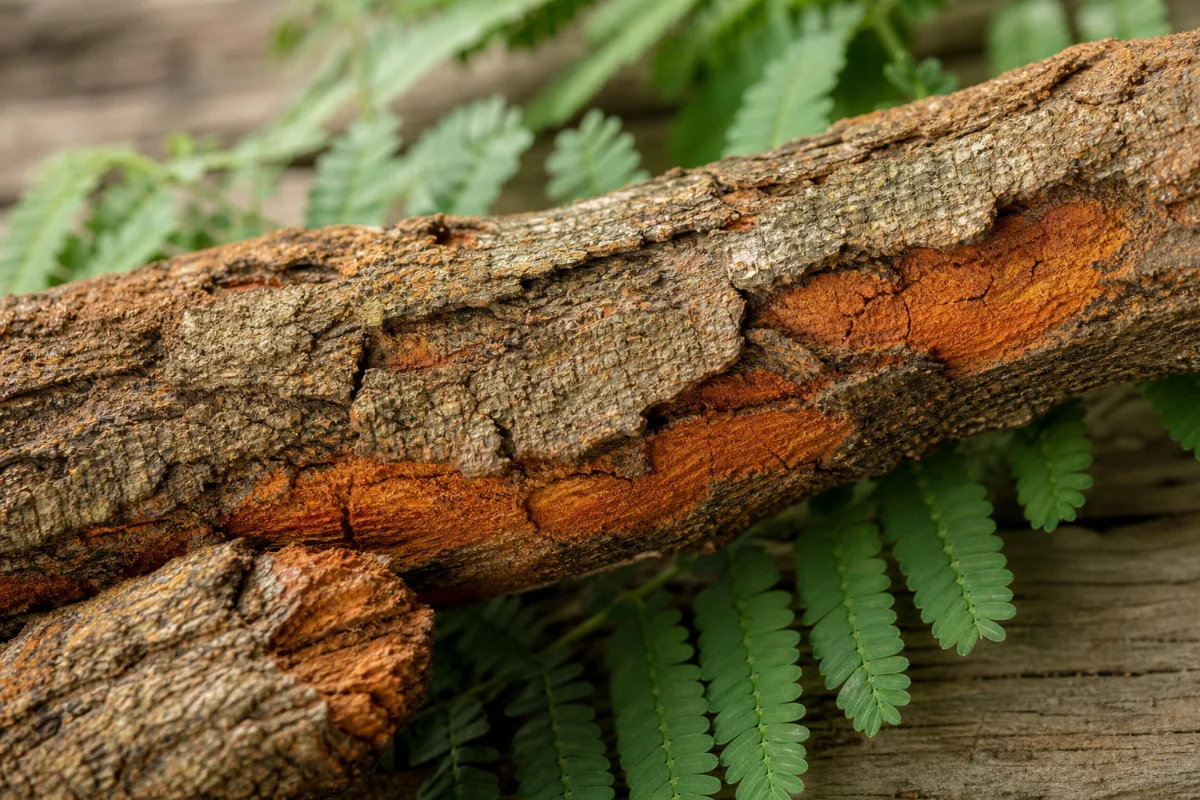
- Roots: Not verified.; Stems: Not verified.; Leaves: Not verified.; Flowers: Blooms and fruits from November to June (2000 review).; Fruit: Not verified.; Bark: Wrinkled, reddish-brown to grey, fibrous, 0.5 to 1.5 mm thick, resinous, astringent, rich in tannins (2000 review).
- Cultivation
- Not verified.
- Harvest and processing
- Not verified.
- Look-alikes and adulterants
- Name: Other Mimosa species and adulterants; Note: Commercial bark samples have been found with adulterants (2007 quality study). Do not confuse with Mimosa pudica or silk-tree "mimosa".
- Sustainability and conservation
- Not assessed.
Traditional use and history history, not clinical proof
| Tradition or era | Documented use | Source |
|---|---|---|
| Mexico and Central America, wounds and burns | Bark tea, powder or ointment on skin wounds and burns; wood for fuel and fences. Use became popular after catastrophic events in Mexico in the 1980s, with media giving wrong information. | p11487939 |
| Northeast Brazil, Indigenous religious rituals | "Jurema wine" from the root bark is a psychedelic drink used in rituals. | p39179178 |
Traditional use shows how a plant was used. It does not show that a supplement works or is safe today.
What is inside, and how it may work
What the plant contains and how those compounds act in cells and animals. Laboratory and animal mechanisms are not proven effects in people.
Main compounds
| Compound | Family | Where it is concentrated | Activity studied | Level of evidence |
|---|---|---|---|---|
| Tannins (mainly type B proanthocyanidins) | condensed tannins | bark About 16% in genuine bark (quality study); eight type B proanthocyanidins annotated in a root bark extract. | Wound-healing activity of the bark is attributed mainly to tannins and saponins (2007 quality paper); not proven in people. 13 18 | Lab |
| Saponins | triterpenoid glycosides | bark Extremely low in the bark in the quality study. | Credited for activity in earlier work; amount is very low. 13 | Lab |
| Arabinogalactans | plant polysaccharides | bark Not given. | Stimulated human skin fibroblasts in dishes. 16 | Laboratory research |
| N,N-Dimethyltryptamine (DMT) PubChem 6089 | tryptamine alkaloid | root bark and stem bark Reported in lab extraction; amounts depend on method and bark part. | Psychoactive controlled substance; linked by researchers to malformations in livestock. 11 17 7 4 | Lab and animal |
| Other bark constituents | lipids, phytosterols, lupeol, methoxychalcones | bark Listed in 2000 review. | Not assessed here. 1 | Lab |
Mechanisms, receptors and pathways
| Target or pathway | Gene or receptor | What was found | Level |
|---|---|---|---|
| Skin fibroblast growth | Not identified | Arabinogalactan fractions stimulated fibroblast activity; mechanism unclear. Whole water extract lowered viability. 16 | Laboratory research |
| Bacteria on wounds | Not identified | Silver-nanoparticle gel made with the extract killed S. aureus and E. coli in dishes; the silver likely drives this. No difference from saline with plain bark in rabbit burns. 8 10 | In vitro and animal |
Absorption, metabolism and elimination
- Absorption
- Not studied; skin absorption of bark compounds unknown.
- Distribution
- No data.
- Metabolism
- No data.
- Elimination
- No data.
- Bioavailability
- No data.
Isolated compounds versus whole extracts
Human trials used a standardised bark extract gel; lab work used isolated sugar fractions; animal burn work used plain powder or a silver-nanoparticle gel. These are different products and cannot be swapped.
Nutritional composition
Tepezcohuite is a medicinal bark, not a source of any essential nutrient.
1 mixed findings2 very low certainty2 not enough evidence
What is Tepezcohuite good for?
What tepezcohuite is claimed to do and what the research shows. "Mixed" means studies disagree. "Insufficient" means too little human research to judge. Nothing here is proven to work.
Benefits, one by one
Each card is a research question, not a promise. Tap a goal to filter. Open a card to see the studies, doses and limits.
Venous leg ulcers (bark extract gel)
Mixed findingsTwo small trials tested a gel with tepezcohuite bark extract on long-lasting leg ulcers. The first reported big healing; the second found no difference from plain gel. The result is mixed.
3 studiesHydrogel with a standardised bark extract (research product, not a ge…
Studies, doses and limits
What the trials found
2007: randomized placebo-controlled trial of a 5% bark extract hydrogel (13 weeks). 2012: randomized trial in 41 adults (32 finished). 2017: a systematic review pooled the two trials (42 patients).
Results
2007 trial: all extract-group patients reported as improved and ulcer size down 92% on average by week 8, versus one control patient (p=0.0001), with no side effects. 2012 trial: ulcer area fell 6.29 cm2 with extract gel and 5.85 cm2 with plain gel, no difference (P=0.815). 2017 review: very high heterogeneity (I2 84%); authors called the gel promising.
Effect sizes as reported
See results: one large reported benefit, one null result.
Why this rating
Two small trials disagree. The better-controlled-looking later trial found the extract no better than plain gel (which, with compression, also helped). The review rated studies at an average 2.5 of 5 on the Jadad scale.
Form and dose studied
Hydrogel with a standardised bark extract (research product, not a general bark powder).
Who was studied
Adults with venous leg ulcers treated in Mexican clinics.
Limits
Small trials; one with 9 dropouts; research gel, not the powders and creams sold; funding not read.
Why researchers looked
Mexican research teams tested the bark extract in a gel because the bark is a traditional skin remedy.
Traditional use
Bark is applied to skin sores in Mexico.
Proposed mechanism Traditional and lab
Tannins and other bark compounds are thought to act on the wound surface; not shown to be the reason for any benefit.
A proposed mechanism does not show that the effect happens in people.
No side effects were reported in either trial. Ulcers need medical care and compression; do not self-treat.
Burns (traditional use; animal studies)
Not enough evidenceTepezcohuite bark is a well-known burn remedy in Mexico, but no human burn trial was found. In animals the results were mixed.
3 studiesBark powder, tea or ointment (traditional); research gels in animals.
Studies, doses and limits
What the trials found
No human burn trial found. Rabbits with chemical burns: bark powder did no better than mupirocin ointment or saline (1991). Rats with second-degree burns: a gel with silver nanoparticles made using bark extract looked promising (2021).
Results
1991: no significant difference between bark powder, mupirocin or saline; the authors warned of possible liver toxicity. 2021: a silver-nanoparticle gel, not plain bark, was described as promising in rats.
Effect sizes as reported
No effect sizes for people.
Why this rating
Animal data only, mixed, and the promising one used silver nanoparticles.
Form and dose studied
Bark powder, tea or ointment (traditional); research gels in animals.
Who was studied
None in people.
Limits
Animal studies only.
Why researchers looked
The bark became famous for burns in Mexico in the 1980s.
Traditional use
Bark powder, tea or ointment is applied on burns and wounds in Mexico; the 2000 review says media attention then spread myths.
Proposed mechanism Traditional
Not tested for burns in people. The 2007 quality paper attributes the bark wound activity mainly to tannins and saponins.
A proposed mechanism does not show that the effect happens in people.
Burns can need urgent medical care. Do not rely on a herb for a serious burn, and ask a doctor before putting anything on a burn.
Skin wounds (traditional use)
Not enough evidenceThe bark is used as tea, powder and ointment on wounds in Mexico and Central America. This is tradition; no wound trial other than leg ulcers was found.
2 studiesBark tea, powder, ointment, creams (traditional).
Studies, doses and limits
What the trials found
Descriptive review only; no controlled study of general wounds.
Results
Review notes use and commercial products, not outcomes.
Effect sizes as reported
No effect sizes.
Why this rating
Tradition and a narrative review of uses; no controlled wound trial found apart from leg ulcers.
Form and dose studied
Bark tea, powder, ointment, creams (traditional).
Who was studied
Local communities in Mexico and Central America.
Limits
Abstract of a narrative review only.
Why researchers looked
Long local use for cuts and skin damage.
Traditional use
Bark tea, powder and ointment; products now include creams, soaps, shampoos and capsules.
Proposed mechanism Traditional
Not established.
A proposed mechanism does not show that the effect happens in people.
Open or deep wounds, infected wounds and animal bites need medical care.
Skin cell activity (lab only)
Very low certaintyIn lab dishes, sugar-like compounds from the bark stimulated skin cells called fibroblasts. The plain water extract actually reduced them. This does not show healing in people.
1 studiesBark fractions (research).
Studies, doses and limits
What the trials found
None.
Results
Water extract at 10 and 100 ug/mL lowered fibroblast viability and growth; an ethanol-precipitated fraction at 10 ug/mL stimulated them.
Effect sizes as reported
Cell-culture finding.
Why this rating
Cells in dishes only, with a mixed result for the whole extract.
Form and dose studied
Bark fractions (research).
Who was studied
Human cell lines.
Limits
Lab only.
Why researchers looked
To find out why the bark might help wounds.
Traditional use
Supports the traditional wound use only as an idea.
Proposed mechanism Laboratory research
Arabinogalactan fractions stimulated fibroblast activity; the mode of action was unclear.
A proposed mechanism does not show that the effect happens in people.
Not applicable.
Germ-killing action on wounds
Very low certaintyThe bark has been called antibacterial and antiseptic. Evidence is thin: no benefit over saline in rabbit burns, and lab activity was seen with a silver-nanoparticle gel.
2 studiesBark powder; silver-nanoparticle gel (research).
Studies, doses and limits
What the trials found
None.
Results
1991 rabbit burn study: no difference in bacteria and fungi among bark powder, mupirocin and saline. 2021: the silver-nanoparticle gel with bark extract killed S. aureus and E. coli in dishes.
Effect sizes as reported
No effect sizes.
Why this rating
The positive lab result involved silver nanoparticles, which kill bacteria by themselves.
Form and dose studied
Bark powder; silver-nanoparticle gel (research).
Who was studied
Rabbits, rats, bacteria in dishes.
Limits
Animal and lab only.
Why researchers looked
Wound infection is a main concern in burns and ulcers.
Traditional use
Described as antiseptic in the trial papers.
Proposed mechanism Animal and lab
Not established for plain bark.
A proposed mechanism does not show that the effect happens in people.
Not applicable.
Connections to the rest of health
How Tepezcohuite connects to the rest of our health knowledge graph. Every link says what kind of connection it is. A safety link (for example to the liver) is a warning, not a benefit. A study that merely mentions a topic never creates a benefit link.
Explore every connection: goals, body systems, organs, symptoms, genes
A. Wellness goals
| Connected to | Kind of connection | Evidence status | Context | Studies |
|---|---|---|---|---|
| Healthy Skin | Mixed findings | Venous leg ulcers (bark extract gel): Two small trials tested a gel with tepezcohuite bark extract on long-lasting leg ulcers. The first reported big healing; the second found no difference from plain gel. The result is mixed. | 12 5 2 | |
| Healthy Skin | Traditional use | Not enough evidence | Burns (traditional use; animal studies): Tepezcohuite bark is a well-known burn remedy in Mexico, but no human burn trial was found. In animals the results were mixed. Skin wounds (traditional use): The bark is used as tea, powder and ointment on wounds in Mexico and Central America. This is tradition; no wound trial other than leg ulcers was found. | 10 8 1 13 |
| Healthy Skin | Very low certainty | Skin cell activity (lab only): In lab dishes, sugar-like compounds from the bark stimulated skin cells called fibroblasts. The plain water extract actually reduced them. This does not show healing in people. Germ-killing action on wounds: The bark has been called antibacterial and antiseptic. Evidence is thin: no benefit over saline in rabbit burns, and lab activity was seen with a silver-nanoparticle gel. | 16 10 8 |
B. Body systems
E. Health conditions
| Connected to | Kind of connection | Evidence status | Context | Studies |
|---|---|---|---|---|
| Venous leg ulcer | Mixed findings | One trial positive, one null. Preparation or compound: Bark extract hydrogel |
12 5 | |
| Birth defects and miscarriage (animal toxicity) | Animal | Documented in animals. Preparation or compound: Leaf, seed, DMT-type alkaloids |
7 4 |
L. Active compounds
| Connected to | Kind of connection | Evidence status | Context | Studies |
|---|---|---|---|---|
| Tannins (mainly type B proanthocyanidins) | Biological association | Lab | Wound-healing activity of the bark is attributed mainly to tannins and saponins (2007 quality paper); not proven in people. Preparation or compound: bark |
13 18 |
| Saponins | Biological association | Lab | Credited for activity in earlier work; amount is very low. Preparation or compound: bark |
13 |
| Arabinogalactans | Biological association | In vitro | Stimulated human skin fibroblasts in dishes. Preparation or compound: bark |
16 |
| N,N-Dimethyltryptamine (DMT) | Biological association | Lab and animal | Psychoactive controlled substance; linked by researchers to malformations in livestock. Preparation or compound: root bark and stem bark |
11 17 7 4 |
| Other bark constituents | Biological association | Lab | Not assessed here. Preparation or compound: bark |
1 |
Each connection is stored with the ingredient, the connected record, the kind of connection, the evidence status, the supporting studies, the preparation or compound involved, and a review date (last reviewed October 25, 2026).
The evidence
The research centre for Tepezcohuite. Every record here was checked against PubMed or the publisher's page; we never list a study we have not verified.
Evidence by outcome
Bars show how many studies we found for each outcome, not how well it works. People are added up across trials only (reviews are not added, to avoid double counting).
How we rate evidence
High certainty
Several well-run trials or reviews agree; further research is unlikely to change the picture much.
Moderate certainty
Good trials point the same way, but some doubt remains.
Low certainty
Small, short or inconsistent trials. The finding could change with better research.
Very low certainty
Very little or very weak human data. Treat as a possibility only.
Mixed findings
Trials or reviews disagree with each other.
Not enough evidence
Not enough human research to say either way.
Evidence against
Good research found no benefit, or found harm.
We take the reviewers' own risk-of-bias and GRADE statements where they exist, and otherwise judge from study size, design, consistency, directness and whether a product matches what is sold. Many publications do not make evidence high. Method note: We started from our existing summary of this herb, then checked each cited paper in PubMed and the accepted name in GBIF. Documents we could not open are marked as second-hand. No study is cited that we could not verify.
Study library: every study we checked 18
| Study | Design | People | Product, dose, length | Result |
|---|---|---|---|---|
| Camargo-Ricalde 2000 Description, distribution, anatomy, chemical composition and uses of Mimosa tenuiflora (Fabaceae-Mimosoideae) in Mexico Revista de Biologia Tropical · PMID 11487939 |
Narrative review (Spanish language) review |
Plant and traditional use in Mexico | Bark tea, powder and ointment bark not given here |
Bark use on skin wounds and burns was popularised in Mexico after catastrophic events in the 1980s; media gave wrong information and myths. Bark holds tannins, saponins, an alkaloid fraction, lupeol and other compounds. Products include shampoos, creams, capsules and soaps. Narrative review; no pooled effect Methods, limits and fundingOutcomes: Identity, uses, chemistry, pharmacology, toxicity Limitations: Abstract only; the pharmacology and toxicity sections were not seen. Funding and conflicts: not read Read: abstract |
| Freitas 2017 The use of medicinal plants in venous ulcers: a systematic review with meta-analysis International Wound Journal · PMID 28488305 · DOI |
Systematic review with meta analysis |
7 Adults with venous ulcers; two Mimosa tenuiflora hydrogel studies pooled (42 patients) |
Herbal topical products various not given here |
Seven studies included; average Jadad quality score 2.5 of 5. The two Mimosa tenuiflora studies were pooled (42 patients) with high heterogeneity (I2 84%). The authors called the Mimosa gel a promising candidate. Pooled effect size not given in the abstract Methods, limits and fundingOutcomes: Ulcer area, re-epithelialisation Limitations: Small, low-quality studies; very high heterogeneity; the two pooled trials disagree. Funding and conflicts: not read Read: abstract |
| GBIF 2026 GBIF species match: Mimosa tenuiflora / Mimosa hostilis GBIF · Source |
Database record not applicable |
bark not given here |
API checked 2026-10-25: Mimosa tenuiflora (Willd.) Poir. is ACCEPTED (key 2969531, family Fabaceae). Mimosa hostilis Benth. is a SYNONYM of it (key 2969532). See results Methods, limits and fundingOutcomes: Accepted name, family Limitations: Taxonomic record. NCBI taxonomy not checked. Funding and conflicts: not applicable Read: full-text | |
| Gardner 2014 Teratogenic effects of Mimosa tenuiflora in a rat model and possible role of N-methyl- and N,N-dimethyltryptamine Journal of Agricultural and Food Chemistry · PMID 24689494 · DOI |
Animal experiment rat |
Pregnant rats | Leaf and seed material, extracts, alkaloid extracts, and pure N-methyltryptamine and DMT leaf, seed fed in diet · vs Control diet |
Plant material, methanol extracts, alkaloid extracts and the purified tryptamines were each linked to more cleft palate and skeletal malformations in pups than control. Higher incidence than control (numbers not in abstract) Methods, limits and fundingOutcomes: Cleft palate and skeletal malformations in pups Limitations: Rat feeding study with leaf and seed, not bark skin products; numbers not in the abstract. US government laboratory authors. Funding and conflicts: not read Read: abstract |
| Lammoglia-Ordiales 2012 A randomised comparative trial on the use of a hydrogel with tepescohuite extract (Mimosa tenuiflora cortex extract-2G) in the treatment of venous leg ulcers International Wound Journal · PMID 22128789 · DOI |
Randomized double blind placebo controlled trial |
41 Adults with venous leg ulcers (mean age 60, ulcer present about 38 months); 32 completed |
Hydrogel with bark extract (MTC-2G) bark not given here · vs Same hydrogel without extract |
Ulcer area fell by 6.29 cm2 with the extract gel and 5.85 cm2 with plain gel. No difference between groups (P=0.815). No changes in lab values or biopsy findings. No difference vs plain gel (Extract gel 3.28 to 9.29 cm2; plain gel 3.58 to 8.12 cm2) Methods, limits and fundingOutcomes: Ulcer surface area, lab tests, biopsy Limitations: Small; 9 of 41 dropped out; both groups also had cleansing and compression, so the plain gel may have helped too. Funding not read. Funding and conflicts: not read Read: abstract |
| Lauriola 2016 Allergic contact dermatitis caused by argan oil, neem oil, and Mimosa tenuiflora Contact Dermatitis · PMID 27870098 · DOI |
Case report |
1 One patient |
Cosmetic ingredients incl. Mimosa tenuiflora not stated not given here |
Title, authors and journal only were available (no abstract in PubMed). The title reports allergic contact dermatitis linked to Mimosa tenuiflora together with argan and neem oils. Case report Methods, limits and fundingOutcomes: Allergic contact dermatitis Limitations: No abstract; details and the number of patients were not seen. Combined ingredients, so the cause cannot be pinned on one. Funding and conflicts: not read Read: title-only |
| Lima Bezerra 2021 Phytochemistry and teratogenic potential of Mimosa tenuiflora (Willd.) Poir. (Fabaceae) in ruminants: A systematic review Toxicon · PMID 33727031 · DOI |
Systematic review review (animals) |
24 Farm ruminants (mainly sheep, goats) in Brazil |
Plant material (leaf, seed, others) whole plant not given here |
The plant has embryotoxic, fetotoxic and abortion-causing potential in farm animals, especially sheep and goats. The indole alkaloid N,N-dimethyltryptamine is likely related to the effects. Narrative synthesis of 24 articles Methods, limits and fundingOutcomes: Malformations, abortion, plant chemistry Limitations: Animal and plant-feeding evidence; the toxic compound is not fully pinned down; bark skin products were not the exposure studied. Funding and conflicts: not read Read: abstract |
| Martinez-Higuera 2021 Hydrogel with silver nanoparticles synthesized by Mimosa tenuiflora for second-degree burns treatment Scientific Reports · PMID 34050228 · DOI |
Animal and laboratory study rat |
Wistar rats with second-degree burns; bacteria in dishes | Gel with silver nanoparticles made with bark extract bark extract 100 ug/g in gel (lab) 14 days · vs Gel with commercial silver nanoparticles |
The silver-nanoparticle gel was described as promising for burn healing, with killing of bacteria and anti-inflammatory effects. Percent recovery of damaged area (figures not in abstract) Methods, limits and fundingOutcomes: Burn area recovery, bacteria killing, histology Limitations: Rat study of a silver-containing nanoparticle gel, not a plain bark product; no human data. Funding and conflicts: Declared no competing interests Read: abstract |
| Medeiros 2008 Teratogenicity of Mimosa tenuiflora seeds to pregnant rats Toxicon · PMID 18078971 · DOI |
Animal experiment rat |
25 Pregnant Wistar rats (15 fed seeds, 10 control) |
Ration with 10% seeds seed 10% of ration Day 6 to 21 of pregnancy · vs Same ration without seeds |
90 bone malformations in 40 of 101 fetuses in the seed group, versus 4 in 3 of 58 control fetuses (p<0.05). The authors concluded the seeds are teratogenic to rat fetuses. 40/101 vs 3/58 fetuses with malformations Methods, limits and fundingOutcomes: Fetal malformations Limitations: Seed, not bark; rats; fed in the diet. Funding and conflicts: not read Read: abstract |
| Palacios 1991 Cicatricial, antibacterial and antimycotic effects of tepescohuite in experimental animals Revista de Investigacion Clinica · PMID 1818366 |
Animal experiment (Spanish language) rabbit |
Rabbits with chemically induced burns | Sterile bark powder bark not given here · vs 2% mupirocin ointment; 0.9% saline |
No statistically significant difference among bark powder, mupirocin and saline. The authors cited possible liver toxicity and low efficacy and advised against human use. No difference between treatments Methods, limits and fundingOutcomes: Healing, bacteria and fungi counts, histology Limitations: Old animal study; the liver-toxicity wording is a conclusion in the abstract and the data were not seen. Conflicts in tone with the 2007 trial. Funding and conflicts: not read Read: abstract |
| PubChem 2026 PubChem compound record: N,N-Dimethyltryptamine (CID 6089) PubChem · Source |
Database record not applicable |
n/a not given here |
API checked 2026-10-25: CID 6089, C12H16N2, 2-(1H-indol-3-yl)-N,N-dimethylethanamine. See results Methods, limits and fundingOutcomes: Compound identity Limitations: Identity record only. Funding and conflicts: not applicable Read: full-text | |
| Rivera-Arce 2007 Therapeutic effectiveness of a Mimosa tenuiflora cortex extract in venous leg ulceration treatment Journal of Ethnopharmacology · PMID 17088036 · DOI |
Randomized double blind placebo controlled trial |
Ambulatory adults with venous leg ulcers, Mexico | Hydrogel with 5% bark extract (tannin 1.8%) bark not given here 13 weeks follow-up · vs Same hydrogel without extract |
Healing was reported in all patients of the extract group; mean ulcer size fell by 92% after week 8. Only one control patient showed benefit (p=0.0001). No side effects in either group. Large reported benefit; group sizes not given in the abstract Methods, limits and fundingOutcomes: Ulcer area by digital photography Limitations: Abstract does not give group sizes. Very large effect from a small, single-centre trial; the later trial did not repeat it. Authors are from a Mexican state social-security research centre; funding not read. Funding and conflicts: not read Read: abstract |
| Rivera-Arce 2007 Pharmacognostical studies of the plant drug Mimosae tenuiflorae cortex Journal of Ethnopharmacology · PMID 17709219 · DOI |
Pharmacognosy (quality control) study plant chemistry |
Bark collected in Chiapas, Mexico, and commercial samples | Bark bark not given here |
Features were established to tell genuine bark from adulterants found in commercial samples. Genuine bark had about 16% tannins, mainly proanthocyanidins; saponin content was extremely low and hard to test routinely. DNA markers (RAPD) can help authenticate the species. Genuine bark about 16% tannins Methods, limits and fundingOutcomes: Identity, tannin and saponin content, adulterants Limitations: Lab quality-control study from the same Mexican group behind the 2007 trial. Funding and conflicts: not read Read: abstract |
| Rocha 2025 Abortions and Congenital Malformations in Small Ruminants Associated with Toxic Plant Consumption in the Brazilian Semi-Arid Region Animals (Basel) · PMID 39943126 · DOI |
Farm survey with necropsies sheep and goats |
80 80 small-ruminant farms in northeast Brazil |
Grazing on toxic plants incl. Mimosa tenuiflora whole plant not given here |
Malformations occurred on about 42 farms; Mimosa tenuiflora and Cenostigma pyramidalis were recorded on 95.23% of those properties. Necropsies supported the plant link and excluded infectious causes. Association on farms Methods, limits and fundingOutcomes: Abortions, malformations Limitations: Observational farm data; two plants named together; animals only. Funding and conflicts: Declared no conflicts Read: abstract |
| US Drug Enforcement Administration 2025 N,N-Dimethyltryptamine (DMT) drug fact sheet US Drug Enforcement Administration · Source |
Regulator fact sheet not applicable |
DMT n/a not given here |
Per our earlier summary: DMT is listed as a US Schedule I controlled substance. We did not re-open this document in this round. See results Methods, limits and fundingOutcomes: Controlled-substance status of DMT Limitations: Summary-only. Covers DMT, not the legal status of the plant or bark, which varies by country and was not checked. Funding and conflicts: Government Read: summary-only | |
| Zippel 2009 Arabinogalactans from Mimosa tenuiflora bark as active principles for wound-healing properties Journal of Ethnopharmacology · PMID 19505559 · DOI |
Laboratory (cell) study in vitro |
Human skin fibroblasts and HaCaT skin cells in dishes | Bark water extract and ethanol-precipitated fractions bark 10 and 100 ug/mL in dishes |
The plain water extract reduced fibroblast viability and growth. A fraction rich in arabinogalactans stimulated fibroblast activity and growth; keratinocytes responded only at the higher amount. How it works remained unclear. Cell-culture finding Methods, limits and fundingOutcomes: Cell viability, growth, gene expression Limitations: Lab only; does not show healing in people. Funding and conflicts: not read Read: abstract |
| de Oliveira 2025 Extraction and Characterization of N,N-Dimethyltryptamine from Mimosa tenuiflora: A Multivariate Approach ACS Omega · PMID 41048742 · DOI |
Laboratory chemistry study plant chemistry |
Powdered root bark and stem bark samples | Extraction of DMT from bark root bark and stem bark not given here |
DMT was extracted and confirmed in the bark; the best yield in the abstract came from stem bark (3.45% of the sample in one method). The paper frames this as lab work toward pharmaceutical use. Chemistry result Methods, limits and fundingOutcomes: DMT yield and identity Limitations: Only the abstract was read; yields are from an extraction method, not the content of a retail bark product. Funding and conflicts: not read Read: abstract |
| de Sousa 2024 Unraveling the metabolomic profile and acute toxicity of ethanolic extract from Mimosa tenuiflora (Willd.) Poir. root bark Toxicon · PMID 39179178 · DOI |
Animal toxicity study mouse |
Female Swiss mice | Ethanol extract of root bark root bark single oral 300 and 2000 mg/kg (animal) 14 days observed |
No deaths. Kidney weights, blood and chemistry values changed, and tissue changes appeared in heart, liver and kidneys. The authors classed it in GHS category 5 (LD50 above 2000 mg/kg) but said it showed acute oral toxicity. Extract held 8 proanthocyanidins, 3 alkaloids and other compounds. Altered blood, chemistry and tissue findings Methods, limits and fundingOutcomes: Mortality, organ weights, blood tests, tissue changes Limitations: Mouse study of a root bark ethanol extract swallowed in one dose; skin use was not tested. Funding and conflicts: Public research funding declared Read: abstract |
What we do not know yet
- No human burn trial.
- Only two small leg-ulcer trials, and they disagree.
- No human pregnancy data.
- No testing of retail bark for contaminants or DMT.
- No interaction studies.
How new research is added
New studies are found by a saved PubMed search and are placed in a review queue. A person reads each one before it changes any evidence rating or safety wording.
Lab markers
What changed in blood or saliva tests during trials. A changed number is not the same as feeling or being healthier, and we give no "normal ranges".
Safety
What studies and official sources say about side effects, medicines and who should check first. Each point shows what kind of evidence it comes from.
Main points to know 6
- Pregnancy: proven harm to animals, no human data. Mimosa tenuiflora causes abortions and malformations in sheep and goats in Brazil, and cleft palate and bone defects in rat pups fed leaf, seed or the DMT-type compounds. Whether skin products or bark teas harm a human pregnancy was not found. Treat pregnancy as a reason to avoid it unless a doctor says otherwise. Animal research 7 4 9 14
- Burns and wounds need medical care. Serious burns, deep or infected wounds and long-lasting leg ulcers need a clinician. The trials gave the gel alongside cleansing, dressings and compression, and a rabbit burn study found the bark no better than saline. Human trials and animal study 12 5 10
- Root bark contains DMT. Bark preparations sold as Mimosa hostilis or jurema contain N,N-dimethyltryptamine (DMT). Lab work found DMT in root and stem bark. DMT is a controlled substance in the United States and in some other places, so root bark products can raise legal as well as health problems. Rules for the plant itself vary by country and were not checked. This page gives no use advice. Lab chemistry and regulator summary 17 18 15
- Animal signs of organ toxicity. A rabbit burn study raised possible liver toxicity, and a single swallowed dose of a root bark extract changed blood, kidney, liver and heart findings in mice. No human liver or kidney injury was found. Animal research 10 18
- Allergic skin reaction is reported. A case report links allergic contact dermatitis to a product containing Mimosa tenuiflora with argan and neem oils (we saw only the title). Case report (title only) 6
- Quality: adulterated bark exists. A Mexican quality study found adulterants in commercial bark samples. We found no published testing of retail barks for heavy metals or other contaminants. Lab 13
Side effects 2
| Effect | How often | Severity and recovery | Evidence |
|---|---|---|---|
| No side effects reported in the leg-ulcer trials The 2007 trial reported no side effects in either group; the 2012 trial reported no changes in lab tests or biopsies. Both were small and short, so rare effects could be missed. | Not established | none reported not applicable | Human trials (small) 12 5 |
| Allergic contact dermatitis (rash) Combined ingredients, so the cause cannot be pinned on Mimosa alone. Stop use if a rash appears. | Not established | unknown unknown | Case report (title only) 6 |
Liver
No human liver injury case was found. The 1991 rabbit burn study concluded the bark was potentially hepatotoxic, and a 2024 mouse study of a root bark extract found liver tissue changes after a single swallowed dose. LiverTox was not found to list tepezcohuite or Mimosa tenuiflora (a quick check, not exhaustive). 10 18
How often. Unknown. Not studied in people.
Monitoring. No agency advice found. Yellow skin or eyes, dark urine or severe itch after using any herb should be checked by a doctor.
This is a safety connection. It is not evidence that Tepezcohuite supports liver health.
Medicines and supplements 2
| With | Why it matters | Importance | Evidence | What to do |
|---|---|---|---|---|
| Antidepressants, MAO-inhibiting drugs and other serotonin-active medicines (relevant to DMT-containing root bark taken by mouth) prescription | Theoretical: DMT is a tryptamine; the interaction is general pharmacology, not shown for tepezcohuite skin products. Not read in our sources. | Unknown for skin use. | Theoretical Not enough evidence 17 | Ask a doctor or pharmacist before swallowing any bark preparation if you take such medicines. |
| Other medicines applied to the same wound or ulcer topical | Not studied. | Unknown. | No data Not enough evidence 5 | Tell the wound nurse or doctor what you are putting on the area. |
Who should check first 3
| Situation | Advice | Evidence |
|---|---|---|
| Pregnancy and breastfeeding | Avoid unless a doctor or midwife advises. Harm in animals is documented; human safety is unknown, and no LactMed entry was found. | Animal research 7 4 9 |
| Children | No safety data in children were found; ask a doctor. | No data |
| Deep, infected or large burns and wounds | Get medical care first. | Clinical practice, trials and animal study 10 5 |
Overdose, product quality and regulators
Summary. Root bark extract: no deaths in mice after one swallowed dose, but blood, chemistry and organ-tissue changes. Leaf and seed: abortion and malformations in farm animals and rats.
Animal. Mouse single-dose study (root bark ethanol extract): changed kidney weight, blood and chemistry values, and heart, liver and kidney tissue. Rat feeding studies: seed 10% of ration caused bone malformations in fetuses (40 of 101 vs 3 of 58 control fetuses).
Human doses studied. Not given here.
High dose or long term signals. Not studied in people.
Overdose response. Not described.
Genotoxicity. Not found.
Toxic plant parts. Leaf and seed (livestock and rat studies); root bark extract (mouse study). Skin-product bark was not tested for these effects.
Adulteration is documented; no contaminant testing of retail bark was found.
Adulterated commercial bark. Authentication features were developed because adulterants are usually found in commercial samples. Genuine bark has about 16% tannins. 13
Heavy metals and microbes. A PubMed search for heavy metals, lead, arsenic or contamination with the plant name returned no bark-testing paper. This is absence of evidence, not proof of safety. Wound products should be sterile; bark powder used on open skin is a possible infection route (reasoning, not a finding).
DMT content varies. DMT amounts in the abstract depend on bark part and method; the figures are from lab extraction, not retail products. 17
| Body | Action | Date |
|---|
When to get medical help
- Spreading redness, pus, fever or worsening pain around a wound or burn
- Rash, swelling or blistering after using a bark product
- Yellow skin or eyes, dark urine
- Possible pregnancy while using it
Stop the supplement and contact a clinician or emergency service. In the US, Poison Control is 1-800-222-1222.
General information only, not medical advice. Ask a clinician or pharmacist before use, especially with medicines, in pregnancy or with a health condition. See the Natural Remedy Safety guide.
Frequently asked questions
What is tepezcohuite?
Does tepezcohuite heal burns?
Does it heal leg ulcers?
Is it safe in pregnancy?
Does tepezcohuite contain DMT?
Is it legal?
DMT is a US Schedule I substance. Rules for Mimosa root bark vary by country and we did not verify them. Check local law.
Is Mimosa hostilis the same thing?
Yes. GBIF lists Mimosa hostilis as a synonym of Mimosa tenuiflora.
Can it harm the liver or kidneys?
Can it cause an allergic rash?
One case report links a rash to a product containing it along with argan and neem oils. We saw only the title.
Is commercial bark pure?
Not always. A Mexican quality study found adulterants in commercial samples, and we found no heavy-metal or contaminant testing.
Can I put it on an open wound?
Which plants are compared with tepezcohuite?
Aloe vera, calendula and witch hazel are other traditional skin herbs. Neem was named in the same allergy report.
Explore by health goal
Editorial transparency
- Written by
- AlternativeMed editorial team. Research compiled with AI assistance, then checked against PubMed records.
- Medical review
- None. This page has not been reviewed by a physician or pharmacist.
- First published
- 2026-10-25
- Last substantive update
- 2026-10-25
- How we research
- We started from our existing summary of this herb, then checked each cited paper in PubMed and the accepted name in GBIF. Documents we could not open are marked as second-hand. No study is cited that we could not verify.
- How we rate evidence
- See "How we rate evidence" in the Evidence tab.
- Independence
- No product is promoted on this page. No affiliate links are shown. If one is added later it will be labelled and kept apart from the evidence.
Sources 18
Each source was opened and checked. Where we read only the abstract, it says so. The small numbers in the text point here.
- Camargo-Ricalde SL. Description, distribution, anatomy, chemical composition and uses of Mimosa tenuiflora (Fabaceae-Mimosoideae) in Mexico. Revista de Biologia Tropical. 2000. PMID 11487939. (abstract)
- Freitas AL, Santos CA, Souza CA, et al.. The use of medicinal plants in venous ulcers: a systematic review with meta-analysis. International Wound Journal. 2017. PMID 28488305. DOI 10.1111/iwj.12751. (abstract)
- GBIF. GBIF species match: Mimosa tenuiflora / Mimosa hostilis. GBIF. 2026. (full-text)
- Gardner D, Riet-Correa F, Lemos D, et al.. Teratogenic effects of Mimosa tenuiflora in a rat model and possible role of N-methyl- and N,N-dimethyltryptamine. Journal of Agricultural and Food Chemistry. 2014. PMID 24689494. DOI 10.1021/jf5005176. (abstract)
- Lammoglia-Ordiales L, Vega-Memije ME, Herrera-Arellano A, et al.. A randomised comparative trial on the use of a hydrogel with tepescohuite extract (Mimosa tenuiflora cortex extract-2G) in the treatment of venous leg ulcers. International Wound Journal. 2012. PMID 22128789. DOI 10.1111/j.1742-481X.2011.00900.x. (abstract)
- Lauriola MM, Corazza M.. Allergic contact dermatitis caused by argan oil, neem oil, and Mimosa tenuiflora. Contact Dermatitis. 2016. PMID 27870098. DOI 10.1111/cod.12665. (title-only)
- Lima Bezerra JJ, Vieira Pinheiro AA, Barbosa Lucena R.. Phytochemistry and teratogenic potential of Mimosa tenuiflora (Willd.) Poir. (Fabaceae) in ruminants: A systematic review. Toxicon. 2021. PMID 33727031. DOI 10.1016/j.toxicon.2021.03.010. (abstract)
- Martinez-Higuera A, Rodriguez-Beas C, Villalobos-Noriega JMA, et al.. Hydrogel with silver nanoparticles synthesized by Mimosa tenuiflora for second-degree burns treatment. Scientific Reports. 2021. PMID 34050228. DOI 10.1038/s41598-021-90763-w. (abstract)
- Medeiros RM, de Figueiredo AP, Benicio TM, et al.. Teratogenicity of Mimosa tenuiflora seeds to pregnant rats. Toxicon. 2008. PMID 18078971. DOI 10.1016/j.toxicon.2007.06.012. (abstract)
- Palacios C, Reyes RE, Lopez-Martinez R, et al.. Cicatricial, antibacterial and antimycotic effects of tepescohuite in experimental animals. Revista de Investigacion Clinica. 1991. PMID 1818366. (abstract)
- PubChem, US National Library of Medicine. PubChem compound record: N,N-Dimethyltryptamine (CID 6089). PubChem. 2026. (full-text)
- Rivera-Arce E, Chavez-Soto MA, Herrera-Arellano A, et al.. Therapeutic effectiveness of a Mimosa tenuiflora cortex extract in venous leg ulceration treatment. Journal of Ethnopharmacology. 2007. PMID 17088036. DOI 10.1016/j.jep.2006.08.032. (abstract)
- Rivera-Arce E, Gattuso M, Alvarado R, et al.. Pharmacognostical studies of the plant drug Mimosae tenuiflorae cortex. Journal of Ethnopharmacology. 2007. PMID 17709219. DOI 10.1016/j.jep.2007.06.023. (abstract)
- Rocha VC, Santos Filho GJ, de Souza MF, et al.. Abortions and Congenital Malformations in Small Ruminants Associated with Toxic Plant Consumption in the Brazilian Semi-Arid Region. Animals (Basel). 2025. PMID 39943126. DOI 10.3390/ani15030356. (abstract)
- US Drug Enforcement Administration, Diversion Control Division. N,N-Dimethyltryptamine (DMT) drug fact sheet. US Drug Enforcement Administration. 2025. (summary-only)
- Zippel J, Deters A, Hensel A.. Arabinogalactans from Mimosa tenuiflora bark as active principles for wound-healing properties. Journal of Ethnopharmacology. 2009. PMID 19505559. DOI 10.1016/j.jep.2009.05.034. (abstract)
- de Oliveira LC, Pereira Galdino T, Pedro MDS, et al.. Extraction and Characterization of N,N-Dimethyltryptamine from Mimosa tenuiflora: A Multivariate Approach. ACS Omega. 2025. PMID 41048742. DOI 10.1021/acsomega.5c06560. (abstract)
- de Sousa RP, de Oliveira CMF, de Lima Sousa RC, et al.. Unraveling the metabolomic profile and acute toxicity of ethanolic extract from Mimosa tenuiflora (Willd.) Poir. root bark. Toxicon. 2024. PMID 39179178. DOI 10.1016/j.toxicon.2024.108076. (abstract)