Herbs & Botanicals · Traditional European cough herb
Sundew
Drosera rotundifolia · also called Round-leaved sundew, Droserae herba
Sundew is a small insect-catching bog plant whose dried above-ground parts have been used for centuries as a tea or extract for spasmodic cough. No good human trial of the herb alone was found, so we cannot say it works. Homeopathic Drosera products are a different thing from the herb. Whooping cough or a lasting cough in a child needs a doctor, and sundew is endangered in many places.
General information, not medical advice. Last substantive update · Not medically reviewed. A named clinician has not signed off on this page. How this page is made
About Sundew
Sundew (Drosera rotundifolia) is a small carnivorous plant of peat bogs. The dried herb has been taken as a tea or extract for spasmodic cough since the seventeenth century. Evidence in people is very thin, and the plant is endangered in many places.
What it is
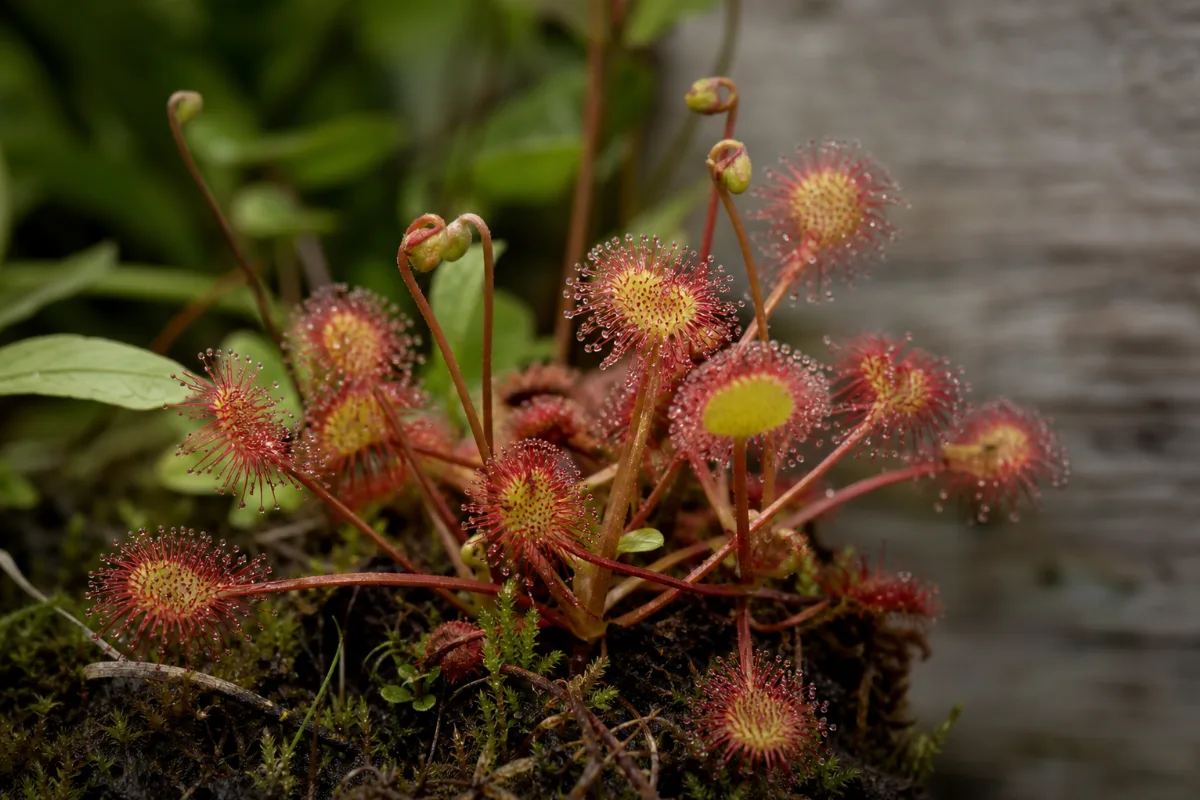
Sundew is a small bog plant with sticky, hair-covered leaves that trap insects. The herb used in medicine is the dried above-ground part. Several sundew species are sold, and they differ in their chemistry.
Round-leaved sundew (Drosera rotundifolia) is the one researchers recommend for medicines.
What makes it distinctive
Sundew contains flavonoids and naphthoquinones. The flavonoids are thought to be behind the cough use. The naphthoquinones, such as plumbagin and 7-methyljuglone, are also the main safety concern, since reviews of plumbagin describe toxicity in lab and animal work.
Species, growing method and drying all change the content. One study found drying cut extract content by 72% up to 100%.
What people use it for
Sundew has been used since the seventeenth century for spasmodic cough and whooping cough, and today for irritable cough and bronchitis. It is also sold as homeopathic dilutions. Those are extremely dilute and are not the same as the herb. Long use is not proof of benefit.
What the research shows
We found no controlled human study of the herb on its own. The one placebo-controlled trial involved 180 children and a homeopathic syrup with four ingredients, one of them very dilute Drosera. Cough scores improved more than with placebo, but the trial was linked to the product's maker and says nothing certain about the herb.
A Cochrane review found no proven symptom treatment for the cough of whooping cough. In mouse airway tissue, sundew flavonoids relaxed muscle and sped up the hairs that move mucus. That is lab work only.
At a glance
Traditional uses history, not proof
- Tea or extract of the dried herb for spasmodic cough, irritable cough and bronchitis
- Traditional use for whooping cough (not supported by trials)
Studied for research
- Cough in children: one trial of a homeopathic combination syrup, not the herb
- Whooping cough: no proven treatment; no sundew trial
- Airway muscle and cilia: mouse tissue only
- Antibacterial and antiviral activity: lab only
Main compounds
- Flavonoids (quercetin, hyperoside, 2"-O-galloylhyperoside)
- Naphthoquinones (plumbagin, 7-methyljuglone, droserone)
Common forms
- Dried herb for tea
- Liquid or dry extract
- Homeopathic dilutions (not the herb)
- Combination cough products
Research links: Homeopathic combination syrup in children (2018) · Cough in whooping cough, Cochrane review (2014) · Extract and flavonoids on mouse airways (2022) · Quality of sundew herb by species (2024) · Plumbagin safety review (2022) · Sundew flavonoids and chemistry (2011) · Research Library · Genes & Biomarkers Library
The plant and its history
- Accepted scientific name
- Drosera rotundifolia L.
- Naming authority
- L.
- Common names
- Sundew (English); Round-leaved sundew (English); Round-leafed sundew (English); Droserae herba (trade name of the dried herb) (Latin)
- Botanical family
- Droseraceae (sundew family)
- Classification
- Plantae > Caryophyllales > Droseraceae > Drosera > Drosera rotundifolia
- Native range
- Bogs and wet peat in cooler regions; central European bogs named in our summary. Wider range not verified.
- Habitat
- Peat bogs and wet heath (from our summary and the 2024 quality study, which notes it can be grown on rewetted peatland).
- What the plant looks like
- Roots: Not described in sources read.; Stems: Not described.; Leaves: Small rounded leaves with sticky glandular hairs that trap insects (general knowledge; not verified here).; Flowers: Not described.; Fruit: Not described.
- Cultivation
- The 2024 and 2025 Greifswald papers describe sustainable cultivation on rewetted peatland.
- Harvest and processing
- Drying methods cut extract content by 72% up to 100% in one study; freezing kept the profile best (2021).
- Look-alikes and adulterants
- Name: Other sundew species (D. intermedia, D. anglica, D. madagascariensis); Note: Used or sold as sundew; flavonoid and naphthoquinone content and toxicity differ, and the 2024 study recommends round-leaved sundew only.
- Sustainability and conservation
- United Plant Savers lists sundew as Critical (summary-only). A 2025 review notes Drosera is uprooted for plumbagin extraction. Legal status by country not checked.
Traditional use and history history, not clinical proof
| Tradition or era | Documented use | Source |
|---|---|---|
| European medicine since the 17th century | Droserae herba used for convulsive (spasmodic) cough and whooping cough. | p21298259 |
| Modern herbal and homeopathic practice | Tea, extracts and homeopathic dilutions for cough; secondary reference lists irritable cough and bronchitis. | s-altmeyers |
| Decline from the mid-20th century (reason: nature conservation) | Therapeutic use faded because of conservation limits; cultivation on rewetted peatland is now being developed. | p37922526 |
Traditional use shows how a plant was used. It does not show that a supplement works or is safe today.
What is inside, and how it may work
What the plant contains and how those compounds act in cells and animals. Laboratory and animal mechanisms are not proven effects in people.
Main compounds
| Compound | Family | Where it is concentrated | Activity studied | Level of evidence |
|---|---|---|---|---|
| Plumbagin (5-hydroxy-2-methyl-1,4-naphthoquinone) PubChem 10205 | naphthoquinone | Reported across Droseraceae; amount in round-leaved sundew herb not stated in abstracts | Toxicity concerns in lab and animal work; low bioavailability (reviews of the isolated compound). 12 11 10 | Laboratory research |
| 7-Methyljuglone (ramentaceone) PubChem 26905 | naphthoquinone | Not stated in abstracts | Tested with flavonoids against E. coli biofilm in the lab. 6 10 | Laboratory research |
| Droserone | naphthoquinone | Not stated | Named as a sundew naphthoquinone in our existing summary; not studied in sources read. PubChem CID not confirmed (name lookup returned a differently named structure). 10 | Unknown |
| 2"-O-galloylhyperoside | flavonoid | Most prominent component of D. rotundifolia and D. anglica (2011 paper) | Raised cilia beat and inhibited PDE1A/PDE4D in mouse airway tissue. 17 7 | Laboratory research |
| Quercetin PubChem 5280343 | flavonoid | Herb extract | Relaxed airway muscle and raised cilia beat in mouse tissue. 7 | Laboratory research |
| Hyperoside PubChem 5281643 | flavonoid | Herb extract | Linked to the airway-muscle effect in mouse tissue. 7 | Laboratory research |
Mechanisms, receptors and pathways
| Target or pathway | Gene or receptor | What was found | Level |
|---|---|---|---|
| Airway smooth muscle and cilia; PDE1A and PDE4D | PDE1A, PDE4D | Extract and flavonoids relaxed contraction and raised cilia beat in mouse windpipe slices. 7 | Laboratory research |
| Gene activity in human airway cells | EGFR ligands, detox proteins, cytokines | Very dilute extract changed expression of dozens of genes without harming cells. 2 | Laboratory research |
Absorption, metabolism and elimination
- Absorption
- Not studied for sundew. Plumbagin has low bioavailability in reviews of the isolated compound.
- Distribution
- Not studied.
- Metabolism
- Not studied.
- Elimination
- Not studied.
- Bioavailability
- Not established.
Isolated compounds versus whole extracts
Whole extracts, fractions and isolated compounds acted differently in the lab: naphthoquinones and flavonoids seemed to work through different routes against bacteria. Herb, homeopathic dilution and isolated plumbagin are three different things; findings from one cannot be applied to another.
Nutritional composition
Sundew is not a food or a nutrient source.
1 low certainty4 very low certainty2 not enough evidence
What is Sundew good for?
What sundew has been used and studied for, and how strong the evidence is. Nothing here is proven for the herb.
Benefits, one by one
Each card is a research question, not a promise. Tap a goal to filter. Open a card to see the studies, doses and limits.
Cough and bronchitis (traditional herbal use)
Not enough evidenceSundew herb has been taken as a tea or extract for irritable cough and bronchitis for centuries. We found no trial of the herb on its own in people, so it is not known whether it works.
2 studiesDried herb tea, liquid or dry extract. Content of active compounds va…
Studies, doses and limits
What the trials found
No controlled human study of sundew herb alone was found. A consumer reference says evidence is insufficient to rate it.
Results
No human results for the herb.
Effect sizes as reported
None.
Why this rating
Only traditional use and secondary references; no trial of the herb alone.
Form and dose studied
Dried herb tea, liquid or dry extract. Content of active compounds varies by species and processing. No amounts are given here.
Who was studied
Not studied.
Limits
The evidence base is thin: two secondary references and lab work. We searched PubMed for Drosera plus cough, pertussis and clinical terms and found no herb-only trial.
Why researchers looked
Long European use for spasmodic, irritating cough.
Traditional use
Tea or extract of the dried above-ground parts, mainly round-leaved sundew. Long use is not proof of benefit.
Proposed mechanism Laboratory research
Lab work on mouse airway tissue suggests flavonoids relax airway muscle and speed the beating of the tiny hairs that move mucus. This has not been shown in people. See the Health tab.
A proposed mechanism does not show that the effect happens in people.
Persistent cough, especially in children, needs medical assessment. See the Safety tab.
Whooping cough (pertussis) cough
Not enough evidenceSundew has a long reputation for whooping-type cough. No trial shows it helps. A Cochrane review found no proven symptom treatment for the cough of whooping cough. Whooping cough needs medical care and can be prevented by vaccination.
2 studiesNot applicable.
Studies, doses and limits
What the trials found
The 2014 Cochrane review included 12 trials (578 people) of cough treatments other than antibiotics and vaccines. None showed a statistically significant benefit; the abstract does not name sundew. No sundew trial for whooping cough was found.
Results
No treatment tested showed clear benefit; evidence insufficient.
Effect sizes as reported
Not applicable to sundew.
Why this rating
No sundew trial; the best review found the whole field insufficient.
Form and dose studied
Not applicable.
Who was studied
Children and adults with whooping cough (in the Cochrane review).
Limits
Review searches ended in 2014; abstract read only.
Why researchers looked
Sundew has been used since the seventeenth century for spasmodic and whooping cough (per a plant-chemistry paper).
Traditional use
Classic European use for spasmodic cough.
Proposed mechanism Laboratory research
Not established. The airway-muscle findings are from mouse tissue only.
A proposed mechanism does not show that the effect happens in people.
Do not use sundew in place of medical care for a child or adult with suspected whooping cough.
Homeopathic combination syrup containing Drosera, for dry cough in children
Low certaintyOne placebo-controlled trial in 180 children found a larger cough-score improvement with a four-ingredient homeopathic syrup that includes very dilute Drosera. This is a homeopathic product, not the herb, and the result cannot be credited to sundew. The trial was linked to the product's maker.
1 studiesHomeopathic dilution in a combination syrup. Not comparable to herb t…
Studies, doses and limits
What the trials found
2018 double-blind randomised trial: 89 children had the syrup and 91 had placebo daily for 7 days. Cough score improved by 5.2 points versus 3.2 (difference 1.9; Cohen d 0.77). 18 mild or moderate side effects in 15 children (6 syrup, 9 placebo).
Results
Syrup beat placebo on the cough score; side effects were similar to placebo.
Effect sizes as reported
Difference 1.9 points; Cohen d 0.77.
Why this rating
One company-linked trial of a four-ingredient homeopathic product. Cannot be applied to the herb. Abstract only.
Form and dose studied
Homeopathic dilution in a combination syrup. Not comparable to herb tea or extract. No amounts are given here.
Who was studied
Children aged 6 months to 12 years with acute dry cough.
Limits
Industry-linked; abstract only; four active ingredients; dry cough of mixed causes.
Why researchers looked
To test a marketed homeopathic cough syrup in children.
Traditional use
Homeopathy uses extremely dilute preparations. This is a different thing from sundew tea or extract.
Proposed mechanism Preliminary mechanism
Not established.
A proposed mechanism does not show that the effect happens in people.
Persistent or worsening cough in a child needs a doctor.
Homeopathic Drosera and pertussinum for whooping cough
Very low certaintyA report of 20 patients says cough eased within days to a week after homeopathic Drosera (6c) with a homeopathic pertussis preparation. There was no comparison group, so it cannot show the medicines worked. It is not about the herb.
1 studiesHomeopathic dilutions; not comparable to the herb. No amounts are giv…
Studies, doses and limits
What the trials found
Uncontrolled case series of 20 patients aged 21 months to 20 years. Outcomes were verbal feedback at follow-up.
Results
Author reports easing within days to a week in most cases.
Effect sizes as reported
Not given.
Why this rating
No control group, no scores, verbal outcomes; whooping cough often improves with time.
Form and dose studied
Homeopathic dilutions; not comparable to the herb. No amounts are given here.
Who was studied
20 patients, one US clinic.
Limits
Uncontrolled; likely reporting bias; abstract only.
Why researchers looked
A clinic tried homeopathic medicines for a cough with no specific drug treatment.
Traditional use
Homeopathic practice; very dilute preparations, not the herb.
Proposed mechanism Preliminary mechanism
None offered.
A proposed mechanism does not show that the effect happens in people.
Whooping cough needs medical care. Homeopathic medicines should not replace it.
Relaxing airway muscle and speeding cilia (mouse tissue)
Very low certaintyIn slices of mouse windpipe, a sundew extract and some of its flavonoids relaxed airway muscle and made the tiny hairs that move mucus beat faster. This is a lab result and has not been shown in people. The study was paid for by a company.
1 studiesEthanol-water extract and its aqueous fraction in the lab; not a home…
Studies, doses and limits
What the trials found
No human evidence.
Results
Antispasmodic effect on acetylcholine-induced contraction and higher ciliary beat frequency in mouse tissue.
Effect sizes as reported
Not given in the abstract.
Why this rating
Mouse tissue only, industry-funded, abstract read only.
Form and dose studied
Ethanol-water extract and its aqueous fraction in the lab; not a home preparation.
Who was studied
Mouse windpipe slices.
Limits
Not tested in living animals or people; lab concentrations do not map to tea or extract.
Why researchers looked
To look for a reason behind the traditional use for cough.
Traditional use
Traditional cough herb.
Proposed mechanism Laboratory research
Quercetin and 2"-O-galloylhyperoside inhibited the enzymes PDE1A and PDE4D, which fits with the faster cilia beat.
A proposed mechanism does not show that the effect happens in people.
None for people from this test.
Effects on human airway-lining cells in a dish
Very low certaintyA very dilute sundew extract changed the activity of many genes in human airway cells in a dish without harming the cells. The authors suggest it might help repair of the airway lining. This is cell-culture work only.
1 studiesWhole-plant ethanol extract diluted 1000-fold; a homeopathic-style di…
Studies, doses and limits
What the trials found
No human evidence.
Results
Dozens of genes changed at 3 h, more at 6 h; viability not impaired.
Effect sizes as reported
Not given in the abstract.
Why this rating
One cell line; very dilute extract.
Form and dose studied
Whole-plant ethanol extract diluted 1000-fold; a homeopathic-style dilution.
Who was studied
Human bronchial cell line.
Limits
Gene changes do not equal clinical benefit.
Why researchers looked
To see how a homeopathic-strength extract acts on airway cells.
Traditional use
Used in herbal and homeopathic cough products.
Proposed mechanism Laboratory research
Changes in genes for growth-factor ligands, detox proteins and cytokines.
A proposed mechanism does not show that the effect happens in people.
None for people from this test.
Antibacterial, antiviral and antioxidant activity (lab)
Very low certaintySundew extracts slowed film formation by resistant E. coli in the lab. Field-grown and lab-grown extracts were active against two enteroviruses in cells, and field-grown plants had stronger antioxidant activity. None of this has been tested in people.
2 studiesFractions and extracts in the lab; not a home preparation.
Studies, doses and limits
What the trials found
No human evidence.
Results
Biofilm inhibition in resistant E. coli; similar antiviral activity at higher concentrations; antioxidant activity 5-6 times higher in field-grown plants.
Effect sizes as reported
Antioxidant 5-6x (field-grown vs lab-grown).
Why this rating
Culture-dish and insect-larva work only.
Form and dose studied
Fractions and extracts in the lab; not a home preparation.
Who was studied
Bacteria, cells, insect larvae.
Limits
Lab activity often fails to carry over to people.
Why researchers looked
To look for new ways to use a plant that can now be grown on rewetted peatland.
Traditional use
None specific.
Proposed mechanism Laboratory research
Naphthoquinones appeared to act through bacterial regulatory proteins; flavonoids by binding iron.
A proposed mechanism does not show that the effect happens in people.
The authors' safety statement applies to their lab models only.
Connections to the rest of health
How Sundew connects to the rest of our health knowledge graph. Every link says what kind of connection it is. A safety link (for example to the liver) is a warning, not a benefit. A study that merely mentions a topic never creates a benefit link.
Explore every connection: goals, body systems, organs, symptoms, genes
A. Wellness goals
| Connected to | Kind of connection | Evidence status | Context | Studies |
|---|---|---|---|---|
| Lung Support | Traditional use | Not enough evidence | Cough and bronchitis (traditional herbal use): Sundew herb has been taken as a tea or extract for irritable cough and bronchitis for centuries. We found no trial of the herb on its own in people, so it is not known whether it works. | 1 9 |
| Breathing Support | Traditional use | Not enough evidence | Cough and bronchitis (traditional herbal use): Sundew herb has been taken as a tea or extract for irritable cough and bronchitis for centuries. We found no trial of the herb on its own in people, so it is not known whether it works. Whooping cough (pertussis) cough: Sundew has a long reputation for whooping-type cough. No trial shows it helps. A Cochrane review found no proven symptom treatment for the cough of whooping cough. Whooping cough needs medical care and can be prevented by vaccination. | 1 9 16 |
| Breathing Support | Low certainty | Homeopathic combination syrup containing Drosera, for dry cough in children: One placebo-controlled trial in 180 children found a larger cough-score improvement with a four-ingredient homeopathic syrup that includes very dilute Drosera. This is a homeopathic product, not the herb, and the result cannot be credited to sundew. The trial was linked to the product's maker. Homeopathic Drosera and pertussinum for whooping cough: A report of 20 patients says cough eased within days to a week after homeopathic Drosera (6c) with a homeopathic pertussis preparation. There was no comparison group, so it cannot show the medicines worked. It is not about the herb. | 15 3 | |
| Lung Support | Preliminary mechanism | Very low certainty | Relaxing airway muscle and speeding cilia (mouse tissue): In slices of mouse windpipe, a sundew extract and some of its flavonoids relaxed airway muscle and made the tiny hairs that move mucus beat faster. This is a lab result and has not been shown in people. The study was paid for by a company. Effects on human airway-lining cells in a dish: A very dilute sundew extract changed the activity of many genes in human airway cells in a dish without harming the cells. The authors suggest it might help repair of the airway lining. This is cell-culture work only. | 7 2 |
| Immune Support | Preliminary mechanism | Very low certainty | Antibacterial, antiviral and antioxidant activity (lab): Sundew extracts slowed film formation by resistant E. coli in the lab. Field-grown and lab-grown extracts were active against two enteroviruses in cells, and field-grown plants had stronger antioxidant activity. None of this has been tested in people. | 6 13 |
B. Body systems
| Connected to | Kind of connection | Evidence status | Context | Studies |
|---|---|---|---|---|
| Respiratory System | Biological association | Not enough evidence | Studied for: Cough and bronchitis (traditional herbal use) Studied for: Whooping cough (pertussis) cough | 1 9 16 15 3 7 2 |
| Immune System | Biological association | Very low certainty | Studied for: Antibacterial, antiviral and antioxidant activity (lab) | 6 13 |
I. Biomarkers
| Connected to | Kind of connection | Evidence status | Context | Studies |
|---|---|---|---|---|
| Cough Assessment Score (children) | Biological association | Low certainty | Measured in trials: lowered. A lab change is not the same as a health benefit. | 15 |
| Ciliary beat frequency (mouse tissue) | Biological association | Very low certainty | Measured in trials: raised. A lab change is not the same as a health benefit. | 7 |
J. Genes, receptors and enzymes
| Connected to | Kind of connection | Evidence status | Context | Studies |
|---|---|---|---|---|
| PDE1A and PDE4D enzymes | Preliminary mechanism | In vitro | Inhibited by sundew flavonoids in a lab assay; linked to faster cilia beat. | 7 |
L. Active compounds
| Connected to | Kind of connection | Evidence status | Context | Studies |
|---|---|---|---|---|
| Plumbagin | Not enough evidence | Naphthoquinone found in several Drosera species; reviews describe toxicity in lab and animal work. Amount in sundew tea not established. Naphthoquinone found in several Drosera species; toxicity concern in lab and animal work. Preparation or compound: plumbagin |
12 11 | |
| Plumbagin (5-hydroxy-2-methyl-1,4-naphthoquinone) | Biological association | In vitro | Toxicity concerns in lab and animal work; low bioavailability (reviews of the isolated compound). Preparation or compound: Reported across Droseraceae; amount in round-leaved sundew herb not stated in abstracts |
12 11 10 |
| 7-Methyljuglone (ramentaceone) | Biological association | In vitro | Tested with flavonoids against E. coli biofilm in the lab. Preparation or compound: Not stated in abstracts |
6 10 |
| Droserone | Biological association | Unknown | Named as a sundew naphthoquinone in our existing summary; not studied in sources read. PubChem CID not confirmed (name lookup returned a differently named structure). Preparation or compound: Not stated |
10 |
| 2"-O-galloylhyperoside | Biological association | In vitro | Raised cilia beat and inhibited PDE1A/PDE4D in mouse airway tissue. Preparation or compound: Most prominent component of D. rotundifolia and D. anglica (2011 paper) |
17 7 |
| Quercetin | Biological association | In vitro | Relaxed airway muscle and raised cilia beat in mouse tissue. Preparation or compound: Herb extract |
7 |
| Hyperoside | Biological association | In vitro | Linked to the airway-muscle effect in mouse tissue. Preparation or compound: Herb extract |
7 |
Each connection is stored with the ingredient, the connected record, the kind of connection, the evidence status, the supporting studies, the preparation or compound involved, and a review date (last reviewed October 25, 2026).
Evidence at a glance: what changed in 2 lab markers
Tap a number to show only those markers. Counts are markers, not people.
The evidence
The research centre for Sundew. Every record here was checked against PubMed or the publisher's page; we never list a study we have not verified.
Evidence by outcome
Bars show how many studies we found for each outcome, not how well it works. People are added up across trials only (reviews are not added, to avoid double counting).
How we rate evidence
High certainty
Several well-run trials or reviews agree; further research is unlikely to change the picture much.
Moderate certainty
Good trials point the same way, but some doubt remains.
Low certainty
Small, short or inconsistent trials. The finding could change with better research.
Very low certainty
Very little or very weak human data. Treat as a possibility only.
Mixed findings
Trials or reviews disagree with each other.
Not enough evidence
Not enough human research to say either way.
Evidence against
Good research found no benefit, or found harm.
We take the reviewers' own risk-of-bias and GRADE statements where they exist, and otherwise judge from study size, design, consistency, directness and whether a product matches what is sold. Many publications do not make evidence high. Method note: We built on our existing summary, read PubMed abstracts and checked GBIF and PubChem. Most studies were read as abstracts only. Two reference pages and one conservation list were carried over from our earlier summary and are labelled as such.
Study library: every study we checked 17
| Study | Design | People | Product, dose, length | Result |
|---|---|---|---|---|
| Altmeyers Encyclopedia (secondary reference) 2026 Drosera herba (sundew) Altmeyers Encyclopedia of Naturopathy · Source |
Secondary reference not applicable |
not applicable | Not applicable (review) not applicable not applicable not applicable · vs none |
Describes traditional use as a tea for irritable cough, bronchitis and whooping cough. Not applicable. Methods, limits and fundingOutcomes: Traditional uses, constituents, regulatory notes Limitations: Secondary German reference. Carried over from our earlier summary and not re-opened for this page (summary-only). Read: summary-only |
| Arruda-Silva 2021 Low-dose Drosera rotundifolia induces gene expression changes in 16HBE human bronchial epithelial cells Scientific Reports · PMID 33504888 · DOI |
Laboratory research cell line (human) |
16HBE human bronchial cell line | Whole-plant ethanolic extract of Drosera rotundifolia diluted 1000-fold in water (a homeopathic-type 3x dilution) whole plant not given in abstract not given · vs none |
Did not impair cell viability; changed expression of dozens of genes at 3 h and more at 6 h, including growth-factor ligands, detoxification proteins and cytokines. Authors suggest it may stimulate self-repair systems. Cell dish only. Methods, limits and fundingOutcomes: Gene expression (RNA sequencing); cell viability Limitations: Cell-line work with a very dilute extract; no animal or human data. Abstract only. Funding and conflicts: No competing interests declared Read: abstract |
| Chung 2018 Whooping Cough Alleviated by Homeopathic Medicines: A Case Report Alternative Therapies in Health and Medicine · PMID 28987075 |
Case series |
20 20 patients aged 21 months to 20 years with whooping cough, one US clinic |
Homeopathic pertussinum 30c weekly plus homeopathic Drosera 6c three times daily (very dilute) homeopathic dilution (not the herb) not given in abstract Not given · vs none (no control group) |
Author reports cough intensity and duration eased within days to a week in most cases, with no adverse effects. Uncontrolled; cannot show the medicines worked. Methods, limits and fundingOutcomes: Verbal feedback on cough intensity and duration at follow-up Limitations: No control group, no scores, outcomes were verbal reports, and whooping cough often eases by itself. Homeopathic dilutions are not the herb. Abstract only. Funding and conflicts: Not stated in abstract Read: abstract |
| GBIF Secretariat 2026 GBIF species match: Drosera rotundifolia L. GBIF Backbone Taxonomy · Source |
Database record not applicable |
not applicable | Not applicable (review) not applicable not applicable not applicable · vs none |
ACCEPTED, exact match, key 3191030, family Droseraceae. Not applicable. Methods, limits and fundingOutcomes: Accepted name Limitations: Taxonomy only. Read: record |
| Gerschler 2024 Quality parameters for the medicinal plant Drosera rotundifolia L.: A new approach with established techniques Archiv der Pharmazie · PMID 37922526 · DOI |
Laboratory quality study plant material, lab |
Sundew material from different species and sources | Droserae herba from several Drosera species dried herb not given in abstract not given · vs none |
Species could be told apart. Flavonoid and naphthoquinone content differed between species. Differences in content and toxicity led the authors to recommend only round-leaved sundew (Drosera rotundifolia) for medicines. There is currently no valid European Pharmacopoeia monograph for Droserae herba. Quality and toxicity differ by species. Methods, limits and fundingOutcomes: Identity tests; flavonoid and naphthoquinone content; toxicity Limitations: Abstract only; the abstract gives no toxicity numbers. Funding and conflicts: Not stated in abstract Read: abstract |
| Gerschler 2025 Drosera rotundifolia L. as E. coli biofilm inhibitor: Insights into the mechanism of action using proteomics/metabolomics and toxicity studies Biofilm · PMID 40124935 · DOI |
In vitro + insect larva model bacteria, cells, insect larvae |
Resistant E. coli cultures; 3D cell cultures; Galleria mellonella larvae | Flavonoid and naphthoquinone fractions and single compounds (7-methyljuglone, 2"-O-galloylhyperoside) from sundew herb fractions not given in abstract not given · vs none |
Naphthoquinones appeared to act through regulatory proteins such as OmpR; flavonoids through iron binding and lower spermidine. Authors report the extracts tested were safe in 3D cell cultures and in the larva model. Lab only. Methods, limits and fundingOutcomes: Biofilm formation; proteins and metabolites; cell toxicity Limitations: Lab and insect model only. The "safe" finding applies to the extracts and models used, not to human use. Funding and conflicts: No competing interests declared Read: abstract |
| Hake 2022 Effects of Extracts and Flavonoids from Drosera rotundifolia L. on Ciliary Beat Frequency and Murine Airway Smooth Muscle Molecules · PMID 36235159 · DOI |
In vitro / ex vivo mouse tissue mouse tissue |
Windpipe slices from mice | Ethanol-water extract and aqueous fraction of Drosera rotundifolia; flavonoids quercetin, 2"-O-galloylhyperoside, hyperoside herb extract (plant part not stated in abstract) not given in abstract not given · vs none |
Extract and aqueous fraction relaxed acetylcholine-induced contractions and raised ciliary beat frequency. Quercetin and 2"-O-galloylhyperoside were the active compounds and inhibited PDE1A and PDE4D. Mouse tissue only. Methods, limits and fundingOutcomes: Airway smooth muscle contraction; ciliary beat frequency; PDE1/PDE4 enzyme inhibition Limitations: Mouse tissue in the lab; says nothing yet about people. Abstract only. Funding and conflicts: Industry-funded (Klosterfrau Vertriebsgesellschaft mbH) Read: abstract |
| Kavi Kishor 2025 The Occurrence, Uses, Biosynthetic Pathway, and Biotechnological Production of Plumbagin, a Potent Antitumor Naphthoquinone Molecules · PMID 40286222 · DOI |
Narrative review review |
Plumbagin sources and production | Not applicable (review) not applicable not applicable not applicable · vs none |
States that several species, including Plumbago and Drosera, are being uprooted for plumbagin extraction, destroying natural habitats. Supports a wild-harvest concern. Methods, limits and fundingOutcomes: Sources and production of plumbagin Limitations: Used only for the uprooting statement in its abstract. Funding and conflicts: No conflicts declared Read: abstract |
| RxList (consumer drug reference) 2026 Sundew RxList supplements · Source |
Secondary reference not applicable |
not applicable | Not applicable (review) not applicable not applicable not applicable · vs none |
Says there is insufficient evidence to rate sundew for cough and bronchitis, and that reliable safety information is lacking, advising avoidance in pregnancy and breastfeeding. Not applicable. Methods, limits and fundingOutcomes: Effectiveness and safety statements Limitations: Consumer reference, not a regulator. Carried over from our earlier summary and not re-opened for this page (summary-only). Read: summary-only |
| Schlauer 2024 Distribution of Acetogenic Naphthoquinones in Droseraceae and Their Chemotaxonomic Utility Biology (Basel) · PMID 38392315 · DOI |
Review plant chemistry |
Droseraceae species | Not applicable (review) not applicable not applicable not applicable · vs none |
Naphthoquinone patterns across the sundew family carry information that separates species. Supports that naphthoquinone content differs by species. Methods, limits and fundingOutcomes: Naphthoquinone distribution used to tell sundew species apart Limitations: Taxonomy-focused; abstract does not list plumbagin, droserone or ramentaceone by name, so those names rest on our existing summary and the PubChem lookup. Abstract only. Funding and conflicts: No conflicts declared Read: abstract |
| Thakor 2022 Plumbagin: A Potential Candidate for Future Research and Development Current Pharmaceutical Biotechnology · PMID 34967293 · DOI |
Narrative review review of lab and animal work |
Plumbagin (found in Plumbaginaceae, Droseraceae and others) | Not applicable (review) not applicable not applicable not applicable · vs none |
Says plumbagin has a narrow therapeutic window and moderate toxicity in animals, but that data are insufficient to prove it unsafe for humans. Moderate animal toxicity; human safety unproven either way. Methods, limits and fundingOutcomes: Pharmacology and toxicity of plumbagin Limitations: Review of the isolated compound; abstract only. Funding and conflicts: Not stated in abstract Read: abstract |
| Thekkumkara 2025 Different Derivatives of Plumbagin Analogue: Bioavailability and Their Toxicity Studies Food Science & Nutrition · PMID 40842665 · DOI |
Narrative review review of lab and animal work |
Plumbagin and derivatives (mainly from Plumbago) | Not applicable (review) not applicable not applicable not applicable · vs none |
Describes plumbagin as poisonous, with cytotoxicity, organ toxicity, oxidative stress and genotoxicity concerns, and low bioavailability. Calls for clinical studies to confirm human safety. Concern signal for the compound; not data on sundew. Methods, limits and fundingOutcomes: Bioavailability and toxicity of plumbagin Limitations: Review of an isolated compound mainly from Plumbago roots, not sundew tea. Abstract only. Funding and conflicts: No conflicts declared Read: abstract |
| Tienaho 2021 Field-Grown and In Vitro Propagated Round-Leaved Sundew (Drosera rotundifolia L.) Show Differences in Metabolic Profiles and Biological Activities Molecules · PMID 34208192 · DOI |
Laboratory research cell lines, chemistry |
Plant extracts tested on cells and in antioxidant assays | Extracts of field-grown and lab-grown Drosera rotundifolia herb extract not given in abstract not given · vs none |
Antioxidant activity 5-6 times higher in field-grown plants; antiviral activity similar at higher concentrations (cell viability about 90%). Drying methods reduced extract content by 72% up to 100%; freezing kept it best. Lab only. Methods, limits and fundingOutcomes: Antioxidant activity; activity against coxsackievirus A9 and B3; chemical profile; effect of drying Limitations: Cell and chemistry work; not tested in people. Abstract only. Funding and conflicts: Funders had no role (stated) Read: abstract |
| United Plant Savers 2026 Species At Risk List United Plant Savers · Source |
Conservation list not applicable |
not applicable | Not applicable (review) not applicable not applicable not applicable · vs none |
Lists sundew in its Critical tier and advises against wild harvest. Not applicable. Methods, limits and fundingOutcomes: Conservation status Limitations: Non-governmental list. Carried over from our earlier summary, not re-opened for this page (summary-only). Legal protection by country was not checked. Read: summary-only |
| Voß 2018 Efficacy and tolerability of a complex homeopathic drug in children suffering from dry cough-A double-blind, placebo-controlled, clinical trial Drug Research (Stuttgart) · PMID 29558782 · DOI |
Controlled trial |
180 180 children aged 6 months to 12 years with acute dry cough |
Homeopathic combination syrup (Monapax): Drosera, Coccus cacti, Cuprum sulfuricum, Ipecacuanha (very dilute) homeopathic dilution of Drosera (not the herb) not given in abstract Daily for 7 days · vs placebo |
Cough score improved by 5.2 points with the syrup and 3.2 points with placebo (p<0.0001); difference 1.9; Cohen d 0.77. 18 mild or moderate adverse reactions in 15 children (6 syrup, 9 placebo). Larger cough-score improvement than placebo (difference 1.9 points). Methods, limits and fundingOutcomes: Cough Assessment Score; tolerability Limitations: Four-ingredient homeopathic product, so the result cannot be credited to Drosera or to sundew herb. Abstract only. Company-linked: one author works for the marketing authorisation holder and another consulted for it. Children with dry cough of many causes, not whooping cough. Funding and conflicts: Industry-linked (author employed by product maker; another consulted for it) Read: abstract |
| Wang 2014 Symptomatic treatment of the cough in whooping cough Cochrane Database of Systematic Reviews · PMID 25243777 · DOI |
Systematic review |
578 12 trials, 578 children and adults with whooping cough |
Not applicable (review) not applicable not applicable not applicable · vs none |
No statistically significant benefit for any treatment tested (diphenhydramine, pertussis immunoglobulin, dexamethasone, salbutamol and others). Only 3 of 12 trials were high quality. Authors: insufficient evidence to draw conclusions. No proven symptomatic treatment; sundew is not named in the abstract. Methods, limits and fundingOutcomes: Frequency of coughing paroxysms; other symptoms and complications Limitations: Abstract read only. Searches ended in 2014. The abstract does not name sundew, so we cannot say whether a sundew trial was among those screened. Funding and conflicts: Cochrane; authors had a related montelukast trial (declared) Read: abstract |
| Zehl 2011 Identification and quantification of flavonoids and ellagic acid derivatives in therapeutically important Drosera species by LC-DAD, LC-NMR, NMR, and LC-MS Analytical and Bioanalytical Chemistry · PMID 21298259 · DOI |
Laboratory chemistry plant chemistry |
Four Drosera species used in medicine | Droserae herba from D. anglica, D. intermedia, D. madagascariensis, D. rotundifolia herb not given in abstract not given · vs none |
Droserae herba has been used for convulsive or whooping cough since the seventeenth century. 2"-O-galloylhyperoside was the most prominent component of D. rotundifolia and D. anglica. A validated method for quality control was developed. Chemistry only. Methods, limits and fundingOutcomes: Identification and quantification of 13 compounds Limitations: Chemistry paper; the history line is its opening statement. Abstract only. Funding and conflicts: Not stated in abstract Read: abstract |
What we do not know yet
- No randomised trial of sundew herb alone for any cough.
- No trial of sundew in whooping cough.
- No safety, interaction, liver, pregnancy or children data for the herb.
- Naphthoquinone content of retail products is unknown.
- EMA/HMPC, ESCOP, NCCIH, LiverTox and LactMed were not re-checked this round.
- Legal protection status by country was not checked.
How new research is added
New studies are found by a saved PubMed search and are placed in a review queue. A person reads each one before it changes any evidence rating or safety wording.
Lab markers
What changed in blood or saliva tests during trials. A changed number is not the same as feeling or being healthier, and we give no "normal ranges".
Other 2
Cough Assessment Score (children)
Lowered in trials
A symptom score used by the trial to rate cough in children.
Low certaintyResults and what it means
Why it was measured
To show whether cough eased over 7 days.
Statistical vs. clinical meaning
Symptom score, not a lab marker; the product is a combination so it says nothing about sundew herb.
Safety implication
None beyond mild or moderate side effects seen in both groups.
| Study | Result | People | Product |
|---|---|---|---|
| 15 | Score improved by 5.2 points with the homeopathic syrup versus 3.2 with placebo (p<0.0001). | 180 children with acute dry cough | Homeopathic combination syrup including Drosera (not the herb) |
Ciliary beat frequency (mouse tissue)
Raised in trials
How fast the tiny hairs lining the airways beat; they move mucus out.
Very low certaintyResults and what it means
Why it was measured
A lab marker of how well airways clear mucus.
Statistical vs. clinical meaning
Lab marker only; not measured in people.
Safety implication
None for people.
| Study | Result | People | Product |
|---|---|---|---|
| 7 | Extract and its aqueous fraction raised ciliary beat frequency; quercetin and 2"-O-galloylhyperoside were active. | Mouse windpipe slices | Drosera rotundifolia extract and flavonoids |
Safety
What studies and official sources say about side effects, medicines and who should check first. Each point shows what kind of evidence it comes from.
Main points to know 5
- Persistent cough, and any suspected whooping cough, needs a doctor. Whooping cough is a serious infection, especially in babies and young children, and can be prevented by vaccination (general medical knowledge; we could not open the CDC page, so this is not verified here). The Cochrane review of cough treatments for whooping cough found no proven symptom treatment. Sundew has not been shown to help. Do not use it in place of medical care. Systematic review 16
- Naphthoquinones in the plant (plumbagin-like compounds) are a toxicity concern. Sundew contains naphthoquinones such as plumbagin, 7-methyljuglone (ramentaceone) and droserone. Reviews of plumbagin, mostly from other plants, describe it as poisonous, with cytotoxicity, organ toxicity and genotoxicity concerns, and a narrow window between helpful and harmful amounts in animals. They also say there is not enough data to prove it unsafe for people. No toxicity study of sundew tea in people was found. Irritation of skin or gut is a general worry for this compound class; we did not read a source that measures it for sundew. Laboratory research 12 11 5
- Species differ, so what is sold as sundew may not be the same. A 2024 quality study found flavonoid and naphthoquinone content, and toxicity, differ between sundew species, and recommended that only round-leaved sundew be used in medicines. There is no valid European Pharmacopoeia monograph, so products are not held to one standard. Other observational 5
- Homeopathic Drosera is not the herb. Homeopathic Drosera is extremely diluted. Safety and results for those products cannot be carried over to the herb, and the reverse is also true. In the one placebo-controlled children's trial of a combination syrup, side effects were similar to placebo. Controlled trial 15
- Sundew is a bog plant that is endangered in many places. United Plant Savers lists sundew as Critical and advises against wild harvest. A review notes that Drosera species are being uprooted for plumbagin extraction. Choose cultivated sources; legal protection differs by country and was not checked. Other observational 14 8
Side effects 2
| Effect | How often | Severity and recovery | Evidence |
|---|---|---|---|
| No specific side effects of sundew herb were found in the sources read Absence of reports is not proof of safety. No case series or poison-centre data were found. | Not established | Unknown Unknown | Not studied 9 |
| Mild or moderate side effects with a homeopathic combination syrup containing Drosera, similar to placebo Homeopathic product; does not describe the herb. | 15 of 180 children (6 syrup, 9 placebo) | mild to moderate Not stated in abstract | Controlled trial 15 |
Liver
No human case of liver injury from sundew was found. Our earlier search found no LiverTox entry for sundew. Plumbagin reviews list organ toxicity as a concern in animal and lab work, but that is not evidence for sundew tea. 12
How often. Unknown.
Monitoring. No monitoring advice found.
This is a safety connection. It is not evidence that Sundew supports liver health.
Medicines and supplements 1
| With | Why it matters | Importance | Evidence | What to do |
|---|---|---|---|---|
| Prescription medicines, other herbs and cough medicines prescription | None known. Lab work shows sundew flavonoids block the enzymes PDE1A and PDE4D in mouse tissue; whether that matters in people is unknown. | No interaction study of any kind was found. | Not studied Not enough evidence 7 | Tell your pharmacist you are using it, especially with other cough or breathing medicines. |
Who should check first 5
| Situation | Advice | Evidence |
|---|---|---|
| Whooping cough, or a cough in a baby or young child that is persistent, severe, with vomiting, whooping sound, or blue lips | Get medical care. Do not rely on sundew. This is general medical caution, not taken from a sundew source. | Systematic review 16 |
| Pregnancy and breastfeeding | Avoid. A consumer drug reference says reliable safety information is lacking and advises avoiding sundew. No human pregnancy or lactation study was found. | Narrative review 9 |
| Children | Ask a doctor first. No safety study of sundew herb in children was found. The only children's trial was of a homeopathic combination. | Controlled trial 15 |
| Allergy or sensitivity to sundew or related plants | No allergy case report for sundew was found. Stop and seek care if you get a rash, swelling or breathing trouble. | Not studied |
| Long-term use, or use of any product you cannot identify the species of | Not advised. Species differ in naphthoquinone content and toxicity, and no long-term data exist. | Other observational 5 |
Overdose, product quality and regulators
Summary. No toxicity study of sundew tea or extract in people was found. The concern comes from the naphthoquinones in the plant. Reviews of plumbagin describe poisonous effects in lab and animal work and a narrow safe window, while also stating human safety is unproven rather than disproven.
Animal. Plumbagin: moderate toxicity in animals (review). Sundew extracts tested in 3D cell cultures and an insect-larva model were reported safe by their authors, which does not translate to human use.
Human doses studied. Not given here.
High dose or long term signals. None studied for sundew.
Overdose response. Not described.
Genotoxicity. Plumbagin genotoxicity is listed as a concern in a review of the isolated compound; not studied for sundew.
Toxic plant parts. Naphthoquinones occur in the leaves and tentacle glands of sundew; which part holds most was not stated in the abstracts read. The herb used is the above-ground part.
Products may contain other sundew species. Quality varies and no pharmacopoeia standard exists.
Species mix-ups. Content of flavonoids and naphthoquinones, and toxicity, differed between sundew species in a 2024 study; drying method also changed the extract content by 72% up to 100% in a 2021 study. 5 13
| Body | Action | Date |
|---|---|---|
| European Pharmacopoeia (EU) | No valid monograph for Droserae herba (as of the 2024 quality study). source | 2024 |
When to get medical help
- A baby or child with long coughing fits, a whooping sound, vomiting after coughing, or pauses in breathing
- Blue or grey lips or face, or struggling to breathe
- Cough lasting more than a few weeks, or with fever, chest pain or coughing up blood
- Skin rash, swelling of the face or lips, or wheezing after taking it
- Severe vomiting, belly pain or diarrhoea after taking it
Stop the supplement and contact a clinician or emergency service. In the US, Poison Control is 1-800-222-1222.
General information only, not medical advice. Ask a clinician or pharmacist before use, especially with medicines, in pregnancy or with a health condition. See the Natural Remedy Safety guide.
Frequently asked questions
What is sundew?
Does sundew work for cough?
Does sundew help whooping cough?
No trial shows that. A Cochrane review found no proven symptom treatment for the cough of whooping cough. See a doctor.
Is homeopathic Drosera the same as sundew herb?
Did a trial show Drosera helps children's cough?
A 2018 trial of 180 children found a homeopathic four-ingredient syrup improved cough scores more than placebo. It was linked to the maker and cannot be credited to Drosera or the herb.
What is in sundew?
Is sundew toxic?
Do all sundew species have the same safety?
No. A 2024 study found content and toxicity differ by species and recommended only round-leaved sundew for medicines.
Is sundew safe in pregnancy, breastfeeding or for children?
When should I see a doctor about a cough?
Seek care for a baby or child with long coughing fits, a whooping sound, vomiting after coughing, or trouble breathing, and for any cough lasting weeks or with fever or chest pain.
Is sundew endangered?
How much should I take?
We cannot give amounts because none has been tested for the herb. Ask a doctor or pharmacist before using it.
Explore by health goal
Editorial transparency
- Written by
- AlternativeMed editorial team. Research compiled with AI assistance, then checked against PubMed records.
- Medical review
- None. This page has not been reviewed by a physician or pharmacist.
- First published
- 2026-10-25
- Last substantive update
- 2026-10-25
- How we research
- We built on our existing summary, read PubMed abstracts and checked GBIF and PubChem. Most studies were read as abstracts only. Two reference pages and one conservation list were carried over from our earlier summary and are labelled as such.
- How we rate evidence
- See "How we rate evidence" in the Evidence tab.
- Independence
- No product is promoted on this page. No affiliate links are shown. If one is added later it will be labelled and kept apart from the evidence.
Sources 17
Each source was opened and checked. Where we read only the abstract, it says so. The small numbers in the text point here.
- Altmeyers Encyclopedia (secondary reference). Drosera herba (sundew). Altmeyers Encyclopedia of Naturopathy. 2026. (summary-only)
- Arruda-Silva F, Bellavite P, Marzotto M. Low-dose Drosera rotundifolia induces gene expression changes in 16HBE human bronchial epithelial cells. Scientific Reports. 2021. PMID 33504888. DOI 10.1038/s41598-021-81843-y. (abstract)
- Chung Y. Whooping Cough Alleviated by Homeopathic Medicines: A Case Report. Alternative Therapies in Health and Medicine. 2018. PMID 28987075. (abstract)
- GBIF Secretariat. GBIF species match: Drosera rotundifolia L.. GBIF Backbone Taxonomy. 2026. (record)
- Gerschler S, Neumann N, Schultze N, et al.. Quality parameters for the medicinal plant Drosera rotundifolia L.: A new approach with established techniques. Archiv der Pharmazie. 2024. PMID 37922526. DOI 10.1002/ardp.202300436. (abstract)
- Gerschler S, Maaß S, Gerth P, et al.. Drosera rotundifolia L. as E. coli biofilm inhibitor: Insights into the mechanism of action using proteomics/metabolomics and toxicity studies. Biofilm. 2025. PMID 40124935. DOI 10.1016/j.bioflm.2025.100268. (abstract)
- Hake A, Begrow F, Spiegler V, et al.. Effects of Extracts and Flavonoids from Drosera rotundifolia L. on Ciliary Beat Frequency and Murine Airway Smooth Muscle. Molecules. 2022. PMID 36235159. DOI 10.3390/molecules27196622. (abstract)
- Kavi Kishor PB, Thaddi BN, Guddimalli R, et al.. The Occurrence, Uses, Biosynthetic Pathway, and Biotechnological Production of Plumbagin, a Potent Antitumor Naphthoquinone. Molecules. 2025. PMID 40286222. DOI 10.3390/molecules30071618. (abstract)
- RxList (consumer drug reference). Sundew. RxList supplements. 2026. (summary-only)
- Schlauer J, Fleischmann A, Hartmeyer SRH, et al.. Distribution of Acetogenic Naphthoquinones in Droseraceae and Their Chemotaxonomic Utility. Biology (Basel). 2024. PMID 38392315. DOI 10.3390/biology13020097. (abstract)
- Thakor N, Janathia B. Plumbagin: A Potential Candidate for Future Research and Development. Current Pharmaceutical Biotechnology. 2022. PMID 34967293. DOI 10.2174/1389201023666211230113146. (abstract)
- Thekkumkara S, Longchar A, Venkidasamy B, et al.. Different Derivatives of Plumbagin Analogue: Bioavailability and Their Toxicity Studies. Food Science & Nutrition. 2025. PMID 40842665. DOI 10.1002/fsn3.70720. (abstract)
- Tienaho J, Reshamwala D, Karonen M, et al.. Field-Grown and In Vitro Propagated Round-Leaved Sundew (Drosera rotundifolia L.) Show Differences in Metabolic Profiles and Biological Activities. Molecules. 2021. PMID 34208192. DOI 10.3390/molecules26123581. (abstract)
- United Plant Savers. Species At Risk List. United Plant Savers. 2026. (summary-only)
- Voß HW, Michalsen A, Brünjes R. Efficacy and tolerability of a complex homeopathic drug in children suffering from dry cough-A double-blind, placebo-controlled, clinical trial. Drug Research (Stuttgart). 2018. PMID 29558782. DOI 10.1055/s-0043-124179. (abstract)
- Wang K, Bettiol S, Thompson MJ, et al.. Symptomatic treatment of the cough in whooping cough. Cochrane Database of Systematic Reviews. 2014. PMID 25243777. DOI 10.1002/14651858.CD003257.pub5. (abstract)
- Zehl M, Braunberger C, Conrad J, et al.. Identification and quantification of flavonoids and ellagic acid derivatives in therapeutically important Drosera species by LC-DAD, LC-NMR, NMR, and LC-MS. Analytical and Bioanalytical Chemistry. 2011. PMID 21298259. DOI 10.1007/s00216-011-4690-3. (abstract)