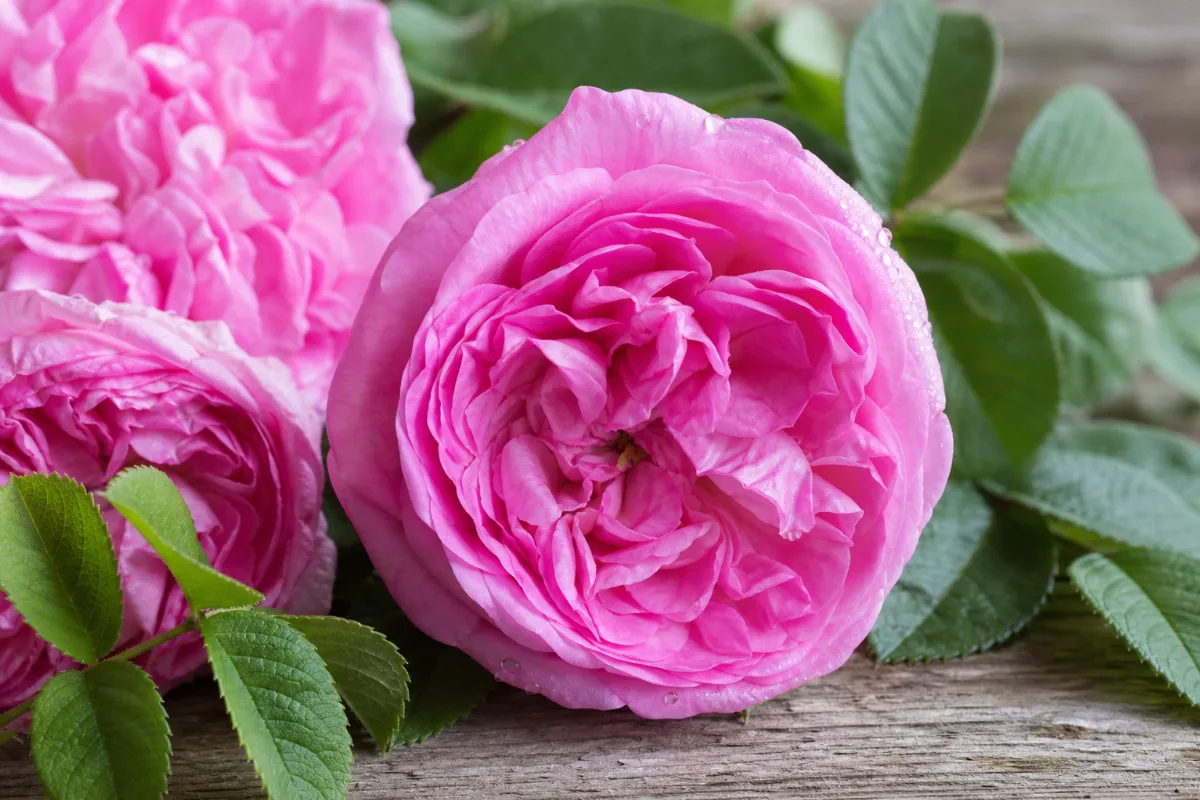
Herbs & Botanicals · Fragrant flower petal herb
Rose petals
Rosa damascena (damask rose) · also called Damask rose, rose flower, Rosae flos
Rose petals come from the damask rose and its close relatives. They are used as a tea, in traditional remedies, and as a source of rose essential oil for aromatherapy. Most of the research is on the oil inhaled as a scent, in small trials mostly from Iran, and it suggests lower anxiety, stress and sleep-problem scores but with weak certainty. Rose oil can irritate or sensitise skin, and the EU does not recommend petal products in pregnancy.
General information, not medical advice. Last substantive update · Not medically reviewed. A named clinician has not signed off on this page. How this page is made
About Rose petals
Rose petals are a traditional herb and the source of rose oil used in aromatherapy. The best-studied use is the scent of rose oil for anxiety, stress and sleep, backed by small, mostly Iranian trials of low certainty. Other uses are weaker. Rose oil can irritate skin, and the EU does not recommend petal products in pregnancy or breastfeeding.
What it is
Rose petals are the dried or fresh petals of the damask rose (Rosa damascena). The EU herbal committee also covers two close relatives, Rosa centifolia and Rosa gallica. The plant is in the rose family, Rosaceae.
In Persian traditional medicine rose has long been used for stomach pain, constipation, the heart and period problems. The petals are also steam-distilled to make rose essential oil.
Four different products
Petals and tea, rose essential oil, rose water and rose hips are different products. Most of the mood, sleep and labour evidence is for the inhaled oil. The constipation trials used syrups, powders and mixed formulas. The EU monograph covers dried petal infusions. Rose water and rose hips were not covered by the evidence read here, and one product's results should not be applied to another.
How it may work
Nobody has shown how the scent of rose oil lowers anxiety scores. Smell may affect emotion, and a pleasant scent may raise expectations of calm, but this is theory. The oil contains citronellol and geraniol, and lab work links the oil to antioxidant, antimicrobial and other effects. These lab results have not been confirmed in people.
What the studies found
A 2025 review pooled 28 trials of rose oil as a scent. Anxiety, stress and sleep-problem scores were lower, but variation between trials was very high, publication bias was found for anxiety, and 24 of 28 trials came from Iran. Depression, systolic and diastolic pressure and pulse did not change significantly.
For constipation, a 2025 review of 13 studies found more bowel movements and better quality of life, but the products were mixtures. Two small trials compared a rose-containing product with a standard laxative and found it similar or better, without a placebo group.
For period symptoms and acute pain, pooled results showed no clear pain relief. Two small trials in labour reported lower pain and anxiety with the scent.
At a glance
Traditional uses history, not proof
- Persian traditional medicine for abdominal and chest pain, constipation, digestion and menstrual complaints
- Rose tea as a folk remedy for period pain
- EU-recognised traditional use of dried petals for mild mouth, throat and skin inflammation
Studied for research
- Anxiety and stress (inhaled rose oil): low certainty
- Sleep quality (inhaled rose oil): low certainty
- Constipation (syrups, powders and mixed formulas): low certainty
- Labour pain and anxiety (inhaled rose oil, two small trials): low certainty
- Period symptoms (oil, skin, oral and tea): mixed
- Acute pain (swallowed or skin rose): no clear benefit
- Mild mouth, throat and skin inflammation: traditional use only
Main compounds
- Citronellol, PubChem CID 8842
- Geraniol, PubChem CID 637566
- Other oil components such as long-chain hydrocarbons
Common forms
- Dried petals and tea
- Rose essential oil (distilled, inhaled in trials)
- Syrups, powders and extracts (constipation trials)
- Rose water (not covered by the evidence read)
- Rose hips are a different product
Research links: Xu 2025: rose aromatherapy, mood and sleep (Frontiers) · Behgam 2025: rose and constipation, review (PubMed) · Koohpayeh 2021: rose and period symptoms (PubMed) · Koohpayeh 2022: rose and acute pain (PubMed) · EMA: rose flower herbal monograph · Research Library · Genes & Biomarkers Library
The plant and its history
- Accepted scientific name
- Rosa damascena
- Naming authority
- GBIF lists Rosa x damascena Mill. as accepted (key 7390572); NCBI Taxonomy lists Rosa x damascena, damask rose (ID 3765).
- Common names
- Rose petals (English); Damask rose (English); Rose flower (English); Rosae flos (Latin); Gole Mohammadi (Persian)
- Botanical family
- Rosaceae (rose family)
- Classification
- Plantae > Tracheophyta > Magnoliopsida > Rosales > Rosaceae > Rosa > Rosa damascena
- Native range
- Not stated in the sources read.
- Habitat
- Not stated in the sources read.
- What the plant looks like
- Roots: Not described in sources read.; Stems: Bushy shrub (Imanieh 2022).; Leaves: Not described in sources read.; Flowers: Petals are the part used; fragrant flowers.; Fruit: Not described in sources read.
- Cultivation
- Grown in Iran, including Fars province (Imanieh 2022); an ornamental in Iran (Mahboubi). Other growing regions not verified.
- Harvest and processing
- Petals are dried for the EU preparation, or steam-distilled from fresh petals for essential oil (Gerasimova 2024).
- Look-alikes and adulterants
- Name: Other roses (R. canina and relatives; rose hips); Note: Different species and plant part; studied for other uses.
- Sustainability and conservation
- Not covered in the sources read.
The plant and the parts used

Traditional use and history history, not clinical proof
| Tradition or era | Documented use | Source |
|---|---|---|
| Persian (Iranian) traditional medicine | Treatment of abdominal and chest pain, strengthening the heart, menstrual bleeding, digestive problems and constipation. | p26870673 |
| Taiwan and world folk practice | Drinking rose tea to ease period pain; described as long-standing folk knowledge. | p16154059 |
| European regulatory recognition | HMPC accepted traditional use of dried petals for mild inflammation of the mouth, throat and skin (30 years of use, 15 in the EU). | s-ema-rosae-flos |
Traditional use shows how a plant was used. It does not show that a supplement works or is safe today.
What is inside, and how it may work
What the plant contains and how those compounds act in cells and animals. Laboratory and animal mechanisms are not proven effects in people.
Main compounds
| Compound | Family | Where it is concentrated | Activity studied | Level of evidence |
|---|---|---|---|---|
| Citronellol PubChem 8842 | Monoterpene alcohol | Petal essential oil 21.22% of one distilled oil sample (Wu 2024); content varies. | Named as a main oil component by Mahboubi 2016. Forms skin-sensitising oxidation products in air (mouse test). 18 23 14 20 | Lab |
| Geraniol PubChem 637566 | Monoterpene alcohol | Petal essential oil 14.1% of one distilled oil sample (Wu 2024); content varies. | Named as a main oil component by Mahboubi 2016; the review links the oil's pharmacological activity to citronellol and geraniol (lab-level). 19 23 14 | Lab |
Mechanisms, receptors and pathways
| Target or pathway | Gene or receptor | What was found | Level |
|---|---|---|---|
| Smell and mood (inhaled oil) | Not specified | How inhaled rose oil lowers anxiety scores in trials is not established. Scent expectation may contribute because blinding is difficult. 24 | Theory |
| Tyrosinase (skin pigment enzyme) | Tyrosinase | Rose oil blocked tyrosinase in a test tube and lowered melanin in mouse pigment cells. No human result. 23 | Lab |
| Chromosomes in cultured cells | Not specified | The oil caused dose-dependent chromosome damage in human lymphocytes and barley cells, but not in mouse bone marrow. 8 | Lab |
| Antimicrobial, antioxidant, analgesic, anti-inflammatory, anti-diabetic, antidepressant properties | Not specified | Mahboubi 2016 describes these as confirmed in preclinical work. They were not tested in people in the sources read and the pain results in people were null. 14 12 | Lab |
Absorption, metabolism and elimination
- Absorption
- No human data found for petals, tea or oil.
- Distribution
- Not found.
- Metabolism
- Not found.
- Elimination
- Not found.
- Bioavailability
- Not found.
Isolated compounds versus whole extracts
Four things carry the name rose. Dried petals and tea are studied for traditional mouth, skin and period uses. Inhaled essential oil (a distilled concentrate) carries almost all the mood, sleep and labour evidence. Constipation trials used syrups and extracts, often with sugar or another herb. Rose water and rose hips (fruit) were not covered by the evidence read. Results for one should not be applied to another.
Nutritional composition
Rose petals are used as a flavouring and herbal tea; no nutrient content or food-safety data were found in the sources read.
7 low certainty5 not enough evidence
What is Rose petals good for?
The studied uses and how strong the human evidence is. For rose petals, most trials are small, short and from Iran, and most test an inhaled oil rather than petals or tea.
Benefits, one by one
Each card is a research question, not a promise. Tap a goal to filter. Open a card to see the studies, doses and limits.
Anxiety (inhaled rose oil)
Low certaintyA 2025 review pooled 28 small trials, almost all in Iran, and found lower anxiety scores after breathing rose oil. The trials differed a lot, the scent makes blinding hard, and this is not evidence for tea or petals.
1 studiesRose oil, a few drops by inhalation for minutes to hours in most tria…
Studies, doses and limits
What the trials found
Xu 2025 pooled 28 randomized trials of Rosa damascena aromatherapy. Overall anxiety fell versus control (SMD -1.31), state anxiety fell (SMD -1.17), and trait anxiety did not change significantly (SMD -0.55, p=0.056). Effects were seen in younger and middle-aged groups; in older people state anxiety was not significant. Inhaled rose oil is a concentrated distilled oil. It is not the same as petals, tea, rose water or rose hips, and these results do not apply to them.
Results
Lower anxiety scores in the short term.
Effect sizes as reported
Overall anxiety SMD -1.31 (95% CI -1.74 to -0.88; I2 90.8%); state anxiety SMD -1.17 (-1.60 to -0.74; I2 88.7%); trait anxiety SMD -0.55 (-1.10 to -0.01; I2 80.6%).
Why this rating
Heterogeneity is very high (about 90%). Publication bias was detected for state anxiety (Egger p<0.01). Blinding is hard because of the scent, and 13 trials were not double-blind. 24 of 28 trials were from Iran. Measured on questionnaires, not clinical diagnosis.
Form and dose studied
Rose oil, a few drops by inhalation for minutes to hours in most trials. The review did not pool by dose.
Who was studied
Healthy people, surgical and procedure patients, hemodialysis, burn, cancer and heart patients, pregnant women, premature infants and health workers.
Limits
Small trials, short follow-up, mostly one country. The review found no data on long-term use. Trial settings were usually supervised hospital care.
Why researchers looked
Rose scent is a traditional calming aroma, and Iranian nursing teams have tested it before procedures and in hospital.
Traditional use
Used in Persian traditional medicine for strengthening the heart (Mahboubi review); anxiety use is modern aromatherapy.
Proposed mechanism Pharmacological theory
How scent lowers anxiety is not established. Smell may act through brain areas for emotion, but this is theory; expectation and the pleasant smell may also play a part.
A proposed mechanism does not show that the effect happens in people.
Essential oils can irritate skin or trigger allergy if they touch the skin. See the Safety tab.
Anxiety before a medical procedure (inhaled rose oil)
Low certaintyOne single-blind trial in 98 heart patients before coronary angiography reported lower stress and anxiety after breathing rose oil for 20 minutes.
2 studiesRose oil 40% on a pad, once for 20 minutes.
Studies, doses and limits
What the trials found
Bikmoradi 2022 randomized 98 patients to breathe 5 drops of a 40% rose solution on a pad for 20 minutes or distilled water. Stress, anxiety and several heart and pressure readings were reported as significantly different. Inhaled rose oil is a concentrated distilled oil. It is not the same as petals, tea, rose water or rose hips, and these results do not apply to them.
Results
Lower stress and anxiety scores; pulse, pressure and oxygen readings also changed.
Effect sizes as reported
P values only in the abstract (stress and anxiety p=0.005 in the rose group and p=0.001 in the control group); between-group size not stated.
Why this rating
One small single-blind trial from one hospital; the abstract reports P values within each group, so the size of the difference between groups is unclear.
Form and dose studied
Rose oil 40% on a pad, once for 20 minutes.
Who was studied
Adults before coronary angiography, Iran.
Limits
Single trial, no follow-up, scent unblinding.
Why researchers looked
Waiting for a procedure is stressful, and nurses look for simple calming steps.
Traditional use
None specific.
Proposed mechanism Pharmacological theory
Not established.
A proposed mechanism does not show that the effect happens in people.
None reported in the abstract.
Stress (inhaled rose oil)
Low certaintyThe same 2025 review found lower stress scores after rose-oil inhalation, with only moderate variation between trials. This is the steadiest of the mood results, though still low certainty.
1 studiesInhaled rose oil.
Studies, doses and limits
What the trials found
Xu 2025 pooled the stress trials. Inhaled rose oil is a concentrated distilled oil. It is not the same as petals, tea, rose water or rose hips, and these results do not apply to them.
Results
Lower stress scores.
Effect sizes as reported
SMD -0.76 (95% CI -1.07 to -0.44; I2 48.7%, the lowest heterogeneity of the outcomes pooled).
Why this rating
Self-rated scores, mostly Iranian trials, scent makes blinding hard, and the sleep and anxiety results show the field has publication bias risk.
Form and dose studied
Inhaled rose oil.
Who was studied
Health workers, patients and healthy people.
Limits
Short-term, self-reported.
Why researchers looked
Stress ratings are a common outcome in nursing trials with health workers and patients.
Traditional use
None specific.
Proposed mechanism Pharmacological theory
Not established.
A proposed mechanism does not show that the effect happens in people.
None reported in the parts read.
Sleep quality (inhaled rose oil)
Low certaintyTwo reviews found better sleep scores after rose-oil inhalation, including in heart patients in hospital. The trials varied enormously, and one negative study changes the result, so this is weak evidence.
2 studiesRose oil, drops by inhalation; Ye 2025 reported subgroups for more th…
Studies, doses and limits
What the trials found
Xu 2025 found better sleep scores (PSQI or hospital sleep questionnaires) with rose-oil aromatherapy. Ye 2025 pooled 13 trials in 740 hospitalised cardiac patients: single essential oils improved sleep quality overall, and the rose subgroup (SMD -1.43) was significant. Sleep was reported by questionnaire, not sleep recordings. Inhaled rose oil is a concentrated distilled oil. It is not the same as petals, tea, rose water or rose hips, and these results do not apply to them.
Results
Better sleep scores in hospital and heart-patient groups.
Effect sizes as reported
Xu 2025: SMD -2.10 (95% CI -3.54 to -0.66; I2 95.5%). Ye 2025: all oils SMD -0.74 (-1.06 to -0.42); rose subgroup SMD -1.43 (-2.73 to -0.13).
Why this rating
Extreme heterogeneity (95.5%), a sensitivity analysis showed one negative study (Hosseini) matters, and the rose result in Ye 2025 is a subgroup with a very wide interval. Questionnaires only.
Form and dose studied
Rose oil, drops by inhalation; Ye 2025 reported subgroups for more than 3 drops and for 3 or more days, not specific to rose.
Who was studied
Cardiac inpatients and mixed patient groups; mainly Iran.
Limits
Subgroup analysis, short follow-up, no objective sleep measures.
Why researchers looked
Hospital patients often sleep badly, and scent is an easy, drug-free option to test.
Traditional use
None specific.
Proposed mechanism Pharmacological theory
Not established.
A proposed mechanism does not show that the effect happens in people.
Ye 2025 reported no adverse events.
Depressive symptoms (inhaled rose oil)
Not enough evidenceNo clear effect. Only two trials measured depression and the pooled result was null.
1 studiesInhaled rose oil.
Studies, doses and limits
What the trials found
Xu 2025 found no significant effect on depressive symptoms (two studies). Inhaled rose oil is a concentrated distilled oil. It is not the same as petals, tea, rose water or rose hips, and these results do not apply to them.
Results
No clear effect.
Effect sizes as reported
SMD 0.07 (95% CI -0.67 to 0.81; I2 77%; two studies).
Why this rating
Only two studies, very wide interval, high variation.
Form and dose studied
Inhaled rose oil.
Who was studied
Mixed.
Limits
Very little data.
Why researchers looked
Anxiety and low mood often go together, so reviews checked depression scales.
Traditional use
None specific.
Proposed mechanism Pharmacological theory
Not established.
A proposed mechanism does not show that the effect happens in people.
None reported.
Functional constipation (oral rose products)
Low certaintyA 2025 review of 13 studies found more bowel movements per week and better quality of life with rose products, but no change in stool-form scores. The products were syrups, powders and extracts, often mixed with sugar, honey or other herbs, so rose alone cannot be credited. No trial used rose tea.
3 studiesSyrup, powder, capsule and extract forms were used; products differ. …
Studies, doses and limits
What the trials found
Behgam 2025: 13 studies; quality of life improved (SMD 0.84), weekly bowel movements rose (SMD 0.86), incomplete evacuation fell (RR 0.78), Bristol stool form did not improve. Imanieh 2022 (100 children over 12 months): a syrup of rose petal decoction with brown sugar cured 100% versus 91.7% on PEG, a difference that was not significant; the only side effect was too-sweet taste. Azimi 2022 (50 adults over 60): a fennel-plus-rose formula beat PEG 4000 on severity, stool consistency and quality of life with fewer side effects (mild diarrhea). Both trials compared against a laxative, not a placebo, and both mixed rose with other ingredients.
Results
More bowel movements per week and better quality of life in the pooled review; similar to or better than a standard laxative in two small trials.
Effect sizes as reported
Behgam 2025: quality of life SMD 0.84 (0.03 to 1.65); weekly bowel movements SMD 0.86 (0.14 to 1.58); incomplete evacuation RR 0.78 (0.63 to 0.94); Bristol SMD -1.34 (-4.39 to 1.71, not significant).
Why this rating
Mixed products with sugar, honey or a second herb; wide intervals; high variation between trials (from our existing summary, not re-opened); mostly Iranian trials; two trials had no placebo. Tea was not tested.
Form and dose studied
Syrup, powder, capsule and extract forms were used; products differ. Tea was not tested.
Who was studied
Adults and children with functional constipation, mostly Iran.
Limits
Small trials, short follow-up, combination products.
Why researchers looked
Rose petals are a traditional Persian remedy for constipation and abdominal pain.
Traditional use
Persian traditional medicine uses rose for constipation and digestive problems (Mahboubi review).
Proposed mechanism Pharmacological theory
Not established. Rose petals are traditionally used for constipation; how they might work is not proven.
A proposed mechanism does not show that the effect happens in people.
Mild diarrhea was reported with the fennel-and-rose formula; a too-sweet taste with the syrup. Rose-containing laxative products are not shown safe in pregnancy.
Labour pain and anxiety (inhaled rose oil)
Low certaintyTwo small trials reported lower pain and anxiety in early labour when mothers breathed rose oil. Both are small and short-term; the scent makes blinding hard.
2 studiesRose essence or oil by inhalation during labour under staff care.
Studies, doses and limits
What the trials found
Hamdamian 2018 (110 first-time mothers, Iran): 0.08 mL rose essence every 30 minutes versus saline; pain was lower at 4-5, 6-7 and 8-10 cm dilation and anxiety was lower at 4-7 and 8-10 cm (P<0.05). Li 2025 (76 analysed, China, three arms with a saline-device placebo): the rose group had lower anxiety and pain at 60 and 120 minutes. Inhaled rose oil is a concentrated distilled oil. It is not the same as petals, tea, rose water or rose hips, and these results do not apply to them.
Results
Lower pain and anxiety scores during first-stage labour.
Effect sizes as reported
P<0.05 in both; effect sizes not given in the abstracts.
Why this rating
Two small single-centre trials, abstracts give no effect sizes; scent unblinding; short readings in labour only.
Form and dose studied
Rose essence or oil by inhalation during labour under staff care.
Who was studied
Healthy first-time mothers in labour.
Limits
Only first-time mothers in labour; nothing on later stages, birth outcomes beyond the secondary measures, or the baby.
Why researchers looked
Midwives look for drug-free ways to ease early labour.
Traditional use
None specific.
Proposed mechanism Pharmacological theory
Not established.
A proposed mechanism does not show that the effect happens in people.
Safety in pregnancy before labour was not studied. See the Safety tab.
Period pain and related symptoms (oil, skin and oral rose; rose tea)
Low certaintyA 2021 review of seven small trials found no clear reduction in period pain or anxiety, but less headache, fatigue and bloating. A separate Taiwan trial of rose tea in 130 teenagers reported less period pain, distress and anxiety over six months, but its abstract gives no numbers.
2 studiesAromatherapy, skin, oral and tea forms were mixed in the review. The …
Studies, doses and limits
What the trials found
Koohpayeh 2021 pooled seven trials (276 treated, 272 comparison; women 18-35) using aromatherapy, skin or oral rose: pain WMD -0.47 (not significant), anxiety WMD -0.40 (not significant), headache WMD -0.42, fatigue WMD -0.48 and bloating WMD -0.72 (all significant). Tseng 2005 (130 Taiwanese teenagers, 70 rose tea and 60 control): less pain, distress and anxiety at 1, 3 and 6 months. The abstract does not say what the control group received or which rose species.
Results
Mixed: no clear pain benefit in the pooled review; some symptom relief; rose tea trial positive but thinly reported.
Effect sizes as reported
Koohpayeh 2021: pain WMD -0.47 (-1.25 to 0.31); headache -0.42 (-0.74 to -0.11); fatigue -0.48 (-0.87 to -0.09); bloating -0.72 (-1.21 to -0.22).
Why this rating
Few small trials mixing oil, skin and oral routes; the one tea trial is from 2005 with few details; the pooled pain result was not significant.
Form and dose studied
Aromatherapy, skin, oral and tea forms were mixed in the review. The tea trial used rose tea (species not stated).
Who was studied
Young women with period pain or premenstrual symptoms.
Limits
Small samples, mixed forms, no long-term data, scent or drink unblinding.
Why researchers looked
Rose is a folk remedy for period pain and menstrual complaints.
Traditional use
Traditional use for menstrual bleeding and cramps (Mahboubi review); the Taiwan trial notes rose tea for period pain is long-standing folk knowledge.
Proposed mechanism Pharmacological theory
Not established.
A proposed mechanism does not show that the effect happens in people.
Not studied in pregnancy; stop and ask a doctor if periods change.
Acute pain (swallowed or skin-applied rose)
Not enough evidenceNo clear benefit. A 2022 review of 11 trials found no significant pain relief from swallowing rose products and no effect from skin use.
1 studiesOral and skin products of varied kinds.
Studies, doses and limits
What the trials found
Koohpayeh 2022 pooled 11 randomized trials (four skin, seven oral): oral SMD -0.55 (not significant), skin SMD 0.10 (no effect). One study reported mild allergic rhinitis. Good quality in 3 of 11 trials, fair in 6, poor in 2. This differs from the labour-pain trials above, which used inhaled oil in labour.
Results
No significant pain relief.
Effect sizes as reported
Oral SMD -0.55 (95% CI -1.27 to 0.17); skin SMD 0.10 (-0.75 to 0.96).
Why this rating
Mixed pain types and products, small trials, wide intervals.
Form and dose studied
Oral and skin products of varied kinds.
Who was studied
Adults with acute pain, mostly women.
Limits
Mixed causes of pain and products.
Why researchers looked
Rose has a traditional reputation for soothing aches.
Traditional use
Traditional use for abdominal and chest pain (Mahboubi review).
Proposed mechanism Animal research
Lab work suggests pain-relieving properties but these are not shown in people.
A proposed mechanism does not show that the effect happens in people.
One study reported mild allergic rhinitis.
Mild mouth and throat inflammation (traditional use, petal infusion)
Not enough evidenceThe EU recognises dried rose petals as a traditional herbal remedy for mild inflammation of the mouth and throat, based on long use. One small trial of 50 people favoured a rose mouthwash, but it was not strong enough to count as proof.
2 studiesInfusion of dried petals used as a mouth rinse (EU monograph form).
Studies, doses and limits
What the trials found
EMA's summary says the conclusion is mainly from long-standing use, and that the committee also considered one 50-patient trial in which rose mouthwash worked better than placebo. We could not read that trial or the full assessment report.
Results
Traditional-use status only.
Effect sizes as reported
Not stated.
Why this rating
Traditional-use registration is not proof of effect; the single trial was small and not read directly.
Form and dose studied
Infusion of dried petals used as a mouth rinse (EU monograph form).
Who was studied
Adults and adolescents over 12.
Limits
Only for mild problems; see a doctor if symptoms last more than a week.
Why researchers looked
Rose petals have been used as a gentle mouth rinse for generations.
Traditional use
EMA accepts at least 30 years of use (15 in the EU) for adults and adolescents over 12.
Proposed mechanism Traditional use
Not established.
A proposed mechanism does not show that the effect happens in people.
None reported by EMA at the time.
Minor skin inflammation (traditional use, wet dressing)
Not enough evidenceThe EU also recognises a petal infusion used as a wet dressing for minor skin inflammation, again based on long use rather than trials.
2 studiesWet dressing from petal infusion (EU monograph form).
Studies, doses and limits
What the trials found
EMA's summary lists skin inflammation alongside mouth and throat, with the same basis of long use. Skin application of rose products did not relieve pain in the 2022 review.
Results
Traditional-use status only.
Effect sizes as reported
Not stated.
Why this rating
No trial read for skin inflammation.
Form and dose studied
Wet dressing from petal infusion (EU monograph form).
Who was studied
Adults and adolescents over 12.
Limits
No skin trials read.
Why researchers looked
Rose petal compresses are an old folk skin remedy.
Traditional use
EMA traditional-use category for adults and adolescents over 12.
Proposed mechanism Traditional use
Not established.
A proposed mechanism does not show that the effect happens in people.
Allergy to rose is a contraindication in the EU monograph.
Blood pressure and pulse (inhaled rose oil)
Not enough evidenceNo clear benefit. Mean arterial pressure fell slightly in the 2025 review, but systolic pressure, diastolic pressure and pulse rate did not change significantly.
2 studiesInhaled rose oil.
Studies, doses and limits
What the trials found
Xu 2025: mean arterial pressure SMD -0.33; systolic, diastolic and pulse rate not significant. Bikmoradi 2022 reported significant changes in heart rate and pressure before angiography.
Results
Small change in mean arterial pressure only.
Effect sizes as reported
MAP SMD -0.33 (95% CI -0.64 to -0.02; p=0.038).
Why this rating
Borderline effect on one measure; others null; measured around procedures.
Form and dose studied
Inhaled rose oil.
Who was studied
Procedure patients.
Limits
Single measurements around stressful procedures.
Why researchers looked
Anxiety can raise pressure and pulse, so reviews checked these.
Traditional use
None specific.
Proposed mechanism Pharmacological theory
Not established.
A proposed mechanism does not show that the effect happens in people.
Do not use rose oil in place of blood pressure treatment.
Connections to the rest of health
How Rose petals connects to the rest of our health knowledge graph. Every link says what kind of connection it is. A safety link (for example to the liver) is a warning, not a benefit. A study that merely mentions a topic never creates a benefit link.
Explore every connection: goals, body systems, organs, symptoms, genes
A. Wellness goals
| Connected to | Kind of connection | Evidence status | Context | Studies |
|---|---|---|---|---|
| Anxiety Support | Potential benefit | Low certainty | Anxiety (inhaled rose oil): A 2025 review pooled 28 small trials, almost all in Iran, and found lower anxiety scores after breathing rose oil. The trials differed a lot, the scent makes blinding hard, and this is not evidence for tea or petals. Anxiety before a medical procedure (inhaled rose oil): One single-blind trial in 98 heart patients before coronary angiography reported lower stress and anxiety after breathing rose oil for 20 minutes. | 24 3 9 13 |
| Calm Relaxation | Potential benefit | Low certainty | Anxiety (inhaled rose oil): A 2025 review pooled 28 small trials, almost all in Iran, and found lower anxiety scores after breathing rose oil. The trials differed a lot, the scent makes blinding hard, and this is not evidence for tea or petals. | 24 |
| Stress Reduction | Potential benefit | Low certainty | Anxiety before a medical procedure (inhaled rose oil): One single-blind trial in 98 heart patients before coronary angiography reported lower stress and anxiety after breathing rose oil for 20 minutes. Stress (inhaled rose oil): The same 2025 review found lower stress scores after rose-oil inhalation, with only moderate variation between trials. This is the steadiest of the mood results, though still low certainty. | 3 24 |
| Resilience Support | Potential benefit | Low certainty | Stress (inhaled rose oil): The same 2025 review found lower stress scores after rose-oil inhalation, with only moderate variation between trials. This is the steadiest of the mood results, though still low certainty. | 24 |
| Sleep Quality | Potential benefit | Low certainty | Sleep quality (inhaled rose oil): Two reviews found better sleep scores after rose-oil inhalation, including in heart patients in hospital. The trials varied enormously, and one negative study changes the result, so this is weak evidence. | 24 25 |
| Better Sleep | Potential benefit | Low certainty | Sleep quality (inhaled rose oil): Two reviews found better sleep scores after rose-oil inhalation, including in heart patients in hospital. The trials varied enormously, and one negative study changes the result, so this is weak evidence. | 24 25 |
| Mood Balance | Potential benefit | Not enough evidence | Depressive symptoms (inhaled rose oil): No clear effect. Only two trials measured depression and the pooled result was null. | 24 |
| Digestive Support | Potential benefit | Low certainty | Functional constipation (oral rose products): A 2025 review of 13 studies found more bowel movements per week and better quality of life with rose products, but no change in stool-form scores. The products were syrups, powders and extracts, often mixed with sugar, honey or other herbs, so rose alone cannot be credited. No trial used rose tea. | 2 10 1 |
| Gut Health | Potential benefit | Low certainty | Functional constipation (oral rose products): A 2025 review of 13 studies found more bowel movements per week and better quality of life with rose products, but no change in stool-form scores. The products were syrups, powders and extracts, often mixed with sugar, honey or other herbs, so rose alone cannot be credited. No trial used rose tea. | 2 10 1 |
| Womens Wellness | Potential benefit | Low certainty | Labour pain and anxiety (inhaled rose oil): Two small trials reported lower pain and anxiety in early labour when mothers breathed rose oil. Both are small and short-term; the scent makes blinding hard. Period pain and related symptoms (oil, skin and oral rose; rose tea): A 2021 review of seven small trials found no clear reduction in period pain or anxiety, but less headache, fatigue and bloating. A separate Taiwan trial of rose tea in 130 teenagers reported less period pain, distress and anxiety over six months, but its abstract gives no numbers. | 9 13 11 22 |
| Hormone Balance | Potential benefit | Low certainty | Period pain and related symptoms (oil, skin and oral rose; rose tea): A 2021 review of seven small trials found no clear reduction in period pain or anxiety, but less headache, fatigue and bloating. A separate Taiwan trial of rose tea in 130 teenagers reported less period pain, distress and anxiety over six months, but its abstract gives no numbers. | 11 22 |
| Joint Support | Potential benefit | Not enough evidence | Acute pain (swallowed or skin-applied rose): No clear benefit. A 2022 review of 11 trials found no significant pain relief from swallowing rose products and no effect from skin use. | 12 |
| Immune Support | Traditional use | Not enough evidence | Mild mouth and throat inflammation (traditional use, petal infusion): The EU recognises dried rose petals as a traditional herbal remedy for mild inflammation of the mouth and throat, based on long use. One small trial of 50 people favoured a rose mouthwash, but it was not strong enough to count as proof. | 5 4 |
| Healthy Skin | Traditional use | Not enough evidence | Minor skin inflammation (traditional use, wet dressing): The EU also recognises a petal infusion used as a wet dressing for minor skin inflammation, again based on long use rather than trials. | 5 4 |
| Blood Pressure Support | Potential benefit | Not enough evidence | Blood pressure and pulse (inhaled rose oil): No clear benefit. Mean arterial pressure fell slightly in the 2025 review, but systolic pressure, diastolic pressure and pulse rate did not change significantly. | 24 3 |
| Heart Health | Potential benefit | Not enough evidence | Blood pressure and pulse (inhaled rose oil): No clear benefit. Mean arterial pressure fell slightly in the 2025 review, but systolic pressure, diastolic pressure and pulse rate did not change significantly. | 24 3 |
B. Body systems
| Connected to | Kind of connection | Evidence status | Context | Studies |
|---|---|---|---|---|
| Nervous System | Biological association | Low certainty | Studied for: Anxiety (inhaled rose oil) Studied for: Anxiety before a medical procedure (inhaled rose oil) | 24 3 25 9 13 |
| Stress Mood | Biological association | Low certainty | Studied for: Anxiety (inhaled rose oil) Studied for: Anxiety before a medical procedure (inhaled rose oil) | 24 3 |
| Sleep Recovery | Biological association | Low certainty | Studied for: Sleep quality (inhaled rose oil) | 24 25 |
| Digestive System | Biological association | Low certainty | Studied for: Functional constipation (oral rose products) Studied for: Mild mouth and throat inflammation (traditional use, petal infusion) | 2 10 1 5 4 |
| Reproductive System | Biological association | Low certainty | Studied for: Labour pain and anxiety (inhaled rose oil) Studied for: Period pain and related symptoms (oil, skin and oral rose; rose tea) | 9 13 11 22 |
| Musculoskeletal System | Biological association | Not enough evidence | Studied for: Acute pain (swallowed or skin-applied rose) | 12 |
| Immune System | Biological association | Not enough evidence | Studied for: Mild mouth and throat inflammation (traditional use, petal infusion) | 5 4 |
| Integumentary System | Biological association | Not enough evidence | Studied for: Minor skin inflammation (traditional use, wet dressing) | 5 4 |
| Cardiovascular System | Biological association | Not enough evidence | Studied for: Blood pressure and pulse (inhaled rose oil) | 24 3 |
E. Health conditions
| Connected to | Kind of connection | Evidence status | Context | Studies |
|---|---|---|---|---|
| Allergic contact dermatitis | Adverse effect or risk | Low certainty | Aromatherapy oils cause dermatitis; oxidised citronellol is a sensitiser in a mouse test. Preparation or compound: Rose essential oil (citronellol and geraniol) |
17 20 21 |
| Pregnancy and breastfeeding | Contraindication | Not enough evidence | EMA advises against use for lack of safety data. Preparation or compound: Petal preparations; tea |
4 |
| Rose allergy | Contraindication | Not enough evidence | Hypersensitivity is a contraindication in the EU monograph. Preparation or compound: All rose products |
4 |
| Anxiety | Potential benefit | Low certainty | Lower anxiety scores in a 2025 review of 28 small, mostly Iranian trials. Preparation or compound: Rosa damascena essential oil, inhaled |
24 |
| Functional constipation | Potential benefit | Low certainty | More bowel movements per week in a 2025 review; products were mixtures. Preparation or compound: Rosa damascena oral products |
2 |
I. Biomarkers
| Connected to | Kind of connection | Evidence status | Context | Studies |
|---|---|---|---|---|
| Anxiety scores (questionnaires) | Biological association | Low certainty | Measured in trials: lowered. A lab change is not the same as a health benefit. | 24 3 |
| Stress scores | Biological association | Low certainty | Measured in trials: lowered. A lab change is not the same as a health benefit. | 24 |
| Sleep quality scores | Biological association | Low certainty | Measured in trials: lowered. A lab change is not the same as a health benefit. | 24 25 |
| Depression scores | Biological association | Not enough evidence | Measured in trials: no-change. A lab change is not the same as a health benefit. | 24 |
| Bowel movements per week | Biological association | Low certainty | Measured in trials: raised. A lab change is not the same as a health benefit. | 2 |
| Stool form (Bristol Stool Form Scale) | Biological association | Mixed findings | Measured in trials: no-change. A lab change is not the same as a health benefit. | 2 1 |
| Quality of life with constipation | Biological association | Low certainty | Measured in trials: raised. A lab change is not the same as a health benefit. | 2 |
| Labour pain score | Biological association | Low certainty | Measured in trials: lowered. A lab change is not the same as a health benefit. | 9 13 |
| Period pain score | Biological association | Mixed findings | Measured in trials: mixed. A lab change is not the same as a health benefit. | 11 22 |
| Headache, fatigue and bloating around periods | Biological association | Low certainty | Measured in trials: lowered. A lab change is not the same as a health benefit. | 11 |
| Mean arterial pressure | Biological association | Not enough evidence | Measured in trials: lowered. A lab change is not the same as a health benefit. | 24 |
| Systolic pressure, diastolic pressure and pulse rate | Biological association | Not enough evidence | Measured in trials: no-change. A lab change is not the same as a health benefit. | 24 3 |
J. Genes, receptors and enzymes
| Connected to | Kind of connection | Evidence status | Context | Studies |
|---|---|---|---|---|
| Tyrosinase | Preliminary mechanism | Lab | Blocked by rose oil in a test tube and in mouse cells. | 23 |
L. Active compounds
| Connected to | Kind of connection | Evidence status | Context | Studies |
|---|---|---|---|---|
| Citronellol | Biological association | Lab | Named as a main oil component by Mahboubi 2016. Forms skin-sensitising oxidation products in air (mouse test). Preparation or compound: Petal essential oil |
18 23 14 20 |
| Geraniol | Biological association | Lab | Named as a main oil component by Mahboubi 2016; the review links the oil's pharmacological activity to citronellol and geraniol (lab-level). Preparation or compound: Petal essential oil |
19 23 14 |
Each connection is stored with the ingredient, the connected record, the kind of connection, the evidence status, the supporting studies, the preparation or compound involved, and a review date (last reviewed October 25, 2026).
Evidence at a glance: what changed in 12 lab markers
Tap a number to show only those markers. Counts are markers, not people.
The evidence
The research centre for Rose petals. Every record here was checked against PubMed or the publisher's page; we never list a study we have not verified.
Evidence by outcome
Bars show how many studies we found for each outcome, not how well it works. People are added up across trials only (reviews are not added, to avoid double counting).
How we rate evidence
High certainty
Several well-run trials or reviews agree; further research is unlikely to change the picture much.
Moderate certainty
Good trials point the same way, but some doubt remains.
Low certainty
Small, short or inconsistent trials. The finding could change with better research.
Very low certainty
Very little or very weak human data. Treat as a possibility only.
Mixed findings
Trials or reviews disagree with each other.
Not enough evidence
Not enough human research to say either way.
Evidence against
Good research found no benefit, or found harm.
We take the reviewers' own risk-of-bias and GRADE statements where they exist, and otherwise judge from study size, design, consistency, directness and whether a product matches what is sold. Many publications do not make evidence high. Method note: We started from our existing rose petals summary, read the abstract (or full text for the Frontiers and EMA records) of every study cited, and checked plant names in GBIF and NCBI Taxonomy and compounds in PubChem. The NCCIH rose page, LiverTox and LactMed could not be found.
Study library: every study we checked 25
| Study | Design | People | Product, dose, length | Result |
|---|---|---|---|---|
| Azimi 2022 Efficacy of the herbal formula of Foeniculum vulgare and Rosa damascena on elderly patients with functional constipation: A double-blind randomized controlled trial Journal of Integrative Medicine · PMID 35339396 · DOI |
Controlled trial |
50 Adults over 60 with functional constipation (Rome IV), Kerman, Iran; 25 per group completed |
Fennel plus Rosa damascena herbal formula (combination) fennel plus rose (parts not stated in abstract) Sachet taken twice a day with warm water 4 weeks, plus 4 weeks follow-up · vs Polyethylene glycol 4000 |
Both groups improved; formula improved severity, stool consistency and quality of life more than PEG (P<0.001) with fewer side effects (mild diarrhea) and longer relief Better than PEG in this small trial Methods, limits and fundingOutcomes: Constipation severity, stool consistency, quality of life, side effects Limitations: Two-herb formula, so rose cannot be credited alone; active comparator, no placebo; 50 people; one centre. Funding and conflicts: Not stated in abstract. Registration: IRCT20200108046056N1 Read: abstract |
| Behgam 2025 The impact of Rosa damascena Mill. on gastrointestinal disorders: a comprehensive analysis through clinical trials, systematic review, and meta-analysis Daru · PMID 40111537 · DOI |
Meta-analysis |
Adults and children with gastrointestinal disorders, mainly functional constipation; 13 studies, mostly in Iran | Rosa damascena products (syrups, powders, capsules, extracts, some mixed with sugar, honey or other herbs) petals (product forms vary) Varied; not pooled Varied · vs Placebo, usual care or laxatives |
Quality of life SMD 0.84; weekly bowel movements SMD 0.86; incomplete evacuation RR 0.78; stool-form (Bristol) score not improved (SMD -1.34, not significant) More bowel movements per week and better quality of life; no change in stool form (Quality of life SMD 0.84 (0.03 to 1.65); bowel movements/week SMD 0.86 (0.14 to 1.58); incomplete evacuation RR 0.78 (0.63 to 0.94); Bristol SMD -1.34 (-4.39 to 1.71)) Methods, limits and fundingOutcomes: Bowel movements per week, stool form (Bristol scale), incomplete evacuation, quality of life Limitations: Mixed products, many combined with other ingredients; quality-of-bias counts (7 good, 3 some concerns, 3 poor) and high variation come from our existing summary, not re-opened; mostly Iranian trials. Funding and conflicts: Authors declare no competing interests. Registration: PROSPERO CRD42024519644 Read: abstract |
| Bikmoradi 2022 Impact of inhalation aromatherapy with Damask Rose (Rosa damascena) on stress, anxiety and hemodynamic parameters of patients undergoing coronary angiography: a single blind randomized clinical trial Journal of Complementary and Integrative Medicine · PMID 34018381 · DOI |
Controlled trial |
98 Patients before coronary angiography, Hamadan, Iran |
Rosa damascena 40% solution, inhaled petals (distilled oil) 5 drops of 40% solution 20 minutes, once · vs Distilled water |
Reported significant differences in stress, anxiety, heart rate, mean/systolic/diastolic pressure and oxygen saturation Lower stress and anxiety scores and changes in pulse and pressure before a procedure Methods, limits and fundingOutcomes: Stress and anxiety (DASS-21), heart rate, blood pressure, oxygen saturation Limitations: Single-blind. The abstract reports P values within each group, so the size of the between-group difference is unclear. One hospital in Iran. Funding and conflicts: Not stated in abstract. Registration: IRCT201702019759N8 Read: abstract |
| European Medicines Agency 2013 Community herbal monograph on Rosa gallica L., Rosa centifolia L., Rosa damascena Mill., flos (EMA/HMPC/137299/2013) EMA/HMPC · Source |
Authoritative guidance |
Adults and adolescents over 12 | Dried petals (rose flower) petals Per monograph Per monograph · vs n/a |
Contraindication: hypersensitivity. Not established under 12. No interactions reported. No fertility data; use in pregnancy and lactation not recommended for lack of data. No undesirable effects or overdose reported. Tests of genotoxicity, reproductive toxicity and carcinogenicity have not been performed. Safety caution sheet for the petal preparation Methods, limits and fundingOutcomes: Safety statements Limitations: The copy read is the December 2013 version marked 'Draft'; the EMA page lists the final adopted text (published 2014, same reference number) and a 2022 revision consultation, which were not read. Funding and conflicts: Regulator document. Read: full-text |
| European Medicines Agency 2017 Rosae flos - herbal medicinal product (EMA summary page for the rose flower monograph) EMA website · Source |
Authoritative guidance |
50 Adults and adolescents over 12 |
Dried petals of Rosa gallica, R. centifolia, R. damascena, as infusion or comminuted herb for mouth lining or skin petals Per monograph Per monograph · vs Placebo in one 50-patient mouthwash study |
HMPC accepts traditional use (at least 30 years, 15 in the EU) for mild inflammation of the skin or lining of the mouth and throat; a 50-patient trial favoured rose mouthwash over placebo, but the conclusion rests mainly on long use; no side effects reported at the time Traditional-use status only Methods, limits and fundingOutcomes: Mild mouth, throat and skin inflammation Limitations: Does not cover combinations with other herbs. Summary page, not the full assessment report. Funding and conflicts: Regulator document. Read: full-text |
| GBIF Backbone / NCBI Taxonomy 2026 Taxonomy record: Rosa x damascena Mill. (7390572) GBIF · Source |
Database record n/a |
n/a | n/a n/a n/a n/a · vs n/a |
Accepted species in family Rosaceae Identity check Methods, limits and fundingOutcomes: Accepted name and rank Limitations: API record only. Funding and conflicts: n/a Read: full-text |
| GBIF Backbone / NCBI Taxonomy 2026 Taxonomy record: Rosa x damascena (damask rose) (3765) NCBI Taxonomy · Source |
Database record n/a |
n/a | n/a n/a n/a n/a · vs n/a |
Species-level record, common name damask rose Identity check Methods, limits and fundingOutcomes: Accepted name and rank Limitations: API record only. Funding and conflicts: n/a Read: full-text |
| Gerasimova 2024 Rosa damascena Mill. Essential Oil: Analysis of In Vitro and In Vivo Genotoxic and Cytotoxic Potentials by Employing Three Cytogenetic Endpoints Molecules · PMID 39795135 · DOI |
Laboratory research in-vitro |
Barley root cells, mouse bone marrow, cultured human lymphocytes | Rosa damascena essential oil (steam-distilled from fresh petals) petals (distilled oil) Concentration series (lab) Lab exposure times · vs Untreated cells |
Dose-dependent chromosome damage in barley and human lymphocytes; moderate toxicity in lymphocytes; no genotoxicity in mouse bone marrow at the doses used Lab signal of chromosome damage at some concentrations Methods, limits and fundingOutcomes: Cell toxicity, chromosome damage, micronuclei Limitations: Lab and animal test only, not a human exposure study; it does not show harm from normal aromatherapy use. Funding and conflicts: No conflicts declared. Read: abstract |
| Hamdamian 2018 Effects of aromatherapy with Rosa damascena on nulliparous women's pain and anxiety of labor during first stage of labor Journal of Integrative Medicine · PMID 29526235 · DOI |
Controlled trial |
110 First-time mothers in labour at an Iranian maternity hospital |
Rosa damascena essence, inhaled petals (distilled essence) 0.08 mL every 30 minutes First stage of labour · vs 0.08 mL normal saline |
Pain lower than control at 4-5, 6-7 and 8-10 cm dilation (P<0.05); anxiety lower at 4-7 and 8-10 cm (P<0.05) Lower pain and anxiety scores during first-stage labour Methods, limits and fundingOutcomes: Pain (numeric scale) and anxiety (Spielberger) at set cervical dilations Limitations: Abstract gives P values only, no effect sizes. One hospital in Iran. Scent makes blinding hard. Short-term outcomes only. Funding and conflicts: Not stated in abstract. Registration: IRCT201306258801N3 Read: abstract |
| Imanieh 2022 Rosa damascena together with brown sugar mitigate functional constipation in children over 12 months old: A double-blind randomized controlled trial Journal of Ethnopharmacology · PMID 35963416 · DOI |
Controlled trial |
100 Children over 12 months old with functional constipation, Iran |
Syrup of Rosa damascena petal decoction with brown sugar (combination) petals Syrup; composition per mL in the paper 2 and 4 weeks follow-up · vs Polyethylene glycol (PEG) laxative |
Cure 100% with the syrup versus 91.7% with PEG; difference not significant; only side effect was a too-sweet taste Similar to PEG in this trial Methods, limits and fundingOutcomes: Cure of constipation, side effects Limitations: The syrup also contained brown sugar, which has laxative effects, so rose cannot be credited alone. No placebo. One country. Funding and conflicts: Authors declare no competing interests. Read: abstract |
| Koohpayeh 2021 Effects of Rosa damascena (Damask rose) on menstruation-related pain, headache, fatigue, anxiety, and bloating: A systematic review and meta-analysis of randomized controlled trials Journal of Education and Health Promotion · PMID 34485569 · DOI |
Meta-analysis |
548 Women aged 18-35 with primary dysmenorrhea or premenstrual syndrome; 7 trials (276 treated, 272 comparison) |
Rosa damascena by inhalation, on the skin or by mouth unspecified Varied Varied · vs Placebo, no treatment or usual care |
Pain WMD -0.47 (not significant); anxiety WMD -0.40 (not significant); headache WMD -0.42, fatigue -0.48 and bloating -0.72 all significant No clear pain relief; some relief of headache, fatigue and bloating (Pain WMD -0.47 (-1.25 to 0.31); headache -0.42 (-0.74 to -0.11); fatigue -0.48 (-0.87 to -0.09); bloating -0.72 (-1.21 to -0.22)) Methods, limits and fundingOutcomes: Menstrual pain, headache, fatigue, anxiety, bloating Limitations: Only 7 small trials with mixed routes and products; the authors call for better-quality trials. Funding and conflicts: No conflicts of interest declared. Read: abstract |
| Koohpayeh 2022 Effects of Topical Application and Oral Intake of Rosa damascena on Acute Pain in Adults: A Systematic Review and Meta-analysis Oman Medical Journal · PMID 36188887 · DOI |
Meta-analysis |
Adults with acute pain; 11 randomized trials (4 topical, 7 oral); 9 recruited only women | Rosa damascena products, oral or on the skin unspecified Varied Varied · vs Placebo, no treatment or usual care |
Oral intake SMD -0.55 (not significant); topical use SMD 0.10 (no effect). One study reported mild allergic rhinitis. No significant pain relief from oral or topical rose (Oral SMD -0.55 (-1.27 to 0.17); topical 0.10 (-0.75 to 0.96)) Methods, limits and fundingOutcomes: Pain severity Limitations: Small trials, mixed products; 3 of 11 good quality, 6 fair, 2 poor. Funding and conflicts: Not stated in abstract. Read: abstract |
| Li 2025 Effects of Rosa damascena on Labor Pain and Anxiety in Primiparous Women Holistic Nursing Practice · PMID 39212535 · DOI |
Controlled trial |
76 First-time mothers in the early (latent) stage of labour, China |
Damask rose aromatherapy, inhaled petals (essential oil) At least 30 minutes by diffuser Early first stage of labour, readings at 30, 60 and 120 minutes · vs Saline in the same device (placebo) and routine care (control) |
Aroma group had lower anxiety and pain than placebo and control at 60 and 120 minutes Lower pain and anxiety scores with scent Methods, limits and fundingOutcomes: Pain, anxiety and contractions Limitations: 76 analysed; abstract gives no numbers. Single centre. Short follow-up. Funding and conflicts: Not stated in abstract. Read: abstract |
| Mahboubi 2016 Rosa damascena as holy ancient herb with novel applications Journal of Traditional and Complementary Medicine · PMID 26870673 · DOI |
Narrative review |
Review of ethnopharmacology, chemistry and lab studies | Rosa damascena (petals, essential oil) petals and oil n/a n/a · vs n/a |
Traditional use for abdominal and chest pain, strengthening the heart, menstrual bleeding, digestive problems and constipation; citronellol and geraniol named as main oil components; lab antimicrobial, antioxidant, analgesic, anti-inflammatory, anti-diabetic and antidepressant properties described Background for traditional use and main oil components Methods, limits and fundingOutcomes: Traditional uses and pharmacology Limitations: Narrative review (to March 2015); mostly preclinical; it calls for larger clinical studies. Funding and conflicts: Not stated in abstract. Read: abstract |
| NCCIH 2026 NCCIH rose page: not found (the address nccih.nih.gov/health/rose returned HTTP 404 on 2026-10-25) NCCIH website · Source |
Not found n/a |
n/a | n/a n/a n/a n/a · vs n/a |
No NCCIH page for rose was found at the expected address; no statement from NCCIH is made None Methods, limits and fundingOutcomes: n/a Limitations: Absence of a page found is not a finding of safety or harm. Funding and conflicts: n/a Read: summary-only |
| NIH LiverTox / LactMed and others 2026 LiverTox, LactMed, Commission E, WHO, FDA: no rose-petal entry found or opened Search record · Source |
Not found n/a |
n/a | n/a n/a n/a n/a · vs n/a |
A search of the NCBI Books database for a LiverTox or LactMed rose entry found no match; Commission E, WHO and FDA pages were not opened None Methods, limits and fundingOutcomes: n/a Limitations: Not found is not the same as safe. Funding and conflicts: n/a Read: summary-only |
| Posadzki 2012 Adverse effects of aromatherapy: a systematic review of case reports and case series International Journal of Risk & Safety in Medicine · PMID 22936057 · DOI |
Systematic review |
71 42 reports of 71 patients with aromatherapy adverse effects |
Essential oils in aromatherapy (many kinds) various Varied Varied · vs None |
Effects from mild to severe including one death; dermatitis most common; lavender, peppermint, tea tree and ylang-ylang most often named Aromatherapy can cause side effects, most often skin reactions; frequency unknown Methods, limits and fundingOutcomes: Adverse effects Limitations: Case reports cannot give rates. Rose oil is not named in the abstract. Funding and conflicts: Not stated in abstract. Read: abstract |
| PubChem 2026 PubChem compound record: Citronellol (CID 8842, C10H20O) PubChem · Source |
Database record n/a |
n/a | Citronellol n/a n/a n/a · vs n/a |
CID 8842, formula C10H20O, 3,7-dimethyloct-6-en-1-ol Identity check Methods, limits and fundingOutcomes: Identity Limitations: Database record only. Funding and conflicts: n/a Read: full-text |
| PubChem 2026 PubChem compound record: Geraniol (CID 637566, C10H18O) PubChem · Source |
Database record n/a |
n/a | Geraniol n/a n/a n/a · vs n/a |
CID 637566, formula C10H18O, (2E)-3,7-dimethylocta-2,6-dien-1-ol Identity check Methods, limits and fundingOutcomes: Identity Limitations: Database record only. Funding and conflicts: n/a Read: full-text |
| Rudbäck 2014 Characterization of skin sensitizers from autoxidized citronellol - impact of the terpene structure on the autoxidation process Contact Dermatitis · PMID 24673435 · DOI |
Animal research animal |
Chemistry plus mouse local lymph node assay | Citronellol (isolated compound) isolated compound Lab Exposure to air over time · vs None |
As citronellol oxidised in air, its skin-sensitizing strength rose; hydroperoxides were the main sensitizers. Citronellol is in fragrance mix II used to screen for fragrance allergy. Oxidised citronellol is a skin sensitizer in animals Methods, limits and fundingOutcomes: Oxidation products and sensitizing strength Limitations: Isolated compound, not rose oil itself; mouse assay, not human risk data. Funding and conflicts: Not stated in abstract. Read: abstract |
| Sindle 2020 Art of Prevention: Essential Oils - Natural Products Not Necessarily Safe International Journal of Women's Dermatology · PMID 34222588 · DOI |
Narrative review |
Review of essential oils and allergic contact dermatitis | Essential oils in general oils n/a n/a · vs n/a |
Essential oils contain complex mixtures; increasing use has led to more reports of allergic contact dermatitis, a delayed allergic skin reaction Natural oils are not automatically safe for skin Methods, limits and fundingOutcomes: Allergic contact dermatitis Limitations: General review, not specific to rose oil. Funding and conflicts: Not stated in abstract. Read: abstract |
| Tseng 2005 Rose tea for relief of primary dysmenorrhea in adolescents: a randomized controlled trial in Taiwan Journal of Midwifery & Women's Health · PMID 16154059 · DOI |
Controlled trial |
130 Female adolescents with primary dysmenorrhea in Taiwan (70 rose tea, 60 control) |
Rose tea (drink) petals (species not stated in abstract) Not stated in abstract Followed at 1, 3 and 6 months · vs Control group (what it received is not stated in the abstract) |
Less pain, distress and anxiety and better well-being than control at 1, 3 and 6 months Reported benefit on period pain Methods, limits and fundingOutcomes: Menstrual pain, distress, anxiety, well-being Limitations: Abstract gives no numbers, no blinding or placebo details and does not name the rose species. Older trial; the authors note rose tea use had not been studied before. A drink cannot be easily blinded. Funding and conflicts: Not stated in abstract. Read: abstract |
| Wu 2024 Rosa x damascena Herrm. essential oil: anti-tyrosinase activity and phytochemical composition Frontiers in Pharmacology · PMID 39323629 · DOI |
Laboratory research in-vitro |
One rose oil sample, test-tube and mouse skin-pigment cells | Rosa x damascena essential oil petals (distilled oil) 25-100 micrograms/mL in cells Lab · vs Untreated |
Main components citronellol 21.22%, geraniol 14.1%, eicosane 11.03%, heneicosane 6.65%, 1-nonadecene 5.16%; blocked tyrosinase in lab Describes what one rose oil contained Methods, limits and fundingOutcomes: Composition by GC-MS; tyrosinase activity Limitations: Single oil sample; composition varies with origin and distillation. Lab only. Funding and conflicts: No conflicts declared. Read: abstract |
| Xu 2025 The effects of Rosa damascene [sic] aromatherapy on mood and sleep: a systematic review and meta-analysis Frontiers in Public Health · Source · DOI |
Meta-analysis |
28 randomized trials (24 in Iran; others Thailand, Turkey, India, China): healthy people, surgical and procedure patients, hemodialysis, burn, cancer and heart patients, pregnant women, premature infants, health workers | Rosa damascena essential oil, mainly inhaled (one trial used skin application) petals (distilled oil) Varied; drops on a pad or by inhalation, typically 2-5 drops for 10-30 minutes in many trials; not pooled Single sessions to several nights · vs Water, saline, unscented oil, usual care or no treatment |
Anxiety SMD -1.31 (I2 90.8%); state anxiety SMD -1.17 (I2 88.7%); trait anxiety not significant; stress SMD -0.76 (I2 48.7%); sleep quality SMD -2.10 (I2 95.5%); mean arterial pressure SMD -0.33; depression SMD 0.07 (2 studies, not significant); systolic/diastolic pressure and pulse rate not significant Lower anxiety, stress and sleep-problem scores with the scent; no clear effect on depression, pulse or systolic/diastolic pressure (Anxiety SMD -1.31 (95% CI -1.74 to -0.88); stress -0.76 (-1.07 to -0.44); sleep -2.10 (-3.54 to -0.66); MAP -0.33 (-0.64 to -0.02); depression 0.07 (-0.67 to 0.81)) Methods, limits and fundingOutcomes: Anxiety, depression, stress, sleep quality, mean arterial pressure, pulse rate Limitations: Very high heterogeneity for anxiety and sleep. Publication bias detected for state anxiety (Egger p<0.01). The scent makes blinding hard: 13 trials lacked a double-blind design. Sleep result was sensitive to one negative study. 24 of 28 trials were from Iran. No safety or adverse-event data were found in the parts read. Funding and conflicts: Funded by a Zhejiang Province Traditional Chinese Medicine project; authors declare no conflict of interest. Registration: PROSPERO CRD42024593400 Read: full-text |
| Ye 2025 Effects of aromatherapy on sleep quality in hospitalized cardiac patients: A systematic review and meta-analysis of randomized controlled trials Complementary Therapies in Medicine · PMID 40987424 · DOI |
Meta-analysis |
740 Hospitalized cardiac patients; 9 studies (13 trials) |
Single essential oils (several kinds), with a Rosa damascena subgroup oil Varied Varied · vs Usual care or placebo |
All single oils SMD -0.74; Rosa damascena subgroup SMD -1.43 Better sleep scores in heart patients, including the rose subgroup (All oils SMD -0.74 (-1.06 to -0.42); Rosa damascena SMD -1.43 (-2.73 to -0.13)) Methods, limits and fundingOutcomes: Sleep quality Limitations: Rose was a subgroup of a mixed-oil analysis; wide interval; small trials. No adverse events were reported. Funding and conflicts: Authors declare no conflict of interest. Registration: PROSPERO CRD42024535895 Read: abstract |
What we do not know yet
- No trial of rose petal tea for anxiety, sleep or constipation was found.
- Most mood trials are from Iran, short, and hard to blind because of the scent.
- Constipation trials used mixed products and laxative comparators rather than placebo.
- No human safety, genotoxicity or reproductive toxicity data (EMA, 2013).
- No trial of rose water.
- NCCIH, LiverTox and LactMed entries were not found; EMA's final text was not read.
How new research is added
New studies are found by a saved PubMed search and placed in a review queue. A person reads each one before it changes any rating or safety wording.
Lab markers
What changed in blood or saliva tests during trials. A changed number is not the same as feeling or being healthier, and we give no "normal ranges".
Other 12
Anxiety scores (questionnaires)
Lowered in trials
Self-rated anxiety scales such as the State-Trait Anxiety Inventory, DASS-21 and visual analogue scales.
Low certaintyResults and what it means
Why it was measured
Used to see if scent lowers worry and tension.
Statistical vs. clinical meaning
Large statistical effects but very high heterogeneity and scent unblinding; self-rated scores are not a diagnosis.
Safety implication
None.
| Study | Result | People | Product |
|---|---|---|---|
| 24 | Overall SMD -1.31; state anxiety SMD -1.17; trait anxiety not significant (-0.55, p=0.056) | 28 trials, mostly in Iran | Rose essential oil by inhalation |
| 3 | Significant differences reported (p=0.005 in the rose group and p=0.001 in control) | 98 patients before coronary angiography | Inhaled 40% rose solution, 20 minutes |
Stress scores
Lowered in trials
Self-rated stress, such as the DASS-21 stress scale or job-stress questionnaires.
Low certaintyResults and what it means
Sleep quality scores
Lowered in trials
Questionnaire scores such as the Pittsburgh Sleep Quality Index (lower is better).
Low certaintyResults and what it means
Why it was measured
Used to track sleep complaints.
Statistical vs. clinical meaning
Extreme heterogeneity, one negative study changes the result, no sleep recordings.
Safety implication
None.
Depression scores
No clear change in trials
Self-rated scales such as DASS-21 depression and the Edinburgh scale.
Not enough evidenceBowel movements per week
Raised in trials
How often people with constipation had a bowel movement in a week.
Low certaintyResults and what it means
Stool form (Bristol Stool Form Scale)
No clear change in trials
A picture-based rating of stool hardness.
Mixed findingsResults and what it means
Why it was measured
Shows whether stools soften.
Statistical vs. clinical meaning
Pooled review null; one combination-formula trial positive.
Safety implication
None.
Quality of life with constipation
Raised in trials
Patient-rated impact of constipation on daily life.
Low certaintyLabour pain score
Lowered in trials
Pain rating on a numeric scale at set cervical dilations.
Low certaintyResults and what it means
Why it was measured
Main outcome in labour trials.
Statistical vs. clinical meaning
Small trials; numbers not in abstracts.
Safety implication
See Safety tab.
Period pain score
Mixed results in trials
Rated pain during menstruation.
Mixed findingsResults and what it means
Why it was measured
Main outcome for dysmenorrhea.
Statistical vs. clinical meaning
Pooled null; tea trial positive but poorly reported.
Safety implication
None.
Headache, fatigue and bloating around periods
Lowered in trials
Rated period-related symptoms.
Low certaintyResults and what it means
Mean arterial pressure
Lowered in trials
Average blood pressure through the heartbeat cycle.
Not enough evidenceSystolic pressure, diastolic pressure and pulse rate
No clear change in trials
Standard blood pressure and heart-rate readings.
Not enough evidenceResults and what it means
Safety
What studies and official sources say about side effects, medicines and who should check first. Each point shows what kind of evidence it comes from.
Main points to know 5
- Little safety research; 'none reported' is not 'proven safe'. The EU herbal committee found no reported side effects or interactions for dried rose petal preparations, but its monograph says tests for genotoxicity, reproductive toxicity and cancer risk have not been done. The trials of inhaled oil, tea and mixed constipation products were small and reported few harms. Authoritative guidance 5 4
- Essential oil can sensitise or irritate skin. Rose oil is concentrated. Reviews of aromatherapy list dermatitis as the most common side effect, and one main rose-oil component, citronellol, forms skin-sensitising products when it oxidises in air (mouse test). Do not put undiluted rose oil on skin and stop if a rash appears. No human case series of rose-oil allergy was found in the sources read. Case series 17 20 21 23
- Pregnancy and breastfeeding: tea and petal products are not recommended; oil was tested only in labour. The EU monograph says safety in pregnancy and breastfeeding is not established and advises against petal products. The labour trials used inhaled rose oil under staff care after labour had begun; they do not show it is safe earlier in pregnancy. Authoritative guidance 5 4 9 13
- Allergy to rose is a contraindication. The EU monograph lists hypersensitivity to the plant as a contraindication. One pain trial in the 2022 review reported mild allergic rhinitis. Authoritative guidance 5 4 12
- Do not use the findings for children under 12 or for long-term use. The EU monograph says use under 12 is not established. One trial gave a rose-petal syrup with sugar to children over 12 months, but this is a single trial. Authoritative guidance 4 10
Side effects 5
| Effect | How often | Severity and recovery | Evidence |
|---|---|---|---|
| Skin rash or allergic contact dermatitis from essential oil Dermatitis was the most common effect in a review of 42 aromatherapy reports (71 patients); rose oil was not among the oils named in the abstract. How often it happens is unknown. | Not established | Mild to severe in aromatherapy case reports Usually settles when the oil is stopped | Case series 17 21 |
| Mild allergic rhinitis (blocked or runny nose) Reported by one study in the 2022 pain review; which product it was is not stated in the abstract. | Not established | Mild Not stated | Controlled trial 12 |
| Mild diarrhea With a fennel-and-rose formula in older adults; fewer than with the PEG comparator according to the authors. | Not established | Mild Not stated | Controlled trial 1 |
| Too-sweet taste The only effect found with rose petal and brown sugar syrup in children. | Not established | Mild Not applicable | Controlled trial 10 |
| No adverse events reported in inhaled-oil and tea trials read The cardiac sleep review reported none and EMA reported none. Most trial abstracts do not discuss safety, so this is weak reassurance. | Not established | Not applicable Not applicable | Controlled trial 25 5 |
Liver
No case of liver injury from rose petals, rose oil or rose tea was found. A search of the NCBI Books database found no LiverTox entry for rose, so no LiverTox rating is known. 16
How often. No frequency is available.
Monitoring. No monitoring advice was found. Seek care for yellow eyes or skin, dark urine, pale stools or severe stomach pain.
This is a safety connection. It is not evidence that Rose petals supports liver health.
Medicines and supplements 5
| With | Why it matters | Importance | Evidence | What to do |
|---|---|---|---|---|
| Prescription medicines prescription | None reported; no interaction study was found. | Unknown. | Authoritative guidance Not enough evidence 4 | Tell your pharmacist you use rose products, especially oil by mouth or on skin. |
| Sedatives, sleep medicines and alcohol theoretical | Inhaled rose oil lowered anxiety and sleep scores in trials, so a calming effect could add to sedatives. No interaction study or case report was found. | Unknown; theory only. | Pharmacological theory Not enough evidence 24 4 | Take care before driving or machinery if you feel drowsy. EMA says no studies on driving have been done. |
| Laxatives and bowel medicines theoretical | Rose products were compared with PEG in two constipation trials and one combination had mild diarrhea, so effects could add to other laxatives. No interaction study was found. | Unknown; theory only. | Pharmacological theory Not enough evidence 10 1 | Ask a pharmacist if you use laxatives or have diarrhea. |
| Blood pressure medicines theoretical | Mean arterial pressure fell slightly with inhaled oil in a pooled analysis, but systolic and diastolic did not change significantly. No interaction study was found. | Unknown; theory only. | Pharmacological theory Not enough evidence 24 | Do not stop pressure medicine because of rose products. |
| Other herbs and supplements herb | None reported by EMA for petal preparations. | Unknown. | Authoritative guidance Not enough evidence 5 | Combination products (for example with fennel) were not covered by the EMA summary. |
Who should check first 5
| Situation | Advice | Evidence |
|---|---|---|
| Allergy to roses or rose products | Avoid; EMA lists hypersensitivity as a contraindication. | Authoritative guidance 4 |
| Pregnancy and breastfeeding (tea, petal products, and oil outside of supervised care) | Not recommended by EMA for petal products for lack of data. Inhaled oil was only studied in labour under staff care. Ask your midwife or doctor. | Authoritative guidance 4 9 13 |
| Children under 12 | Use is not established by EMA. One trial used a petal syrup with sugar in children over 12 months; do not treat that as general advice. | Authoritative guidance 4 10 |
| Broken, inflamed or sensitive skin (undiluted oil) | Avoid putting undiluted essential oil on skin; stop if irritation or a rash starts. | Case series 17 21 |
| Constipation that is new, painful or lasts more than a week | Get medical advice; rose products are not a diagnosis. EMA says see a doctor if symptoms last more than one week. | Authoritative guidance 5 4 |
Overdose, product quality and regulators
Summary. No formal human toxicity data were found. The EU monograph states that tests for genotoxicity, reproductive toxicity and cancer risk have not been performed. A 2024 lab study of rose essential oil found chromosome damage in barley cells and cultured human lymphocytes at some concentrations, but not in mouse bone marrow; this is a lab signal, not proof of harm from ordinary use.
Animal. Mouse bone marrow: no genotoxicity at the doses tested; moderate cytotoxicity in cultured human lymphocytes (Gerasimova 2024).
Human doses studied. Inhaled oil for minutes to hours in trials; petal syrups and formulas for weeks; rose tea for months in one older trial.
High dose or long term signals. No long-term human safety data found.
Overdose response. EMA: no case of overdose has been reported.
Genotoxicity. Lab study: dose-dependent chromosome damage in barley and human lymphocytes; none in mouse bone marrow. EMA: tests not performed.
Toxic plant parts. No toxic parts are named in the sources read. Rose hips (fruit) are a different product and were not covered.
No adulteration or contamination data were found for rose petal, oil or rose water products in the sources read. Rose oil is an expensive distilled oil, so dilution or synthetic additions are a general concern, but this was not verified here.
Oil composition. One oil sample was mainly citronellol (21.22%), geraniol (14.1%) and long-chain hydrocarbons. Composition varies by origin and distillation. 23
Adulteration and heavy metals. Not found in the sources read. 16
| Body | Action | Date |
|---|---|---|
| EMA / HMPC (European Union) | EU herbal monograph (traditional use) for rose flower (Rosa gallica, R. centifolia, R. damascena petals) for mild inflammation of the mouth, throat and skin, adults and adolescents over 12. Safety in pregnancy and lactation not established. Summary page and the December 2013 text were read; the final adopted 2014 text and the 2022 revision consultation were not read. source | Adopted 2014 (EMA page); revision consultation 2022 |
When to get medical help
- Swelling of the lips, face or throat, wheezing or trouble breathing after using a rose product.
- A spreading, blistering or very itchy rash after oil touched the skin.
- Severe or bloody diarrhea, or severe stomach pain.
- Yellow skin or eyes, or dark urine.
- Bleeding or pain in pregnancy after using any herbal product.
Stop the supplement and contact a clinician or emergency service. In the US, Poison Control is 1-800-222-1222.
General information only, not medical advice. Ask a clinician or pharmacist before use, especially with medicines, in pregnancy or with a health condition. See the Natural Remedy Safety guide.
Frequently asked questions
What are rose petals good for?
The best-studied use is rose oil breathed as a scent for anxiety, stress and sleep, with low-certainty evidence. Rose products have also been tested for constipation, period symptoms and labour pain with mixed results. The EU accepts petals for mild mouth, throat and skin inflammation based on long use.
Does rose aromatherapy help anxiety?
Does rose oil help sleep?
Does rose tea help with constipation?
Does rose tea help period pain?
Does rose oil help labour pain?
Can rose oil cause an allergic reaction?
Are rose petals safe in pregnancy or while breastfeeding?
Does rose interact with medicines?
What do the EU and other regulators say?
Is rose water or rose hip the same thing?
Is there any liver risk?
No case of liver injury from rose petals or oil was found, and no LiverTox entry was found. Seek care for yellow skin or eyes or dark urine.
Explore by health goal
Anxiety SupportStress ReductionWomens WellnessCalm RelaxationResilience SupportSleep QualityBetter SleepMood BalanceDigestive SupportGut HealthHormone BalanceJoint SupportImmune SupportHealthy SkinBlood Pressure SupportHeart Health
Editorial transparency
- Written by
- AlternativeMed editorial team. Research compiled with AI assistance, then checked against PubMed and regulator records.
- Medical review
- None. This page has not been reviewed by a physician or pharmacist.
- First published
- 2026-10-25
- Last substantive update
- 2026-10-25
- How we research
- We started from our existing rose petals summary, read the abstract (or full text for the Frontiers and EMA records) of every study cited, and checked plant names in GBIF and NCBI Taxonomy and compounds in PubChem. The NCCIH rose page, LiverTox and LactMed could not be found.
- How we rate evidence
- See "How we rate evidence" in the Evidence tab.
- Independence
- No product is promoted on this page. Funding statements are noted in the study records where given.
Sources 25
Each source was opened and checked. Where we read only the abstract, it says so. The small numbers in the text point here.
- Azimi M, Niayesh H, Raeiszadeh M, et al.. Efficacy of the herbal formula of Foeniculum vulgare and Rosa damascena on elderly patients with functional constipation: A double-blind randomized controlled trial. Journal of Integrative Medicine. 2022. PMID 35339396. DOI 10.1016/j.joim.2022.03.001. (abstract)
- Behgam N, Rahimi Esbo S, Nikbakht HA, et al.. The impact of Rosa damascena Mill. on gastrointestinal disorders: a comprehensive analysis through clinical trials, systematic review, and meta-analysis. Daru. 2025. PMID 40111537. DOI 10.1007/s40199-025-00558-x. (abstract)
- Bikmoradi A, Roshanaei G, Moradkhani S, et al.. Impact of inhalation aromatherapy with Damask Rose (Rosa damascena) on stress, anxiety and hemodynamic parameters of patients undergoing coronary angiography: a single blind randomized clinical trial. Journal of Complementary and Integrative Medicine. 2022. PMID 34018381. DOI 10.1515/jcim-2020-0415. (abstract)
- European Medicines Agency, HMPC. Community herbal monograph on Rosa gallica L., Rosa centifolia L., Rosa damascena Mill., flos (EMA/HMPC/137299/2013). EMA/HMPC. 2013. (full-text)
- European Medicines Agency. Rosae flos - herbal medicinal product (EMA summary page for the rose flower monograph). EMA website. 2017. (full-text)
- GBIF Backbone / NCBI Taxonomy. Taxonomy record: Rosa x damascena Mill. (7390572). GBIF. 2026. (full-text)
- GBIF Backbone / NCBI Taxonomy. Taxonomy record: Rosa x damascena (damask rose) (3765). NCBI Taxonomy. 2026. (full-text)
- Gerasimova T, Gateva S, Jovtchev G, et al.. Rosa damascena Mill. Essential Oil: Analysis of In Vitro and In Vivo Genotoxic and Cytotoxic Potentials by Employing Three Cytogenetic Endpoints. Molecules. 2024. PMID 39795135. DOI 10.3390/molecules30010078. (abstract)
- Hamdamian S, Nazarpour S, Simbar M, et al.. Effects of aromatherapy with Rosa damascena on nulliparous women's pain and anxiety of labor during first stage of labor. Journal of Integrative Medicine. 2018. PMID 29526235. DOI 10.1016/j.joim.2018.02.005. (abstract)
- Imanieh MH, Honar N, Mohagheghzadeh A, et al.. Rosa damascena together with brown sugar mitigate functional constipation in children over 12 months old: A double-blind randomized controlled trial. Journal of Ethnopharmacology. 2022. PMID 35963416. DOI 10.1016/j.jep.2022.115582. (abstract)
- Koohpayeh SA, Hosseini M, Nasiri M, et al.. Effects of Rosa damascena (Damask rose) on menstruation-related pain, headache, fatigue, anxiety, and bloating: A systematic review and meta-analysis of randomized controlled trials. Journal of Education and Health Promotion. 2021. PMID 34485569. DOI 10.4103/jehp.jehp_18_21. (abstract)
- Koohpayeh SA, Hosseini M, Nasiri M, et al.. Effects of Topical Application and Oral Intake of Rosa damascena on Acute Pain in Adults: A Systematic Review and Meta-analysis. Oman Medical Journal. 2022. PMID 36188887. DOI 10.5001/omj.2022.33. (abstract)
- Li Y, Zhu Y, Hu Q, et al.. Effects of Rosa damascena on Labor Pain and Anxiety in Primiparous Women. Holistic Nursing Practice. 2025. PMID 39212535. DOI 10.1097/HNP.0000000000000693. (abstract)
- Mahboubi M. Rosa damascena as holy ancient herb with novel applications. Journal of Traditional and Complementary Medicine. 2016. PMID 26870673. DOI 10.1016/j.jtcme.2015.09.005. (abstract)
- NCCIH. NCCIH rose page: not found (the address nccih.nih.gov/health/rose returned HTTP 404 on 2026-10-25). NCCIH website. 2026. (summary-only)
- NIH LiverTox / LactMed and others. LiverTox, LactMed, Commission E, WHO, FDA: no rose-petal entry found or opened. Search record. 2026. (summary-only)
- Posadzki P, Alotaibi A, Ernst E. Adverse effects of aromatherapy: a systematic review of case reports and case series. International Journal of Risk & Safety in Medicine. 2012. PMID 22936057. DOI 10.3233/JRS-2012-0568. (abstract)
- PubChem. PubChem compound record: Citronellol (CID 8842, C10H20O). PubChem. 2026. (full-text)
- PubChem. PubChem compound record: Geraniol (CID 637566, C10H18O). PubChem. 2026. (full-text)
- Rudbäck J, Hagvall L, Börje A, et al.. Characterization of skin sensitizers from autoxidized citronellol - impact of the terpene structure on the autoxidation process. Contact Dermatitis. 2014. PMID 24673435. DOI 10.1111/cod.12234. (abstract)
- Sindle A, Martin K. Art of Prevention: Essential Oils - Natural Products Not Necessarily Safe. International Journal of Women's Dermatology. 2020. PMID 34222588. DOI 10.1016/j.ijwd.2020.10.013. (abstract)
- Tseng YF, Chen CH, Yang YH. Rose tea for relief of primary dysmenorrhea in adolescents: a randomized controlled trial in Taiwan. Journal of Midwifery & Women's Health. 2005. PMID 16154059. DOI 10.1016/j.jmwh.2005.06.003. (abstract)
- Wu Q, Fang W, Liu H, et al.. Rosa x damascena Herrm. essential oil: anti-tyrosinase activity and phytochemical composition. Frontiers in Pharmacology. 2024. PMID 39323629. DOI 10.3389/fphar.2024.1451452. (abstract)
- Xu S, Shen X, Xu L, et al.. The effects of Rosa damascene [sic] aromatherapy on mood and sleep: a systematic review and meta-analysis. Frontiers in Public Health. 2025. DOI 10.3389/fpubh.2025.1646592. (full-text)
- Ye C, Huang X, Wang Z, et al.. Effects of aromatherapy on sleep quality in hospitalized cardiac patients: A systematic review and meta-analysis of randomized controlled trials. Complementary Therapies in Medicine. 2025. PMID 40987424. DOI 10.1016/j.ctim.2025.103247. (abstract)