Herbs & Botanicals · Traditional calming herb
Oat Straw
Avena sativa · also called Oat straw, milky oats, green oats, oat herb
Oat straw is the dried green stem and leaf of the oat plant, and milky oats are its unripe seed heads. They are used as calming teas and tinctures, and as branded green oat extracts. The EU accepts oat herb for mild stress and sleep on traditional use only, and small trials of branded extracts show some thinking-test gains after a single dose. Most of those trials were linked to the makers. The key caution: if you have celiac disease or an oat allergy, ask a doctor first.
General information, not medical advice. Last substantive update · Not medically reviewed. A named clinician has not signed off on this page. How this page is made
About Oat Straw
Oat straw and milky oats are a traditional calming herb. Human evidence is weak: a few small, mostly maker-linked trials of branded extracts found some thinking-test gains after a single dose, but a 12-week trial in older adults found none. Safety data are thin, and oat allergy and gluten cross-contact are the main cautions.
What it is
Oat straw is the dried green aerial part of Avena sativa, the same species as the oat grain. Milky oats are the unripe seed heads. They are used as tea, tincture and capsules. Branded green oat extracts are used in trials.
The EU defines oat herb as aerial parts harvested before flowering. Plant compounds of interest include triterpene saponins and flavonoids. Avenanthramides and beta-glucan are better known from the grain.
What the research shows
The EU accepts oat herb for mild mental stress and to aid sleep on traditional use only, saying clinical trial evidence is insufficient. Human trials are mostly of branded extracts and mostly about thinking tests. Single doses made some tasks faster or more accurate in small trials. One four-week trial of 132 people found better working memory and multitasking scores, and one 12-week trial in 37 older adults found no effect. A 2023 review of six trials said to be cautious.
Many trials involved the extract makers: Frutarom/IFF Health (Neuravena) and Anklam Extrakt (cognitaven). One trial run for IFF Health found more people cut cigarettes on the extract. No trial of oat straw tea or tincture was found.
At a glance
Traditional uses history, not proof
- Calming "nerve tonic"
- Mild stress and restless sleep
- Tea or tincture of green tops
Studied for research
- Mild stress and sleep, insufficient (traditional use)
- Thinking tests after one dose, low
- Working memory over four weeks, low
- Daily use in older adults, insufficient
- Body stress response, very low
- Brain waves, very low
- Cutting down smoking, very low
- Wellbeing while cutting down smoking, very low
Main compounds
- Triterpene saponins (avenacosides)
- Flavonoids
- Avenanthramides (mostly grain)
- Beta-glucan (mostly grain)
- Silica (traditional claim, not verified)
Common forms
- Dried oat straw (tea or infusion)
- Milky oat tincture
- Branded green oat extract capsules
- Powdered herb capsules
- EU oat herb medicines
Research links: EMA: oat herb (Avenae herba) · Green oat extract cognition trial, 2020 (PubMed) · Review of oat extract and cognition, 2023 (PubMed) · Oats and bowel disease, systematic review (PubMed) · Gluten in oat products survey (PubMed) · NHS: coeliac disease · Research Library · Genes & Biomarkers Library
The plant and its history
- Accepted scientific name
- Avena sativa L.
- Naming authority
- GBIF accepted name Avena sativa L. (usageKey 2705290), checked 2026-10-25.
- Common names
- Oat straw (English); Milky oats (English); Green oats (English); Oat herb (Avenae herba) (English / Latin)
- Botanical family
- Poaceae (grass family)
- Classification
- Plantae > Poales (GBIF) > Poaceae (GBIF) > Avena > Avena sativa
- Native range
- Not verified from a source read.
- Habitat
- Cultivated cereal crop (general knowledge; not verified here).
- What the plant looks like
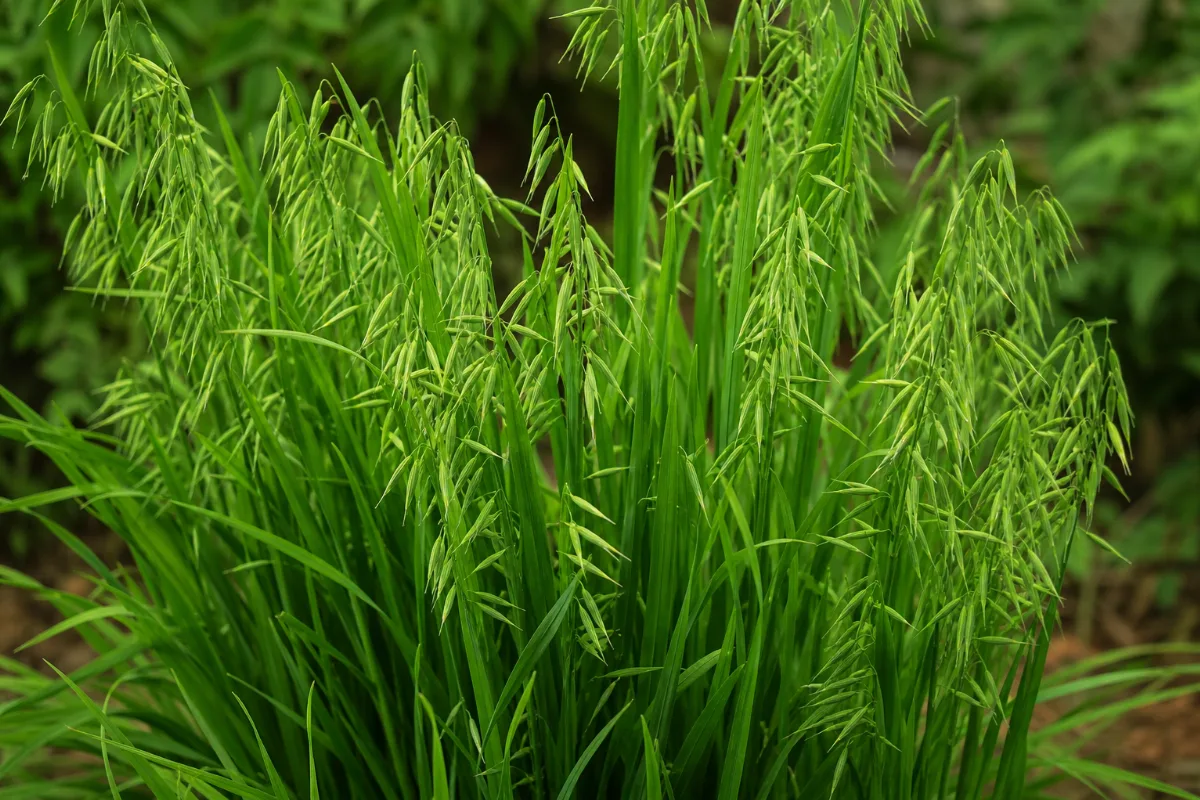
- Roots: Fibrous grass roots (not verified from a source).; Stems: Hollow jointed stems; dried green stems are sold as oat straw.; Leaves: Long narrow grass leaves.; Flowers: Loose panicle of spikelets.; Fruit: The oat grain (a caryopsis).
- Cultivation
- Grown as a grain crop; green oat extracts use the aerial parts before flowering (EMA) or the unripe "milky" seed heads.
- Harvest and processing
- Oat herb in the EU = aerial parts harvested before flowering, used chopped, as fresh juice, or as dry or liquid extracts (EMA). Milky oat tops are harvested when the unripe grain is still soft; this was not verified from a source.
- Look-alikes and adulterants
- Name: Oats (grain) and oat bran; Note: Same species, different part. Different uses (food, beta-glucan and cholesterol) and different gluten issues. See the oats page.; Name: Wild oat (Avena fatua); Note: A related wild grass sometimes found in oat fields (general knowledge, NOT verified from a source).
- Sustainability and conservation
- Not assessed here.
The plant and the parts used

Traditional use and history history, not clinical proof
| Tradition or era | Documented use | Source |
|---|---|---|
| European herbal medicine (EU regulator wording) | Oat herb for mild mental stress and to aid sleep; the EU accepts at least 30 years of use (15 in the EU) for its traditional-use status. | s-ema-avenae-herba |
| Western herbal practice (milky oat tops as a "nerve tonic") | Described in our earlier summary; NOT verified from a primary source. | s-ema-avenae-herba |
Traditional use shows how a plant was used. It does not show that a supplement works or is safe today.
What is inside, and how it may work
What the plant contains and how those compounds act in cells and animals. Laboratory and animal mechanisms are not proven effects in people.
Main compounds
| Compound | Family | Where it is concentrated | Activity studied | Level of evidence |
|---|---|---|---|---|
| Avenacoside A (triterpene saponin) PubChem 71581001 | saponin (steroidal glycoside) | Oat plant (green parts and grain; exact content not verified) | Saponins are thought to contribute to the effects of green oat extracts. The 2020 trial abstract calls them species-specific triterpene saponins. 9 17 | Laboratory research |
| Avenanthramide A PubChem 5281157 | polyphenol (phenolic amide) | Mostly oat grain; green-herb content NOT verified | Not studied in any trial read here. 17 | None |
| Flavonoids | polyphenol | Green oat extract | The 2017 trial abstract says Neuravena contains flavonoids and triterpene saponins that are potentially bioactive. 8 | Laboratory research |
| Beta-glucan | soluble fibre (polysaccharide) | Oat grain and bran; green-herb content NOT verified | Linked to cholesterol effects of oat grain; not tested in oat straw. See the oats page. 17 | None |
| Silica (orthosilicic acid) PubChem 14942 | mineral | Oat straw (traditional claim; NOT verified from a source) | Often claimed for bone, hair or nails; no source read. 17 | None |
Mechanisms, receptors and pathways
| Target or pathway | Gene or receptor | What was found | Level |
|---|---|---|---|
| Brain electrical activity | Not identified | Single doses changed EEG measures in two small trials (resting delta power down, theta power up during a concentration test; smaller N2, ERN and P3 responses). 2 10 | Human data |
| Stress response | Not identified | Four weeks of the highest amount lowered skin-sweat response to a laboratory stressor in one trial. 9 | Human data |
| Rat stress and behaviour | Not identified | Rat studies reported lower stress signs or better behaviour; EMA mentions rat studies. Lab/animal only. 15 3 | Animal research |
Absorption, metabolism and elimination
- Absorption
- No human absorption study of oat herb compounds was found.
- Distribution
- Not studied.
- Metabolism
- Not studied.
- Elimination
- Not studied.
- Bioavailability
- Not known.
Isolated compounds versus whole extracts
The trials used standardised branded extracts, not tea or plain oat straw. Whether oat straw tea or milky oat tincture works the same way is not known.
Nutritional composition
Oat straw tea contains plant compounds and minerals but no nutrient claim here is verified. The nutrition of oat grain (fibre, beta-glucan) is covered on the oats page.
2 low certainty4 very low certainty2 not enough evidence
What is Oat Straw good for?
The proposed uses and how strong the human evidence is for each. "Low" means a few small studies; "insufficient" means too little to say.
Benefits, one by one
Each card is a research question, not a promise. Tap a goal to filter. Open a card to see the studies, doses and limits.
Mild stress and sleep (traditional use)
Not enough evidenceIn the EU, oat herb is accepted for easing mild signs of mental stress and helping sleep, but only because of long use. The EU regulator says there are not enough clinical trials to prove it works.
2 studiesThe trials used different branded dry extracts of green oat herb (Neu…
Studies, doses and limits
What the trials found
The EU herbal committee (HMPC) accepted oat herb preparations (aerial parts harvested before flowering) for mild mental stress and to aid sleep in adults and adolescents over 12, on traditional-use grounds. It says clinical trial evidence is insufficient and no side effects had been reported when it assessed them.
Results
No sleep trial of oat herb was found. One trial in people cutting down smoking reported better sleep scores (see the Body tab); it was not a sleep trial.
Effect sizes as reported
Not applicable
Why this rating
Rated by long use and an agency statement, not by trials. A traditional-use status means "plausible and used safely for 30+ years", not "proven".
Form and dose studied
The trials used different branded dry extracts of green oat herb (Neuravena from Frutarom/IFF, cognitaven from Anklam). Teas, tinctures and plain dried oat straw were not tested. This page does not suggest amounts.
Who was studied
Adults and adolescents over 12 (EU wording).
Limits
No human trial of calming or sleep in people with stress or insomnia. Combination products are not covered by the EU conclusion.
Why researchers looked
People have used green oat tops and oat straw as a calming "nerve tonic" for a long time.
Traditional use
Oat straw and milky oat tops are old folk remedies for frazzled nerves and poor sleep in Western herbal tradition (our earlier summary; no historical source was read).
Proposed mechanism Animal research
Not shown in people. EMA notes lab studies in rats where oat herb lowered stress signs over about 7 weeks.
A proposed mechanism does not show that the effect happens in people.
See the Safety tab.
Thinking tests after one dose
Low certaintyIn several small trials, a single dose of a branded green oat extract made some thinking tasks faster or more accurate in healthy middle-aged and older adults. Results were patchy. A 2023 review judged the evidence average and said to be cautious.
4 studiesThe trials used different branded dry extracts of green oat herb (Neu…
Studies, doses and limits
What the trials found
Kennedy 2017 (adults 40-65 who felt their memory had slipped): the 800 mg dose sped up performance across timed tasks, cut errors on delayed word recall and made an executive task faster; working memory span rose on only one of two repeats. Berry 2011 (older adults with below-average thinking): fewer Stroop colour-naming errors at 1,600 mg but not at 2,400 mg. Martinez-Horta 2021 (20 healthy adults, 800 mg): faster reactions with no loss of accuracy. Jibril 2023 reviewed six trials (287 people): acute intake may improve accuracy and speed; caution because few trials and mixed doses.
Results
Some tasks improved after one dose; many other measures did not; the pattern is not the same from trial to trial.
Effect sizes as reported
Berry 2011: F(1,36)=18.85, p<0.001 for Stroop colour-naming errors at 1,600 mg versus placebo or 2,400 mg.
Why this rating
Several small, short, mostly maker-linked trials of branded extracts. A systematic review says caution. Benefits seen after one dose, not shown in real-life tasks.
Form and dose studied
The trials used different branded dry extracts of green oat herb (Neuravena from Frutarom/IFF, cognitaven from Anklam). Teas, tinctures and plain dried oat straw were not tested. This page does not suggest amounts.
Who was studied
Healthy adults, many with mild self-reported memory decline; older volunteers.
Limits
Small. Mostly the extract makers or their staff are involved. Many outcomes tested, few changed. Different doses between trials (one trial found an effect at a lower but not at a higher amount). Not tested in people with dementia.
Why researchers looked
Researchers wanted to test whether green oat herb could lift attention and memory.
Traditional use
Oat herb is traditionally taken for the nerves; the cognition trials are modern.
Proposed mechanism Laboratory research
Proposed: saponins and flavonoids in green oat may act on the brain. This is a guess drawn from lab work; not shown in people.
A proposed mechanism does not show that the effect happens in people.
No serious problems were reported in the abstracts. See the Safety tab.
Working memory and multitasking over four weeks
Low certaintyOne trial of 132 healthy adults found that four weeks of a green oat extract improved a working-memory test and a multitasking test. It was funded by the extract maker and mood did not change. No other trial has repeated it.
2 studiesThe trials used different branded dry extracts of green oat herb (Neu…
Studies, doses and limits
What the trials found
Kennedy 2020 (132 adults, 35-65, 29 days, branded cognitaven extract): at day 29, both the lowest and highest of three amounts beat placebo on a Corsi blocks working-memory task and a multitasking task; the middle amount is not reported as helping. No treatment-related effect on mood. The same review (Jibril 2023) says short-term chronic use helped.
Results
Two cognitive tasks improved; mood unchanged.
Effect sizes as reported
Not reported in the abstract (only "significantly improved" versus placebo).
Why this rating
One moderate-sized trial, sponsored by the extract maker, healthy people, a different product from the other trials. Not replicated.
Form and dose studied
The trials used different branded dry extracts of green oat herb (Neuravena from Frutarom/IFF, cognitaven from Anklam). Teas, tinctures and plain dried oat straw were not tested. This page does not suggest amounts.
Who was studied
Healthy adults aged 35-65.
Limits
Single trial; sponsor employees among authors (authors say the sponsor did not influence analysis). The middle amount did not clearly help. Healthy volunteers only.
Why researchers looked
To see whether benefits last if the extract is taken daily.
Traditional use
Not applicable.
Proposed mechanism Laboratory research
Not known.
A proposed mechanism does not show that the effect happens in people.
Authors report no safety concerns in the abstract that we read; this does not replace the Safety tab.
Daily use in healthy older adults (12 weeks)
Not enough evidenceA 12-week trial in 37 healthy older adults found no benefit on any thinking test. So the small gains after a single dose did not carry over to everyday use in this group.
2 studiesThe trials used different branded dry extracts of green oat herb (Neu…
Studies, doses and limits
What the trials found
Wong 2012 (37 healthy adults, average age 67, 12 weeks versus placebo in a cross-over): no difference on the Stroop test, letter cancellation, rule-shift, multitasking battery or trail-making test. The authors suggest it might be different in mild cognitive impairment, which was not tested.
Results
No effect.
Effect sizes as reported
No effect on any measure.
Why this rating
One small null trial (37 people). It shows no effect in this group, but it is too small to rule out a small one, and it used a branded extract.
Form and dose studied
The trials used different branded dry extracts of green oat herb (Neuravena from Frutarom/IFF, cognitaven from Anklam). Teas, tinctures and plain dried oat straw were not tested. This page does not suggest amounts.
Who was studied
Healthy older adults with normal thinking.
Limits
Small; one extract; healthy people only; maker-linked product (funding not stated in the abstract).
Why researchers looked
To test whether a daily oat extract helps older people keep their thinking sharp.
Traditional use
Not applicable.
Proposed mechanism None
Not applicable.
A proposed mechanism does not show that the effect happens in people.
Not applicable.
Body response to a stressful task
Very low certaintyIn the 132-person four-week trial, the highest amount of green oat extract lowered a skin-sweat response during a laboratory stress test. This is a body signal, not proof that people feel less stressed.
1 studiesThe trials used different branded dry extracts of green oat herb (Neu…
Studies, doses and limits
What the trials found
Kennedy 2020: after four weeks the highest amount lowered electrodermal activity (skin sweat) in response to a multitasking stressor. There were no treatment-related effects on mood.
Results
Lower electrodermal response at one amount; mood unchanged.
Effect sizes as reported
Not reported in the abstract.
Why this rating
One trial; a physiological marker, not a symptom; mood did not change; sponsor-funded.
Form and dose studied
The trials used different branded dry extracts of green oat herb (Neuravena from Frutarom/IFF, cognitaven from Anklam). Teas, tinctures and plain dried oat straw were not tested. This page does not suggest amounts.
Who was studied
Healthy adults.
Limits
Single trial; surrogate measure; the same product as above.
Why researchers looked
Oat herb is used traditionally for stress, so researchers tested a stress challenge.
Traditional use
Used for "frayed nerves" in folk medicine.
Proposed mechanism Laboratory research
Not known.
A proposed mechanism does not show that the effect happens in people.
See the Safety tab.
Brain-wave changes (EEG)
Very low certaintyTwo small trials found that a single dose of oat herb extract changed brain-wave readings. These show the extract does something measurable, but not that people feel or think better.
2 studiesThe trials used different branded dry extracts of green oat herb (Neu…
Studies, doses and limits
What the trials found
Dimpfel 2011: in healthy volunteers, resting delta power in the left front-temporal area fell (p<0.01) and theta power rose during a concentration test (p<0.05); arithmetic showed only a weaker trend (p=0.115); no effect on the P300 test. Martinez-Horta 2021 (20 adults, one dose): smaller N2, ERN and P3a/P3b responses and faster reactions with no loss of accuracy; the placebo group got slower and less accurate.
Results
Brain-wave measures shifted; link to everyday benefit not shown.
Effect sizes as reported
Dimpfel: p<0.01 and p<0.05 for the main changes.
Why this rating
Tiny, short trials of a surrogate measure by maker-linked teams.
Form and dose studied
The trials used different branded dry extracts of green oat herb (Neuravena from Frutarom/IFF, cognitaven from Anklam). Teas, tinctures and plain dried oat straw were not tested. This page does not suggest amounts.
Who was studied
Healthy adults.
Limits
EEG changes do not equal benefit; very small samples.
Why researchers looked
To look for a brain-level effect that could explain the results of thinking tests.
Traditional use
Not applicable.
Proposed mechanism Human data
Plausible, not proven: shifts in brain wave activity.
A proposed mechanism does not show that the effect happens in people.
Not applicable.
Cutting down on cigarettes
Very low certaintyIn one 8-week trial of 145 people, more people on a branded green oat extract cut their cigarettes by more than a fifth than on placebo. The trial was run for the extract maker, and this is the only trial of this use.
1 studiesThe trials used different branded dry extracts of green oat herb (Neu…
Studies, doses and limits
What the trials found
Friling 2024 (72 extract, 73 placebo, 8 weeks plus 4-week follow-up, NCT04749017): 66.7% on the extract versus 49.3% on placebo reduced daily cigarettes by more than 20% (p=0.034).
Results
More "reducers" on the extract.
Effect sizes as reported
66.7% vs 49.3% reducers (p=0.034).
Why this rating
One trial run for the extract maker; measured by reduction, not quitting; the abstract does not give craving or nicotine-dependence results.
Form and dose studied
The trials used different branded dry extracts of green oat herb (Neuravena from Frutarom/IFF, cognitaven from Anklam). Teas, tinctures and plain dried oat straw were not tested. This page does not suggest amounts.
Who was studied
Adults reducing or stopping smoking.
Limits
Single trial; industry-linked; not a quit-smoking trial; short.
Why researchers looked
Stress and cravings make quitting hard, so researchers tested whether the extract helps.
Traditional use
Not applicable.
Proposed mechanism Laboratory research
Not known.
A proposed mechanism does not show that the effect happens in people.
Described as safe and well tolerated in the abstract.
Quality of life, stress and sleep while cutting down smoking
Very low certaintyIn the same trial, people on the extract reported better quality of life, a bigger drop in perceived stress and better sleep scores than people on placebo. Gains in quality of life lasted four weeks after stopping.
1 studiesThe trials used different branded dry extracts of green oat herb (Neu…
Studies, doses and limits
What the trials found
Friling 2024: greater improvement in WHOQOL-BREF, SF-36 and a visual quality-of-life scale; perceived stress fell more; sleep scores improved on the extract and worsened on placebo.
Results
Better self-reported wellbeing than placebo.
Effect sizes as reported
Not reported in the abstract (only "greater improvements").
Why this rating
One trial; self-reported scales; industry-linked; results for depression and anxiety are not given in the abstract.
Form and dose studied
The trials used different branded dry extracts of green oat herb (Neuravena from Frutarom/IFF, cognitaven from Anklam). Teas, tinctures and plain dried oat straw were not tested. This page does not suggest amounts.
Who was studied
Adults reducing or stopping smoking.
Limits
Single trial; self-report; not a sleep or anxiety study.
Why researchers looked
To see if the extract eases the mood and sleep dip that can come with smoking less.
Traditional use
Not applicable.
Proposed mechanism Laboratory research
Not known.
A proposed mechanism does not show that the effect happens in people.
Described as safe and well tolerated in the abstract.
Connections to the rest of health
How Oat Straw connects to the rest of our health knowledge graph. Every link says what kind of connection it is. A safety link (for example to the liver) is a warning, not a benefit. A study that merely mentions a topic never creates a benefit link.
Explore every connection: goals, body systems, organs, symptoms, genes
A. Wellness goals
| Connected to | Kind of connection | Evidence status | Context | Studies |
|---|---|---|---|---|
| Stress Reduction | Traditional use | Not enough evidence | Mild stress and sleep (traditional use): In the EU, oat herb is accepted for easing mild signs of mental stress and helping sleep, but only because of long use. The EU regulator says there are not enough clinical trials to prove it works. | 3 15 |
| Calm Relaxation | Traditional use | Not enough evidence | Mild stress and sleep (traditional use): In the EU, oat herb is accepted for easing mild signs of mental stress and helping sleep, but only because of long use. The EU regulator says there are not enough clinical trials to prove it works. | 3 15 |
| Better Sleep | Traditional use | Not enough evidence | Mild stress and sleep (traditional use): In the EU, oat herb is accepted for easing mild signs of mental stress and helping sleep, but only because of long use. The EU regulator says there are not enough clinical trials to prove it works. | 3 15 |
| Cognitive Performance | Potential benefit | Low certainty | Thinking tests after one dose: In several small trials, a single dose of a branded green oat extract made some thinking tasks faster or more accurate in healthy middle-aged and older adults. Results were patchy. A 2023 review judged the evidence average and said to be cautious. Working memory and multitasking over four weeks: One trial of 132 healthy adults found that four weeks of a green oat extract improved a working-memory test and a multitasking test. It was funded by the extract maker and mood did not change. No other trial has repeated it. | 8 1 10 7 9 |
| Memory Support | Potential benefit | Low certainty | Thinking tests after one dose: In several small trials, a single dose of a branded green oat extract made some thinking tasks faster or more accurate in healthy middle-aged and older adults. Results were patchy. A 2023 review judged the evidence average and said to be cautious. Working memory and multitasking over four weeks: One trial of 132 healthy adults found that four weeks of a green oat extract improved a working-memory test and a multitasking test. It was funded by the extract maker and mood did not change. No other trial has repeated it. | 8 1 10 7 9 |
| Cognitive Performance | Not enough evidence | Daily use in healthy older adults (12 weeks): A 12-week trial in 37 healthy older adults found no benefit on any thinking test. So the small gains after a single dose did not carry over to everyday use in this group. | 21 7 | |
| Stress Reduction | Potential benefit | Very low certainty | Body response to a stressful task: In the 132-person four-week trial, the highest amount of green oat extract lowered a skin-sweat response during a laboratory stress test. This is a body signal, not proof that people feel less stressed. Cutting down on cigarettes: In one 8-week trial of 145 people, more people on a branded green oat extract cut their cigarettes by more than a fifth than on placebo. The trial was run for the extract maker, and this is the only trial of this use. | 9 4 |
| Cognitive Performance | Very low certainty | Brain-wave changes (EEG): Two small trials found that a single dose of oat herb extract changed brain-wave readings. These show the extract does something measurable, but not that people feel or think better. | 2 10 | |
| Better Sleep | Potential benefit | Very low certainty | Quality of life, stress and sleep while cutting down smoking: In the same trial, people on the extract reported better quality of life, a bigger drop in perceived stress and better sleep scores than people on placebo. Gains in quality of life lasted four weeks after stopping. | 4 |
B. Body systems
| Connected to | Kind of connection | Evidence status | Context | Studies |
|---|---|---|---|---|
| Stress Mood | Biological association | Not enough evidence | Studied for: Mild stress and sleep (traditional use) Studied for: Body response to a stressful task | 3 15 9 4 |
| Sleep Recovery | Biological association | Not enough evidence | Studied for: Mild stress and sleep (traditional use) Studied for: Quality of life, stress and sleep while cutting down smoking | 3 15 4 |
| Nervous System | Biological association | Not enough evidence | Studied for: Mild stress and sleep (traditional use) Studied for: Thinking tests after one dose | 3 15 8 1 10 7 2 |
| Brain Focus | Biological association | Low certainty | Studied for: Thinking tests after one dose Studied for: Working memory and multitasking over four weeks | 8 1 10 7 9 21 2 |
E. Health conditions
| Connected to | Kind of connection | Evidence status | Context | Studies |
|---|---|---|---|---|
| Celiac disease | Review | Most with celiac disease tolerate uncontaminated oats; many gluten-free oat products are still over limits in a survey. Most people with celiac disease tolerate uncontaminated oats, but many gluten-free oat products tested above limits. Preparation or compound: Oat products (gluten cross-contact) |
19 18 | |
| Oat allergy | Adverse effect or risk | Case report | Case reports of anaphylaxis after oats; none for oat straw found. Preparation or compound: Oat food |
20 6 16 |
I. Biomarkers
| Connected to | Kind of connection | Evidence status | Context | Studies |
|---|---|---|---|---|
| Skin sweat response (electrodermal activity) | Biological association | Very low certainty | Measured in trials: lowered. A lab change is not the same as a health benefit. | 9 |
| Stroop colour-naming errors | Biological association | Low certainty | Measured in trials: lowered. A lab change is not the same as a health benefit. | 1 |
| Working memory (Corsi blocks) | Biological association | Low certainty | Measured in trials: raised. A lab change is not the same as a health benefit. | 9 8 |
| EEG brain-wave power (theta, delta) | Biological association | Very low certainty | Measured in trials: mixed. A lab change is not the same as a health benefit. | 2 10 |
| Mood scores | Biological association | Low certainty | Measured in trials: unchanged. A lab change is not the same as a health benefit. | 9 |
| Cigarettes per day (share of people cutting by over 20%) | Biological association | Very low certainty | Measured in trials: lowered. A lab change is not the same as a health benefit. | 4 |
| Quality-of-life scores (WHOQOL-BREF, SF-36) | Biological association | Very low certainty | Measured in trials: raised. A lab change is not the same as a health benefit. | 4 |
| Perceived stress and sleep scores | Biological association | Very low certainty | Measured in trials: improved. A lab change is not the same as a health benefit. | 4 |
| Resting blood pressure | Biological association | Low certainty | Measured in trials: unchanged. A lab change is not the same as a health benefit. | 1 |
K. Biological pathways
L. Active compounds
| Connected to | Kind of connection | Evidence status | Context | Studies |
|---|---|---|---|---|
| Avenacoside A (triterpene saponin) | Biological association | In vitro | Saponins are thought to contribute to the effects of green oat extracts. The 2020 trial abstract calls them species-specific triterpene saponins. Preparation or compound: Oat plant (green parts and grain; exact content not verified) |
9 17 |
| Avenanthramide A | Biological association | None | Not studied in any trial read here. Preparation or compound: Mostly oat grain; green-herb content NOT verified |
17 |
| Flavonoids | Biological association | In vitro | The 2017 trial abstract says Neuravena contains flavonoids and triterpene saponins that are potentially bioactive. Preparation or compound: Green oat extract |
8 |
| Beta-glucan | Biological association | None | Linked to cholesterol effects of oat grain; not tested in oat straw. See the oats page. Preparation or compound: Oat grain and bran; green-herb content NOT verified |
17 |
| Silica (orthosilicic acid) | Biological association | None | Often claimed for bone, hair or nails; no source read. Preparation or compound: Oat straw (traditional claim; NOT verified from a source) |
17 |
Each connection is stored with the ingredient, the connected record, the kind of connection, the evidence status, the supporting studies, the preparation or compound involved, and a review date (last reviewed October 25, 2026).
Evidence at a glance: what changed in 6 lab markers
Tap a number to show only those markers. Counts are markers, not people.
The evidence
The research centre for Oat Straw. Every record here was checked against PubMed or the publisher's page; we never list a study we have not verified.
Evidence by outcome
Bars show how many studies we found for each outcome, not how well it works. People are added up across trials only (reviews are not added, to avoid double counting).
How we rate evidence
High certainty
Several well-run trials or reviews agree; further research is unlikely to change the picture much.
Moderate certainty
Good trials point the same way, but some doubt remains.
Low certainty
Small, short or inconsistent trials. The finding could change with better research.
Very low certainty
Very little or very weak human data. Treat as a possibility only.
Mixed findings
Trials or reviews disagree with each other.
Not enough evidence
Not enough human research to say either way.
Evidence against
Good research found no benefit, or found harm.
We take the reviewers' own risk-of-bias and GRADE statements where they exist, and otherwise judge from study size, design, consistency, directness and whether a product matches what is sold. Many publications do not make evidence high. Method note: We started from our earlier evidence summary for oat straw, read the EMA public page and read PubMed abstracts for the studies cited (allergy case reports were cited by title only because PubMed has no abstract). Plant names were checked in GBIF and NCBI Taxonomy and compounds in PubChem. Not read: the EU monograph PDF, NCCIH, FDA, WHO, LiverTox and LactMed pages (a title search found no chapter). NHS and NIDDK celiac pages come from our earlier summary. Certainty ratings are the compiler's reading.
Study library: every study we checked 21
| Study | Design | People | Product, dose, length | Result |
|---|---|---|---|---|
| Berry 2011 Acute effects of an Avena sativa herb extract on responses to the Stroop Color-Word test. Journal of Alternative and Complementary Medicine · PMID 21711204 · DOI |
Controlled trial |
Older volunteers with below-average cognitive performance (about 37 in the stats) | Oat herb extract (Neuravena) Oat herb Single doses of 0, 1,600 and 2,400 mg a week apart. Trial amount only; not a recommendation. Single doses at weekly intervals · vs Placebo and other amount (cross-over) |
Fewer colour-naming errors after the 1,600 mg dose than after placebo or 2,400 mg (F(1,36)=18.85, p<0.001). In 7 people with suspected impairment, Stroop interference also improved. Resting blood pressure was unaffected. Fewer Stroop errors at one amount only Methods, limits and fundingOutcomes: Stroop colour-word errors, resting blood pressure Limitations: Only the abstract was read. The higher amount did not help, so the pattern is odd. Very small subgroup of 7. Group size is inferred from the statistics, not stated. Funding and conflicts: Funding not stated in the abstract. Neuravena is a branded product. Read: abstract |
| Dimpfel 2011 Ingested oat herb extract (Avena sativa) changes EEG spectral frequencies in healthy subjects. Journal of Alternative and Complementary Medicine · PMID 21563962 · DOI |
Controlled trial |
Healthy volunteers (number not in the abstract) | Oat herb extract (Neuravena) Oat herb (Avenae herba) Two amounts, 1,250 mg and 2,500 mg, in the trial. Trial amount only; not a recommendation. Single dose, EEG during rest and mental tasks · vs Placebo (cross-over) |
Resting delta power fell (p < 0.01) and theta power rose during the concentration test (p < 0.05) in the left frontotemporal area. Arithmetic showed a theta rise only at a weaker level (p = 0.115). No effect on the P300 test. Brain-wave changes only Methods, limits and fundingOutcomes: EEG brain-wave power during rest, a concentration test and mental arithmetic Limitations: Only the abstract was read. EEG changes are a surrogate; no thinking-test benefit shown in this paper. Funding and conflicts: Funding not stated in the abstract. Neuravena is a branded product. Read: abstract |
| European Medicines Agency 2026 Avenae herba - herbal medicinal product (public page) European Medicines Agency · Source |
Regulatory or database not applicable |
Oat herb = aerial parts of Avena sativa L. harvested before flowering. HMPC concluded, on traditional use only, that oat herb preparations can relieve mild symptoms of mental stress and aid sleep in adults and adolescents over 12. Not backed by enough clinical trials. HMPC noted rat studies. No side effects had been reported at the time of assessment. The monograph PDF with its precautions was not read. EMA lists the herbal-monograph status as under periodic review (call for data). Methods, limits and fundingLimitations: See notes. Read: public page read 2026-10-25 | ||
| Friling 2024 Dietary supplementation with a wild green oat extract (Avena sativa L.) to improve wellness and wellbeing during smoking reduction or cessation: a randomized double-blind controlled study. Frontiers in Nutrition · PMID 38962436 · DOI |
Controlled trial |
145 Adults reducing or stopping smoking (72 extract, 73 placebo) |
Wild green oat extract (Neuravena), a branded extract Green oat herb (aerial parts) 900 mg a day in the trial. Trial amount only; not a recommendation. 8 weeks plus a 4-week follow-up · vs Placebo |
The extract group had greater improvement in quality-of-life scores and a bigger fall in perceived stress; sleep scores improved in the extract group and worsened on placebo. More people cut daily cigarettes by over 20% (66.7% vs 49.3%, p = 0.034). Quality-of-life gains lasted 4 weeks after stopping. The authors call it safe and well tolerated. 66.7% vs 49.3% reduced cigarettes by more than 20% (p = 0.034) Methods, limits and fundingOutcomes: Quality of life, perceived stress, sleep, nicotine dependence, craving, cigarettes per day Limitations: Only the abstract was read. Self-reported scales; results for depression, anxiety, craving and nicotine dependence are not given in the abstract. Not a sleep study or a quit-smoking trial. Funding and conflicts: Several authors are employees of IFF Health, which sells Neuravena; the university team was hired by IFF Health to run the study. Registration: NCT04749017 Read: abstract |
| GBIF 2026 GBIF species match: Avena sativa L. GBIF · Source |
Regulatory or database not applicable |
GBIF usageKey 2705290: Avena sativa L., ACCEPTED, species, family Poaceae, order Poales, exact match, confidence 100. Methods, limits and fundingLimitations: See notes. Read: API read 2026-10-25 | ||
| Goh 2023 Oat milk anaphylaxis: Oat an emerging food allergen. Journal of the European Academy of Dermatology and Venereology · PMID 37471498 · DOI |
Case report |
Not stated (title only) | Oat milk Oat grain |
Title only was read: reports anaphylaxis after oat milk and calls oat an emerging food allergen. Case report Methods, limits and fundingOutcomes: Anaphylaxis after oat milk Limitations: No abstract was available in PubMed; only the title was read. Read: title only |
| Jibril 2023 Effect of Avena sativa (Oats) on cognitive function: A systematic review of randomized controlled trials. Clinical Nutrition ESPEN · PMID 36657906 · DOI |
Systematic review |
287 Healthy adults, 6 randomised trials (3 cross-over) |
Avena sativa extracts (oat extracts) Mainly green oat herb extracts (the abstract says "oat extracts") Doses varied between trials Acute (4 trials) and chronic (2 trials) · vs Placebo |
Acute intake appeared to improve accuracy and speed. Short-term chronic supplementation improved cognition; long-term chronic supplementation did not. Evidence quality "average". Acute benefit possible; long-term benefit not shown Methods, limits and fundingOutcomes: Accuracy and speed of cognitive performance Limitations: Only the abstract was read. Few trials, mixed doses; the authors ask for caution. Not independent of the individual trials above. Funding and conflicts: Authors declare no competing interests. Read: abstract |
| Kennedy 2017 Acute effects of a wild green-oat (Avena sativa) extract on cognitive function in middle-aged adults: A double-blind, placebo-controlled, within-subjects trial. Nutritional Neuroscience · PMID 26618715 · DOI |
Controlled trial |
Healthy adults aged 40-65 who felt their memory had declined with age (number not stated in the abstract) | Wild green-oat extract (Neuravena), a branded extract Green oat herb (aerial parts) Single doses of 800 mg and 1,600 mg in the trial. Trial amount only; not a recommendation. Six visits, each a single dose; testing up to 6 hours after · vs Placebo (cross-over) |
The 800 mg dose increased speed of performance across timed tasks, improved delayed word recall errors and made an executive task (Peg and Ball) faster. Working memory span (Corsi blocks) rose only on the second time that dose was taken. Faster performance on some tasks after one dose Methods, limits and fundingOutcomes: Attention, spatial, working and episodic memory, executive function Limitations: Only the abstract was read. Sample size not in the abstract. Several outcomes tested; only some changed, and one change appeared on only one of two repeats. Single doses only. Funding and conflicts: Two authors are from Frutarom Switzerland, the extract maker (affiliation in the abstract). No funding statement in the abstract. Read: abstract |
| Kennedy 2020 Acute and Chronic Effects of Green Oat (Avena sativa) Extract on Cognitive Function and Mood during a Laboratory Stressor in Healthy Adults: A Randomised, Double-Blind, Placebo-Controlled Study in Healthy Humans. Nutrients · PMID 32485993 · DOI |
Controlled trial |
132 Healthy men and women aged 35-65 |
Green oat extract (cognitaven), a branded extract made by Anklam Extrakt Green oat herb (aerial parts) Three amounts tested (430, 860, 1,290 mg a day). Trial amount only; not a recommendation. 29 days, with tests on day 1 and day 29 · vs Placebo (parallel groups) |
A single dose of 1,290 mg, and more so four weeks of 430 mg or 1,290 mg, improved a working-memory task (Corsi blocks) and a multitasking task compared with placebo. After four weeks the highest amount lowered the skin-sweat (electrodermal) response to the stressor. No treatment-related effects on mood. Better scores on 2 tasks; lower electrodermal response at the top amount; no mood effect Methods, limits and fundingOutcomes: Cognition, mood, and body response to a laboratory multitasking stressor Limitations: Only the abstract was read. Healthy volunteers; short; the middle amount (860 mg) is not reported as helping. Product differs from the Neuravena extract in the other trials. Funding and conflicts: Sponsored by Anklam Extrakt GmbH, whose employees are authors; the authors state the sponsor had no input into data collection, analysis or interpretation. Read: abstract |
| Martinez-Horta 2021 Effects of a Green Oat Herb Extract on Cognitive Performance and Neurophysiological Activity: A Randomized Double-Blind Placebo-Controlled Study. Frontiers in Neuroscience · PMID 34658781 · DOI |
Controlled trial |
20 Healthy adults |
Green oat herb extract (Neuravena) Green oat herb (aerial parts) 800 mg once in the trial. Trial amount only; not a recommendation. Single dose, EEG during tasks · vs Placebo |
After the extract, the N2, ERN and P3a/P3b brain responses were smaller and reactions faster with no loss of accuracy. In the placebo group reaction time and accuracy got worse. The authors say it may protect against tiredness effects. Faster reactions; smaller ERP responses after one dose Methods, limits and fundingOutcomes: Reaction time, accuracy and brain-wave (ERP) measures during attention tasks Limitations: Only the abstract was read. 20 people; one dose; EEG changes are not the same as a real-life benefit. Funding and conflicts: Authors include employees of Frutarom, the extract maker. Read: abstract |
| NCBI Bookshelf 2026 LiverTox and LactMed search for oat / oat straw NCBI Bookshelf · Source |
Regulatory or database not applicable |
A Bookshelf search for oat or Avena in LiverTox and LactMed titles found no chapter. This is a search, not a full read of every page; absence is not proof of safety. Methods, limits and fundingLimitations: See notes. Read: search run 2026-10-25 | ||
| NCBI Taxonomy 2026 NCBI Taxonomy: Avena sativa NCBI Taxonomy · Source |
Regulatory or database not applicable |
NCBI Taxonomy id 4498 returned for the search "Avena sativa". Methods, limits and fundingLimitations: See notes. Read: API read 2026-10-25 | ||
| NHS (UK) 2026 Coeliac disease NHS (UK) · Source |
Regulatory or database not applicable |
Standard UK guidance on the gluten-free diet in coeliac disease. Used only as a general pointer. Methods, limits and fundingLimitations: See notes. Read: summary-only (read in our earlier oat-straw summary; not re-opened) | ||
| NIDDK (NIH) 2026 Eating, diet and nutrition for celiac disease NIDDK (NIH) · Source |
Regulatory or database not applicable |
Our earlier summary recorded that oats can be cross-contaminated with gluten grains and that a few people with coeliac disease react even to pure oats; people should ask a clinician and choose gluten-free labelled oat products. Not re-opened this time. Methods, limits and fundingLimitations: See notes. Read: summary-only (read in our earlier oat-straw summary; not re-opened) | ||
| Phytotherapy Research 2009 An extract from wild green oat improves rat behaviour. Phytotherapy Research · PMID 19322760 |
Animal research animal |
Rats | Wild green oat extract Green oat herb |
Title only was read: the paper reports improved rat behaviour. Animal only Methods, limits and fundingOutcomes: Rat behaviour Limitations: Only the title was read. Animal study; no conclusion drawn for people. Read: title only |
| Prados-Castano 2016 Anaphylaxis Due to Oat Ingestion. Journal of Investigational Allergology and Clinical Immunology · PMID 27012025 |
Case report |
Not stated (title only) | Oat (food) Oat grain |
Title only was read: anaphylaxis after eating oats. Case report Methods, limits and fundingOutcomes: Anaphylaxis after eating oats Limitations: No abstract was available in PubMed; only the title was read. Read: title only |
| PubChem 2026 PubChem compound records: avenanthramide A, avenacoside A, orthosilicic acid, beta-glucan PubChem · Source |
Regulatory or database not applicable |
CIDs confirmed by name lookup: avenanthramide A 5281157; avenacoside A 71581001; orthosilicic acid 14942; "Beta-Glucan" 439262 is only a small representative piece of a long polymer, so no CID is shown for it. Methods, limits and fundingLimitations: See notes. Read: API read 2026-10-25 | ||
| Rodriguez 2022 Commercial oats in gluten-free diet: A persistent risk for celiac patients. Frontiers in Nutrition · PMID 36276819 · DOI |
Cross sectional not applicable |
52 25 gluten-free labelled and 27 regular oat products sold in Chile |
Oat flours, rolled oats and instant oat cereals (oat grain products) Oat grain products n/a Product survey · vs Regular oat products |
Gluten was above the local limit in 40% and above the Codex limit in 36% of gluten-free labelled oat products. Labelled and unlabelled products did not differ among the positive ones. Flours were more contaminated than rolled or instant oats. 36-40% of gluten-free labelled oat products over the limit Methods, limits and fundingOutcomes: Gluten content against 5 ppm (Chile) and 20 ppm (Codex) limits Limitations: Only the abstract was read. One country, a small market; grain products, not oat straw. Findings may differ elsewhere. Funding and conflicts: Authors state no commercial or financial relationships. Read: abstract |
| Thies 2014 Oats and bowel disease: a systematic literature review. British Journal of Nutrition · PMID 25267242 · DOI |
Systematic review |
29 studies of oats or oat bran (including 11 in adults with coeliac disease) | Oats and oat bran (the food grain, not the green herb) Whole oat grain and bran Varied Varied · vs Controls or other cereals |
Most of the 11 coeliac studies showed no harm from uncontaminated oats. Oats or oat bran increased stool weight and eased constipation in healthy volunteers. The authors say most people with coeliac disease could eat up to 100 g a day of uncontaminated oats. Uncontaminated oats tolerated by most with coeliac disease Methods, limits and fundingOutcomes: Bowel disease risk markers, stool weight, coeliac outcomes Limitations: Only the abstract was read. About oat grain and bran, not oat straw. The word "uncontaminated" is the key condition. Funding and conflicts: Not stated in the abstract. Read: abstract |
| Tomas-Perez 2020 Oat Allergy: Report on 2 Cases. Journal of Investigational Allergology and Clinical Immunology · PMID 31932273 · DOI |
Case report |
2 Two people with oat allergy |
Oat (food) Oat grain |
Title only was read: two reported cases of oat allergy. Two cases Methods, limits and fundingOutcomes: Allergic reaction to oats Limitations: No abstract was available in PubMed; only the title was read. No details of symptoms are claimed. Read: title only |
| Wong 2012 Chronic effects of a wild green oat extract supplementation on cognitive performance in older adults: a randomised, double-blind, placebo-controlled, crossover trial. Nutrients · PMID 22690320 · DOI |
Controlled trial |
37 Healthy older adults, average age 67 |
Wild green oat extract (Neuravena ELFA 955, Frutarom, Switzerland) Green oat herb (aerial parts) 1,500 mg a day in the trial. Trial amount only; not a recommendation. 12 weeks per phase, cross-over · vs Placebo (cross-over) |
Twelve weeks of the extract did not affect any measure of cognition. No effect on any cognitive measure Methods, limits and fundingOutcomes: Stroop test, letter cancellation, rule-shift, multitasking battery, trail-making Limitations: Only the abstract was read. Small trial of people with normal thinking; the authors suggest effects might show in mild cognitive impairment, which was not tested. Funding and conflicts: Funding not stated in the abstract. The tested product is the maker Frutarom's branded extract. Read: abstract |
What we do not know yet
- No trial of oat straw tea or milky oat tincture.
- No trial in people with anxiety, insomnia or diagnosed cognitive impairment.
- No independent (non-industry) replication of the thinking-test results.
- No data on drug interactions, pregnancy or breastfeeding.
- No gluten testing of oat straw products found.
How new research is added
New studies are found by a saved PubMed search and placed in a review queue. A person reads each one before it changes any rating or safety wording.
Lab markers
What changed in blood or saliva tests during trials. A changed number is not the same as feeling or being healthier, and we give no "normal ranges".
Other 9
Skin sweat response (electrodermal activity)
Lowered in trials
A measure of how much the skin sweats, which rises under stress.
Very low certaintyResults and what it means
Why it was measured
A body marker of the stress reaction.
Statistical vs. clinical meaning
A body signal, not a symptom.
Safety implication
Not applicable.
| Study | Result | People | Product |
|---|---|---|---|
| 9 | After four weeks the highest amount lowered the response to a laboratory stressor. | 132 healthy adults | Cognitaven green oat extract, 29 days |
Stroop colour-naming errors
Lowered in trials
A thinking test of attention: naming ink colours while words say other colours.
Low certaintyResults and what it means
Why it was measured
A quick test of attention and focus.
Statistical vs. clinical meaning
A lab test, not daily life.
Safety implication
Not applicable.
| Study | Result | People | Product |
|---|---|---|---|
| 1 | Fewer errors at the 1,600 mg dose than at placebo or 2,400 mg (p<0.001). | Older volunteers with below-average thinking | Neuravena single doses |
Working memory (Corsi blocks)
Raised in trials
A computer test of remembering and repeating sequences of locations.
Low certaintyResults and what it means
Why it was measured
Working memory is the "mental notepad" we use for tasks.
Statistical vs. clinical meaning
A lab test; results were inconsistent.
Safety implication
Not applicable.
EEG brain-wave power (theta, delta)
Mixed results in trials
Electrical brain activity recorded from the scalp.
Very low certaintyResults and what it means
Why it was measured
A brain-level signal of a change in how the brain works during tasks.
Statistical vs. clinical meaning
Surrogate measure.
Safety implication
Not applicable.
Mood scores
Unchanged in trials
Questionnaires on how people feel.
Low certaintyCigarettes per day (share of people cutting by over 20%)
Lowered in trials
Number of cigarettes smoked daily.
Very low certaintyResults and what it means
Why it was measured
A direct measure of smoking reduction.
Statistical vs. clinical meaning
Self-reported; one trial.
Safety implication
Not applicable.
| Study | Result | People | Product |
|---|---|---|---|
| 4 | 66.7% on the extract vs 49.3% on placebo cut by more than 20% (p=0.034). | 145 adults reducing smoking | Neuravena green oat extract, 8 weeks |
Quality-of-life scores (WHOQOL-BREF, SF-36)
Raised in trials
Questionnaires on overall wellbeing.
Very low certaintyResults and what it means
Perceived stress and sleep scores
Improved in trials
Questionnaires on how stressed and how well rested people feel.
Very low certaintyResults and what it means
Why it was measured
Self-reported stress and sleep.
Statistical vs. clinical meaning
Self-reported; one trial.
Safety implication
Not applicable.
| Study | Result | People | Product |
|---|---|---|---|
| 4 | Perceived stress fell more on the extract; sleep scores improved on the extract and worsened on placebo. | 145 adults reducing smoking | Neuravena green oat extract, 8 weeks |
Resting blood pressure
Unchanged in trials
Blood pressure measured at rest.
Low certaintyResults and what it means
Why it was measured
A basic safety check in the Stroop trial.
Statistical vs. clinical meaning
Single-dose only; no long-term data.
Safety implication
No change after single doses; no long-term data.
| Study | Result | People | Product |
|---|---|---|---|
| 1 | Resting blood pressure was unaffected by single doses. | Older volunteers | Neuravena single doses |
Safety
What studies and official sources say about side effects, medicines and who should check first. Each point shows what kind of evidence it comes from.
Main points to know 5
- Celiac disease and gluten. Oat straw is a different plant part from oat grain, and we found no gluten test of oat straw products. Oats themselves have no wheat gluten, but oat crops and mills are often shared with wheat, barley and rye. A small number of people with celiac disease also react to the oat protein itself. If you have celiac disease, ask your doctor or dietitian first, and look for a product labelled gluten-free. Review 19 18 13 14
- Oat allergy. Oat allergy exists, including severe reactions (anaphylaxis) in published case reports of oat food. We found no report about oat straw. Anyone who has had a reaction to oats should not use oat herb products without medical advice. Case report 20 6 16
- Very little safety testing. The EU regulator said no side effects had been reported when it reviewed oat herb. The branded-extract trials we read reported no serious problems in their abstracts. But trials were small and short (single doses to 12 weeks), and most were funded by makers, so rare or long-term problems are not ruled out. Authoritative guidance 3 4 21
- Not for young children, and unclear in pregnancy. The EU conclusion covers adults and adolescents over 12 only. We could not find good data on pregnancy or breastfeeding. Ask your midwife, doctor or pharmacist first. Authoritative guidance 3 11
- Medicines taken by mouth. Oat fibre is bulky and acts in the gut. A fibre-rich product could in theory change how fast some medicines are absorbed. We found no study of oat straw doing this, so this is a theory, not a finding. Ask your pharmacist how to space it from your medicines. Not verified 19
Side effects 4
| Effect | How often | Severity and recovery | Evidence |
|---|---|---|---|
| No side effects reported in the EU assessment EMA says none had been reported at the time. Absence of reports is not proof of safety. The full monograph was not read. | Not established | not applicable not applicable | Authoritative guidance 3 |
| Stomach or bowel upset Oat grain and bran increase stool weight and ease constipation in healthy people. No bowel side-effect data were found for oat straw or green oat extracts in the abstracts read. | Not established | mild expected, not measured not applicable | Not verified 19 |
| Allergic reaction to oats Based on titles of reports about oat grain or oat milk; not about oat straw. | Not established | can be serious (anaphylaxis in case reports of oat food) Not stated | Case report 20 6 16 |
| Gluten reaction in celiac disease From gluten cross-contact in oat grain products; no oat straw gluten testing found. | Not established | varies Not stated | Review 19 18 |
Liver
No case of liver injury linked to oat herb was found. A search of the NIH LiverTox and LactMed titles for oat or Avena found no chapter. That is a search result, not proof of liver safety. 11
How often. No frequency can be given.
Monitoring. No agency monitoring advice for the liver was found. Seek care for yellow skin or eyes, dark urine or pale stools.
This is a safety connection. It is not evidence that Oat Straw supports liver health.
Medicines and supplements 3
| With | Why it matters | Importance | Evidence | What to do |
|---|---|---|---|---|
| Medicines taken by mouth (general) prescription | Fibre can bind or slow the absorption of some drugs. This is a general property of fibre-rich foods, not tested for oat straw. | Unknown. No study of oat straw or green oat extract with any drug was found. | Not verified Not enough evidence 19 | Ask a pharmacist if you take medicines with narrow safety margins (for example thyroid, blood thinners, seizure or heart medicines) and want to use a fibre-rich oat product. |
| Sedatives, sleep medicines and alcohol prescription | Oat herb is traditionally used for calming and sleep, so it could in theory add to drowsiness. | Theory only. Trials reported no such effect in their abstracts. | Pharmacological theory Not enough evidence 3 | Take care if you also use sedatives; ask your doctor or pharmacist. |
| Other calming herbs (valerian, passionflower, lemon balm) herb | Overlapping traditional use. | Not studied. Some products are combinations, which the EU conclusion does not cover. | Not verified Not enough evidence 3 | Check labels for combination products and ask your pharmacist. |
Who should check first 5
| Situation | Advice | Evidence |
|---|---|---|
| Known allergy to oats | Avoid oat herb products unless an allergy specialist approves. | Case report 20 6 16 |
| Celiac disease or non-celiac gluten sensitivity | Ask your doctor or dietitian first. Choose products with a gluten-free label, and be aware gluten-free oat products can still test above limits. | Review 19 18 13 14 |
| Pregnancy and breastfeeding | Not enough data to say it is safe. Ask a midwife, doctor or pharmacist before using oat herb products. | Authoritative guidance 3 11 |
| Children under 12 | Not covered by the EU traditional-use conclusion. Ask a doctor first. | Authoritative guidance 3 |
| Taking medicines with narrow safety margins | Ask a pharmacist before using a fibre-rich oat product. This is a precaution, not a proven interaction. | Not verified 19 |
Overdose, product quality and regulators
Summary. No toxic plant part or poisoning is known for oat herb in the sources read. The main concerns are allergy and gluten cross-contact, not poisoning.
Animal. Only rat behaviour and stress studies were seen (EMA mentions rat studies; PubMed has a rat behaviour paper). No animal toxicity study was read.
Human doses studied. Trials used branded extracts from single doses to 12 weeks. These amounts are not recommendations.
High dose or long term signals. None found. Long-term safety in people has not been studied.
Overdose response. Not studied.
Genotoxicity. Not tested in the sources read.
Toxic plant parts. None known. The plant parts used are the green stems, leaves and unripe seed heads; EMA defines oat herb as aerial parts harvested before flowering. Other parts: not applicable.
The documented contamination issue is gluten from other grains in oat products. Pesticide, heavy metal and fungus contamination of oat straw or green oat products was not looked up.
Gluten in gluten-free labelled oat products. In a Chilean market survey, 36-40% of gluten-free labelled oat flours, rolled and instant oat products were above the gluten limits (20 ppm Codex; 5 ppm local). Not oat straw. 18
Uncontaminated oats and celiac disease. A systematic review found most people with celiac disease tolerated uncontaminated oats; the key word is uncontaminated. 19
| Body | Action | Date |
|---|---|---|
| European Medicines Agency (HMPC) (European Union) | Traditional-use conclusion: oat herb preparations (aerial parts harvested before flowering) to relieve mild symptoms of mental stress and to aid sleep, for adults and adolescents over 12. Traditional use only; clinical trial evidence insufficient. Status "ongoing call for scientific data". source | Page read 2026-10-25; summary for the public first published 2019-08-23 |
When to get medical help
- Swelling of the face, lips or throat, trouble breathing, or widespread hives after a product with oats: call emergency services now (possible severe allergy).
- Hives, itching or wheeze after using it: stop and see a doctor.
- Ongoing diarrhoea, weight loss, anaemia or stomach pain if you have celiac disease and use oat products: see your doctor.
- Yellow skin or eyes, dark urine or pale stools: stop and seek care.
- Symptoms (low mood, trouble sleeping, worry) that last: see a doctor; do not rely on a herb alone.
Stop the supplement and contact a clinician or emergency service. In the US, Poison Control is 1-800-222-1222.
General information only, not medical advice. Ask a clinician or pharmacist before use, especially with medicines, in pregnancy or with a health condition. See the Natural Remedy Safety guide.
Frequently asked questions
What is oat straw?
Is oat straw the same as oatmeal or oat bran?
Does oat straw calm stress or help sleep?
It is accepted in the EU as a traditional herbal remedy for mild stress and to aid sleep in adults and adolescents over 12, but only because of long use. The EU regulator says there is not enough clinical trial evidence. We found no sleep trial.
Does it improve memory or concentration?
Were the studies paid for by the makers?
Can oat straw help me quit smoking?
One 8-week trial run for the maker found more people on the extract cut their cigarettes by over a fifth (66.7% vs 49.3%) and reported better wellbeing. It is one trial, not a quit-smoking treatment, and has not been repeated.
Is oat straw safe if I have celiac disease?
Not automatically. Oats have no wheat gluten of their own, but oat crops and mills are often shared with wheat, barley and rye, and a survey found 36-40% of gluten-free labelled oat grain products above gluten limits. Some people with celiac disease also react to oat protein. We found no gluten test of oat straw products. Ask your doctor or dietitian.
Can oats cause an allergy?
What are the side effects?
The EU regulator said none had been reported when it reviewed oat herb, and the trials read reported no serious problems in their abstracts. Trials were small and short, so rare or long-term effects are unknown. Oat grain can cause gas or loosen stools in some people; this was not measured for oat straw.
Does it affect how my medicines work?
Explore by health goal
Stress ReductionCognitive PerformanceBetter SleepMemory SupportCalm Relaxation
Editorial transparency
- Written by
- AlternativeMed editorial team. Research compiled with AI assistance, then checked against PubMed records.
- Medical review
- None. This page has not been reviewed by a physician or pharmacist.
- First published
- 2026-10-25
- Last substantive update
- 2026-10-25
- How we research
- We started from our earlier evidence summary for oat straw, read the EMA public page and read PubMed abstracts for the studies cited (allergy case reports were cited by title only because PubMed has no abstract). Plant names were checked in GBIF and NCBI Taxonomy and compounds in PubChem. Not read: the EU monograph PDF, NCCIH, FDA, WHO, LiverTox and LactMed pages (a title search found no chapter). NHS and NIDDK celiac pages come from our earlier summary. Certainty ratings are the compiler's reading.
- How we rate evidence
- See "How we rate evidence" in the Evidence tab.
- Independence
- No product is promoted on this page. No affiliate links are shown.
Sources 21
Each source was opened and checked. Where we read only the abstract, it says so. The small numbers in the text point here.
- Berry NM, Robinson MJ, Bryan J, Buckley JD, Murphy KJ, Howe PR. Acute effects of an Avena sativa herb extract on responses to the Stroop Color-Word test.. Journal of Alternative and Complementary Medicine. 2011. PMID 21711204. DOI 10.1089/acm.2010.0450. (abstract)
- Dimpfel W, Storni C, Verbruggen M. Ingested oat herb extract (Avena sativa) changes EEG spectral frequencies in healthy subjects.. Journal of Alternative and Complementary Medicine. 2011. PMID 21563962. DOI 10.1089/acm.2010.0143. (abstract)
- European Medicines Agency. Avenae herba - herbal medicinal product (public page). European Medicines Agency. 2026. (public page read 2026-10-25)
- Friling M, Garcia-Munoz AM, Lavie A, Perez-Pinero S, Victoria-Montesinos D, Lopez-Roman FJ, Garcia-Guillen AI, Munoz-Carrillo JC, Canovas F, Ivanir E, Jalanka J. Dietary supplementation with a wild green oat extract (Avena sativa L.) to improve wellness and wellbeing during smoking reduction or cessation: a randomized double-blind controlled study.. Frontiers in Nutrition. 2024. PMID 38962436. DOI 10.3389/fnut.2024.1405156. (abstract)
- GBIF. GBIF species match: Avena sativa L.. GBIF. 2026. (API read 2026-10-25)
- Goh JY, Lee HY. Oat milk anaphylaxis: Oat an emerging food allergen.. Journal of the European Academy of Dermatology and Venereology. 2023. PMID 37471498. DOI 10.1111/jdv.19374. (title only)
- Jibril AT, Arero AG, Kankam SB, Fuseini M. Effect of Avena sativa (Oats) on cognitive function: A systematic review of randomized controlled trials.. Clinical Nutrition ESPEN. 2023. PMID 36657906. DOI 10.1016/j.clnesp.2022.12.011. (abstract)
- Kennedy DO, Jackson PA, Forster J, Khan J, Grothe T, Perrinjaquet-Moccetti T, Haskell-Ramsay CF. Acute effects of a wild green-oat (Avena sativa) extract on cognitive function in middle-aged adults: A double-blind, placebo-controlled, within-subjects trial.. Nutritional Neuroscience. 2017. PMID 26618715. DOI 10.1080/1028415X.2015.1101304. (abstract)
- Kennedy DO, Bonnlander B, Lang SC, Pischel I, Forster J, Khan J, Jackson PA, Wightman EL. Acute and Chronic Effects of Green Oat (Avena sativa) Extract on Cognitive Function and Mood during a Laboratory Stressor in Healthy Adults: A Randomised, Double-Blind, Placebo-Controlled Study in Healthy Humans.. Nutrients. 2020. PMID 32485993. DOI 10.3390/nu12061598. (abstract)
- Martinez-Horta S, Ivanir E, Perrinjaquet-Moccetti T, Keuter MH, Kulisevsky J. Effects of a Green Oat Herb Extract on Cognitive Performance and Neurophysiological Activity: A Randomized Double-Blind Placebo-Controlled Study.. Frontiers in Neuroscience. 2021. PMID 34658781. DOI 10.3389/fnins.2021.748188. (abstract)
- NCBI Bookshelf. LiverTox and LactMed search for oat / oat straw. NCBI Bookshelf. 2026. (search run 2026-10-25)
- NCBI Taxonomy. NCBI Taxonomy: Avena sativa. NCBI Taxonomy. 2026. (API read 2026-10-25)
- NHS (UK). Coeliac disease. NHS (UK). 2026. (summary-only (read in our earlier oat-straw summary; not re-opened))
- NIDDK (NIH). Eating, diet and nutrition for celiac disease. NIDDK (NIH). 2026. (summary-only (read in our earlier oat-straw summary; not re-opened))
- . An extract from wild green oat improves rat behaviour.. Phytotherapy Research. 2009. PMID 19322760. (title only)
- Prados-Castano M, Pinero-Saavedra M, Leguisamo-Milla S, Pastor C, Cuesta P, Bartolome B. Anaphylaxis Due to Oat Ingestion.. Journal of Investigational Allergology and Clinical Immunology. 2016. PMID 27012025. (title only)
- PubChem. PubChem compound records: avenanthramide A, avenacoside A, orthosilicic acid, beta-glucan. PubChem. 2026. (API read 2026-10-25)
- Rodriguez JM, Estevez V, Bascunan K, Ayala J, Araya M. Commercial oats in gluten-free diet: A persistent risk for celiac patients.. Frontiers in Nutrition. 2022. PMID 36276819. DOI 10.3389/fnut.2022.986282. (abstract)
- Thies F, Masson LF, Boffetta P, Kris-Etherton P. Oats and bowel disease: a systematic literature review.. British Journal of Nutrition. 2014. PMID 25267242. DOI 10.1017/S0007114514002293. (abstract)
- Tomas-Perez M, Iglesias-Souto FJ, Bartolome B. Oat Allergy: Report on 2 Cases.. Journal of Investigational Allergology and Clinical Immunology. 2020. PMID 31932273. DOI 10.18176/jiaci.0477. (title only)
- Wong RH, Howe PR, Bryan J, Coates AM, Buckley JD, Berry NM. Chronic effects of a wild green oat extract supplementation on cognitive performance in older adults: a randomised, double-blind, placebo-controlled, crossover trial.. Nutrients. 2012. PMID 22690320. DOI 10.3390/nu4050331. (abstract)