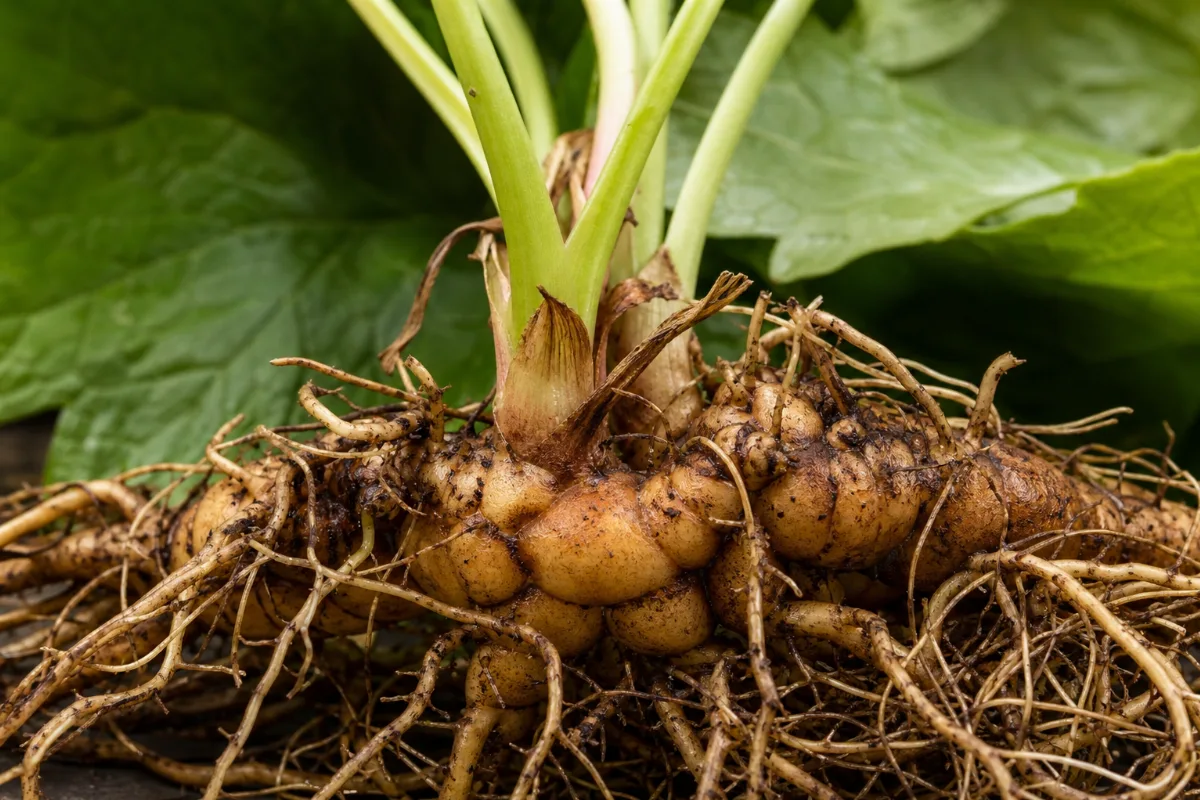
Herbs & Botanicals · Poisonous root, source of drugs
Mayapple
Podophyllum peltatum · also called Mayapple, American mandrake, podophyllin (the resin)
Mayapple is a North American woodland plant. The whole plant except the ripe fruit is poisonous, and its root resin, podophyllin, has caused serious poisonings and deaths. It is not for self-treatment, and it must not be used in pregnancy. A purified chemical from it is a prescription wart medicine and a starting material for the cancer drugs etoposide and teniposide, but the plant itself is not a remedy.
General information, not medical advice. Last substantive update · Not medically reviewed. A named clinician has not signed off on this page. How this page is made
About Mayapple
Mayapple (Podophyllum peltatum) is a North American woodland plant whose root and rhizome hold podophyllotoxin, a chemical that stops cells dividing. That makes it poisonous, and also useful as the starting point for a wart medicine and for cancer drugs. The plant itself is not a remedy.
Safety first
Every part except the ripe fruit is poisonous, and sources do not agree even on the fruit, so do not eat any part. Swallowing the plant or the resin (podophyllin), or putting it on large areas of skin, has caused vomiting, diarrhoea, coma, nerve damage, kidney failure and death. There is no specific antidote.
Wart treatment is for a clinician only. Resin is no longer a first-line choice, and purified podofilox is a prescribed medicine. Do not use it in pregnancy or breastfeeding. Keep the plant and any wart products away from children.
What it is
American mayapple is an umbrella-leaved woodland plant of the barberry family. Its rhizome and root are the source of the resin podophyllin. It is a different plant from the Himalayan Podophyllum hexandrum (now Sinopodophyllum hexandrum, also called P. emodi), which is endangered and is the main raw material for cancer-drug precursors. The name mandrake is also used for an unrelated European plant.
Where the medicines come from
Podophyllotoxin is the active chemical. Purified podofilox is used on genital warts. Chemists change the molecule to make etoposide and teniposide, which are cancer medicines. These are made drugs, not the plant, and are given only under medical care.
What the research shows
For warts, a 2019 review of 37 trials found purified podophyllotoxin 0.5% was the most effective of the patient-applied treatments, and a 2020 review of 41 studies found it cleared warts more often than imiquimod but with more side effects. The 2019 reviewers called the overall evidence low quality, and warts often return.
No trial tests mayapple root, tea or resin as a home remedy.
Pregnancy
IPCS says podophyllum is absorbed, crosses the placenta and has been linked to malformations, and lists pregnancy as a contraindication. A large Danish registry found no significant rise in birth defects or miscarriage after local prescription podophyllotoxin, but that does not cover resin, the plant or swallowed products. Ask a doctor or pharmacist before any use.
At a glance
Traditional uses history, not proof
- Strong purge or laxative (long abandoned)
- Resin on warts (now a clinic-only, second-line treatment)
Studied for research
- Genital warts: purified podophyllotoxin cleared warts in trials; evidence low quality; not the plant
- Cancer drugs (etoposide, teniposide): made from the chemical; the plant is not a cancer treatment
- Antiviral action: lab only
Main compounds
- Podophyllotoxin (podofilox), the poisonous cell-division blocker
- Etoposide and teniposide (lab-made drug derivatives, not in the plant)
Common forms
- Podophyllin resin (clinic use only; poisoning reported)
- Purified podofilox (prescription wart medicine)
- Etoposide (prescription cancer drug)
Research links: IPCS poisons monograph on podophyllum · Anogenital warts treatments: network meta-analysis (2019) · Topical wart treatments: network meta-analysis (2020) · Podophyllin poisoning in a child (2020) · Local podophyllotoxin in pregnancy, Danish registry (2020) · Podophyllotoxin review (2000) · Research Library · Genes & Biomarkers Library
The plant and its history
- Accepted scientific name
- Podophyllum peltatum L.
- Naming authority
- L.
- Common names
- Mayapple (English); American mandrake (English)
- Botanical family
- Berberidaceae (barberry family)
- Classification
- Plantae > Ranunculales > Berberidaceae > Podophyllum > Podophyllum peltatum
- Native range
- North America (eastern); not confirmed in a source read here.
- Habitat
- Not described in the sources read.
- What the plant looks like
- Roots: Rhizome and roots are the part used to make podophyllin resin.; Stems: Not described.; Leaves: Not described.; Flowers: Not described.; Fruit: Fruit: ripe fruit described as not toxic by IPCS; other parts toxic.
- Cultivation
- Not verified.
- Harvest and processing
- Resin (podophyllin) is an ethanol extract of the rhizome and root (Canel review).
- Look-alikes and adulterants
- Name: Himalayan or Indian mayapple (Sinopodophyllum hexandrum, formerly Podophyllum hexandrum or P. emodi); Note: A separate, endangered species of the Himalaya and China and the main extraction source for etoposide precursors. It holds more podophyllotoxin and is a different plant from American mayapple. Not interchangeable.; Name: Dysosma species, for example Bajiaolian (Dysosma pleianthum); Note: Another podophyllotoxin plant used in Chinese herbal practice; it poisoned five people in Taiwan.; Name: European mandrake (Mandragora officinarum); Note: Unrelated plant also called mandrake; confusion led to a mayapple poisoning.
- Sustainability and conservation
- The Himalayan species is described as endangered (Giri; Shen); American mayapple status not assessed.
Traditional use and history history, not clinical proof
| Tradition or era | Documented use | Source |
|---|---|---|
| Historic Western medicine | Resin used as a strong purge and later on warts; replaced by safer options because of irritation and poisoning. | s-ipcs-pim427 |
| Late 20th century to now | Podophyllotoxin derivatives etoposide and teniposide developed as cancer drugs; purified podofilox for warts. | p10872202 |
| Chinese herbal practice | Related Dysosma roots (Bajiaolian) used for many conditions; poisoning followed. NOT mayapple. | p1361136 |
Traditional use shows how a plant was used. It does not show that a supplement works or is safe today.
What is inside, and how it may work
What the plant contains and how those compounds act in cells and animals. Laboratory and animal mechanisms are not proven effects in people.
Main compounds
| Compound | Family | Where it is concentrated | Activity studied | Level of evidence |
|---|---|---|---|---|
| Podophyllotoxin (podofilox) PubChem 10607 | aryltetralin lignan | rhizome and root Not stated here. | Blocks tubulin and cell division; the cause of toxicity and the starting chemical for drugs. 17 4 11 | Human data |
| Etoposide PubChem 36462 | semisynthetic podophyllotoxin derivative (drug) | not found in the plant Made from precursors; not present as such. | Prescription cancer drug. 17 16 18 | Human data |
| Teniposide PubChem 452548 | semisynthetic podophyllotoxin derivative (drug) | not found in the plant Made from precursors; not present as such. | Prescription drug for leukaemia and some brain tumours (per the 2026 Science abstract). 17 18 | Human data |
Mechanisms, receptors and pathways
| Target or pathway | Gene or receptor | What was found | Level |
|---|---|---|---|
| Tubulin / mitotic spindle | tubulin | Podophyllotoxin binds tubulin and prevents the spindle forming, so cells cannot divide; nerve transport is also disrupted. 11 5 | Human data |
Absorption, metabolism and elimination
- Absorption
- Resin is rapidly absorbed after swallowing and through skin, especially broken skin (IPCS).
- Distribution
- Crosses the placenta (IPCS).
- Metabolism
- Not covered in the sources read.
- Elimination
- Not covered.
- Bioavailability
- Not established for the plant; the chemical is lipid soluble and crosses cell membranes (Jain 2020).
Isolated compounds versus whole extracts
Everything that has been tested for benefit used the purified chemical (podofilox) or a drug made from it, not the plant. The whole plant and crude resin are poisonous, and results from the purified products must not be carried to the plant.
Nutritional composition
Mayapple is not a food or nutrient; the ripe fruit is described as non-toxic by one source but should not be tried.
1 low certainty2 not enough evidence1 evidence against
What is Mayapple good for?
What mayapple chemicals have been studied for and how strong the evidence is. None of this supports using the plant.
Benefits, one by one
Each card is a research question, not a promise. Tap a goal to filter. Open a card to see the studies, doses and limits.
Genital warts (purified podophyllotoxin, not the plant)
Low certaintyA purified chemical from mayapple root, called podophyllotoxin or podofilox, is a prescribed wart medicine. In trials it cleared warts better than placebo and slightly better than imiquimod cream, but the evidence quality is low and side effects are more common. This is a medicine from a clinician, not a use for the plant, tea or home extracts.
4 studiesPurified podofilox is a prescription product; the whole plant and hom…
Studies, doses and limits
What the trials found
A 38-man double-blind trial of 0.5% podofilox solution against placebo found warts shrank to about 5% of their starting area vs 93% with placebo, but warts came back in all patients followed long-term (1990). Two network meta-analyses (2019, 2020) found 0.5% podophyllotoxin solution cleared warts better than imiquimod, with more side effects; the 2019 review rated overall evidence quality low.
Results
Podofilox: wart area to 5.1% of baseline vs 92.9% with placebo (small trial). Network analysis: odds ratio 1.94 (95% CI 1.02 to 3.71) for clearance vs imiquimod.
Effect sizes as reported
OR 1.94 vs imiquimod 5% cream (Jung 2020).
Why this rating
Several randomised trials, but many at unclear or high risk of bias, and reviewers called the evidence low quality. Applies only to the purified medicine.
Form and dose studied
Purified podofilox is a prescription product; the whole plant and home preparations have not been tested.
Who was studied
Adults with external genital warts treated under a clinician. Not for pregnancy per CDC (summary-only).
Limits
Recurrence is common. Resin (podophyllin) trials are not what these reviews mainly cover. Trials do not test mayapple root or tea.
Why researchers looked
Podophyllotoxin stops cells dividing, so it was tried on fast-growing wart tissue.
Traditional use
Mayapple resin (podophyllin) was long used on warts; it is now a second-line clinic treatment because of poisoning risk.
Proposed mechanism Pharmacological theory
Podophyllotoxin binds tubulin and blocks the spindle that cells need to divide (IPCS; Canel review).
A proposed mechanism does not show that the effect happens in people.
Local burning, pain and skin damage are common. Resin has caused body-wide poisoning and deaths. See the Safety tab.
Source of the cancer drugs etoposide and teniposide
Not enough evidenceMayapple (and the Himalayan species) hold podophyllotoxin, which chemists modify into etoposide and teniposide, prescription medicines for several cancers. The drugs are made from the chemical; the plant itself is not a cancer treatment and is poisonous.
4 studiesEtoposide is a clinic-supervised drug; the plant is not a substitute.
Studies, doses and limits
What the trials found
A 2000 review states the derivatives etoposide, etoposide phosphate and teniposide are used for several cancers. A 2026 Science paper says etoposide is approved for first-line treatment of small cell lung cancer and teniposide for leukaemia and some brain tumours. No trial tests the plant itself.
Results
Established prescription drugs; not a benefit of eating or taking the plant.
Effect sizes as reported
None for the plant.
Why this rating
No evidence that the plant or its crude extracts treat cancer; the drugs are different, tested medicines.
Form and dose studied
Etoposide is a clinic-supervised drug; the plant is not a substitute.
Who was studied
People with cancers treated by oncologists.
Limits
Etoposide has serious side effects and is a chemically modified drug. Himalayan Sinopodophyllum hexandrum is the main extraction source and is endangered.
Why researchers looked
The chemical blocks cell division, so its derivatives were developed to treat fast-growing tumours.
Traditional use
Not a traditional use: the drugs were developed from the chemistry of the plant.
Proposed mechanism Pharmacological theory
Podophyllotoxin blocks tubulin; its derivatives etoposide and teniposide act on a different target, topoisomerase II (general pharmacology; not re-checked in a paper here).
A proposed mechanism does not show that the effect happens in people.
Never replace cancer treatment with mayapple. The plant is poisonous.
Traditional laxative or purge
Evidence againstMayapple resin was used as a strong purge. It was replaced by safer laxatives because it is a harsh irritant and can poison. Do not use it this way.
2 studiesNo tested product.
Studies, doses and limits
What the trials found
No trial of mayapple as a laxative was found. Poisoning reports (vomiting, diarrhoea, paralysed bowel) are the human data.
Results
No benefit shown; harm documented.
Effect sizes as reported
None.
Why this rating
Safer proven laxatives exist and the plant causes poisoning, sometimes fatal.
Form and dose studied
No tested product.
Who was studied
None safe to recommend.
Limits
Evidence is historical description only.
Why researchers looked
Historical use as a cathartic.
Traditional use
IPCS notes the resin was used as a laxative and has been replaced by safer options.
Proposed mechanism Pharmacological theory
Irritation of the gut lining; the resin has caustic and cathartic action (IPCS).
A proposed mechanism does not show that the effect happens in people.
Diarrhoea and vomiting are early signs of poisoning.
Antiviral and cell-killing activity (lab)
Not enough evidencePodophyllotoxin stops cells and some viruses from multiplying in the lab. This is a laboratory finding about the chemical, not a treatment you can try with the plant.
2 studiesNot applicable.
Studies, doses and limits
What the trials found
No human trial of the plant. Reviews describe lab antiviral activity of the chemical.
Results
Laboratory only.
Effect sizes as reported
None available.
Why this rating
Lab and chemistry reviews only.
Form and dose studied
Not applicable.
Who was studied
None.
Limits
The reviews are about the Himalayan species and the chemical, not American mayapple tea.
Why researchers looked
Chemists study podophyllotoxin and its relatives for antiviral and anticancer drugs.
Traditional use
Not a traditional claim.
Proposed mechanism Laboratory research
It blocks microtubule assembly (Giri review).
A proposed mechanism does not show that the effect happens in people.
The same action that stops cell division makes the plant poisonous.
Connections to the rest of health
How Mayapple connects to the rest of our health knowledge graph. Every link says what kind of connection it is. A safety link (for example to the liver) is a warning, not a benefit. A study that merely mentions a topic never creates a benefit link.
Explore every connection: goals, body systems, organs, symptoms, genes
A. Wellness goals
| Connected to | Kind of connection | Evidence status | Context | Studies |
|---|---|---|---|---|
| Womens Wellness | Low certainty | Genital warts (purified podophyllotoxin, not the plant): A purified chemical from mayapple root, called podophyllotoxin or podofilox, is a prescribed wart medicine. In trials it cleared warts better than placebo and slightly better than imiquimod cream, but the evidence quality is low and side effects are more common. This is a medicine from a clinician, not a use for the plant, tea or home extracts. | 15 2 13 3 | |
| Cellular Protection | Not enough evidence | Source of the cancer drugs etoposide and teniposide: Mayapple (and the Himalayan species) hold podophyllotoxin, which chemists modify into etoposide and teniposide, prescription medicines for several cancers. The drugs are made from the chemical; the plant itself is not a cancer treatment and is poisonous. | 4 18 9 16 | |
| Digestive Support | Traditional use | Evidence against | Traditional laxative or purge: Mayapple resin was used as a strong purge. It was replaced by safer laxatives because it is a harsh irritant and can poison. Do not use it this way. | 11 12 |
| Immune Support | Not enough evidence | Antiviral and cell-killing activity (lab): Podophyllotoxin stops cells and some viruses from multiplying in the lab. This is a laboratory finding about the chemical, not a treatment you can try with the plant. | 9 4 |
B. Body systems
| Connected to | Kind of connection | Evidence status | Context | Studies |
|---|---|---|---|---|
| Skin Hair Beauty | Biological association | Low certainty | Studied for: Genital warts (purified podophyllotoxin, not the plant) | 15 2 13 3 |
| Reproductive Health | Biological association | Low certainty | Studied for: Genital warts (purified podophyllotoxin, not the plant) | 15 2 13 3 |
| Immune System | Biological association | Not enough evidence | Studied for: Source of the cancer drugs etoposide and teniposide Studied for: Antiviral and cell-killing activity (lab) | 4 18 9 16 |
| Digestive System | Biological association | Evidence against | Studied for: Traditional laxative or purge | 11 12 |
I. Biomarkers
| Connected to | Kind of connection | Evidence status | Context | Studies |
|---|---|---|---|---|
| Complete clearance of genital warts | Biological association | Low certainty | Measured in trials: improved. A lab change is not the same as a health benefit. | 15 13 2 |
K. Biological pathways
| Connected to | Kind of connection | Evidence status | Context | Studies |
|---|---|---|---|---|
| Tubulin | Preliminary mechanism | Human | Target of podophyllotoxin. | 11 |
L. Active compounds
| Connected to | Kind of connection | Evidence status | Context | Studies |
|---|---|---|---|---|
| Podophyllotoxin (podofilox) | Biological association | Human | Blocks tubulin and cell division; the cause of toxicity and the starting chemical for drugs. Preparation or compound: rhizome and root |
17 4 11 |
| Etoposide | Biological association | Human | Prescription cancer drug. Preparation or compound: not found in the plant |
17 16 18 |
| Teniposide | Biological association | Human | Prescription drug for leukaemia and some brain tumours (per the 2026 Science abstract). Preparation or compound: not found in the plant |
17 18 |
Each connection is stored with the ingredient, the connected record, the kind of connection, the evidence status, the supporting studies, the preparation or compound involved, and a review date (last reviewed October 25, 2026).
The evidence
The research centre for Mayapple. Every record here was checked against PubMed or the publisher's page; we never list a study we have not verified.
Evidence by outcome
Bars show how many studies we found for each outcome, not how well it works. People are added up across trials only (reviews are not added, to avoid double counting).
How we rate evidence
High certainty
Several well-run trials or reviews agree; further research is unlikely to change the picture much.
Moderate certainty
Good trials point the same way, but some doubt remains.
Low certainty
Small, short or inconsistent trials. The finding could change with better research.
Very low certainty
Very little or very weak human data. Treat as a possibility only.
Mixed findings
Trials or reviews disagree with each other.
Not enough evidence
Not enough human research to say either way.
Evidence against
Good research found no benefit, or found harm.
We take the reviewers' own risk-of-bias and GRADE statements where they exist, and otherwise judge from study size, design, consistency, directness and whether a product matches what is sold. Many publications do not make evidence high. Method note: We built on our existing summary, read PubMed abstracts and the IPCS monograph, and checked GBIF and PubChem. CDC and NCI items were carried over and not re-opened. Most studies were read as abstracts only.
Study library: every study we checked 18
| Study | Design | People | Product, dose, length | Result |
|---|---|---|---|---|
| Andersson 2020 Association Between Fetal Safety Outcomes and Exposure to Local Podophyllotoxin During Pregnancy JAMA Dermatol · PMID 31913405 · DOI |
Cohort study |
9229 Danish registry cohort of 1,650,649 pregnancies (1997 to 2016); 9229 in the birth-defect analysis |
Local (topical) prescription podophyllotoxin used in pregnancy not applicable (purified chemical) not given here not given here · vs none |
Major birth defects were 3.5% with podophyllotoxin exposure and 3.4% without (prevalence odds ratio 1.02, 95% CI 0.69 to 1.50). Miscarriage 8.3% vs 9.6% (HR 0.87, 0.73 to 1.04). Preterm birth, small size and stillbirth also showed no significant link. The authors suggested local podophyllotoxin may be safe in pregnancy. No significant increase in birth defects or miscarriage Methods, limits and fundingOutcomes: Major birth defects, miscarriage, preterm birth, small size, stillbirth Limitations: Observational registry; prescription fills may not equal use; how much was absorbed is unknown; applies to local prescription podophyllotoxin, not to resin, plant or swallowed products. Guidelines still advise avoiding it. Funding and conflicts: Not stated in abstract Read: abstract |
| Barton 2019 Effectiveness of topical and ablative therapies in treatment of anogenital warts: a systematic review and network meta-analysis BMJ Open · PMID 31676644 · DOI |
Systematic review |
37 randomised trials, adults 16+ with anogenital warts | podophyllotoxin 0.5% solution (purified) compared with other wart treatments not applicable (purified chemical) not given here not given here · vs none |
Carbon dioxide laser was the most effective treatment for clearance. Among treatments applied by patients, podophyllotoxin 0.5% solution cleared warts best, with a statistically significant difference from imiquimod 5% cream and polyphenon E 10% ointment. Surgical excision was best at keeping warts from coming back. The reviewers rated the overall quality of evidence as low. Podophyllotoxin 0.5% best of the patient-applied creams and solutions; evidence low quality Methods, limits and fundingOutcomes: Complete wart clearance; recurrence Limitations: Many trials at unclear or high risk of bias; few head-to-head comparisons; little data on recurrence. Funding and conflicts: Not stated in abstract Registration: CRD42013005457 Read: abstract |
| CDC 2026 Anogenital warts (STI treatment guidelines) CDC · Source |
Regulator |
not applicable | podofilox and podophyllin resin for anogenital warts not applicable not given here not given here · vs none |
Summary-only (our existing summary; the CDC page returned a block page when opened on 2026-10-25). As summarised: podofilox is a patient-applied wart medicine, contraindicated in pregnancy; podophyllin resin is clinic-applied, no longer first line, and the guideline advises against it in pregnancy. not applicable Methods, limits and fundingOutcomes: see results Limitations: Not re-opened; check the live page before relying on exact wording. Funding and conflicts: not applicable Read: summary-only |
| Canel 2000 Podophyllotoxin Phytochemistry · PMID 10872202 · DOI |
Review review-of-lab-and-clinical |
Review of the chemistry and uses of podophyllotoxin | Podophyllin (ethanol extract of Podophyllum peltatum or P. emodi, now P. hexandrum) as a source of podophyllotoxin rhizome and root not given here not given here · vs none |
The review states that podophyllin is a good source of the lignan podophyllotoxin. Podophyllotoxin and its derivatives are strongly antiviral and anticancer. The derivatives etoposide, etoposide phosphate and teniposide are used in several cancers. Research focuses on better derivatives and renewable sources. Source of etoposide-type drugs Methods, limits and fundingOutcomes: Chemistry, sources and drug derivatives Limitations: Review of the chemistry; not a trial. Funding and conflicts: Not stated in abstract Read: abstract |
| Chapon 1991 Accidental poisoning with podophyllin: a case with study of peripheral nerve Rev Neurol (Paris) · PMID 1648254 |
Case report |
1 A 53-year-old veterinary surgeon |
Podophyllin, 0.8 g swallowed by accident resin not given here not given here · vs none |
Twelve hours after swallowing, he was deeply comatose, with widespread damage to sensory, motor and automatic nerves, plus short-lived bone marrow and liver toxicity. The coma lasted 2 weeks. He began to improve at 3 months but died four months later of gut bleeding. Nerve biopsy showed fibre loss; podophyllin acts as a spindle poison that blocks nerve transport. Fatal after delayed course Methods, limits and fundingOutcomes: Coma, nerve and organ effects Limitations: Single case; abstract in English of a French paper. Funding and conflicts: Not stated in abstract Read: abstract |
| Frasca 1997 Mandrake toxicity. A case of mistaken identity Arch Intern Med · PMID 9308513 · DOI |
Case report |
1 A 31-year-old man |
Mandrake plant bought at a health food store; chromatography found podophyllotoxin, so almost certainly Podophyllum peltatum plant material (part not stated) not given here not given here · vs none |
He swallowed an unknown amount, believing it to be the hallucinogenic European mandrake (Mandragora). He had severe nausea and vomiting, stayed overnight, and recovered without obvious body-wide effects. The authors warn that the two plants called mandrake are confused. Vomiting; recovered Methods, limits and fundingOutcomes: Symptoms and recovery Limitations: Single case; unknown amount. Funding and conflicts: Not stated in abstract Read: abstract |
| GBIF 2026 GBIF species match: Podophyllum peltatum L. (key 3033839) GBIF · Source |
Registry or database plant |
not applicable | American mayapple rhizome and root not given here not given here · vs none |
GBIF API on 2026-10-25: Podophyllum peltatum L. is ACCEPTED (exact match), family Berberidaceae, order Ranunculales. not applicable Methods, limits and fundingOutcomes: see results Limitations: Taxonomy database record. Funding and conflicts: not applicable Read: full-text |
| GBIF 2026 GBIF species match: Podophyllum hexandrum Royle and P. emodi GBIF · Source |
Registry or database plant |
not applicable | Himalayan mayapple (Sinopodophyllum hexandrum) rhizome and root not given here not given here · vs none |
GBIF API on 2026-10-25: both Podophyllum hexandrum Royle and Podophyllum emodi Wall. ex Hook.f. & Thomson are listed as SYNONYMS of the accepted name Sinopodophyllum hexandrum (key 3981186), genus Sinopodophyllum, family Berberidaceae. not applicable Methods, limits and fundingOutcomes: see results Limitations: Taxonomy database record; some sources still use the older names. Funding and conflicts: not applicable Read: full-text |
| Giri 2000 Production of podophyllotoxin from Podophyllum hexandrum: a potential natural product for clinically useful anticancer drugs Cytotechnology · PMID 19003377 · DOI |
Review review-of-lab-and-clinical |
Review of production methods | Podophyllotoxin from Podophyllum hexandrum rhizome (Himalayan species) rhizome not given here not given here · vs none |
The review describes P. hexandrum as an endangered plant whose rhizome holds podophyllotoxin, the starting compound for etoposide and teniposide. It blocks microtubule assembly and is also antiviral in the lab. Heavy collection from the wild and no organised farming limit supply, and chemical synthesis is very complex, so cell culture and other biotechnology routes are being explored. Himalayan species is endangered and over-collected Methods, limits and fundingOutcomes: Source and supply Limitations: Review; Himalayan species, not American mayapple. Funding and conflicts: Not stated in abstract Read: abstract |
| Holdright 1990 Accidental poisoning with podophyllin Hum Exp Toxicol · PMID 2328153 · DOI |
Case report |
1 One adult |
Podophyllin swallowed by mistake for cough linctus resin not given here not given here · vs none |
The report describes poisoning after podophyllin, sold without prescription at the time for warts, was taken by mistake for cough medicine. The abstract gives no further detail. Poisoning from mistaken swallowing Methods, limits and fundingOutcomes: Toxicity after swallowing Limitations: Abstract is very short; no outcome details read. Funding and conflicts: Not stated in abstract Read: abstract |
| IPCS INCHEM Podophyllum (poisons information monograph PIM 427) IPCS INCHEM · Source |
Regulator |
not applicable | Podophyllum peltatum and podophyllotoxin products rhizome and root not given here not given here · vs none |
Read in full on 2026-10-25. Podophyllum resin is absorbed quickly after swallowing and through skin. Serious body-wide poisoning has followed use on large areas, and some skin cases were fatal. Effects listed: vomiting, stupor, coma, fast heartbeat, low blood pressure, paralysed bowel, low urine output, kidney failure, white blood cell changes, nerve damage and death. There is no specific test or antidote. It binds tubulin and stops cell division. It crosses the placenta and has been linked to malformations; pregnancy, breastfeeding, children and bleeding or biopsied warts are listed as contraindications. Unripe fruit or other parts may cause mainly diarrhoea; the ripe fruit is described as not producing toxicity. Fever and convulsions are more frequent in children. not applicable Methods, limits and fundingOutcomes: see results Limitations: The monograph is about podophyllum resin; its date is not shown; it is old in places and does not cover current regulation. Funding and conflicts: not applicable Read: full-text |
| Jain 2020 A Rare Case of Podophyllin Poisoning: Early Intervention is Lifesaving Indian J Crit Care Med · PMID 32863644 · DOI |
Case report |
1 A 2-year-old girl |
Podophyllin (resin from the rhizome and roots of Podophyllum peltatum or P. emodi), accidental poisoning rhizome and root resin not given here not given here · vs none |
The authors describe a 2-year-old with accidental podophyllin poisoning who developed nerve toxicity, then multi-organ failure, and died. They note that podophyllin poisoning is rare, that podophyllotoxin is the most toxic part, that both skin and swallowed exposure can cause it, that the worst effects are on nerves, bone marrow, gut, liver and kidneys, and that there is no specific antidote. Child died Methods, limits and fundingOutcomes: Clinical course Limitations: Single case; the abstract also summarises older cases. Funding and conflicts: Not stated in abstract Read: abstract |
| Jung 2020 Topically applied treatments for external genital warts in nonimmunocompromised patients: a systematic review and network meta-analysis Br J Dermatol · PMID 31675442 · DOI |
Systematic review |
6371 41 randomised studies, 6371 patients with external genital warts |
podophyllotoxin 0.5% solution (purified) compared with imiquimod and other topical agents not applicable (purified chemical) not given here not given here · vs none |
Podophyllotoxin 0.5% solution cleared lesions more often than imiquimod 5% cream (odds ratio 1.94, 95% CI 1.02 to 3.71) but caused more side effects overall. No treatment differed significantly from the others for recurrence, severe side effects or stopping because of side effects. OR 1.94 for clearance vs imiquimod; more side effects Methods, limits and fundingOutcomes: Lesion clearance; recurrence; adverse events Limitations: Network analysis of trials of different quality; unconventional agents need more study. Funding and conflicts: Not stated in abstract Read: abstract |
| Kao 1992 Podophyllotoxin intoxication: toxic effect of Bajiaolian in herbal therapeutics Hum Exp Toxicol · PMID 1361136 · DOI |
Case series |
5 Five people in Taiwan |
Bajiaolian root infusions (Dysosma pleianthum, a related plant in the mayapple family, also containing podophyllotoxin) root of Dysosma pleianthum (NOT Podophyllum peltatum) not given here not given here · vs none |
Five people who drank Bajiaolian infusions, recommended by herbal practitioners for postpartum recovery, neck mass, liver cancer and other problems, had nausea, vomiting, diarrhoea, abdominal pain, low platelets and white cells, abnormal liver tests, loss of balance, confusion and long-lasting tingling or numbness. The picture matched podophyllum poisoning. The authors stress it followed "therapeutic doses" quoted in Chinese medicine textbooks. Podophyllotoxin poisoning from a herbal tea Methods, limits and fundingOutcomes: Poisoning symptoms Limitations: A related plant, not American mayapple; five cases; shows risk of herbal use of podophyllotoxin plants. Funding and conflicts: Not stated in abstract Read: abstract |
| Kirby 1990 Double-blind randomized clinical trial of self-administered podofilox solution versus vehicle in the treatment of genital warts Am J Med · PMID 2186623 · DOI |
Controlled trial |
38 38 men with penile warts |
0.5% podofilox solution (purified podophyllotoxin) versus placebo solution, applied by the patients not applicable (purified chemical) not given here not given here · vs none |
After four weeks, podofilox users had wart number and area reduced to 15.9% and 5.1% of starting values, against 97.4% and 92.9% with placebo (p = 0.0001). Local side effects were more common with podofilox but were temporary. Warts recurred often: only 21% of patients were wart-free two weeks after treatment ended. Warts shrank to about 5% of starting area vs 93% with placebo Methods, limits and fundingOutcomes: Wart number and area; local reactions; recurrence Limitations: Small, old trial in men only; recurrences frequent; compares podofilox with placebo only, not with resin. Funding and conflicts: Research support listed; manufacturer role not stated in abstract (check) Read: abstract |
| National Cancer Institute 2026 Etoposide (cancer drug information) NCI · Source |
Regulator |
not applicable | etoposide (semisynthetic drug) not applicable not given here not given here · vs none |
Summary-only (our existing summary). As summarised: etoposide is an approved prescription cancer drug used with other medicines. It is a chemically modified derivative of podophyllotoxin, not the plant. not applicable Methods, limits and fundingOutcomes: see results Limitations: Not re-opened. Funding and conflicts: not applicable Read: summary-only |
| PubChem 2026 PubChem name lookups: podophyllotoxin, podofilox, etoposide, teniposide PubChem · Source |
Registry or database plant |
not applicable | podophyllotoxin and derivatives not applicable not given here not given here · vs none |
PubChem API on 2026-10-25: podophyllotoxin and podofilox both resolve to CID 10607; etoposide CID 36462; teniposide CID 452548. not applicable Methods, limits and fundingOutcomes: see results Limitations: Name lookup only. Funding and conflicts: not applicable Read: full-text |
| Shen 2026 Enabling sustainable supply of the essential cancer medicines etoposide and teniposide in yeast Science · PMID 42531388 · DOI |
Lab yeast |
Engineered yeast | Podophyllotoxin-type lignans for etoposide and teniposide not applicable not given here not given here · vs none |
The authors note that etoposide and teniposide currently rely on precursors extracted from the endangered plant Sinopodophyllum hexandrum (the Himalayan species) followed by chemical steps. They rebuilt the pathway in yeast, with over 60 genetic edits and 45 added enzymes, for a secure supply of these essential medicines. Yeast route to cancer-drug precursors Methods, limits and fundingOutcomes: Biosynthesis route Limitations: Laboratory engineering; the paper is about the Himalayan plant, not American mayapple. Funding and conflicts: Not stated in abstract Read: abstract |
What we do not know yet
- No trial of mayapple root, tea or resin for any use.
- Wart trials are old, small or at risk of bias; reviewers rated the evidence low.
- No safety data on pregnancy for resin or the plant beyond case reports and monographs.
- No tested herb-drug interactions.
- CDC wording is from a summary; no EMA, LiverTox, NCCIH or LactMed record was read.
How new research is added
New studies are found by a saved PubMed search and are placed in a review queue. A person reads each one before it changes any evidence rating or safety wording.
Lab markers
What changed in blood or saliva tests during trials. A changed number is not the same as feeling or being healthier, and we give no "normal ranges".
Other 1
Complete clearance of genital warts
Improved in trials
Whether all visible warts are gone at the end of treatment.
Low certaintyResults and what it means
Why it was measured
The main goal of wart treatment.
Statistical vs. clinical meaning
Meaningful for clinicians, but quality is low and recurrence is common.
Safety implication
Skin damage and, with resin, body-wide poisoning.
| Study | Result | People | Product |
|---|---|---|---|
| 13 | Podophyllotoxin 0.5% solution cleared more than imiquimod 5% cream (OR 1.94, 95% CI 1.02 to 3.71) but caused more side effects. | 41 randomised studies, 6371 patients | Purified podophyllotoxin 0.5% solution |
| 15 | Wart area fell to 5.1% of baseline with podofilox vs 92.9% with placebo; only 21% stayed wart-free 2 weeks after treatment. | 38 men with penile warts | 0.5% podofilox solution |
Safety
What studies and official sources say about side effects, medicines and who should check first. Each point shows what kind of evidence it comes from.
Main points to know 4
- The plant is poisonous. Do not eat it, brew it or put it on your skin.. The root, rhizome, leaves and unripe fruit hold podophyllotoxin, a chemical that stops cells dividing. Swallowing the plant or its resin (podophyllin) can cause severe vomiting, diarrhoea, confusion, coma, kidney failure, blood-cell changes, nerve damage and death. There is no specific antidote. Only the ripe fruit is described as not toxic, and sources differ, so it is not a safe thing to try. Case report 11 5 12
- Warts: a prescription or professional treatment only. Podophyllin resin applied to warts has caused body-wide poisoning and deaths, especially on large areas, bleeding or broken skin, or when left on. Purified podofilox is a prescribed medicine used as directed by a clinician. Never treat warts at home with mayapple or resin products. Ask a doctor or pharmacist. Regulator 11 3 10
- Pregnancy and breastfeeding: avoid. IPCS says podophyllum is absorbed through the skin, crosses the placenta, has been linked to malformations in humans, and is contraindicated in pregnancy and breastfeeding. CDC (summary-only) says podofilox is contraindicated in pregnancy. One large Danish registry study of local prescription podophyllotoxin found no significant rise in birth defects or miscarriage, but that does not cover resin, the plant or swallowed products, and guidelines still advise avoiding it. Regulator 11 3 1
- Children and mix-ups. A 2-year-old died after accidental podophyllin poisoning, and fever and convulsions are more frequent in children. Keep the plant, resin and wart products out of reach. The name mandrake covers two different plants: a man who thought he was taking European mandrake swallowed mayapple and was admitted with severe vomiting. Check the Latin name. Case report 12 11 6
Side effects 5
| Effect | How often | Severity and recovery | Evidence |
|---|---|---|---|
| Vomiting, belly pain and diarrhoea after swallowing The mistaken-mandrake case had severe nausea and vomiting and recovered. | Not established | serious Usually reversible if mild | Case report 6 11 |
| Nerve damage (peripheral neuropathy), coma One adult was comatose for 2 weeks and died 4 months later; nerve fibres were lost. | Not established | life-threatening Can be permanent | Case report 5 12 11 |
| Blood-cell drops, kidney and liver problems Low platelets and white cells and abnormal liver tests were seen with a related plant (Dysosma) tea. | Not established | serious Unknown | Case report 12 14 11 |
| Skin burns, tissue damage and eye injury on contact Resin is a caustic; IPCS notes it can also damage the cornea. | Not established | serious Variable | Regulator 11 |
| Local irritation with purified podofilox Podophyllotoxin caused more side effects overall than imiquimod in the 2020 review. | More common than with placebo | mild to moderate Temporary in the trial | Controlled trial 15 13 |
Liver
A tea of the related Chinese plant Dysosma pleianthum caused abnormal liver tests in five people, and IPCS notes liver enzymes may rise after mayapple poisoning. LiverTox could not be read for this plant. No separate liver-injury pattern was established. 14 11
How often. Unknown.
Monitoring. No official advice found. Yellow skin or eyes, dark urine or severe tiredness after any exposure need urgent medical care.
This is a safety connection. It is not evidence that Mayapple supports liver health.
Medicines and supplements 1
| With | Why it matters | Importance | Evidence | What to do |
|---|---|---|---|---|
| Medicines that suppress bone marrow or are toxic to nerves, kidneys or liver (for example some chemotherapy) prescription | Podophyllotoxin poisoning itself affects blood cells and nerves, so effects could add up. This is reasoning from the poisoning picture, not a tested interaction. | Unknown. No interaction study of mayapple with any medicine was found. | Theoretical Very low certainty 11 | Do not combine with anything. Tell your doctor or pharmacist about any exposure. |
Who should check first 4
| Situation | Advice | Evidence |
|---|---|---|
| Pregnancy and breastfeeding | Avoid. IPCS lists them as contraindications and CDC (summary-only) advises against podofilox and resin in pregnancy. | Regulator 11 3 1 |
| Children | No established indication; fatal poisoning reported. Keep the plant and products away. | Case report 12 11 |
| Bleeding, broken or recently biopsied skin or warts | IPCS lists these as contraindications because resin is absorbed through such skin. | Regulator 11 |
| Existing nerve, bone-marrow, kidney or liver disease | Avoid; these are the organs podophyllum poisoning damages. This is a precaution based on the poisoning reports. | Other 11 12 |
Overdose, product quality and regulators
Summary. Podophyllotoxin binds tubulin and halts cell division. Toxicity affects the gut, nerves, blood, liver and kidneys and can be fatal; there is no antidote and treatment is supportive.
Animal. Not read in this build.
Human doses studied. Not given here.
High dose or long term signals. Effects can appear hours after exposure and nerve damage can appear later (a delayed course over months was described).
Overdose response. Emergency care; no specific antidote (IPCS; Jain 2020).
Genotoxicity. Not found in the sources read.
Toxic plant parts. Root and rhizome are the source of the resin and are the most dangerous. IPCS says unripe fruit and other plant parts can cause mainly diarrhoea and that the ripe fruit does not produce toxicity; a pet-poison source says similar, but some historic reports differ, so no part should be tried.
The main risk is identity confusion rather than adulteration.
Mandrake name confusion. Plant sold as mandrake in a US health food store was chromatographically identified as containing podophyllotoxin; the buyer thought it was European mandrake (Mandragora). 6
Related plant in Chinese herbal practice. Bajiaolian (Dysosma pleianthum), another podophyllotoxin plant, poisoned five people who drank infusions recommended for postpartum recovery and other uses. 14
Two Podophyllum species in resin. Podophyllin comes from the rhizomes and roots of P. peltatum (North America) or the Himalayan species, so strength and content can differ. 12 4
| Body | Action | Date |
|---|---|---|
| IPCS INCHEM (International) | Poisons monograph on podophyllum: contraindicated in pregnancy, breastfeeding and children; no specific antidote. source | n.d. |
When to get medical help
- Persistent vomiting, severe belly pain or diarrhoea after eating or touching the plant or resin
- Confusion, drowsiness, seizures or loss of consciousness
- Numbness, tingling or weakness, which can appear days to weeks later
- Little or no urine, or yellow skin or eyes
- Large skin burns or any eye contact: call a poison centre or emergency service straight away
Stop the supplement and contact a clinician or emergency service. In the US, Poison Control is 1-800-222-1222.
General information only, not medical advice. Ask a clinician or pharmacist before use, especially with medicines, in pregnancy or with a health condition. See the Natural Remedy Safety guide.
Frequently asked questions
What is mayapple?
Is mayapple poisonous?
Can I treat warts with mayapple?
What is the difference between podophyllin and podofilox?
Does purified podophyllotoxin work for genital warts?
Is mayapple a cancer treatment?
Is it safe in pregnancy or breastfeeding?
Is it safe for children?
Is American mayapple the same as the Himalayan or Chinese plant?
Is mayapple the same as mandrake?
No. Mandrake can mean European Mandragora or American mayapple. A man who thought he was taking Mandragora swallowed mayapple and was admitted with severe vomiting.
Can the fruit be eaten?
IPCS describes the ripe fruit as not toxic, but other parts are poisonous, sources differ, and it is not recommended to try.
What are the warning signs of poisoning?
How much should I take?
Do not take it. We give no amounts because the plant is poisonous. Ask a doctor or pharmacist about any wart or cancer medicine.
Explore by health goal
Womens WellnessCellular ProtectionDigestive SupportImmune Support
Editorial transparency
- Written by
- AlternativeMed editorial team. Research compiled with AI assistance, then checked against PubMed records.
- Medical review
- None. This page has not been reviewed by a physician or pharmacist.
- First published
- 2026-10-25
- Last substantive update
- 2026-10-25
- How we research
- We built on our existing summary, read PubMed abstracts and the IPCS monograph, and checked GBIF and PubChem. CDC and NCI items were carried over and not re-opened. Most studies were read as abstracts only.
- How we rate evidence
- See "How we rate evidence" in the Evidence tab.
- Independence
- No product is promoted on this page. No affiliate links are shown. If one is added later it will be labelled and kept apart from the evidence.
Sources 18
Each source was opened and checked. Where we read only the abstract, it says so. The small numbers in the text point here.
- Andersson NW, Andersen JT. Association Between Fetal Safety Outcomes and Exposure to Local Podophyllotoxin During Pregnancy. JAMA Dermatol. 2020. PMID 31913405. DOI 10.1001/jamadermatol.2019.4315. (abstract)
- Barton S, Wakefield V, O'Mahony C, et al.. Effectiveness of topical and ablative therapies in treatment of anogenital warts: a systematic review and network meta-analysis. BMJ Open. 2019. PMID 31676644. DOI 10.1136/bmjopen-2018-027765. (abstract)
- CDC. Anogenital warts (STI treatment guidelines). CDC. 2026. (summary-only)
- Canel C, Moraes RM, Dayan FE, et al.. Podophyllotoxin. Phytochemistry. 2000. PMID 10872202. DOI 10.1016/s0031-9422(00)00094-7. (abstract)
- Chapon F, Dupuy B, Gosset, et al.. Accidental poisoning with podophyllin: a case with study of peripheral nerve. Rev Neurol (Paris). 1991. PMID 1648254. (abstract)
- Frasca T, Brett AS, Yoo SD. Mandrake toxicity. A case of mistaken identity. Arch Intern Med. 1997. PMID 9308513. DOI 10.1001/archinte.157.17.2007. (abstract)
- GBIF. GBIF species match: Podophyllum peltatum L. (key 3033839). GBIF. 2026. (full-text)
- GBIF. GBIF species match: Podophyllum hexandrum Royle and P. emodi. GBIF. 2026. (full-text)
- Giri A, Lakshmi Narasu M. Production of podophyllotoxin from Podophyllum hexandrum: a potential natural product for clinically useful anticancer drugs. Cytotechnology. 2000. PMID 19003377. DOI 10.1023/A:1008138230896. (abstract)
- Holdright DR, Jahangiri M. Accidental poisoning with podophyllin. Hum Exp Toxicol. 1990. PMID 2328153. DOI 10.1177/096032719000900113. (abstract)
- IPCS INCHEM. Podophyllum (poisons information monograph PIM 427). IPCS INCHEM. . (full-text)
- Jain MK, Patnaik S, Rup AR, Gaurav A. A Rare Case of Podophyllin Poisoning: Early Intervention is Lifesaving. Indian J Crit Care Med. 2020. PMID 32863644. DOI 10.5005/jp-journals-10071-23448. (abstract)
- Jung JM, Jung CJ, Lee WJ, et al.. Topically applied treatments for external genital warts in nonimmunocompromised patients: a systematic review and network meta-analysis. Br J Dermatol. 2020. PMID 31675442. DOI 10.1111/bjd.18638. (abstract)
- Kao WF, Hung DZ, Tsai WJ, et al.. Podophyllotoxin intoxication: toxic effect of Bajiaolian in herbal therapeutics. Hum Exp Toxicol. 1992. PMID 1361136. DOI 10.1177/096032719201100607. (abstract)
- Kirby P, Dunne A, King DH, et al.. Double-blind randomized clinical trial of self-administered podofilox solution versus vehicle in the treatment of genital warts. Am J Med. 1990. PMID 2186623. DOI 10.1016/0002-9343(90)90424-c. (abstract)
- National Cancer Institute. Etoposide (cancer drug information). NCI. 2026. (summary-only)
- PubChem. PubChem name lookups: podophyllotoxin, podofilox, etoposide, teniposide. PubChem. 2026. (full-text)
- Shen S, Hu X, Li, et al.. Enabling sustainable supply of the essential cancer medicines etoposide and teniposide in yeast. Science. 2026. PMID 42531388. DOI 10.1126/science.aef5438. (abstract)