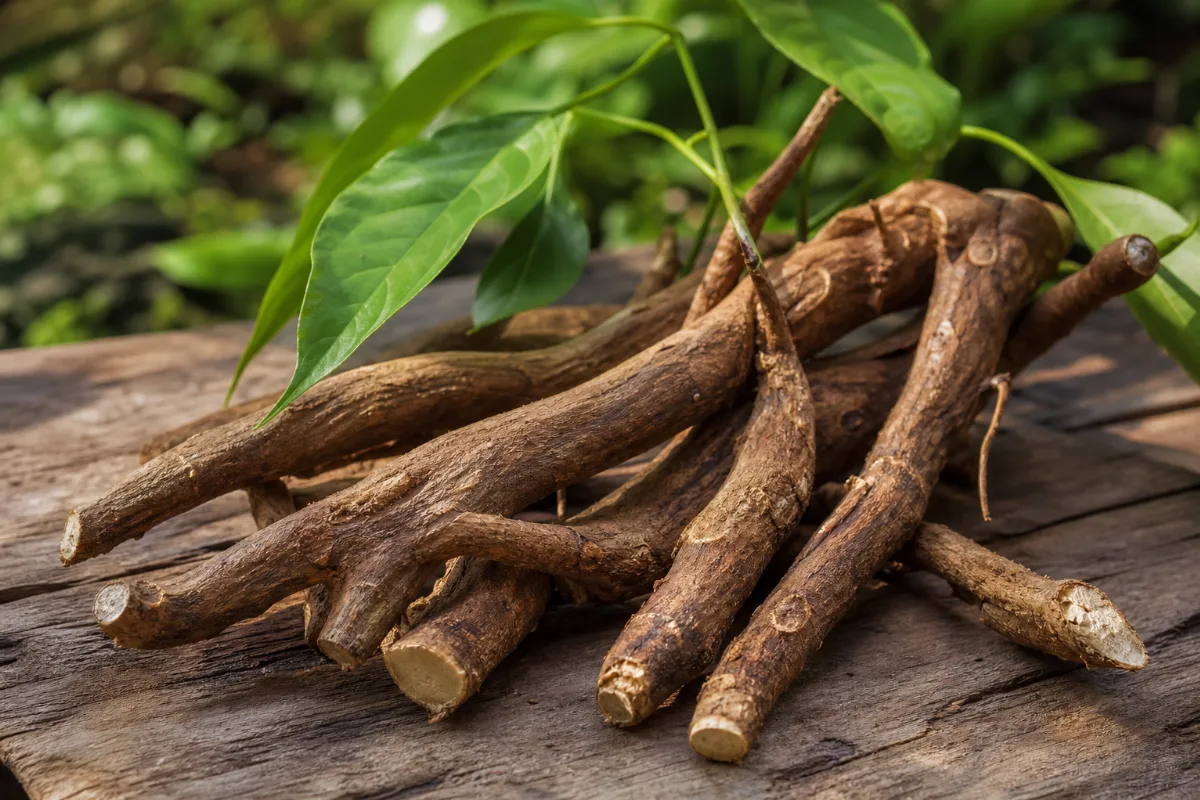
Natural Psychedelics · Plant
Iboga
Tabernanthe iboga Baill. · also called Iboga, eboka, bois sacré (names in GBIF)
Danger first: iboga's best-known compound, ibogaine, can lengthen the heart's QT interval and cause deadly rhythm problems, even in people with no known heart disease. Iboga is a shrub of Central African forests and is central to the Bwiti tradition of Gabon. Research is almost all on purified ibogaine, mostly small and uncontrolled studies for opioid and cocaine dependence. The plant itself has not been tested in controlled trials.
General information, not medical advice. Last substantive update · Not medically reviewed. A named clinician has not signed off on this page. The Bwiti and conservation wording has not had Indigenous or cultural review. How this page is made
About Iboga
Iboga (Tabernanthe iboga) is a Central African forest shrub whose root bark holds ibogaine and related alkaloids. Ibogaine can lengthen the heart's QT interval and cause fatal rhythm problems. Research on ibogaine for addiction is small and mostly uncontrolled, and the plant itself has not been tested. The plant is central to the Bwiti tradition of Gabon.
What it is
Tabernanthe iboga Baill. is an accepted species in the dogbane family (Apocynaceae), native to western Central Africa, with records from Gabon, Cameroon, Congo, the Central African Republic, DR Congo and Angola.
It is an understory shrub of lowland forests of the Congo Basin. The root bark holds the alkaloids, and ibogaine is the best known. Ibogaine is broken down in the body to noribogaine, which stays at active levels for days.
The Bwiti tradition
Iboga is central to Bwiti, a religion practised in Gabon and neighbouring countries. Sources call it a cultural keystone for the people of Gabon. This page does not describe ceremonies and does not speak for the tradition.
Tradition is different from clinical research. A clinic giving purified ibogaine is not the same as Bwiti practice, and clinical findings should not be read as describing it. Credit and respect belong to the Bwiti and the peoples of the region.
What research shows
Almost all clinical research is on purified ibogaine or noribogaine, not the plant. A 2022 systematic review found 24 studies with 705 people, including two randomised double-blind trials, and said the data suggest less withdrawal and craving, while reporting severe complications and deaths.
A 2026 scoping review found only three randomised trials in the entire literature and concluded clinical use cannot be recommended without larger controlled trials. A trial of noribogaine in opioid-dependent patients showed no significant withdrawal change and a dose-linked QTc rise.
Some leading papers come from authors with patents or company interests in ibogaine or noribogaine. One uncontrolled veterans study reported large improvements, but with no control group it cannot show cause.
Conservation
GBIF reports the IUCN Red List category as Least Concern. Chacruna says that assessment cites a wide range and apparently large populations, but that detailed biological studies are lacking.
The same article and a forest-products report raise concerns about overharvesting, deforestation and rising outside demand, with no official harvest or trade data. Most supply is wild-harvested. Gabon is reported to have declared the plant a national cultural heritage reserve in 2000 and to restrict export.
At a glance
Traditional uses history, not proof
- Central to the Bwiti religion in Gabon, Equatorial Guinea and southern Cameroon (GOV.UK chapter; Chacruna). This page does not describe ceremonies.
- In small amounts described as a stimulant against fatigue, hunger and thirst (GOV.UK chapter; Mash 2023).
Studied for research
- Opioid withdrawal and craving (purified ibogaine, mostly open-label), very low
- Cocaine craving (one small pilot, second-hand), very low
- Veterans' PTSD, depression, anxiety after brain injury (one uncontrolled study), very low
- Traditional stimulant use, insufficient (not studied)
Main compounds
- Ibogaine, the best-studied alkaloid
- Noribogaine, its long-lasting metabolite
- Other iboga alkaloids in the root bark
Common forms
Research links: Ibogaine heart risk review, Addiction 2026 (abstract) · How toxic is ibogaine? (abstract) · Systematic review of ibogaine trials 2022 (abstract) · Iboga conservation (Chacruna Institute) · US federal Schedule I list (eCFR) · Research Library · Genes & Biomarkers Library
The plant and its history
- Accepted scientific name
- Tabernanthe iboga
- Naming authority
- Baill.
- Synonyms
- Iboga vateriana Braun-Blanq. & K.Schum.; Tabernanthe albiflora Stapf; Tabernanthe bocca Stapf; Tabernanthe mannii Stapf; Tabernanthe pubescens Pichon; Tabernanthe subsessilis Stapf; Tabernanthe tenuiflora Stapf
- Common names
- Iboga (English); Eboka (English/French); Bois sacré (French); Bois amer (French); Bitter-grass (English)
- Botanical family
- Apocynaceae (the dogbane family)
- Classification
- Plantae > Tracheophyta > Magnoliopsida > Gentianales > Apocynaceae > Tabernanthe > Tabernanthe iboga
- Native range
- Western Central Africa: Gabon, Cameroon, Congo, Central African Republic, DR Congo, Cabinda and Angola; Bioko is also listed by Catalogue of Life (GBIF distribution records from WCVP).
- Habitat
- An understory shrub of lowland tropical forests of the Congo Basin (GOV.UK chapter).
- What the plant looks like
- Roots: The root cortex (root bark) holds the alkaloids (GOV.UK chapter).; Stems: Shrub; not described further in the sources read.; Leaves: Not checked.; Flowers: Not checked.; Fruit: Not checked.
- Cultivation
- Not covered on this page.
- Harvest and processing
- Not covered on this page. The sources report wild harvest and unknown trade volumes.
- Look-alikes and adulterants
- Name: Other Apocynaceae plants (e.g. Voacanga africana); Note: Chacruna reports Voacanga africana is being explored as an alternative alkaloid source; this is not a lookalike identification guide. No identification help is given here.
- Sustainability and conservation
- GBIF reports the IUCN Red List category as Least Concern (taxon ID 120678584). Chacruna says the IUCN assessment cited a wide range and apparently large populations (2018), but that detailed biological studies are lacking, and raises concerns about overharvesting, deforestation and rising demand. The GOV.UK chapter says there are no official harvest or trade data and sustainability has been questioned. The IUCN document itself was not opened; CITES status was not checked.
Traditional use and history history, not clinical proof
| Tradition or era | Documented use | Source |
|---|---|---|
| Bwiti tradition, Gabon, Equatorial Guinea and southern Cameroon | Iboga is central to the Bwiti religion; the GOV.UK chapter says large amounts are used for hallucinogenic effect by members, and Chacruna describes it as a cultural keystone species. Chacruna and Mash describe use in initiation and weekly ceremonies and as a sacrament. This page does not describe ceremonies. Credit belongs to the Bwiti and the peoples of Gabon and neighbouring countries; this section needs Indigenous/cultural review. | s-chacruna-iboga |
| Small-amount traditional use | In small amounts the plant is described as a stimulant to keep going through demanding work, and against fatigue, hunger and thirst. | s-gov-uk-iboga |
| 1960s onward, outside Africa | Mash writes that American and European self-help groups gave testimonials that ibogaine reduced drug craving and withdrawal. These are testimonials, not trials. Mash has a financial interest in ibogaine development. | p36907284 |
| Naming and early chemistry | The species name is by Baillon (1888, per GBIF). A chemistry review says iboga alkaloids were first found in the roots of this plant, 'a sacred plant to the people of Gabon'. | p28194562 |
Traditional use shows how a plant was used. It does not show that a supplement works or is safe today.
What is inside, and how it may work
What the plant contains and how those compounds act in cells and animals. Laboratory and animal mechanisms are not proven effects in people.
Main compounds
| Compound | Family | Where it is concentrated | Activity studied | Level of evidence |
|---|---|---|---|---|
| Ibogaine PubChem 197060 | indole alkaloid (iboga class) | Root cortex Not stated in sources read; no content figure given. | Blocks hERG heart channels; acts on NMDA, opioid and sigma-2 receptor sites, serotonin and dopamine systems (review). 21 12 10 | Human and lab |
| Noribogaine (10-hydroxyibogamine) PubChem 3083548 | indole alkaloid, metabolite of ibogaine | Made in the body from ibogaine n/a | Stays in the body for days; lengthens QTc in patients; no opioid-agonist effect in healthy men's pupil and cold pressor tests. 22 5 7 | Human data |
| Other iboga alkaloids (including 18-methoxycoronaridine, a related compound studied separately) | iboga-class alkaloids | Root Not stated. | Described in a chemistry review; not assessed here. 11 | Review |
Mechanisms, receptors and pathways
| Target or pathway | Gene or receptor | What was found | Level |
|---|---|---|---|
| hERG potassium channel (heart) | hERG (KCNH2) | Ibogaine reduced hERG currents at concentrations like those in treatment, a plausible route to long QT and arrhythmia. 10 12 | Lab |
| NMDA, kappa and mu opioid receptors, sigma-2 sites; serotonin, dopamine, acetylcholine systems | multiple | Micromolar affinity for NMDA, kappa- and mu-opioid receptors and sigma-2 sites; alters BDNF, substance P, c-fos and egr-1 expression in lab and animal work. 12 | Lab animal |
| CYP2D6 metabolism | CYP2D6 | Converts ibogaine to noribogaine; blocking it with paroxetine about doubled active exposure in volunteers. 6 | Human data |
Absorption, metabolism and elimination
- Absorption
- Ibogaine was absorbed rapidly after oral dosing in volunteers (Tmax 1.5 h with CYP2D6 blocked); noribogaine peaked 2 to 4 hours after oral doses.
- Distribution
- Noribogaine apparent volume of distribution was high (mean 1417 to 3086 L) in healthy men.
- Metabolism
- CYP2D6 converts ibogaine to noribogaine. CYP2D6 phenotype correlated strongly with ibogaine AUC (r = 0.82).
- Elimination
- Noribogaine half-life about 28 to 49 hours in healthy men and 24 to 30 hours in opioid-dependent patients. Ibogaine half-life was 10.2 hours when CYP2D6 was blocked.
- Bioavailability
- Not established in the sources read.
Isolated compounds versus whole extracts
Nearly all research is on purified ibogaine or noribogaine. No controlled study of iboga root bark, extracts or traditional preparations was read. The plant contains many alkaloids, so results from the isolated compound should not be assumed for the plant. Ibogaine in a clinic is not iboga in ceremony.
Nutritional composition
Iboga is not a food or nutrient.
4 very low certainty1 not enough evidence
What is Iboga good for?
The uses people ask about and how strong the human evidence is. The research is on ibogaine, a compound from iboga, not on the plant. None of it shows a treatment.
Benefits, one by one
Each card is a research question, not a promise. Tap a goal to filter. Open a card to see the studies, doses and limits.
Opioid withdrawal and drug craving
Very low certaintyMost clinical research is on purified ibogaine for opioid and cocaine dependence, not on iboga root bark. A 2022 systematic review of 24 studies (705 people) says the data suggest less withdrawal and craving, but nearly all were open-label and the same review reports severe complications and deaths. No approved medicine exists.
7 studiesResearch used purified ibogaine hydrochloride or its metabolite norib…
Studies, doses and limits
What the trials found
Two randomised trials in people with substance dependence exist: one small cocaine-craving pilot (20 adults) and one noribogaine safety study in 27 opioid-dependent patients that did not show a significant withdrawal change. A Dutch open-label study of 14 patients and a 191-person case series reported that withdrawal and craving fell; neither had a control group.
Results
Review: data suggest ibogaine reduces withdrawal symptoms and craving. Dutch study (14 adults, hospital): 11 of 14 did not return to morphine within 24 hours. Case series (191 people): authors report lower withdrawal and craving. Noribogaine in 27 patients: non-significant trend towards lower withdrawal.
Effect sizes as reported
No pooled effect size. Results are descriptive.
Why this rating
Mostly open-label studies with no blinded comparison, small numbers, short follow-up, and strong expectation effects. Several leading papers come from authors with financial interests. Safety problems limit the kind of study that can be done.
Form and dose studied
Research used purified ibogaine hydrochloride or its metabolite noribogaine in hospitals or clinics with monitoring. Iboga root bark or extracts have not been tested in controlled trials. Amounts are not given on this page.
Who was studied
Adults with opioid or cocaine dependence in clinics (Netherlands, offshore clinic) and trials in New Zealand.
Limits
These are not trials of iboga the plant. The longer-term benefit is unknown. Many treated people are lost from follow-up.
Why researchers looked
People with opioid dependence have sought ibogaine outside regular medicine, and testimonials from the 1960s onward led researchers to test it.
Traditional use
Not a Bwiti use. In traditional settings the root bark is a ceremonial and, in small amounts, a stimulant plant; addiction treatment is a modern use of the isolated compound (Mash 2023; GOV.UK chapter).
Proposed mechanism Lab animal
Ibogaine and its metabolite noribogaine act on several brain systems at once (NMDA, opioid and sigma-2 receptor sites, serotonin, dopamine). This comes from lab and animal work; how it relates to benefit in people is not known.
A proposed mechanism does not show that the effect happens in people.
Ibogaine can lengthen the heart's QT interval and cause fatal rhythm problems. See the Safety tab first.
Cocaine craving
Very low certaintyA scoping review reports one small double-blind pilot in 20 cocaine-dependent adults that found less craving than placebo for up to 24 weeks. We did not read the trial itself.
2 studiesPurified ibogaine in a trial. Amount not given here.
Studies, doses and limits
What the trials found
One randomised double-blind pilot (20 adults), described only second-hand in a 2026 scoping review; a 191-person open-label series included cocaine users.
Results
Reduced craving versus placebo over follow-up of up to 24 weeks, per the scoping review.
Effect sizes as reported
Not given in the review abstract.
Why this rating
A single pilot of 20 people, read only second-hand.
Form and dose studied
Purified ibogaine in a trial. Amount not given here.
Who was studied
Cocaine-dependent adults.
Limits
Tiny sample; original paper not read.
Why researchers looked
Cocaine dependence has no approved medicine, so ibogaine was tested in a pilot.
Traditional use
No traditional use for this is described in the sources read.
Proposed mechanism Lab animal
Unknown in people; animal models of addiction were reported as supportive in a review by an author with a financial stake.
A proposed mechanism does not show that the effect happens in people.
Same heart risk as in the Safety tab.
Post-injury disability, PTSD, depression and anxiety
Very low certaintyOne uncontrolled study gave ibogaine with magnesium to 30 special operations veterans with brain injury. Scores for function, PTSD, depression and anxiety improved, with no serious adverse events reported. With no control group, it cannot show ibogaine caused the change.
1 studiesIbogaine plus magnesium in a clinic with extra supportive therapies.
Studies, doses and limits
What the trials found
Prospective open-label observational study, 30 men, registered NCT04313712.
Results
Functioning improved immediately (Cohen's d 0.74) and at 1 month (d 2.20). At 1 month: PTSD d 2.54, depression d 2.80, anxiety d 2.13. No unexpected or serious adverse events.
Effect sizes as reported
Very large before-after changes, which are typical when there is no control group and strong expectations.
Why this rating
Open-label, uncontrolled, 30 people, a package of treatments, one month of follow-up, and authors with patent and clinic links.
Form and dose studied
Ibogaine plus magnesium in a clinic with extra supportive therapies.
Who was studied
30 male special operations veterans, mostly mild brain injury.
Limits
Cannot separate ibogaine from the other care. The study team called for controlled trials.
Why researchers looked
Some veterans seek ibogaine abroad. Researchers wanted to test whether adding magnesium and monitoring would make it safer.
Traditional use
Not a traditional use.
Proposed mechanism Hypothesis
Not established. Magnesium was added in the hope of reducing heart-rhythm risk; the study was not designed to prove that.
A proposed mechanism does not show that the effect happens in people.
Absence of reported events in 30 men does not remove the known heart risk.
Fatigue, hunger and thirst (traditional use)
Not enough evidenceSources describe the plant as a stimulant in small amounts in its homeland. No trial has tested this.
2 studiesNot applicable.
Studies, doses and limits
What the trials found
No human trial found.
Results
None.
Effect sizes as reported
None.
Why this rating
Reports of tradition only.
Form and dose studied
Not applicable.
Who was studied
Communities in Central Africa.
Limits
Descriptions come from secondary sources. This profile cannot speak for Bwiti practice; it needs review by Bwiti and Gabonese voices.
Why researchers looked
Described in the ethnobotanical record, not in trials.
Traditional use
A GOV.UK forest-products chapter says small amounts of the plant act as a stimulant that helps people keep going during demanding work. A 2023 review gives the same use against fatigue, hunger and thirst. Bwiti members in Gabon, Equatorial Guinea and southern Cameroon also use the plant in a religious setting (see Bwiti page). Traditional use is not proof of safety or benefit.
Proposed mechanism None
Not studied.
A proposed mechanism does not show that the effect happens in people.
See the Safety tab.
Addiction behaviour in animals
Very low certaintyA review by an author with a financial interest says ibogaine and noribogaine showed effects in animal models of addiction. This is animal research.
2 studiesNot applicable.
Studies, doses and limits
What the trials found
Not applicable.
Results
Reported positive in animal models (review level only; individual studies not read).
Effect sizes as reported
None given.
Why this rating
Animal research, summarised by an interested author, individual studies not read.
Form and dose studied
Not applicable.
Who was studied
Laboratory animals.
Limits
Animal results often fail to translate.
Why researchers looked
Animal models were used to test the idea before human studies.
Traditional use
None.
Proposed mechanism Animal research
Multiple targets at once. Animal results do not tell us what happens in people.
A proposed mechanism does not show that the effect happens in people.
Rats showed damage to cerebellar cells in older work (see Safety).
Connections to the rest of health
How Iboga connects to the rest of our health knowledge graph. Every link says what kind of connection it is. A safety link (for example to the liver) is a warning, not a benefit. A study that merely mentions a topic never creates a benefit link.
Explore every connection: goals, body systems, organs, symptoms, genes
B. Body systems
C. Body parts and organs
I. Biomarkers
| Connected to | Kind of connection | Evidence status | Context | Studies |
|---|---|---|---|---|
| Heart-rate-corrected QT interval (QTc) | Biological association | Moderate certainty | Measured in trials: raised. A lab change is not the same as a health benefit. | 8 7 |
| Opioid withdrawal ratings | Biological association | Low certainty | Measured in trials: lowered (not significant). A lab change is not the same as a health benefit. | 7 |
| Drug craving questionnaires | Biological association | Very low certainty | Measured in trials: lowered (open-label). A lab change is not the same as a health benefit. | 13 17 |
| PTSD, depression and anxiety scores (CAPS-5, MADRS, HAM-A) | Biological association | Very low certainty | Measured in trials: lowered (uncontrolled). A lab change is not the same as a health benefit. | 3 |
| Opioid-like effects (pupil size, cold pressor pain test) | Biological association | Low certainty | Measured in trials: no change. A lab change is not the same as a health benefit. | 5 |
J. Genes, receptors and enzymes
L. Active compounds
| Connected to | Kind of connection | Evidence status | Context | Studies |
|---|---|---|---|---|
| Ibogaine | Biological association | Human and lab | Blocks hERG heart channels; acts on NMDA, opioid and sigma-2 receptor sites, serotonin and dopamine systems (review). Preparation or compound: Root cortex |
21 12 10 |
| Noribogaine (10-hydroxyibogamine) | Biological association | Human | Stays in the body for days; lengthens QTc in patients; no opioid-agonist effect in healthy men's pupil and cold pressor tests. Preparation or compound: Made in the body from ibogaine |
22 5 7 |
| Other iboga alkaloids (including 18-methoxycoronaridine, a related compound studied separately) | Biological association | Review | Described in a chemistry review; not assessed here. Preparation or compound: Root |
11 |
Each connection is stored with the ingredient, the connected record, the kind of connection, the evidence status, the supporting studies, the preparation or compound involved, and a review date (last reviewed October 25, 2026).
Evidence at a glance: what changed in 1 lab markers
Tap a number to show only those markers. Counts are markers, not people.
The evidence
The research centre for Iboga. Every record here was checked against PubMed or the publisher's page; we never list a study we have not verified.
Evidence by outcome
Bars show how many studies we found for each outcome, not how well it works. People are added up across trials only (reviews are not added, to avoid double counting).
How we rate evidence
High certainty
Several well-run trials or reviews agree; further research is unlikely to change the picture much.
Moderate certainty
Good trials point the same way, but some doubt remains.
Low certainty
Small, short or inconsistent trials. The finding could change with better research.
Very low certainty
Very little or very weak human data. Treat as a possibility only.
Mixed findings
Trials or reviews disagree with each other.
Not enough evidence
Not enough human research to say either way.
Evidence against
Good research found no benefit, or found harm.
We take the reviewers' own risk-of-bias and GRADE statements where they exist, and otherwise judge from study size, design, consistency, directness and whether a product matches what is sold. Many publications do not make evidence high. Method note: We searched PubMed, read the abstracts of 17 papers, checked the plant name in GBIF and the compounds in PubChem, read the US federal Schedule I text through the eCFR, and read a GOV.UK forest-products chapter and a Chacruna Institute article. Only abstracts were read for papers. Certainty ratings are the compiler's own reading. Industry and financial ties are flagged where the abstract states them.
Study library: every study we checked 24
| Study | Design | People | Product, dose, length | Result |
|---|---|---|---|---|
| Alper 2012 Fatalities temporally associated with the ingestion of ibogaine. Journal of Forensic Sciences · PMID 22268458 · DOI |
Case series |
19 19 people (15 men, 4 women, aged 24 to 54) who died 1.5 to 76 hours after taking ibogaine, 1990 to 2008, outside West Central Africa |
Ibogaine (including ethnopharmacological forms) Isolated compound (ibogaine); not the plant Not reproduced on this page See abstract |
No characteristic pattern of nerve toxicity was found. Advanced existing medical problems, mainly heart-related, and/or other commonly abused substances explained or contributed to death in 12 of the 14 cases with enough post-mortem data. Other apparent risk factors were seizures from alcohol or benzodiazepine withdrawal and uninformed use of ethnopharmacological forms of ibogaine. Descriptive Methods, limits and fundingOutcomes: Cause and circumstances of death Limitations: Forensic case series; selection of known fatalities only, so no death rate can be worked out. Funding and conflicts: Not read in the abstract. Read: abstract |
| Brunt 2026 Rare but relevant: Ibogaine and cardiovascular complications-prolonged QT interval and ventricular arrhythmias. Addiction · PMID 41560340 · DOI |
Narrative review |
Review of ibogaine heart risk | Ibogaine and noribogaine Isolated compound (ibogaine); not the plant Not reproduced on this page See abstract |
Describes ibogaine as having a rare but clinically significant heart risk: QTc prolongation and potentially fatal ventricular arrhythmias such as torsades de pointes. Case reports show these events at therapeutic doses and in people without known heart disease. People differ widely in how fast CYP2D6 breaks ibogaine down, which may raise risk in some. The author says any future use should be only under medical supervision, with CYP2D6 genotyping and close heart monitoring. Narrative Methods, limits and fundingOutcomes: QTc prolongation, ventricular arrhythmia, torsades de pointes Limitations: Narrative review; frequency of events is not given in the abstract. Funding and conflicts: Conflict of interest statement: none. Read: abstract |
| Cherian 2024 Magnesium-ibogaine therapy in veterans with traumatic brain injuries. Nature Medicine · PMID 38182784 · DOI |
Observational open label |
30 30 male special operations veterans, mostly mild traumatic brain injury |
Ibogaine with magnesium, with other supportive treatments, in a clinic Isolated compound (ibogaine); not the plant Not reproduced on this page See abstract |
Functioning improved right after treatment (Cohen's d 0.74) and at 1 month (d 2.20). PTSD (d 2.54), depression (d 2.80) and anxiety (d 2.13) improved at 1 month. There were no unexpected or serious adverse events. The authors call for controlled trials. Large uncontrolled before-after changes Methods, limits and fundingOutcomes: WHODAS disability, CAPS-5 PTSD, MADRS depression, HAM-A anxiety Limitations: Open-label, no control group and expectation can be strong; the package included other treatments; 30 men only. Funding and conflicts: Some authors report a related patent application; clinic staff were co-authors. Registration NCT04313712. Registration: NCT04313712 Read: abstract |
| Edwards 2025 A case series of ibogaine toxicity reported to the United Kingdom National Poisons Information Service (NPIS) over a 10-year period. Clinical Toxicology (Philadelphia) · PMID 39882933 · DOI |
Case series |
7 Seven patients in 11 enquiries to the UK National Poisons Information Service, 2012 to 2022 |
Ibogaine, as tablets or root bark Isolated compound (ibogaine); not the plant Not reproduced on this page See abstract |
All seven had symptoms. Seven had nerve symptoms and six had signs of heart toxicity; the most frequent features included cardiac arrest, low oxygen, torsades de pointes, QT prolongation, coma, convulsions and slow heart rate. Four had taken root bark. The authors say ibogaine is not licensed in the UK and that people self-treating for drug use risk severe heart and nerve toxicity. Descriptive Methods, limits and fundingOutcomes: Symptoms and heart effects Limitations: Seven telephone enquiries; not a measure of how often harm occurs. Funding and conflicts: Not read in the abstract. Read: abstract |
| Glue 2015 Ascending-dose study of noribogaine in healthy volunteers: pharmacokinetics, pharmacodynamics, safety, and tolerability. Journal of Clinical Pharmacology · PMID 25279818 · DOI |
Rct phase1 |
36 36 healthy drug-free men |
Noribogaine (ibogaine's metabolite), single oral doses Isolated compound (ibogaine); not the plant Not reproduced on this page See abstract · vs Placebo |
Noribogaine was absorbed within 2 to 3 hours and cleared slowly (half-life 28 to 49 hours). No safety or tolerability problems were found in any group, and no opioid-agonist effects showed in pupil size or the cold pressor test. No opioid-like effects seen Methods, limits and fundingOutcomes: Safety, blood levels, opioid-like effects (pupil size, cold pressor test) Limitations: Phase I study in healthy men; not ibogaine, not people with addiction. The abstract does not report QT results. Funding and conflicts: Not read in the abstract; several authors work with the sponsor-linked company in the companion study. Read: abstract |
| Glue 2015 Influence of CYP2D6 activity on the pharmacokinetics and pharmacodynamics of a single 20 mg dose of ibogaine in healthy volunteers. Journal of Clinical Pharmacology · PMID 25651476 · DOI |
Rct crossover pk |
21 21 healthy volunteers pretreated for 6 days with placebo or the CYP2D6 inhibitor paroxetine |
Ibogaine, single oral dose (small, research dose) Isolated compound (ibogaine); not the plant Not reproduced on this page See abstract · vs Placebo pretreatment |
Ibogaine was quickly converted to noribogaine. In people given paroxetine, which blocks CYP2D6, levels of ibogaine were higher and lasted longer (half-life 10.2 hours), and exposure to the active moiety (ibogaine plus noribogaine) was about twice as high. CYP2D6 activity was strongly linked to ibogaine exposure (r = 0.82 for AUC). The authors suggest genotyping people before ibogaine treatment. About 2-fold exposure with CYP2D6 blocked Methods, limits and fundingOutcomes: Blood levels of ibogaine and noribogaine Limitations: Healthy volunteers, one small research dose; shows a drug-interaction mechanism, not harm. Funding and conflicts: Not read in the abstract. Read: abstract |
| Glue 2016 Ascending Single-Dose, Double-Blind, Placebo-Controlled Safety Study of Noribogaine in Opioid-Dependent Patients. Clinical Pharmacology in Drug Development · PMID 27870477 · DOI |
Rct phase1 |
27 27 patients on methadone who wanted to stop, switched to morphine the previous week |
Noribogaine, single oral doses Isolated compound (ibogaine); not the plant Not reproduced on this page See abstract · vs Placebo |
Noribogaine was well tolerated; common events were harmless changes in light perception, headache and nausea. Heart-rate-corrected QT (QTcI) rose with blood level, with the largest average effect about 16, 28 and 42 ms across the three dose groups. Opioid withdrawal ratings showed a trend to improve that was not statistically significant, and the design may have confounded the evaluation. Dose-linked QTcI rise up to about 42 ms; withdrawal change not significant Methods, limits and fundingOutcomes: Safety, QTc, opioid withdrawal ratings Limitations: Small, single-dose, safety study; not designed to show benefit. Funding and conflicts: Authors include employees of DemeRx, Inc., the company developing noribogaine. Read: abstract |
| Knuijver 2022 Safety of ibogaine administration in detoxification of opioid-dependent individuals: a descriptive open-label observational study. Addiction · PMID 33620733 · DOI |
Observational open label |
14 14 adults with opioid use disorder in a Dutch university psychiatry department, on opioid maintenance and wanting abstinence after standard care failed |
Ibogaine hydrochloride, single dose, in a hospital with monitoring Isolated compound (ibogaine); not the plant Not reproduced on this page See abstract |
Maximum QTc (Fridericia) lengthening averaged 95 ms (range 29 to 146 ms). Half of the patients reached a QTc above 500 ms. In 6 of 14 the QTc stayed above 450 ms for more than 24 hours. No torsades de pointes was seen. Every patient had severe temporary ataxia and could not walk unaided. 11 of 14 did not return to morphine within 24 hours. The authors conclude ibogaine can cause a clinically relevant but reversible QTc lengthening, slow heart rate and severe ataxia. Mean max QTc increase 95 ms Methods, limits and fundingOutcomes: QTc, blood pressure, heart rate, ataxia (SARA), delirium scale; return to morphine Limitations: Small, open-label, no comparison group, 24 hours of monitoring, supervised hospital setting. Not a test of long-term benefit. Funding and conflicts: Not read in the abstract (non-US government support noted by PubMed). Read: abstract |
| Koeck 2022 A systematic literature review of clinical trials and therapeutic applications of ibogaine. Journal of Substance Abuse Treatment · PMID 35012793 · DOI |
Systematic review |
705 24 studies with 705 people given ibogaine or noribogaine (searched to December 2020) |
Ibogaine or noribogaine (mostly purified ibogaine) Isolated compound (ibogaine); not the plant Not reproduced on this page See abstract · vs Mostly none (open-label) |
Found 2 randomised double-blind trials, 1 other double-blind controlled trial, 17 open-label studies or case series, 3 case reports and 1 retrospective survey. The authors say the published data suggest ibogaine reduces withdrawal symptoms and craving, with a possible benefit for depressive and trauma-related symptoms. Studies also reported severe medical complications and deaths linked to nerve and heart toxicity (2 deaths in the included studies). Narrative summary; no pooled effect Methods, limits and fundingOutcomes: Withdrawal, craving, mood and trauma symptoms; complications and deaths Limitations: Most included studies had no blinded comparison group. Authors call for rigorous studies in medical settings. Funding and conflicts: Not read in the abstract. Read: abstract |
| Koenig 2014 Anti-addiction drug ibogaine inhibits hERG channels: a cardiac arrhythmia risk. Addiction Biology · PMID 22458604 · DOI |
Laboratory in vitro |
Laboratory cells carrying human hERG potassium channels | Ibogaine Isolated compound (ibogaine); not the plant Not reproduced on this page See abstract |
Concentrations of ibogaine like those reached in treatment reduced currents through human hERG potassium channels. The authors say this offers a way ibogaine could cause life-threatening arrhythmias. Reduced hERG current Methods, limits and fundingOutcomes: Current through hERG channels Limitations: Cell experiment, not a study in people. Funding and conflicts: Not read in the abstract. Read: abstract |
| Lavaud 2017 The Iboga Alkaloids. Progress in the Chemistry of Organic Natural Products · PMID 28194562 · DOI |
Narrative review |
Chemistry review | Iboga alkaloids Isolated compound (ibogaine); not the plant Not reproduced on this page See abstract |
Iboga alkaloids are indolomonoterpenes with an isoquinuclidine core. They were first found in roots of Tabernanthe iboga, described as a sacred plant to the people of Gabon. Ibogaine is the main member of the class. Its status as a drug in several countries has hampered development. The related 18-methoxycoronaridine is being studied for similar purposes. n/a Methods, limits and fundingOutcomes: Chemistry, biosynthesis, biological properties Limitations: Chemistry review, not clinical evidence. Funding and conflicts: Not read in the abstract. Read: abstract |
| Litjens 2016 How toxic is ibogaine? Clinical Toxicology (Philadelphia) · PMID 26807959 · DOI |
Narrative review |
Literature review: 382 references, 156 with human data, 14 detailed toxicology case reports | Ibogaine and noribogaine Isolated compound (ibogaine); not the plant Not reproduced on this page See abstract |
Ibogaine is broken down mainly by CYP2D6 into noribogaine, which stays at clinically relevant levels for days. Ibogaine blocks hERG heart potassium channels, which delays heart repolarisation, lengthens the QT interval and can cause arrhythmias and sudden cardiac arrest. Twenty-seven fatalities were reported after ibogaine; existing heart conditions were implicated where post-mortem data existed. Eight case reports suggest ibogaine itself caused ventricular tachyarrhythmias and a long QT interval. Rat studies showed damage to cerebellar Purkinje cells; no sign of this was seen at lower doses. Narrative Methods, limits and fundingOutcomes: Mechanisms, toxicity, fatalities Limitations: Review of case reports; cannot give a rate of harm. Funding and conflicts: Not read in the abstract. Read: abstract |
| Mash 2018 Ibogaine Detoxification Transitions Opioid and Cocaine Abusers Between Dependence and Abstinence: Clinical Observations and Treatment Outcomes. Frontiers in Pharmacology · PMID 29922156 · DOI |
Case series open label |
191 191 volunteers seeking detoxification from opioids or cocaine, inpatient with medical monitoring (offshore clinic) |
Ibogaine, single oral dose in a clinic Isolated compound (ibogaine); not the plant Not reproduced on this page See abstract |
The authors report no significant adverse events in the dose range used, and that ibogaine reduced opioid withdrawal symptoms and drug craving in an open-label series. One-month follow-up data were reviewed where available. Self-reported lower withdrawal and craving Methods, limits and fundingOutcomes: Withdrawal, craving questionnaires, mood, adverse events, one-month follow-up where available Limitations: Open-label, no control group, retrospective-style case series, follow-up incomplete. Could not show that ibogaine, rather than expectation or the clinic, caused the change. Funding and conflicts: Not stated in the abstract. The senior author reports patents on noribogaine and a stake in a company developing ibogaine (see her 2023 review). Read: abstract |
| Mash 2023 IUPHAR - invited review - Ibogaine - A legacy within the current renaissance of psychedelic therapy. Pharmacological Research · PMID 36907284 · DOI |
Narrative review |
Invited review | Ibogaine and noribogaine Isolated compound (ibogaine); not the plant Not reproduced on this page See abstract |
Describes ethnobotanical use of ibogaine-containing plant in low amounts against fatigue, hunger and thirst, and at high amounts as a sacrament in African ritual contexts. Notes that ibogaine is broken down to a long-acting metabolite, noribogaine, that both have shown effects in animal models of addiction, and that open-label pilot studies of detoxification showed positive benefit. Narrative Methods, limits and fundingOutcomes: History, mechanisms, preliminary treatment evidence Limitations: A review by an author with a financial interest; testimonials and open-label data are weak evidence. Funding and conflicts: Author is an inventor on patents on the active metabolite and CEO, founder and shareholder of DemeRx Inc.; ATAI has funded trials with DemeRx. Read: abstract |
| Mestre 2024 Multiple Episodes of Cardiac Arrest Induced by Treatment With Ibogaine: A Case Report. Cureus · PMID 39081435 · DOI |
Case report |
1 One patient with opioid dependence and no structural heart disease |
Ibogaine, single dose Isolated compound (ibogaine); not the plant Not reproduced on this page See abstract |
A single dose of ibogaine led to long QT and several cardiac arrests in a patient without structural heart disease. The authors say even low doses can be lethal. Descriptive Methods, limits and fundingOutcomes: Long QT, cardiac arrest Limitations: One case. Funding and conflicts: Authors declare no financial relationships. Read: abstract |
| Paling 2012 Life-threatening complications of ibogaine: three case reports. Netherlands Journal of Medicine · PMID 23123541 |
Case report |
3 Three patients with toxic effects after ibogaine used to treat drug dependence |
Ibogaine Isolated compound (ibogaine); not the plant Not reproduced on this page See abstract |
Findings suggest a causal link between ibogaine and serious breathing and heart problems, including a lengthened QT interval. The authors warn that online marketing is giving many more people access to ibogaine. Descriptive Methods, limits and fundingOutcomes: Respiratory and cardiac problems, causality (Naranjo scale) Limitations: Three cases only. Funding and conflicts: Not read in the abstract. Read: abstract |
| Sharma 2026 From monotherapy to sequential models: An updated scoping review on ibogaine's role in treatment for psychiatric disorders. Journal of Psychopharmacology · PMID 42117212 · DOI |
Scoping review |
Human studies of ibogaine, noribogaine or 5-MeO-DMT, prioritising randomised trials | Ibogaine and noribogaine Isolated compound (ibogaine); not the plant Not reproduced on this page See abstract |
Only three randomised trials were found: a double-blind pilot in 20 cocaine-dependent adults (reduced craving versus placebo over follow-up of up to 24 weeks), a noribogaine safety study in 36 healthy volunteers (safe, no opioid-agonist effects) and a noribogaine study in 27 opioid-dependent patients (dose-dependent QTc lengthening, non-significant reduction in withdrawal). Adverse effects include nerve, mood and heart events, including QTc lengthening; deaths have occurred alongside medical and drug-use problems. The review says clinical use cannot be recommended without larger, well-controlled trials. Narrative Methods, limits and fundingOutcomes: Craving, safety, QTc, adverse effects Limitations: Scoping review, so no formal quality rating. The trial details are second-hand from the review. Funding and conflicts: Author reports research support from PCORI and Gilead Sciences, not related to this work. Read: abstract |
| n/a 2021 Chacruna Institute: Iboga Conservation (Anya Ermakova, 7 June 2021) n/a · Source |
Secondary article n/a |
n/a | n/a n/a n/a n/a |
Describes iboga as central to the Bwiti religion in Gabon and parts of Central Africa. Reports that in 2000 Gabon's Council of Ministers declared the plant a cultural heritage strategic reserve and that, as of 2019, exporting iboga was illegal unless grown on private land with the required permits. IUCN listed it Least Concern (2018) citing wide range and apparently large populations, but the author says detailed biological studies are lacking. Raises concerns: rising demand, overharvesting, poaching, deforestation, shortages and price rises in Gabonese cities, counterfeit 'iboga' linked to at least one death, and most supply still wild-harvested. Methods, limits and fundingOutcomes: Describes iboga as central to the Bwiti religion in Gabon and parts of Central Africa. Reports that in 2000 Gabon's Council of Ministers declared the plant a cultural heritage strategic reserve and that, as of 2019, exporting iboga was illegal unless grown on private land with the required permits. IUCN listed it Least Concern (2018) citing wide range and apparently large populations, but the author says detailed biological studies are lacking. Raises concerns: rising demand, overharvesting, poaching, deforestation, shortages and price rises in Gabonese cities, counterfeit 'iboga' linked to at least one death, and most supply still wild-harvested. Limitations: A non-profit's article (opinion and reporting), not a regulator or a peer-reviewed study. Needs Indigenous and cultural review. Read: full-text |
| n/a 2025 Sunderland et al. Iboga (Tabernanthe iboga), in The key non-timber forest products of Central Africa (listed on GOV.UK) n/a · Source |
Report n/a |
n/a | n/a n/a n/a n/a |
Describes an understory shrub of lowland tropical forests of the Congo Basin with alkaloids in the root cortex, ibogaine the most studied. Says small amounts act as a stimulant, larger amounts are hallucinogenic and used by Bwiti members in Gabon, Equatorial Guinea and southern Cameroon. States there are no official harvest or trade data and that sustainability of harvesting has been questioned. Methods, limits and fundingOutcomes: Describes an understory shrub of lowland tropical forests of the Congo Basin with alkaloids in the root cortex, ibogaine the most studied. Says small amounts act as a stimulant, larger amounts are hallucinogenic and used by Bwiti members in Gabon, Equatorial Guinea and southern Cameroon. States there are no official harvest or trade data and that sustainability of harvesting has been questioned. Limitations: Year is that of the report series (not checked); a research summary, not a conservation assessment. Read: full-text |
| n/a 2026 US eCFR, 21 CFR 1308.11 Schedule I (version dated 2026-10-21, read 2026-10-25) n/a · Source |
Law text n/a |
n/a | n/a n/a n/a n/a |
Lists Ibogaine, DEA controlled substances code 7260, in Schedule I hallucinogenic substances, with 'Tabernanthe iboga' among its other names. Methods, limits and fundingOutcomes: Lists Ibogaine, DEA controlled substances code 7260, in Schedule I hallucinogenic substances, with 'Tabernanthe iboga' among its other names. Limitations: Federal law text; state law and other countries differ and change. Read: full-text |
| n/a 2026 PubChem: Ibogaine, CID 197060 (retrieved 2026-10-25 by REST API) n/a · Source |
Database record n/a |
n/a | n/a n/a n/a n/a |
Formula C20H26N2O, molecular weight 310.4, CID 197060. Methods, limits and fundingOutcomes: Formula C20H26N2O, molecular weight 310.4, CID 197060. Limitations: A database record. Read: api |
| n/a 2026 PubChem: (-)-Noribogaine, CID 3083548 (retrieved 2026-10-25 by REST API) n/a · Source |
Database record n/a |
n/a | n/a n/a n/a n/a |
Formula C19H24N2O, molecular weight 296.4, CID 3083548. Methods, limits and fundingOutcomes: Formula C19H24N2O, molecular weight 296.4, CID 3083548. Limitations: A database record. Read: api |
| n/a 2026 GBIF Backbone Taxonomy: Tabernanthe iboga Baill. (retrieved 2026-10-25 by API) n/a · Source |
Database record n/a |
n/a | n/a n/a n/a n/a |
Accepted species name, family Apocynaceae, order Gentianales. Seven synonyms listed. Distribution records from the World Checklist of Vascular Plants cover Angola, Cabinda, Cameroon, Central African Republic, Congo, DR Congo and Gabon. Methods, limits and fundingOutcomes: Accepted species name, family Apocynaceae, order Gentianales. Seven synonyms listed. Distribution records from the World Checklist of Vascular Plants cover Angola, Cabinda, Cameroon, Central African Republic, Congo, DR Congo and Gabon. Limitations: A database record, not a field study; GBIF text here is a summary of its API. Read: full-text |
| n/a 2026 IUCN Red List category for Tabernanthe iboga as reported by GBIF (retrieved 2026-10-25) n/a · Source |
Database record n/a |
n/a | n/a n/a n/a n/a |
GBIF reports the IUCN Red List category as Least Concern (code LC, IUCN taxon ID 120678584). The IUCN page itself was not opened. Methods, limits and fundingOutcomes: GBIF reports the IUCN Red List category as Least Concern (code LC, IUCN taxon ID 120678584). The IUCN page itself was not opened. Limitations: Second-hand: the IUCN assessment document was not read, so its date and rationale are not confirmed here. Read: api |
What we do not know yet
- No controlled trial of iboga root bark, extracts or traditional preparations.
- Only three randomised trials of ibogaine or noribogaine exist, all small.
- No reliable rate of heart events or deaths, and no data on pregnancy or children.
- IUCN assessment and CITES status were not read directly; other countries' laws were not checked.
How new research is added
New studies are found by a saved PubMed search and placed in a review queue. A person reads each one before it changes any rating or safety wording.
Lab markers
What changed in blood or saliva tests during trials. A changed number is not the same as feeling or being healthier, and we give no "normal ranges".
Other 5
Heart-rate-corrected QT interval (QTc)
Raised in trials
A heart tracing measure of how long the heart takes to reset between beats. A long QTc raises the risk of dangerous rhythms.
Moderate certaintyOpioid withdrawal ratings
Lowered (not significant) in trials
Questionnaires scoring symptoms of opioid withdrawal.
Low certaintyResults and what it means
Why it was measured
To test whether noribogaine eases withdrawal.
Statistical vs. clinical meaning
Not significant; design may have confounded results.
Safety implication
Heart effect seen at the same time.
| Study | Result | People | Product |
|---|---|---|---|
Drug craving questionnaires
Lowered (open-label) in trials
Self-rated desire to use the drug.
Very low certaintyPTSD, depression and anxiety scores (CAPS-5, MADRS, HAM-A)
Lowered (uncontrolled) in trials
Clinician-rated scales for trauma symptoms, depression and anxiety.
Very low certaintyResults and what it means
Why it was measured
To see whether veterans improved after treatment.
Statistical vs. clinical meaning
No control group.
Safety implication
No serious events reported in 30 men.
| Study | Result | People | Product |
|---|---|---|---|
Opioid-like effects (pupil size, cold pressor pain test)
No change in trials
Tests that show whether a drug acts like an opioid.
Low certaintyResults and what it means
Why it was measured
To check whether noribogaine acts like an opioid in people.
Statistical vs. clinical meaning
Healthy male volunteers, noribogaine only.
Safety implication
Does not cover ibogaine or its heart effect.
| Study | Result | People | Product |
|---|---|---|---|
Safety
What studies and official sources say about side effects, medicines and who should check first. Each point shows what kind of evidence it comes from.
Main points to know 5
- Danger first: heart rhythm problems and deaths. Ibogaine, the main compound from iboga, blocks a heart potassium channel (hERG), lengthens the heart's QT interval and can trigger torsades de pointes, a rhythm that can stop the heart. A 2016 toxicology review counted 27 fatalities after ibogaine and 8 case reports in which ibogaine appeared to cause ventricular arrhythmias and a long QT interval. A 2026 review says these events occur even at therapeutic doses and in people with no known heart disease. Review and case reports 12 2 10
- In a monitored hospital study, half of patients passed a QTc of 500 ms. In 14 patients with opioid use disorder given ibogaine under hospital monitoring, the QTc rose by an average 95 ms at its peak, half reached above 500 ms (a level generally treated as high-risk), and in 6 of 14 it stayed above 450 ms for over 24 hours. No torsades occurred, and the change was reversible. All had severe temporary ataxia (could not walk without help). This shows the heart effect is expected, not rare, even when care is close. Observational open label 8
- Deaths: heart disease and other substances are common, but not always present. A forensic review of 19 deaths between 1.5 and 76 hours after ibogaine found existing medical problems, mainly heart-related, and/or other abused substances explained or contributed to death in 12 of 14 cases with enough data. The authors also point to seizures from alcohol or benzodiazepine withdrawal and uninformed use of traditional-type forms as risk factors. A 2024 case report describes several cardiac arrests after a single dose in a person with no structural heart disease. Case series 1 15
- Poison service data: 6 of 7 patients had heart toxicity. Over ten years the UK National Poisons Information Service logged enquiries about seven ibogaine patients. All had symptoms; six had signs of heart toxicity, including cardiac arrest and torsades de pointes, and seven had nerve symptoms (such as coma and convulsions). Four had taken root bark. Case series 4
- Not a legal, approved or proven medicine. Iboga and ibogaine have no approved medical use in the sources read. Research on ibogaine for addiction is small and mostly uncontrolled. Anyone considering it should speak to a doctor first, including a heart check. Reviews 9 17
Side effects 6
| Effect | How often | Severity and recovery | Evidence |
|---|---|---|---|
| QT prolongation, torsades de pointes, cardiac arrest, slow heart rate Noribogaine alone also lengthened QTc in a trial of 27 patients (about 16, 28 and 42 ms by group). | QTc rose by an average 95 ms in 14 monitored patients; frequency in the wider population is not known. | life-threatening QTc change was reversible in the monitored study; arrests can be fatal | Observational and case reports 8 12 2 4 15 16 |
| Ataxia (loss of balance and coordination) Affects falls and driving. | All 14 patients in the monitored study. | severe Temporary in that study | Observational 8 |
| Seizures, coma, convulsions Seizures linked to alcohol or benzodiazepine withdrawal were a risk factor in the fatality review. | Reported in poison-service patients and in people withdrawing from alcohol or benzodiazepines. | severe Not stated | Case series 4 1 |
| Breathing problems and low oxygen | Reported in case reports and poison-service data. | severe Not stated | Case report 16 4 |
| Nausea, headache, changes in light perception Noribogaine only. | Common in the noribogaine patient study. | mild Short-lived | Rct phase1 7 |
| Possible damage to cerebellar cells The forensic review of human deaths did not find a typical nerve-toxicity pattern. | Seen in rats; relevance to people unclear. | unknown unknown | Animal research 12 |
Liver
No source read reports a pattern of liver injury from iboga or ibogaine. This does not show it is safe for the liver.
How often. Not studied in the abstracts read.
Monitoring. No monitoring advice was read.
This is a safety connection. It is not evidence that Iboga supports liver health.
Medicines and supplements 4
| With | Why it matters | Importance | Evidence | What to do |
|---|---|---|---|---|
| CYP2D6-blocking medicines (for example paroxetine; others also block this enzyme) prescription | CYP2D6 breaks ibogaine down to noribogaine. Blocking it raises ibogaine levels. | In 21 healthy volunteers, paroxetine roughly doubled exposure to ibogaine plus noribogaine. CYP2D6 differences between people also change levels. | Rct crossover pk Moderate certainty 6 2 12 | Ask a doctor or pharmacist. This is why researchers suggest genotyping and careful prescriber review. |
| Other medicines that lengthen the QT interval (for example some antipsychotics, antibiotics, anti-nausea medicines) prescription | Added effect on heart repolarisation (reasoning from the mechanism). | Not tested together with ibogaine in the abstracts read. Named classes are general knowledge, not from these studies. | Theory Not enough evidence 12 | Ask a doctor or pharmacist before any combination. |
| Alcohol, benzodiazepines (withdrawal) and commonly abused drugs substance | Withdrawal seizures and added body strain. | Withdrawal seizures from alcohol or benzodiazepines and other substances contributed to deaths in the fatality review. | Case series Low certainty 1 | Tell a doctor everything you use. |
| Opioids substance | Studies switched people from long-acting opioids to morphine before treatment; combinations are not safe to improvise. | Not studied as an interaction; study designs controlled the opioid used. | Observational Not enough evidence 8 7 | Ask a doctor. |
Who should check first 4
| Situation | Advice | Evidence |
|---|---|---|
| Any heart condition, heart rhythm problem, long QT, or a family history of sudden death | Reviewers list existing heart conditions as a risk factor in deaths. A heart specialist should decide; this page cannot. | Case series 1 2 |
| Taking medicines that lengthen QT or block CYP2D6 | See interactions. Ask a pharmacist. | Rct crossover pk 6 |
| Pregnancy, breastfeeding and children | No specific data were found in the sources read. Absence of data is not safety. Do not assume it is safe. | None |
| Driving or operating machinery | Severe ataxia was universal in the monitored study; impairment is expected. | Observational 8 |
Overdose, product quality and regulators
Summary. The root bark (root cortex) holds the alkaloids. The best-documented toxic effect is on the heart. The best-studied compound is ibogaine; noribogaine, its metabolite, stays in the body for days and also lengthens QTc.
Animal. Rats given ibogaine showed damage to cerebellar Purkinje cells; no sign of this was seen at lower doses (review).
Human doses studied. Not reproduced on this page.
High dose or long term signals. Poison-service patients reported cardiac arrest, coma and convulsions. Long-term effects were not found in the abstracts.
Overdose response. Poisoning is a medical emergency. See urgent signs.
Genotoxicity. Not read.
Toxic plant parts. Root bark holds the alkaloids (GOV.UK chapter). Other parts were not covered.
Iboga products are not made to pharmaceutical standards, so what is inside is not reliably known.
Counterfeit iboga. A Chacruna Institute article reports counterfeit 'iboga' linked to at least one death and says most supply is still wild-harvested. This is an article, not an analysis of products. 18
Uninformed use of traditional-type forms. The forensic review lists uninformed use of ethnopharmacological forms as an apparent risk factor in deaths. 1
Product content. No analytical study of iboga products or content was read. We give no content figure.
| Body | Action | Date |
|---|---|---|
| US Drug Enforcement Administration, 21 CFR 1308.11 (Schedule I) (United States) | Lists Ibogaine (DEA code 7260) in Schedule I, with Tabernanthe iboga among its other names, as of the eCFR version dated 2026-10-21. Laws differ by country and state and change; this is not legal advice. source | 2026-10-25 |
When to get medical help
- Fainting, chest pain, a racing, slow or irregular heartbeat, seizures, trouble breathing, or being very hard to wake after iboga or ibogaine: call emergency services at once (US 911; UK 999; EU 112).
- In the US, Poison Help is 1-800-222-1222 (a widely published number; not re-checked on a source page today). In other countries use the local poison centre or emergency line.
- Do not wait to see if it passes. Tell responders exactly what was taken.
If someone may be poisoned or in a crisis, contact a clinician or emergency service straight away. In the US, Poison Control is 1-800-222-1222.
General information only, not medical advice. Ask a clinician or pharmacist before use, especially with medicines, in pregnancy or with a health condition. See the Natural Remedy Safety guide.
Frequently asked questions
Is iboga safe?
No. The best-documented danger is to the heart. Ibogaine, its main compound, can lengthen the heart's QT interval and trigger torsades de pointes, a rhythm that can stop the heart. A 2016 review counted 27 deaths after ibogaine, and a 2026 review says serious heart events happen even in people with no known heart disease.
Why does iboga affect the heart?
How many people have died?
Nobody knows a rate. A forensic review found 19 known deaths from 1990 to 2008 outside West Central Africa, and a toxicology review counted 27 fatalities. Heart disease and other substances played a part in most cases where details were available, but not all, and one 2024 case report describes cardiac arrests in a person without structural heart disease.
Is iboga the same as ibogaine?
Does iboga treat addiction?
That has not been shown. A 2022 systematic review of 24 studies says the data suggest less withdrawal and craving, but most studies were open-label, and it also reports severe complications and deaths. Only three randomised trials exist, and a 2026 review says clinical use cannot be recommended without larger, well-controlled trials.
What did the study of veterans find?
A 2024 study of 30 special operations veterans with brain injury found large improvements in function, PTSD, depression and anxiety at one month after ibogaine with magnesium, and no serious adverse events were reported. There was no control group, so it cannot show ibogaine caused the change. The authors call for controlled trials.
What medicines interact with it?
What is Bwiti?
Is iboga endangered?
GBIF reports the IUCN Red List category as Least Concern. An article by the Chacruna Institute says detailed biological studies are lacking and raises worries about overharvesting, deforestation and rising outside demand. A forest-products report says there are no official harvest or trade data.
Is iboga legal?
It depends on where you are, and laws change. In the United States, ibogaine (with Tabernanthe iboga among its other names) is on the federal Schedule I list. A UK poisons-service paper describes ibogaine as not licensed there. Gabon is reported to restrict export. Check current local rules; this is not legal advice.
What should I do if someone feels unwell after taking it?
Explore by health goal
Editorial transparency
- Written by
- AlternativeMed editorial team. Research compiled with AI assistance, then checked against PubMed records.
- Medical review
- None. This page has not been reviewed by a physician or pharmacist.
- First published
- 2026-10-25
- Last substantive update
- 2026-10-25
- How we research
- We searched PubMed, read the abstracts of 17 papers, checked the plant name in GBIF and the compounds in PubChem, read the US federal Schedule I text through the eCFR, and read a GOV.UK forest-products chapter and a Chacruna Institute article. Only abstracts were read for papers. Certainty ratings are the compiler's own reading. Industry and financial ties are flagged where the abstract states them.
- How we rate evidence
- See "How we rate evidence" in the Evidence tab.
- Independence
- No product is promoted. No affiliate links are shown and none will be added. This page is information, not a recommendation to use iboga or ibogaine.
Sources 24
Each source was opened and checked. Where we read only the abstract, it says so. The small numbers in the text point here.
- Alper KR, Stajic M, Gill JR. Fatalities temporally associated with the ingestion of ibogaine.. Journal of Forensic Sciences. 2012. PMID 22268458. DOI 10.1111/j.1556-4029.2011.02008.x. (abstract)
- Brunt TM. Rare but relevant: Ibogaine and cardiovascular complications-prolonged QT interval and ventricular arrhythmias.. Addiction. 2026. PMID 41560340. DOI 10.1111/add.70319. (abstract)
- Cherian KN, Keynan JN, Anker L, et al. Magnesium-ibogaine therapy in veterans with traumatic brain injuries.. Nature Medicine. 2024. PMID 38182784. DOI 10.1038/s41591-023-02705-w. (abstract)
- Edwards EP, Gray LA, Elamin MEMO, et al. A case series of ibogaine toxicity reported to the United Kingdom National Poisons Information Service (NPIS) over a 10-year period.. Clinical Toxicology (Philadelphia). 2025. PMID 39882933. DOI 10.1080/15563650.2024.2447500. (abstract)
- Glue P, Lockhart M, Lam F, et al. Ascending-dose study of noribogaine in healthy volunteers: pharmacokinetics, pharmacodynamics, safety, and tolerability.. Journal of Clinical Pharmacology. 2015. PMID 25279818. DOI 10.1002/jcph.404. (abstract)
- Glue P, Winter H, Garbe K, et al. Influence of CYP2D6 activity on the pharmacokinetics and pharmacodynamics of a single 20 mg dose of ibogaine in healthy volunteers.. Journal of Clinical Pharmacology. 2015. PMID 25651476. DOI 10.1002/jcph.471. (abstract)
- Glue P, Cape G, Tunnicliff D, et al. Ascending Single-Dose, Double-Blind, Placebo-Controlled Safety Study of Noribogaine in Opioid-Dependent Patients.. Clinical Pharmacology in Drug Development. 2016. PMID 27870477. DOI 10.1002/cpdd.254. (abstract)
- Knuijver T, Schellekens A, Belgers M, et al. Safety of ibogaine administration in detoxification of opioid-dependent individuals: a descriptive open-label observational study.. Addiction. 2022. PMID 33620733. DOI 10.1111/add.15448. (abstract)
- Koeck P, Froelich K, Walter M, et al. A systematic literature review of clinical trials and therapeutic applications of ibogaine.. Journal of Substance Abuse Treatment. 2022. PMID 35012793. DOI 10.1016/j.jsat.2021.108717. (abstract)
- Koenig X, Kovar M, Boehm S, et al. Anti-addiction drug ibogaine inhibits hERG channels: a cardiac arrhythmia risk.. Addiction Biology. 2014. PMID 22458604. DOI 10.1111/j.1369-1600.2012.00447.x. (abstract)
- Lavaud C, Massiot G. The Iboga Alkaloids.. Progress in the Chemistry of Organic Natural Products. 2017. PMID 28194562. DOI 10.1007/978-3-319-49712-9_2. (abstract)
- Litjens RP, Brunt TM. How toxic is ibogaine?. Clinical Toxicology (Philadelphia). 2016. PMID 26807959. DOI 10.3109/15563650.2016.1138226. (abstract)
- Mash DC, Duque L, Page B, Allen-Ferdinand K. Ibogaine Detoxification Transitions Opioid and Cocaine Abusers Between Dependence and Abstinence: Clinical Observations and Treatment Outcomes.. Frontiers in Pharmacology. 2018. PMID 29922156. DOI 10.3389/fphar.2018.00529. (abstract)
- Mash DC. IUPHAR - invited review - Ibogaine - A legacy within the current renaissance of psychedelic therapy.. Pharmacological Research. 2023. PMID 36907284. DOI 10.1016/j.phrs.2022.106620. (abstract)
- Mestre D, Paula A, Gil FP, et al. Multiple Episodes of Cardiac Arrest Induced by Treatment With Ibogaine: A Case Report.. Cureus. 2024. PMID 39081435. DOI 10.7759/cureus.63487. (abstract)
- Paling FP, Andrews LM, Valk GD, Blom HJ. Life-threatening complications of ibogaine: three case reports.. Netherlands Journal of Medicine. 2012. PMID 23123541. (abstract)
- Sharma P, Kendrick J, Schram J, et al. From monotherapy to sequential models: An updated scoping review on ibogaine's role in treatment for psychiatric disorders.. Journal of Psychopharmacology. 2026. PMID 42117212. DOI 10.1177/02698811261443674. (abstract)
- n/a. Chacruna Institute: Iboga Conservation (Anya Ermakova, 7 June 2021). n/a. 2021. (full-text)
- n/a. Sunderland et al. Iboga (Tabernanthe iboga), in The key non-timber forest products of Central Africa (listed on GOV.UK). n/a. 2025. (full-text)
- n/a. US eCFR, 21 CFR 1308.11 Schedule I (version dated 2026-10-21, read 2026-10-25). n/a. 2026. (full-text)
- n/a. PubChem: Ibogaine, CID 197060 (retrieved 2026-10-25 by REST API). n/a. 2026. (api)
- n/a. PubChem: (-)-Noribogaine, CID 3083548 (retrieved 2026-10-25 by REST API). n/a. 2026. (api)
- n/a. GBIF Backbone Taxonomy: Tabernanthe iboga Baill. (retrieved 2026-10-25 by API). n/a. 2026. (full-text)
- n/a. IUCN Red List category for Tabernanthe iboga as reported by GBIF (retrieved 2026-10-25). n/a. 2026. (api)