Herbs & Botanicals · West African seed, source of 5-HTP
Griffonia
Griffonia simplicifolia · also called Griffonia, Griffonia seed, 5-HTP source
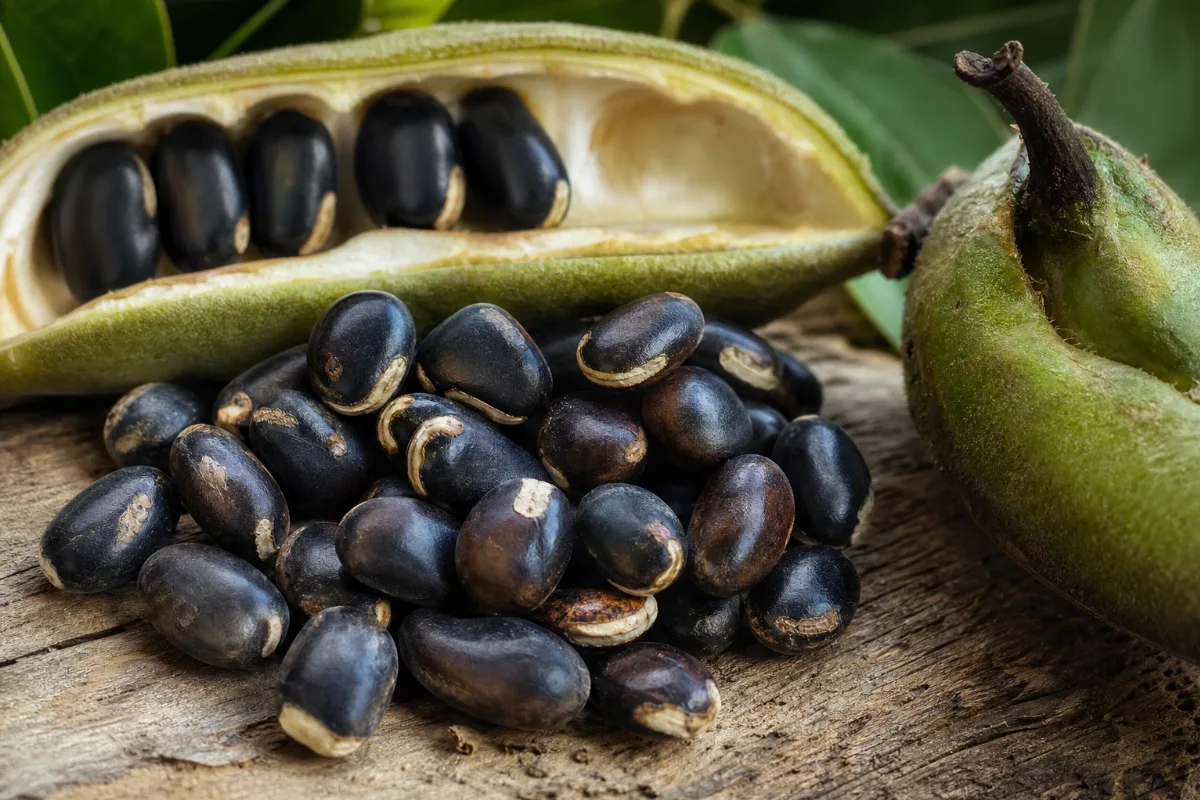
Griffonia is a West African seed that is the main source of 5-HTP, which the body turns into serotonin. It is sold for mood and sleep. Almost all trials tested purified 5-HTP rather than the seed, and the evidence is small and old. The key caution: it can cause dangerous serotonin overload with antidepressants and other serotonin medicines.
General information, not medical advice. Last substantive update · Not medically reviewed. A named clinician has not signed off on this page. How this page is made
About Griffonia
Griffonia (Griffonia simplicifolia) is a West African climbing shrub whose seed holds a lot of 5-HTP, the building block the body uses to make serotonin. Seed extracts and purified 5-HTP are sold for mood, sleep and appetite. The trials are mostly small, old and of purified 5-HTP. The serious issue is safety: serotonin syndrome with antidepressants and other serotonin medicines, product contamination concerns, and little data for pregnancy.
What it is
Griffonia simplicifolia is a legume plant of West African forests. Its seeds hold 6-20% 5-HTP by wet weight, which is why they are the commercial source of 5-HTP. The seed also holds alkaloids such as griffonine and fatty acids.
Keep three things apart: the whole seed, a seed extract, and isolated 5-HTP. Strength differs between them and between makers, and almost all human trials used isolated 5-HTP.
What the research shows
The best review is a 2002 Cochrane review. It found only two good-enough trials (64 people) of 5-HTP or tryptophan in depression. They beat placebo, but the reviewers said the evidence was not conclusive. Other uses rest on single small trials: fibromyalgia (50 people, 1990), a two-week appetite trial in people with diabetes, a 30-person sleep trial with no placebo, and old migraine studies that disagree.
A 2026 single-dose trial in 112 adults found no help for distractibility. The one 2026 trial of a Griffonia product tested pain in 18 healthy volunteers and found no useful effect. In short: the trials are of 5-HTP, not usually of whole seed.
Where it comes from
The seeds are wild-harvested in West Africa. A 2021 review says Ghana exported at least 5,550 tonnes of seed between 2005 and 2013, and names habitat loss, fewer pollinating birds and destructive harvesting as threats. Most seed goes to China for extraction, and about 48% of the extracts go to North America.
At a glance
Traditional uses history, not proof
- Insecticide, arachnicide, fodder, dye, mordant and chewing-stick in West Africa (2021 review)
- Antidepressant use is modern, not traditional
Studied for research
- Low mood and depression, low certainty (Cochrane: two small trials, not conclusive)
- Sleep, very low certainty (one small trial without placebo)
- Fibromyalgia, very low certainty (one 1990 trial)
- Appetite and weight, very low certainty (a two-week trial)
- Migraine, very low certainty (mixed old trials)
- Attention, no benefit in a single-dose trial
Main compounds
- 5-HTP (CID 439280)
- Griffonine and other alkaloids
- Linoleic and oleic acid
Common forms
- Seed extract
- Whole seed or seed powder
- Purified 5-HTP (separate product)
- Combination products
Research links: Cochrane review: tryptophan and 5-HTP for depression (2002) · Sleep trial in older adults (2024) · Griffonia pain trial (2026) · Peak X contaminant study (2003) · Safety review of 5-HTP (2004) · Health Canada 5-HTP monograph · Research Library · Genes & Biomarkers Library
The plant and its history
- Accepted scientific name
- Griffonia simplicifolia (Vahl ex DC.) Baill.
- Naming authority
- (Vahl ex DC.) Baill.
- Common names
- Griffonia (English); Griffonia seed (English)
- Botanical family
- Fabaceae (legume family)
- Classification
- Plantae > Tracheophyta > Magnoliopsida > Fabales > Fabaceae > Griffonia > Griffonia simplicifolia
- Native range
- West Africa. Five countries export the seed: Cote d'Ivoire, Ghana, Liberia, Nigeria and Togo (2021 review).
- Habitat
- Understorey of West African forests; wild stands in forest reserves and national parks (2021 review).
- What the plant looks like
- Roots: Not described in sources read; Stems: Plants are sometimes cut to harvest the pods; Leaves: Used as livestock forage (2021 review); Flowers: Bird-pollinated (2021 review); Fruit: Pods with 1-4 seeds each; the seed holds 6-20% 5-HTP by wet weight (2021 review)
- Cultivation
- The commercial supply comes from wild stands; no cultivation data were found in the sources read.
- Harvest and processing
- Pods are collected from wild plants, seeds are exported (mainly to China), and 5-HTP extracts are made there and re-exported, about 48% to North America (2021 review).
- Sustainability and conservation
- The trade is wild-harvested. The 2021 review names six threats (forest loss, fewer pollinating birds, invasive plants, grazing, industrial seed removal and destructive harvest) but also notes some resilience from re-sprouting. No formal IUCN status was checked.
Traditional use and history history, not clinical proof
| Tradition or era | Documented use | Source |
|---|---|---|
| Traditional West African uses | Insecticide, arachnicide, fodder, dye, mordant and chewing-stick. Antidepressant use is not listed as traditional. | p33991640 |
| 1980s export trade | Ghana exported 75-80 tonnes of seed to Europe, already its main medicinal plant export. | p33991640 |
| 1989 to today | After L-tryptophan supplements were withdrawn in 1989 for EMS, 5-HTP became a popular supplement in its place. | p15068828 |
| 2005-2013 | Ghana exported at least 5,550 tonnes of seed (about 9.1 to 13.5 billion seeds). | p33991640 |
| Present day | No EMA/HMPC monograph found; Health Canada has a 5-HTP natural health product monograph but has not approved 5-HTP as a food additive (2024). | s-healthcanada-nhp-5htp |
Traditional use shows how a plant was used. It does not show that a supplement works or is safe today.
What is inside, and how it may work
What the plant contains and how those compounds act in cells and animals. Laboratory and animal mechanisms are not proven effects in people.
Main compounds
| Compound | Family | Where it is concentrated | Activity studied | Level of evidence |
|---|---|---|---|---|
| 5-Hydroxytryptophan (5-HTP, oxitriptan) PubChem 439280 | Amino acid (tryptophan derivative) | Seed 6-20% of seed wet weight (2021 review) | The immediate precursor of serotonin; the compound tested in nearly all trials. 3 18 24 | Human data |
| Griffonine and other alkaloids | Beta-carboline alkaloid derivative | Seed Lower than 5-HTP (2019 analysis) | Not studied for health effects in the sources read; CID not verified. 18 | Laboratory research |
| Linoleic and oleic acid | Unsaturated fatty acids | Seed | Dominant seed fatty acids (2019 analysis). 18 | Laboratory research |
| Serotonin (made from 5-HTP in the body) PubChem 5202 | Monoamine neurotransmitter | Not in the plant for this purpose | Raised in blood after 5-HTP in one small trial. 15 24 | Human data |
| Carbidopa (interacting drug) PubChem 34359 | Decarboxylase inhibitor | Not a plant compound | Blocks conversion of 5-HTP to serotonin outside the brain. 17 24 | Human data |
| 4,5-Tryptophan-dione (peak X contaminant) | Tryptophan derivative | Manufacturing contaminant, not a plant constituent 0.5% to 10.3% of the case-implicated level in 6 shop samples | Putative neurotoxin; CID not looked up. 6 | Laboratory research |
Mechanisms, receptors and pathways
| Target or pathway | Gene or receptor | What was found | Level |
|---|---|---|---|
| Serotonin production | Amino acid decarboxylase (AADC) converts 5-HTP to serotonin; tryptophan hydroxylase makes 5-HTP | 5-HTP bypasses the slow tryptophan hydroxylase step; serotonin is then turned into melatonin. 7 17 | Human data |
| Peripheral conversion | AADC outside the brain | Blocked by carbidopa, so more 5-HTP can reach the brain. 17 | Human data |
| Blood serotonin | Not stated | Serum serotonin rose with daily 5-HTP in older adults. 15 | Human data |
| Pain facilitation | Not stated | A larger allodynia area on Griffonia led authors to suggest serotonergic facilitation of pain pathways; speculative. 12 | Human data |
| Gut bacteria | Not applicable | Microbial diversity rose in poor sleepers; effect on health unknown. 15 | Human data |
Absorption, metabolism and elimination
- Absorption
- Not found in the abstracts read.
- Distribution
- Crosses the blood-brain barrier (2026 trial introduction).
- Metabolism
- Converted to serotonin by AADC; peripheral conversion can be blocked by carbidopa.
- Elimination
- Not found.
- Bioavailability
- Not found.
Isolated compounds versus whole extracts
Keep three things apart: the whole seed, the seed extract, and isolated 5-HTP. Nearly all trials used isolated 5-HTP. The one Griffonia product trial was small, in healthy volunteers, and tested pain. Extract strength varies, and seed 5-HTP content ranges widely. Contaminants (peak X) were reported in 5-HTP products, so source and purity matter. Results from one form should not be assumed for the others.
Nutritional composition
Griffonia seed is a medicinal seed, not a food. 5-HTP also occurs only in limited amounts in foods (Health Canada). Its seed oil is mostly linoleic and oleic acid.
3 low certainty4 very low certainty1 not enough evidence
What is Griffonia good for?
The studied uses and how strong the human evidence is. 'Low' means a few small trials. 'Very low' means one small or uncontrolled study. 'Insufficient' means no usable human trial. These results are for purified 5-HTP unless stated. Safety comes first: see the Safety tab.
Benefits, one by one
Each card is a research question, not a promise. Tap a goal to filter. Open a card to see the studies, doses and limits.
Low mood and depression
Low certaintyThe best review found two good-enough trials of 5-HTP or tryptophan, 64 people in all, that beat placebo. The reviewers still said the evidence was not strong enough to be conclusive, and proven antidepressants exist.
4 studiesPurified 5-HTP or tryptophan; not whole seed.
Studies, doses and limits
What the trials found
The 2002 Cochrane review searched 108 trials and kept only 2 (64 people) that were randomised, placebo-controlled and used a depression scale. 5-HTP and tryptophan were pooled. A 2006 review (Turner) looks at the placebo-controlled trials in detail, but only its abstract was read here.
Results
Better than placebo in the pooled analysis, but the reviewers say the quality was too low to be conclusive and that the possible link with eosinophilia-myalgia syndrome had not been settled.
Effect sizes as reported
Peto odds ratio 4.10 (95% CI 1.28 to 13.15); risk difference 0.36; NNT 2.78 (Cochrane, 2 trials, 64 people).
Why this rating
Only two small old trials passed quality screening; the review's own conclusion is 'not conclusive'.
Form and dose studied
Purified 5-HTP or tryptophan; not whole seed.
Who was studied
Adults with unipolar depression or dysthymia.
Limits
Tiny numbers, old trials, 5-HTP and tryptophan pooled, wide confidence interval.
Why researchers looked
5-HTP becomes serotonin, a brain chemical targeted by common antidepressants, so it was tested in depression from the 1970s.
Traditional use
Griffonia seed was not a traditional mood medicine in the sources read. Traditional uses named are insecticide, arachnicide, fodder, dye, mordant and chewing-stick (2021 review); the antidepressant use is modern, after 5-HTP was found in the seeds.
Proposed mechanism Pharmacological theory
5-HTP is the step just before serotonin in the body's own production line, so taking it can raise serotonin. Raising a building block does not by itself prove a health benefit.
A proposed mechanism does not show that the effect happens in people.
Never combine with antidepressants without a prescriber's direction: serotonin syndrome. Depression needs proper assessment.
Sleep quality
Very low certaintyOne small 12-week trial in older adults found 5-HTP improved some sleep scores in people who slept badly, and not in good sleepers. There was no placebo.
3 studiesPurified 5-HTP.
Studies, doses and limits
What the trials found
Sutanto 2024: 30 older adults in Singapore were randomised to 5-HTP or no supplement for 12 weeks, single-blind. Blood serotonin rose. Among poor sleepers only, a questionnaire sleep measure improved and gut bacteria diversity rose.
Results
Some sleep components better in poor sleepers; no benefit shown for good sleepers.
Effect sizes as reported
Questionnaire change -2.80 +/- 1.10, p = 0.005 in poor sleepers (as printed in the abstract; the abstract's labelling is unclear).
Why this rating
One 30-person single-blind trial with no placebo and a sub-group result.
Form and dose studied
Purified 5-HTP.
Who was studied
Healthy older adults, Singapore.
Limits
No placebo, tiny, sub-group, abstract wording unclear. Drowsiness is a listed effect, so driving caution applies.
Why researchers looked
Serotonin is a building block for melatonin, so 5-HTP has been tried for sleep.
Traditional use
Not a traditional sleep remedy in the sources read.
Proposed mechanism Pharmacological theory
5-HTP is the step just before serotonin in the body's own production line, so taking it can raise serotonin. Raising a building block does not by itself prove a health benefit. Maffei's review notes serotonin is turned into melatonin.
A proposed mechanism does not show that the effect happens in people.
Drowsiness; avoid with sedatives unless a pharmacist agrees. Serotonin syndrome risk, especially with antidepressants; see the Safety tab.
Anxiety
Not enough evidenceNo anxiety trial was read for this page. Older summaries say early studies are unclear and might point both ways.
3 studiesPurified 5-HTP.
Studies, doses and limits
What the trials found
Maffei's review lists anxiety and panic among topics discussed, but only its abstract was read, so no result can be quoted. Our earlier summary of a now-unavailable MedlinePlus page said early anxiety studies were unclear.
Results
Not established.
Effect sizes as reported
None extracted.
Why this rating
No anxiety trial was read.
Form and dose studied
Purified 5-HTP.
Who was studied
Not applicable.
Limits
Evidence gap; Health Canada asks people with anxiety or depression to speak to a professional before using 5-HTP.
Why researchers looked
Serotonin affects mood and worry, so 5-HTP has been tried.
Traditional use
Not a traditional use.
Proposed mechanism Pharmacological theory
5-HTP is the step just before serotonin in the body's own production line, so taking it can raise serotonin. Raising a building block does not by itself prove a health benefit.
A proposed mechanism does not show that the effect happens in people.
Serotonin syndrome risk, especially with antidepressants; see the Safety tab.
Attention and distractibility (ADHD traits)
Low certaintyA 2026 trial of a single dose in 112 adults found no helpful effect on distractibility, and about 1 in 5 on 5-HTP had fatigue, nausea or vomiting.
1 studiesPurified 5-HTP, single dose.
Studies, doses and limits
What the trials found
Jackson 2026: 56 adults with high ADHD traits and 56 with low traits were randomised to 5-HTP or placebo, then tested 90 minutes later on two attention tasks.
Results
No positive effect on any distractibility measure. One task score was not improved on 5-HTP while placebo improved. 19.6% of the 5-HTP group had adverse events.
Effect sizes as reported
No effect sizes in the abstract; 19.6% adverse events.
Why this rating
One randomised trial, but a single dose and a short test.
Form and dose studied
Purified 5-HTP, single dose.
Who was studied
Adults with high or low ADHD traits (self-rated screen, not diagnosed).
Limits
Single dose; long-term use not tested; not clinical ADHD.
Why researchers looked
Some researchers think serotonin pathways may be involved in ADHD.
Traditional use
Not a traditional use.
Proposed mechanism Pharmacological theory
5-HTP is the step just before serotonin in the body's own production line, so taking it can raise serotonin. Raising a building block does not by itself prove a health benefit.
A proposed mechanism does not show that the effect happens in people.
Fatigue, nausea and vomiting seen.
Migraine and headache prevention
Very low certaintyOld trials give a mixed picture: 5-HTP did about as well as an older migraine drug in adults (no placebo), but did no better than placebo in children.
4 studiesPurified 5-HTP.
Studies, doses and limits
What the trials found
Titus 1986: 124 adults, 5-HTP versus methysergide, similar improvement (71% versus 75%), no placebo. Santucci 1986: 21 children, no difference from placebo. Nicolodi 1999: authors report fewer migraines in a placebo-controlled study; abstract has no numbers.
Results
Mixed. Adults improved, but without a placebo arm; children showed no benefit over placebo.
Effect sizes as reported
71% (5-HTP) and 75% (methysergide) improved; no other figures in the abstracts.
Why this rating
Three old, small studies pointing different ways; the only one clearly placebo-controlled with numbers was negative.
Form and dose studied
Purified 5-HTP.
Who was studied
Adults with migraine; children aged 6-12.
Limits
No modern trial. Methysergide itself has serious side effects. Combined with triptans, serotonin syndrome is a theoretical concern.
Why researchers looked
Serotonin has long been linked to migraine in older theories, so 5-HTP was tried to prevent attacks.
Traditional use
Not a traditional use.
Proposed mechanism Pharmacological theory
5-HTP is the step just before serotonin in the body's own production line, so taking it can raise serotonin. Raising a building block does not by itself prove a health benefit.
A proposed mechanism does not show that the effect happens in people.
Serotonin syndrome risk, especially with antidepressants; see the Safety tab.
Fibromyalgia
Very low certaintyOne 1990 trial of 50 people reported that 5-HTP improved all fibromyalgia measures compared with placebo, with mild side effects. It has not been repeated in the sources read.
2 studiesPurified 5-HTP.
Studies, doses and limits
What the trials found
Caruso 1990 (Milan): 50 patients, double-blind, 5-HTP versus placebo. The abstract says all clinical measures improved significantly, with only mild and transient side effects, and gives no numbers.
Results
Improved on all measures according to the abstract; size unknown.
Effect sizes as reported
No figures in the abstract.
Why this rating
One 35-year-old trial, abstract without numbers, no replication found.
Form and dose studied
Purified 5-HTP.
Who was studied
Adults with primary fibromyalgia.
Limits
Single old trial; the authors themselves ask for more studies. Health Canada's monograph lists fibromyalgia as a use but also asks people with anxiety or depression to seek advice.
Why researchers looked
Low serotonin has been proposed in fibromyalgia pain and sleep problems.
Traditional use
Not a traditional use.
Proposed mechanism Pharmacological theory
5-HTP is the step just before serotonin in the body's own production line, so taking it can raise serotonin. Raising a building block does not by itself prove a health benefit.
A proposed mechanism does not show that the effect happens in people.
Serotonin syndrome risk, especially with antidepressants; see the Safety tab.
Appetite and weight
Very low certaintyA two-week trial in 25 overweight people with type 2 diabetes found that 5-HTP cut food intake and body weight. It was very short, tiny and in a special group.
2 studiesPurified 5-HTP.
Studies, doses and limits
What the trials found
Cangiano 1998: 25 overweight adults with type 2 diabetes were randomised, double-blind, to 5-HTP or placebo for 2 weeks with no diet advice; 20 finished. The 5-HTP group ate less (less carbohydrate and fat) and lost weight. The abstract gives no numbers.
Results
Lower intake and weight over 2 weeks.
Effect sizes as reported
No figures in the abstract.
Why this rating
One two-week trial, 20 completers, no figures, no long-term follow-up.
Form and dose studied
Purified 5-HTP.
Who was studied
Overweight adults with type 2 diabetes.
Limits
Weight loss over two weeks is not lasting weight loss. People with diabetes should speak to their care team before adding any supplement.
Why researchers looked
Serotonin helps signal fullness, and low brain serotonin was proposed to drive carbohydrate craving.
Traditional use
Not a traditional use.
Proposed mechanism Pharmacological theory
5-HTP is the step just before serotonin in the body's own production line, so taking it can raise serotonin. Raising a building block does not by itself prove a health benefit. This is a hypothesis about appetite signalling.
A proposed mechanism does not show that the effect happens in people.
GI upset and nausea are common listed effects. Serotonin syndrome risk, especially with antidepressants; see the Safety tab.
Pain sensitivity (experimental)
Low certaintyThe only trial of an actual Griffonia product found no useful effect on experimentally induced pain in healthy volunteers, and one measure suggested slightly more sensitivity.
1 studiesGriffonia simplicifolia product (5-HTP content not stated in the abst…
Studies, doses and limits
What the trials found
Schlemmer 2026: 18 healthy volunteers took a Griffonia product or placebo for 28 days each in a crossover. Pain after a heat test did not change; only the spread of mechanical allodynia was larger on Griffonia. Two of 18 had mild, short-lived side effects.
Results
No useful effect; one possibly negative signal.
Effect sizes as reported
Pain after heat test: beta -4.17 (95% CI -14.44 to 6.10). Allodynia distance: 95% CI 0.05 to 1.59.
Why this rating
Well-designed crossover but only 17 completers, healthy people and laboratory pain.
Form and dose studied
Griffonia simplicifolia product (5-HTP content not stated in the abstract).
Who was studied
Healthy volunteers.
Limits
Does not tell us about people with real pain conditions.
Why researchers looked
Serotonin is involved in how the brain dampens pain signals, and 5-HTP was tested for that.
Traditional use
Not a traditional use.
Proposed mechanism Pharmacological theory
5-HTP is the step just before serotonin in the body's own production line, so taking it can raise serotonin. Raising a building block does not by itself prove a health benefit.
A proposed mechanism does not show that the effect happens in people.
Mild transient side effects in 2 of 18.
Connections to the rest of health
How Griffonia connects to the rest of our health knowledge graph. Every link says what kind of connection it is. A safety link (for example to the liver) is a warning, not a benefit. A study that merely mentions a topic never creates a benefit link.
Explore every connection: goals, body systems, organs, symptoms, genes
A. Wellness goals
| Connected to | Kind of connection | Evidence status | Context | Studies |
|---|---|---|---|---|
| Mood Balance | Potential benefit | Low certainty | Low mood and depression: The best review found two good-enough trials of 5-HTP or tryptophan, 64 people in all, that beat placebo. The reviewers still said the evidence was not strong enough to be conclusive, and proven antidepressants exist. | 13 17 7 3 |
| Better Sleep | Potential benefit | Very low certainty | Sleep quality: One small 12-week trial in older adults found 5-HTP improved some sleep scores in people who slept badly, and not in good sleepers. There was no placebo. | 15 7 21 |
| Sleep Quality | Potential benefit | Very low certainty | Sleep quality: One small 12-week trial in older adults found 5-HTP improved some sleep scores in people who slept badly, and not in good sleepers. There was no placebo. | 15 7 21 |
| Anxiety Support | Preliminary mechanism | Not enough evidence | Anxiety: No anxiety trial was read for this page. Older summaries say early studies are unclear and might point both ways. | 7 22 21 |
| Calm Relaxation | Preliminary mechanism | Not enough evidence | Anxiety: No anxiety trial was read for this page. Older summaries say early studies are unclear and might point both ways. | 7 22 21 |
| Better Focus | Potential benefit | Low certainty | Attention and distractibility (ADHD traits): A 2026 trial of a single dose in 112 adults found no helpful effect on distractibility, and about 1 in 5 on 5-HTP had fatigue, nausea or vomiting. | 5 |
| Mental Clarity | Potential benefit | Low certainty | Attention and distractibility (ADHD traits): A 2026 trial of a single dose in 112 adults found no helpful effect on distractibility, and about 1 in 5 on 5-HTP had fatigue, nausea or vomiting. | 5 |
| Joint Support | Potential benefit | Very low certainty | Fibromyalgia: One 1990 trial of 50 people reported that 5-HTP improved all fibromyalgia measures compared with placebo, with mild side effects. It has not been repeated in the sources read. | 2 21 |
| Weight Management | Potential benefit | Very low certainty | Appetite and weight: A two-week trial in 25 overweight people with type 2 diabetes found that 5-HTP cut food intake and body weight. It was very short, tiny and in a special group. | 1 21 |
B. Body systems
| Connected to | Kind of connection | Evidence status | Context | Studies |
|---|---|---|---|---|
| Stress Mood | Biological association | Low certainty | Studied for: Low mood and depression | 13 17 7 3 |
| Nervous System | Biological association | Low certainty | Studied for: Low mood and depression Studied for: Anxiety | 13 17 7 3 22 21 5 16 11 9 2 12 |
| Sleep Recovery | Biological association | Very low certainty | Studied for: Sleep quality | 15 7 21 |
| Musculoskeletal System | Biological association | Very low certainty | Studied for: Fibromyalgia | 2 21 |
| Metabolism Weight | Biological association | Very low certainty | Studied for: Appetite and weight | 1 21 |
E. Health conditions
| Connected to | Kind of connection | Evidence status | Context | Studies |
|---|---|---|---|---|
| Serotonin syndrome | Drug or supplement interaction | Low certainty | Authoritative guidance and one case report with linezolid. Antidepressants and other serotonin medicines; one case report with linezolid. Preparation or compound: 5-HTP; Griffonia extract |
21 10 |
| Eosinophilia-myalgia syndrome | Adverse effect or risk | Mixed findings | Case report and contaminant study; disputed by a review. Contaminated 5-HTP; disputed. Preparation or compound: Contaminated 5-HTP |
8 6 4 |
| Pregnancy | Contraindication | Not enough evidence | Health Canada advice; no safety studies read. Health Canada advice; no safety trials. Preparation or compound: All forms |
21 |
I. Biomarkers
| Connected to | Kind of connection | Evidence status | Context | Studies |
|---|---|---|---|---|
| Depression rating scales | Biological association | Low certainty | Measured in trials: lowered. A lab change is not the same as a health benefit. | 13 |
| Global sleep score (PSQI) and sleep tracker | Biological association | Very low certainty | Measured in trials: lowered. A lab change is not the same as a health benefit. | 15 |
| Blood serotonin | Biological association | Very low certainty | Measured in trials: raised. A lab change is not the same as a health benefit. | 15 |
| Distractibility (computer tasks) | Biological association | Low certainty | Measured in trials: no-change. A lab change is not the same as a health benefit. | 5 |
| Daily food (energy) intake and body weight | Biological association | Very low certainty | Measured in trials: lowered. A lab change is not the same as a health benefit. | 1 |
| Mechanical allodynia distance (experimental pain) | Biological association | Low certainty | Measured in trials: raised. A lab change is not the same as a health benefit. | 12 |
| Gut bacteria diversity | Biological association | Very low certainty | Measured in trials: raised. A lab change is not the same as a health benefit. | 15 |
J. Genes, receptors and enzymes
| Connected to | Kind of connection | Evidence status | Context | Studies |
|---|---|---|---|---|
| DDC (aromatic L-amino acid decarboxylase / AADC) | Preliminary mechanism | Human | The enzyme that turns 5-HTP into serotonin; gene symbol from general knowledge, not read in the abstracts. | 17 |
| TPH1 and TPH2 (tryptophan hydroxylase) | Preliminary mechanism | Human | Make 5-HTP from tryptophan; named in Maffei's abstract. | 7 |
L. Active compounds
| Connected to | Kind of connection | Evidence status | Context | Studies |
|---|---|---|---|---|
| 5-Hydroxytryptophan (5-HTP, oxitriptan) | Biological association | Human | The immediate precursor of serotonin; the compound tested in nearly all trials. Preparation or compound: Seed |
3 18 24 |
| Griffonine and other alkaloids | Biological association | In vitro | Not studied for health effects in the sources read; CID not verified. Preparation or compound: Seed |
18 |
| Linoleic and oleic acid | Biological association | In vitro | Dominant seed fatty acids (2019 analysis). Preparation or compound: Seed |
18 |
| Serotonin (made from 5-HTP in the body) | Biological association | Human | Raised in blood after 5-HTP in one small trial. Preparation or compound: Not in the plant for this purpose |
15 24 |
| Carbidopa (interacting drug) | Biological association | Human | Blocks conversion of 5-HTP to serotonin outside the brain. Preparation or compound: Not a plant compound |
17 24 |
| 4,5-Tryptophan-dione (peak X contaminant) | Biological association | In vitro | Putative neurotoxin; CID not looked up. Preparation or compound: Manufacturing contaminant, not a plant constituent |
6 |
Each connection is stored with the ingredient, the connected record, the kind of connection, the evidence status, the supporting studies, the preparation or compound involved, and a review date (last reviewed October 25, 2026).
Evidence at a glance: what changed in 7 lab markers
Tap a number to show only those markers. Counts are markers, not people.
The evidence
The research centre for Griffonia. Every record here was checked against PubMed or the publisher's page; we never list a study we have not verified.
Evidence by outcome
Bars show how many studies we found for each outcome, not how well it works. People are added up across trials only (reviews are not added, to avoid double counting).
How we rate evidence
High certainty
Several well-run trials or reviews agree; further research is unlikely to change the picture much.
Moderate certainty
Good trials point the same way, but some doubt remains.
Low certainty
Small, short or inconsistent trials. The finding could change with better research.
Very low certainty
Very little or very weak human data. Treat as a possibility only.
Mixed findings
Trials or reviews disagree with each other.
Not enough evidence
Not enough human research to say either way.
Evidence against
Good research found no benefit, or found harm.
We take the reviewers' own risk-of-bias and GRADE statements where they exist, and otherwise judge from study size, design, consistency, directness and whether a product matches what is sold. Many publications do not make evidence high. Method note: We searched PubMed, read the abstracts of every study cited, and checked names against GBIF, NCBI Taxonomy and PubChem. Pages that could not be found or opened are marked as not found. Where only a summary was available, we say so.
Study library: every study we checked 25
| Study | Design | People | Product, dose, length | Result |
|---|---|---|---|---|
| Cangiano 1998 Effects of oral 5-hydroxy-tryptophan on energy intake and macronutrient selection in non-insulin dependent diabetic patients Int J Obes Relat Metab Disord · PMID 9705024 · DOI |
Controlled trial |
25 Overweight adults with type 2 diabetes; 20 finished (9 5-HTP, 11 placebo) |
Purified 5-HTP not applicable (purified compound) 750 mg per day as reported 2 weeks · vs Placebo |
The 5-HTP group ate less (less carbohydrate and fat) and lost weight over the two weeks; the abstract gives no numbers. Short-term fall in intake and weight Methods, limits and fundingOutcomes: Daily energy intake, carbohydrate and fat intake, body weight Limitations: Two weeks only, 20 completers, people with diabetes (not a general population), no diet advice given, abstract has no figures. Funding and conflicts: Not stated in the abstract Read: abstract |
| Caruso 1990 Double-blind study of 5-hydroxytryptophan versus placebo in the treatment of primary fibromyalgia syndrome J Int Med Res · PMID 2193835 · DOI |
Controlled trial |
50 Adults with primary fibromyalgia syndrome (Milan, Italy) |
Purified 5-HTP not applicable (purified compound) Not stated in the abstract Not stated in the abstract · vs Placebo |
The abstract says all clinical measures improved significantly with 5-HTP and side effects were mild and transient. It gives no numbers. Improvement reported; size unknown Methods, limits and fundingOutcomes: Clinical fibromyalgia measures Limitations: Abstract only, no figures; 1990 trial; the authors themselves ask for further controlled studies. Funding and conflicts: Not stated in the abstract Read: abstract |
| Cunningham 2021 From forest to pharmacy: Should we be depressed about a sustainable Griffonia simplicifolia (Fabaceae) seed supply chain? J Ethnopharmacol · PMID 33991640 · DOI |
Trade and ecology review |
Wild Griffonia in West Africa | Griffonia seed (trade) seed Not stated in the abstract Not stated in the abstract · vs None |
Seeds hold 6-20% 5-HTP (wet weight). Wild West African populations are the sole commercial source. Ghana exported at least 5,550 tonnes (about 9.1 to 13.5 billion seeds) in 2005-2013. China is the main importer, and about 48% of the 5-HTP extracts are re-exported to North America. Six threats are named, including habitat loss and destructive harvest. Supply is a real concern Methods, limits and fundingOutcomes: Trade volumes and harvest sustainability Limitations: Trade analysis, not a health study. Funding and conflicts: One author is affiliated with Traditional Medicinals, a herbal products company (affiliation in the paper) Read: abstract |
| Das 2004 Safety of 5-hydroxy-L-tryptophan Toxicol Lett · PMID 15068828 · DOI |
Narrative review |
Published and market experience with 5-HTP | Purified 5-HTP not applicable Not stated in the abstract Not stated in the abstract · vs None |
The authors say no definitive toxicity cases have emerged in about 20 years of worldwide use, with the possible exception of one unresolved Canadian case, and call the 'peak X' finding not credible. Reassuring on cases; argues against concern Methods, limits and fundingOutcomes: Safety record, contaminants Limitations: Written by authors at a supplement-ingredient company (ISSI Laboratories); a later mass-spectrometry paper (Klarskov 2003) reads the same peak differently. Funding and conflicts: Industry-linked (ISSI Laboratories affiliation in the paper) Read: abstract |
| Jackson 2026 The effect of 5-hydroxytryptophan, a serotonin precursor, on adults with high levels of ADHD traits: A randomised, controlled trial PLoS One · PMID 42160304 · DOI |
Controlled trial |
112 56 adults with high and 56 with low ADHD traits (self-report screen), Sheffield, UK |
Purified 5-HTP not applicable (purified compound) Single dose (amount not given in the abstract) One dose, tested 90 minutes later · vs Placebo |
No positive effect on any distractibility measure. 19.6% of the 5-HTP group had fatigue, nausea or vomiting. No benefit Methods, limits and fundingOutcomes: Distractibility on two computer tasks Limitations: One dose only, people with ADHD traits not a diagnosis, short test. Funding and conflicts: The authors declare no competing interests Read: abstract |
| Klarskov 2003 Structural characterization of a case-implicated contaminant, 'Peak X,' in commercial preparations of 5-hydroxytryptophan J Rheumatol · PMID 12508395 |
Laboratory analysis in-vitro |
6 Case-implicated 5-HTP plus 6 over-the-counter samples |
Purified 5-HTP products not applicable Not stated in the abstract Not stated in the abstract · vs Authentic reference compound |
Peak X1 was identified as 4,5-tryptophan-dione, a putative neurotoxin. In the 6 shop samples it was 0.5% to 10.3% of the amount in the case-implicated product. The authors say this gives some cause for concern. Contaminant identified in shop products Methods, limits and fundingOutcomes: Chemical structure of the contaminant Limitations: Chemistry, not a clinical study; samples from the early 2000s; health effect not tested. Funding and conflicts: Not stated in the abstract Read: abstract |
| Maffei 2020 5-Hydroxytryptophan (5-HTP): Natural Occurrence, Analysis, Biosynthesis, Biotechnology, Physiology and Toxicology Int J Mol Sci · PMID 33375373 · DOI |
Narrative review |
Animal studies and human trials of 5-HTP | Purified 5-HTP not applicable Not stated in the abstract Not stated in the abstract · vs None |
Discusses 5-HTP in depression, anxiety, panic, sleep, obesity, myoclonus and serotonin syndrome, and toxic impurities in tryptophan and 5-HTP preparations. 5-HTP makes serotonin, which is then turned into melatonin. Background Methods, limits and fundingOutcomes: Physiology, uses, toxicity, impurities Limitations: Abstract only was read; narrative, not a systematic review. Funding and conflicts: The author declares no conflict of interest Read: abstract |
| Michelson 1994 An eosinophilia-myalgia syndrome related disorder associated with exposure to L-5-hydroxytryptophan J Rheumatol · PMID 7699627 |
Case series |
A family and a comparison group exposed to L-5-HTP | Purified L-5-HTP (contaminated batch) not applicable Not stated in the abstract Not stated in the abstract · vs Other L-5-HTP samples |
One family member had EMS and two others had raised eosinophils. Their 5-HTP held an impurity absent from samples used by other patients. After switching to 5-HTP without it, eosinophilia resolved in 2 members. Case-level link to an impurity Methods, limits and fundingOutcomes: Eosinophilia-myalgia-like illness; impurities by HPLC Limitations: A family report from the FDA; small; cause not proven. Funding and conflicts: FDA authors Read: abstract |
| Nicolodi 1999 L-5-hydroxytryptophan can prevent nociceptive disorders in man Adv Exp Med Biol · PMID 10721054 · DOI |
Rct (placebo controlled, prospective) |
People predisposed to headache | Purified L-5-HTP not applicable (purified compound) Not stated in the abstract Long-term · vs Placebo |
The authors report a significant decrease in migraine with 5-HTP in a long-term placebo-controlled study. The abstract has no numbers or sample size. Reported fall in migraine; size unknown Methods, limits and fundingOutcomes: Migraine attacks Limitations: Abstract only, no figures, book chapter, no independent confirmation found. Funding and conflicts: Not stated in the abstract Read: abstract |
| Ostabal Artigas 2015 Serotoninergic syndrome due to interaction between linezolid and 5-hydroxytryptophan (Spanish) Med Clin (Barc) · PMID 25978918 · DOI |
Case report |
1 Intensive care patient |
5-HTP with linezolid (an antibiotic that blocks MAO) not applicable Not stated in the abstract Not stated in the abstract · vs None |
Only the title, journal and year could be confirmed; PubMed shows no abstract. The title reports serotonin syndrome from linezolid plus 5-HTP. Title only Methods, limits and fundingOutcomes: Serotonin syndrome Limitations: No abstract available; details unknown. Funding and conflicts: Unknown Read: title-only |
| Santucci 1986 L-5-hydroxytryptophan versus placebo in childhood migraine prophylaxis: a double-blind crossover study Cephalalgia · PMID 3533271 · DOI |
Rct (double blind crossover) |
27 Children aged 6-12 with migraine; 21 started the trial |
Purified L-5-HTP not applicable (purified compound) About 5 mg per kg body weight per day as reported 12 weeks per period · vs Placebo |
Both 5-HTP and placebo cut migraine; no difference between them in the first period. No benefit over placebo Methods, limits and fundingOutcomes: Migraine index and attack frequency Limitations: Small, old, crossover with a period effect. Funding and conflicts: Not stated in the abstract Read: abstract |
| Schlemmer 2026 The Effect of Griffonia simplicifolia on Pain Intensity, Central and Peripheral Sensitization, and Pain Modulation in Healthy Volunteers Nutrients · PMID 42197069 · DOI |
Rct (double blind crossover) |
18 Healthy volunteers (17 finished), Graz, Austria |
Griffonia simplicifolia product (extract; 5-HTP content not stated in the abstract) not stated in the abstract 100 mg once daily as reported 28 days, then 4-week washout and crossover · vs Placebo |
No significant effect on pain after the heat test (beta -4.17; 95% CI -14.44 to 6.10). Only one measure differed: mechanical allodynia spread was larger on Griffonia (95% CI 0.05 to 1.59). Mild, short-lived side effects in 2 of 18 (11%). No useful effect; a possible pain-sensitising signal (-14.44 to 6.10) Methods, limits and fundingOutcomes: Experimental pain tests (heat-induced sensitization, thresholds, pain modulation) Limitations: Healthy people, experimental pain, not a clinical condition; 18 people. Funding and conflicts: The authors declare no conflicts of interest Read: abstract |
| Shaw 2002 Tryptophan and 5-hydroxytryptophan for depression Cochrane Database Syst Rev · PMID 11869656 · DOI |
Systematic review |
64 Adults with unipolar depression or dysthymia; 2 of 108 trials qualified |
Purified 5-HTP or tryptophan (results combined) not applicable (purified compounds) Not stated in the abstract Not stated in the abstract · vs Placebo |
Better than placebo: Peto odds ratio 4.10 (95% CI 1.28 to 13.15), risk difference 0.36, NNT 2.78. The reviewers call the evidence of insufficient quality to be conclusive. Possible benefit, not conclusive (OR 1.28 to 13.15) Methods, limits and fundingOutcomes: Depressive symptom scales Limitations: Only 2 trials and 64 people; 5-HTP and tryptophan pooled; old trials. The review also notes the unresolved link with eosinophilia-myalgia syndrome. Funding and conflicts: Not stated in the abstract Read: abstract |
| Sternberg 1980 Development of a scleroderma-like illness during therapy with L-5-hydroxytryptophan and carbidopa N Engl J Med · PMID 6997735 · DOI |
Case report |
1 A patient with intention myoclonus given 5-HTP with carbidopa |
L-5-HTP plus carbidopa not applicable Not stated in the abstract Not stated in the abstract · vs None |
A scleroderma-like illness developed. Kynurenine stayed high after stopping and rose again on rechallenge. It was not seen in 8 other patients on the same combination, nor in 10 patients on levodopa with carbidopa. The authors suggest high serotonin plus a kynurenine enzyme abnormality may matter. One patient; not shown to be common Methods, limits and fundingOutcomes: Scleroderma-like illness; plasma kynurenine Limitations: Single case with small comparison groups; 1980; people with a neurological disease taking medicinal amounts. Funding and conflicts: Not stated in the abstract Read: abstract |
| Sutanto 2024 The impact of 5-hydroxytryptophan supplementation on sleep quality and gut microbiota composition in older adults: A randomized controlled trial Clin Nutr · PMID 38309227 · DOI |
Rct (single blind, no supplement control) |
30 Older adults, mean age 66, Singapore |
Purified 5-HTP not applicable (purified compound) 100 mg per day as reported 12 weeks · vs No supplement |
Blood serotonin rose with 5-HTP. In poor sleepers only, the questionnaire score improved (the abstract prints a change of -2.80 +/- 1.10, p = 0.005, labelled sleep latency) and gut bacteria diversity rose. Good sleepers did not benefit. Small benefit in poor sleepers only Methods, limits and fundingOutcomes: Sleep quality (PSQI questionnaire and wrist actigraphy), blood serotonin, urine melatonin, gut bacteria Limitations: 30 people, single-blind, no placebo, sub-group finding, abstract text is partly garbled. Registered NCT04078724. Funding and conflicts: Conflict statement not shown in the abstract Read: abstract |
| Titus 1986 5-Hydroxytryptophan versus methysergide in the prophylaxis of migraine. Randomized clinical trial Eur Neurol · PMID 3536521 · DOI |
Rct (active comparator, no placebo) |
124 People with migraine |
Purified 5-HTP not applicable (purified compound) Not stated in the abstract Not stated in the abstract · vs Methysergide (a prescription migraine drug) |
Improvement in 71% on 5-HTP and 75% on methysergide; the effect was clearer for attack intensity and duration than for how often attacks came. Side effects were more common with methysergide. Similar to an older drug; no placebo arm Methods, limits and fundingOutcomes: Improvement in migraine attacks Limitations: No placebo group, so improvement cannot be separated from placebo response; 1986. Funding and conflicts: Not stated in the abstract Read: abstract |
| Turner 2006 Serotonin a la carte: supplementation with the serotonin precursor 5-hydroxytryptophan Pharmacol Ther · PMID 16023217 · DOI |
Narrative review |
Preclinical and clinical evidence for 5-HTP in depression | Purified 5-HTP not applicable Not stated in the abstract Not stated in the abstract · vs None |
Reviews double-blind placebo-controlled trials and safety issues, with emphasis on EMS and serotonin syndrome. It explains that the peripheral enzyme that converts 5-HTP to serotonin can be blocked by decarboxylase inhibitors such as carbidopa. Background and mechanism Methods, limits and fundingOutcomes: Efficacy and safety (EMS, serotonin syndrome) Limitations: Abstract only was read; details of individual trials not taken from it. Funding and conflicts: Not stated in the abstract Read: abstract |
| Vigliante 2019 Chemical Characterization and DNA Fingerprinting of Griffonia simplicifolia Baill. Molecules · PMID 30875930 · DOI |
Laboratory analysis in-vitro |
Commercial Griffonia seeds | Griffonia seed seed Not stated in the abstract Not stated in the abstract · vs None |
5-HTP was the main compound, followed by griffonine (a beta-carboline alkaloid derivative) and other alkaloids; linoleic and oleic acid led the fatty acids. A DNA fingerprint (PCR-RFLP) can identify the plant. Identity method Methods, limits and fundingOutcomes: Chemistry and DNA identity Limitations: Lab study. Funding and conflicts: The authors declare no conflict of interest Read: abstract |
| s-gbif-griffonia 2026 GBIF species match and record: Griffonia simplicifolia (Vahl ex DC.) Baill. (usageKey 5349428) · Source |
Database record |
Exact match, status ACCEPTED, confidence 99. Plantae, Tracheophyta, Magnoliopsida, Fabales, Fabaceae, genus Griffonia. Not applicable Methods, limits and fundingOutcomes: Record read Limitations: Name and family only. Funding and conflicts: Public body Read: full-text | ||
| s-healthcanada-food-decision 2024 Health Canada: Decision on 5-hydroxytryptophan (5-HTP) as a supplemental ingredient in foods · Source |
Regulator document |
Not approved as an added ingredient in foods: public information was insufficient to set acceptable conditions of use, 5-HTP occurs only in limited amounts in foods, and it has no history of being added to foods. Health Canada will consider a request to reconsider with more data. Page dated 2024-08-15. Not applicable Methods, limits and fundingOutcomes: Record read Limitations: Read through an automated page summary. About food, not supplements. Funding and conflicts: Public body Read: summary-via-fetch | ||
| s-healthcanada-nhp-5htp 2026 Health Canada Natural Health Products Ingredients Database: 5-HTP (5-hydroxytryptophan) monograph · Source |
Regulator document |
Lists uses (mood balance, sleep problems linked to mood, fibromyalgia symptoms, migraine prevention, weight management with diet and activity). Contraindications: scleroderma, taking antidepressants, and pregnancy for the weight-management use. Cautions: carbidopa and other serotonergic products, dextromethorphan, some pain and migraine medicines, drowsiness; consult before use in pregnancy (other uses) and breastfeeding. Adults 18 and over only. Stop and seek advice for skin hardening, muscle or joint pain or stiffness, tremor, agitation or confusion, or fast heart rate. Not applicable Methods, limits and fundingOutcomes: Record read Limitations: Read through an automated page summary, not line by line; wording paraphrased. Applies to the purified ingredient. Funding and conflicts: Public body Read: summary-via-fetch | ||
| s-medlineplus-5htp 2016 MedlinePlus (Natural Medicines) 5-HTP monograph · Source |
Authoritative guidance (unverifiable) |
Summary-only. Our earlier internal summary, which cited this page, says it rated 5-HTP possibly effective for depression, insufficient for several other uses, a major interaction with antidepressants, further cautions with carbidopa, dextromethorphan, meperidine, pentazocine and tramadol, advised stopping at least 2 weeks before surgery, and advised avoiding use in pregnancy and breastfeeding. Not applicable Methods, limits and fundingOutcomes: Record read Limitations: This page was NOT re-opened. MedlinePlus now states that the Natural Medicines herbs and supplements information has been unavailable since 29 July 2025, so it can no longer be checked. Treat every claim attributed to it as unverified. Funding and conflicts: Public body Read: summary-only | ||
| s-ncbi-taxonomy-griffonia 2026 NCBI Taxonomy search: Griffonia simplicifolia (taxid 3850) · Source |
Database record |
Search returned the single id 3850 for the name. The record itself was not opened. Not applicable Methods, limits and fundingOutcomes: Record read Limitations: Id from a search result only. Funding and conflicts: Public body Read: search-result-only | ||
| s-pubchem-cids 2026 PubChem compound records: oxitriptan (5-HTP) CID 439280, serotonin CID 5202, carbidopa CID 34359 · Source |
Database record |
CID 439280 = Oxitriptan, C11H12N2O3, (2S)-2-amino-3-(5-hydroxy-1H-indol-3-yl)propanoic acid. CID 5202 = Serotonin, C10H12N2O. CID 34359 = Carbidopa, C10H14N2O4. Not applicable Methods, limits and fundingOutcomes: Record read Limitations: Names and formulas checked through the PubChem API. Funding and conflicts: Public body Read: full-text | ||
| s-regulators-not-found 2026 Regulator searches with no 5-HTP or Griffonia entry found (EMA/HMPC, NCCIH, LiverTox, LactMed, FDA, WHO) · Source |
Search note |
EMA/HMPC: no herbal monograph found for Griffonia simplicifolia (guessed URL returned 404; no search run). NCCIH: /health/5-htp returned 404. LiverTox: a PubMed Books search for 5-hydroxytryptophan LiverTox returned 0 results. LactMed: not found. FDA: no 5-HTP document was read. WHO: not checked. Not applicable Methods, limits and fundingOutcomes: Record read Limitations: Not found does not mean absent or safe; several pages could not be searched directly. Funding and conflicts: Public body Read: not-found |
What we do not know yet
- No trial of whole Griffonia seed or its extract for mood, sleep or other conditions.
- The depression evidence is a 2002 review of two small trials.
- Fibromyalgia, appetite and migraine rest on old single studies with few figures.
- No long-term or pregnancy safety studies.
- Current contamination levels in products are unknown.
- EMA, NCCIH, LiverTox, LactMed, FDA and WHO positions could not be confirmed; MedlinePlus claims could not be re-checked.
How new research is added
New studies are found by a saved PubMed search and placed in a review queue. A person reads each one before it changes any rating or safety wording.
Lab markers
What changed in blood or saliva tests during trials. A changed number is not the same as feeling or being healthier, and we give no "normal ranges".
Other 7
Depression rating scales
Lowered in trials
Questionnaires or clinician scores of depressive symptoms.
Low certaintyResults and what it means
Why it was measured
They are the standard way to judge treatment of depression.
Statistical vs. clinical meaning
Statistical benefit in tiny trials; the reviewers call it inconclusive.
Safety implication
A score change does not replace a clinical assessment.
| Study | Result | People | Product |
|---|---|---|---|
| 13 | Pooled response better than placebo; Peto OR 4.10 (95% CI 1.28 to 13.15) | 64 people, 2 trials | 5-HTP or tryptophan |
Global sleep score (PSQI) and sleep tracker
Lowered in trials
A questionnaire score of sleep quality, plus wrist-watch sleep tracking.
Very low certaintyResults and what it means
Why it was measured
Shows whether sleep felt or measured better.
Statistical vs. clinical meaning
Sub-group result in a small trial with no placebo.
Safety implication
Little safety information in this trial.
| Study | Result | People | Product |
|---|---|---|---|
| 15 | Improved in poor sleepers only (change -2.80 +/- 1.10, p = 0.005, as printed); good sleepers not helped | 30 older adults | 5-HTP 12 weeks versus no supplement |
Blood serotonin
Raised in trials
Serotonin measured in blood serum.
Very low certaintyResults and what it means
Why it was measured
Checks whether the supplement raised serotonin.
Statistical vs. clinical meaning
A rise in blood serotonin shows absorption and conversion, not a benefit for the brain.
Safety implication
Higher serotonin is the reason for the interaction risk.
| Study | Result | People | Product |
|---|---|---|---|
| 15 | Serum serotonin rose with 5-HTP (value not given in the abstract) | 30 older adults | 5-HTP 12 weeks |
Distractibility (computer tasks)
No clear change in trials
Reaction and accuracy on attention tasks.
Low certaintyResults and what it means
Why it was measured
Measures how easily attention is pulled away.
Statistical vs. clinical meaning
A null result in a single-dose trial.
Safety implication
19.6% had fatigue, nausea or vomiting.
| Study | Result | People | Product |
|---|---|---|---|
| 5 | No positive effect on any distractibility measure | 112 adults | 5-HTP single dose versus placebo |
Daily food (energy) intake and body weight
Lowered in trials
Food diary totals and body weight.
Very low certaintyResults and what it means
Why it was measured
Measures whether appetite and eating changed.
Statistical vs. clinical meaning
Short-term change in a food diary; not lasting weight loss.
Safety implication
GI effects likely at higher amounts.
| Study | Result | People | Product |
|---|---|---|---|
| 1 | 5-HTP group ate less (less carbohydrate and fat) and lost weight over 2 weeks; no numbers in the abstract | 20 completers, type 2 diabetes | 5-HTP 2 weeks versus placebo |
Mechanical allodynia distance (experimental pain)
Raised in trials
How far from a test spot light touch becomes painful after a heat test.
Low certaintyResults and what it means
Why it was measured
A lab marker of pain sensitisation.
Statistical vs. clinical meaning
One of many measures; may be chance, but the authors suggest serotonin could increase sensitisation.
Safety implication
Not a safety conclusion.
| Study | Result | People | Product |
|---|---|---|---|
| 12 | Distance larger on Griffonia (95% CI 0.05 to 1.59); other pain measures unchanged | 17 healthy volunteers | Griffonia simplicifolia product versus placebo, 28 days each |
Gut bacteria diversity
Raised in trials
A diversity score for gut bacteria from stool samples.
Very low certaintyResults and what it means
Why it was measured
Gut bacteria are linked to sleep and mood in newer research.
Statistical vs. clinical meaning
Exploratory; the meaning of a diversity score for health is not settled.
Safety implication
None found.
| Study | Result | People | Product |
|---|---|---|---|
| 15 | Diversity rose with 5-HTP in poor sleepers (Simpson index difference 0.037 versus -0.007, interaction p = 0.013) | 30 older adults | 5-HTP 12 weeks versus no supplement |
Safety
What studies and official sources say about side effects, medicines and who should check first. Each point shows what kind of evidence it comes from.
Main points to know 6
- Serotonin syndrome: do not combine with antidepressants or other serotonin medicines. 5-HTP raises serotonin. Taken with antidepressants (SSRIs, SNRIs, tricyclics, MAO inhibitors), the antibiotic linezolid, or other serotonin-raising medicines, serotonin can climb too high. Signs can include agitation, confusion, fast heartbeat, tremor, sweating, diarrhoea and fever, and it can become an emergency. Health Canada's monograph makes antidepressants a contraindication. One case report (title only) links linezolid plus 5-HTP to serotonin syndrome. Authoritative guidance 21 17 10 7
- Eosinophilia-myalgia syndrome (EMS) and contaminated products. EMS is a serious illness with muscle pain and blood changes. It caused an outbreak linked to contaminated L-tryptophan in 1989. A 1994 FDA report described an EMS-like illness in a family using a 5-HTP product with an impurity, and a 2003 study identified a contaminant ('peak X', 4,5-tryptophan-dione, a putative neurotoxin) in shop products. A 2004 review by supplement-industry authors says no definitive toxicity cases have emerged and calls peak X not credible. Reviewers disagree, so product purity matters and the question is not settled. The Cochrane review says the link has not been elucidated. Case series 8 6 4 13
- Carbidopa and scleroderma-like illness. Carbidopa (a Parkinson's medicine) stops 5-HTP turning into serotonin outside the brain, which changes how much reaches the brain. A scleroderma-like illness was reported in a patient on 5-HTP plus carbidopa. Health Canada's monograph says not to use 5-HTP if you have scleroderma and to ask a professional first if you take carbidopa. Stop and get advice for skin hardening, muscle or joint pain or stiffness. Case report 14 17 21
- Stomach upset, drowsiness and other effects. Health Canada lists stomach discomfort and digestive upset and warns about drowsiness when driving. In the 2026 single-dose trial 19.6% on 5-HTP had fatigue, nausea or vomiting. Our earlier summary of a now-unavailable MedlinePlus page also listed heartburn, diarrhoea and sexual or muscle problems; these are unverified. Authoritative guidance 21 5 22
- Pregnancy, breastfeeding, children and surgery. Health Canada says weight-management use is contraindicated in pregnancy and to consult a professional before any other use in pregnancy and before use while breastfeeding; its monograph covers adults 18 and over only. The earlier summary of MedlinePlus (unverified) advised avoiding use in pregnancy and breastfeeding and stopping at least 2 weeks before surgery. Tell your surgical team about any serotonin supplement. Authoritative guidance 21 22
- Seed, extract and isolated 5-HTP are not the same. Almost all safety information is about purified 5-HTP. Griffonia seed holds 6-20% 5-HTP by wet weight, and extracts vary between makers. One small trial of a Griffonia product in 18 healthy volunteers reported mild, short-lived side effects in 2. Treat a Griffonia extract as if it were 5-HTP. Controlled trial 3 12
Side effects 5
| Effect | How often | Severity and recovery | Evidence |
|---|---|---|---|
| Nausea, vomiting, fatigue 112 adults, single dose of purified 5-HTP. | 19.6% of the 5-HTP group in one single-dose trial | Mild to moderate Not stated | Controlled trial 5 |
| Stomach discomfort or digestive upset Listed in the Health Canada monograph without frequency. | Not established | Mild Not stated | Authoritative guidance 21 |
| Drowsiness Use caution when driving or operating machinery. | Not established | Mild Not stated | Authoritative guidance 21 |
| Mild, short-lived side effects with a Griffonia product Healthy volunteers, 28 days. | 2 of 18 (11%) | Mild Transient | Controlled trial 12 |
| Skin hardening, muscle or joint pain, tremor, agitation, confusion, fast heartbeat Signs Health Canada says should lead to stopping and seeking advice. | Not established | Possibly serious Not stated | Authoritative guidance 21 14 |
Liver
No LiverTox entry or human liver-injury case report for 5-HTP or Griffonia was found; a PubMed Books search returned nothing. This is not a statement that it is safe for the liver. 25
How often. No frequency of liver injury is available.
Monitoring. No monitoring advice was found. Stop and seek care for yellow skin or eyes, dark urine, pale stools or severe tiredness.
This is a safety connection. It is not evidence that Griffonia supports liver health.
Medicines and supplements 6
| With | Why it matters | Importance | Evidence | What to do |
|---|---|---|---|---|
| SSRIs, SNRIs, tricyclic antidepressants, MAO inhibitors, linezolid prescription | Both raise serotonin activity, so effects add up. | Potentially serious: serotonin syndrome. Health Canada lists antidepressants as a contraindication. | Authoritative guidance Moderate certainty 21 17 10 | Do not combine unless your prescriber specifically directs it. Never start 5-HTP when stopping or switching an antidepressant without advice. |
| Triptans, tramadol, dextromethorphan, meperidine, pentazocine prescription | Each affects serotonin, so adding 5-HTP could add to the effect. | Possible serotonin syndrome. Health Canada names dextromethorphan and some pain and migraine medicines; tramadol and triptans are named in an unverified earlier summary and by pharmacology. | Pharmacological theory Low certainty 21 22 | Ask a pharmacist before combining, especially with migraine or pain medicines. |
| St John's wort, SAMe, tryptophan and other mood supplements supplement | Other serotonin-raising supplements could add to 5-HTP. | Possible additive effect; no case reports read. Health Canada tells users of other mood-balance supplements to consult a professional. | Pharmacological theory Low certainty 21 | Do not stack serotonin-raising supplements without advice. Check combination products for hidden 5-HTP. |
| Carbidopa (Parkinson's disease medicine) prescription | Carbidopa blocks the enzyme that turns 5-HTP into serotonin outside the brain. | More 5-HTP reaches the brain, and a scleroderma-like illness was reported in one patient on both. | Case report Low certainty 14 17 21 | Do not combine without a neurologist's direction. |
| Sedatives, sleep medicines and alcohol prescription | Drowsiness is a listed effect. | Added drowsiness is plausible; no study read. | Pharmacological theory Not enough evidence 21 | Ask a pharmacist; avoid driving until you know how you react. |
| Anaesthesia and surgery prescription | Some drugs used in surgery act on serotonin. | Advice to stop 2 weeks beforehand comes from an unverified earlier summary. | Authoritative guidance Not enough evidence 22 | Tell the surgical and anaesthetic team. |
Who should check first 5
| Situation | Advice | Evidence |
|---|---|---|
| Taking antidepressants or MAO inhibitors | Do not use unless a prescriber directs it. | Authoritative guidance 21 |
| Scleroderma | Do not use (Health Canada). | Authoritative guidance 21 14 |
| Pregnancy (weight-management use) and breastfeeding | Avoid; consult a professional for any use in pregnancy or breastfeeding. | Authoritative guidance 21 |
| Children and teenagers | Not covered by Health Canada's adult monograph. One 1986 trial used it in children aged 6-12 but is no basis for use. | Authoritative guidance 21 11 |
| Taking carbidopa | Ask a neurologist or pharmacist first. | Authoritative guidance 21 14 |
Overdose, product quality and regulators
Summary. Human poisoning data were not found in the sources read. The EMS question is the main toxicity concern.
Animal. A rat toxicity paper exists (Preuss 2006) but was not read. Veterinary reports of severe 5-HTP poisoning in dogs exist; titles only, not used.
Human doses studied. Trials used a range of amounts. Ask a doctor or pharmacist about amounts.
High dose or long term signals. Our earlier summary of an unavailable MedlinePlus page linked very large amounts to severe stomach problems and muscle spasms; not verified.
Overdose response. Serotonin syndrome is the feared overdose picture. Seek emergency care.
Genotoxicity. Not found.
Toxic plant parts. The seed is the commercial part. Other plant parts were not covered by the sources read, and no toxic part was named.
The main concern is a manufacturing contaminant in 5-HTP; extracts also vary in strength.
Peak X (4,5-tryptophan-dione) in 5-HTP products. In 6 shop samples peak X1 was present at 0.5% to 10.3% of the level in a case-implicated product; the authors say this gives some cause for concern. A company-linked review says the peak lacks credibility. Neither is a clinical outcome study. 6 4
Impurity in an EMS-like case. The family case in 1994 involved an impurity absent from other patients' 5-HTP; eosinophilia resolved in 2 after a switch. 8
Identity of the seed. A DNA fingerprint can confirm the plant; seeds contain mainly 5-HTP plus griffonine and other alkaloids. Content varies (6-20% 5-HTP by wet weight). 18 3
| Body | Action | Date |
|---|---|---|
| Health Canada (natural health product monograph) (Canada) | Monograph for 5-HTP lists uses and contraindications (antidepressants, scleroderma, weight-management use in pregnancy); adults 18+. source | |
| Health Canada (food) (Canada) | Not approved as an ingredient added to foods: public information insufficient to set conditions of use. source | 2024-08-15 |
| MedlinePlus / Natural Medicines (US) | The 5-HTP monograph is no longer available (herbs and supplements data removed 29 July 2025). source | 2025-07-29 |
When to get medical help
- Agitation, confusion, sweating, high temperature, muscle twitching or stiffness, fast heartbeat or severe diarrhoea after starting 5-HTP or combining it with another medicine: call emergency services (possible serotonin syndrome).
- Severe muscle pain or weakness, shortness of breath or skin rash with swelling: seek urgent care (possible EMS).
- Skin tightening or hardening, or new joint pain and stiffness: stop and see a doctor.
- Thoughts of self-harm: seek help immediately; do not rely on supplements.
Stop the supplement and contact a clinician or emergency service. In the US, Poison Control is 1-800-222-1222.
General information only, not medical advice. Ask a clinician or pharmacist before use, especially with medicines, in pregnancy or with a health condition. See the Natural Remedy Safety guide.
Frequently asked questions
What is Griffonia?
Is Griffonia the same as 5-HTP?
Does it help depression?
It might help a little, but this is not proven. A Cochrane review found two small trials (64 people) that favoured 5-HTP or tryptophan over placebo and called the evidence not conclusive. Proven antidepressants exist, and low mood needs a proper assessment.
Is it dangerous with antidepressants?
What other medicines are a concern?
What is eosinophilia-myalgia syndrome?
Does it help sleep?
Does it help fibromyalgia, weight or migraine?
What are the side effects?
Is it safe in pregnancy or breastfeeding?
Avoid it unless a professional agrees. Health Canada contraindicates the weight-management use in pregnancy and asks for professional advice for other uses and for breastfeeding. No safety trials were found.
Is it approved by regulators?
How much should I take?
This page does not give amounts. Ask a doctor or pharmacist, especially if you take any medicine.
Explore by health goal
Mood BalanceBetter SleepSleep QualityAnxiety SupportCalm RelaxationBetter FocusMental ClarityJoint SupportWeight Management
Editorial transparency
- Written by
- AlternativeMed editorial team. Research compiled with AI assistance, then checked against PubMed records.
- Medical review
- None. This page has not been reviewed by a physician or pharmacist.
- First published
- 2026-10-25
- Last substantive update
- 2026-10-25
- How we research
- We searched PubMed, read the abstracts of every study cited, and checked names against GBIF, NCBI Taxonomy and PubChem. Pages that could not be found or opened are marked as not found. Where only a summary was available, we say so.
- How we rate evidence
- See "How we rate evidence" in the Evidence tab.
- Independence
- No product is promoted on this page. No affiliate links are shown.
Sources 25
Each source was opened and checked. Where we read only the abstract, it says so. The small numbers in the text point here.
- Cangiano C, Laviano A, Del Ben M, et al.. Effects of oral 5-hydroxy-tryptophan on energy intake and macronutrient selection in non-insulin dependent diabetic patients. Int J Obes Relat Metab Disord. 1998. PMID 9705024. DOI 10.1038/sj.ijo.0800642. (abstract)
- Caruso I, Sarzi Puttini P, Cazzola M, et al.. Double-blind study of 5-hydroxytryptophan versus placebo in the treatment of primary fibromyalgia syndrome. J Int Med Res. 1990. PMID 2193835. DOI 10.1177/030006059001800304. (abstract)
- Cunningham AB, Brinckmann JA, Harter DEV. From forest to pharmacy: Should we be depressed about a sustainable Griffonia simplicifolia (Fabaceae) seed supply chain?. J Ethnopharmacol. 2021. PMID 33991640. DOI 10.1016/j.jep.2021.114202. (abstract)
- Das YT, Bagchi M, Bagchi D, Preuss HG. Safety of 5-hydroxy-L-tryptophan. Toxicol Lett. 2004. PMID 15068828. DOI 10.1016/j.toxlet.2003.12.070. (abstract)
- Jackson E, Riley T, Overton PG. The effect of 5-hydroxytryptophan, a serotonin precursor, on adults with high levels of ADHD traits: A randomised, controlled trial. PLoS One. 2026. PMID 42160304. DOI 10.1371/journal.pone.0349512. (abstract)
- Klarskov K, Johnson KL, Benson LM, et al.. Structural characterization of a case-implicated contaminant, 'Peak X,' in commercial preparations of 5-hydroxytryptophan. J Rheumatol. 2003. PMID 12508395. (abstract)
- Maffei ME. 5-Hydroxytryptophan (5-HTP): Natural Occurrence, Analysis, Biosynthesis, Biotechnology, Physiology and Toxicology. Int J Mol Sci. 2020. PMID 33375373. DOI 10.3390/ijms22010181. (abstract)
- Michelson D, Page SW, Casey R, et al.. An eosinophilia-myalgia syndrome related disorder associated with exposure to L-5-hydroxytryptophan. J Rheumatol. 1994. PMID 7699627. (abstract)
- Nicolodi M, Sicuteri F. L-5-hydroxytryptophan can prevent nociceptive disorders in man. Adv Exp Med Biol. 1999. PMID 10721054. DOI 10.1007/978-1-4615-4709-9_23. (abstract)
- Ostabal Artigas MI. Serotoninergic syndrome due to interaction between linezolid and 5-hydroxytryptophan (Spanish). Med Clin (Barc). 2015. PMID 25978918. DOI 10.1016/j.medcli.2015.03.010. (title-only)
- Santucci M, Cortelli P, Rossi PG, et al.. L-5-hydroxytryptophan versus placebo in childhood migraine prophylaxis: a double-blind crossover study. Cephalalgia. 1986. PMID 3533271. DOI 10.1046/j.1468-2982.1986.0603155.x. (abstract)
- Schlemmer AJ, Hammer S, Fandler-Hofler S, et al.. The Effect of Griffonia simplicifolia on Pain Intensity, Central and Peripheral Sensitization, and Pain Modulation in Healthy Volunteers. Nutrients. 2026. PMID 42197069. DOI 10.3390/nu18101609. (abstract)
- Shaw K, Turner J, Del Mar C. Tryptophan and 5-hydroxytryptophan for depression. Cochrane Database Syst Rev. 2002. PMID 11869656. DOI 10.1002/14651858.CD003198. (abstract)
- Sternberg EM, Van Woert MH, Young SN, et al.. Development of a scleroderma-like illness during therapy with L-5-hydroxytryptophan and carbidopa. N Engl J Med. 1980. PMID 6997735. DOI 10.1056/NEJM198010023031403. (abstract)
- Sutanto CN, Xia X, Heng CW, et al.. The impact of 5-hydroxytryptophan supplementation on sleep quality and gut microbiota composition in older adults: A randomized controlled trial. Clin Nutr. 2024. PMID 38309227. DOI 10.1016/j.clnu.2024.01.010. (abstract)
- Titus F, Davalos A, Alom J, Codina A. 5-Hydroxytryptophan versus methysergide in the prophylaxis of migraine. Randomized clinical trial. Eur Neurol. 1986. PMID 3536521. DOI 10.1159/000116030. (abstract)
- Turner EH, Loftis JM, Blackwell AD. Serotonin a la carte: supplementation with the serotonin precursor 5-hydroxytryptophan. Pharmacol Ther. 2006. PMID 16023217. DOI 10.1016/j.pharmthera.2005.06.004. (abstract)
- Vigliante I, Mannino G, Maffei ME. Chemical Characterization and DNA Fingerprinting of Griffonia simplicifolia Baill.. Molecules. 2019. PMID 30875930. DOI 10.3390/molecules24061032. (abstract)
- . GBIF species match and record: Griffonia simplicifolia (Vahl ex DC.) Baill. (usageKey 5349428). . 2026. (full-text)
- . Health Canada: Decision on 5-hydroxytryptophan (5-HTP) as a supplemental ingredient in foods. . 2024. (summary-via-fetch)
- . Health Canada Natural Health Products Ingredients Database: 5-HTP (5-hydroxytryptophan) monograph. . 2026. (summary-via-fetch)
- . MedlinePlus (Natural Medicines) 5-HTP monograph. . 2016. (summary-only)
- . NCBI Taxonomy search: Griffonia simplicifolia (taxid 3850). . 2026. (search-result-only)
- . PubChem compound records: oxitriptan (5-HTP) CID 439280, serotonin CID 5202, carbidopa CID 34359. . 2026. (full-text)
- . Regulator searches with no 5-HTP or Griffonia entry found (EMA/HMPC, NCCIH, LiverTox, LactMed, FDA, WHO). . 2026. (not-found)