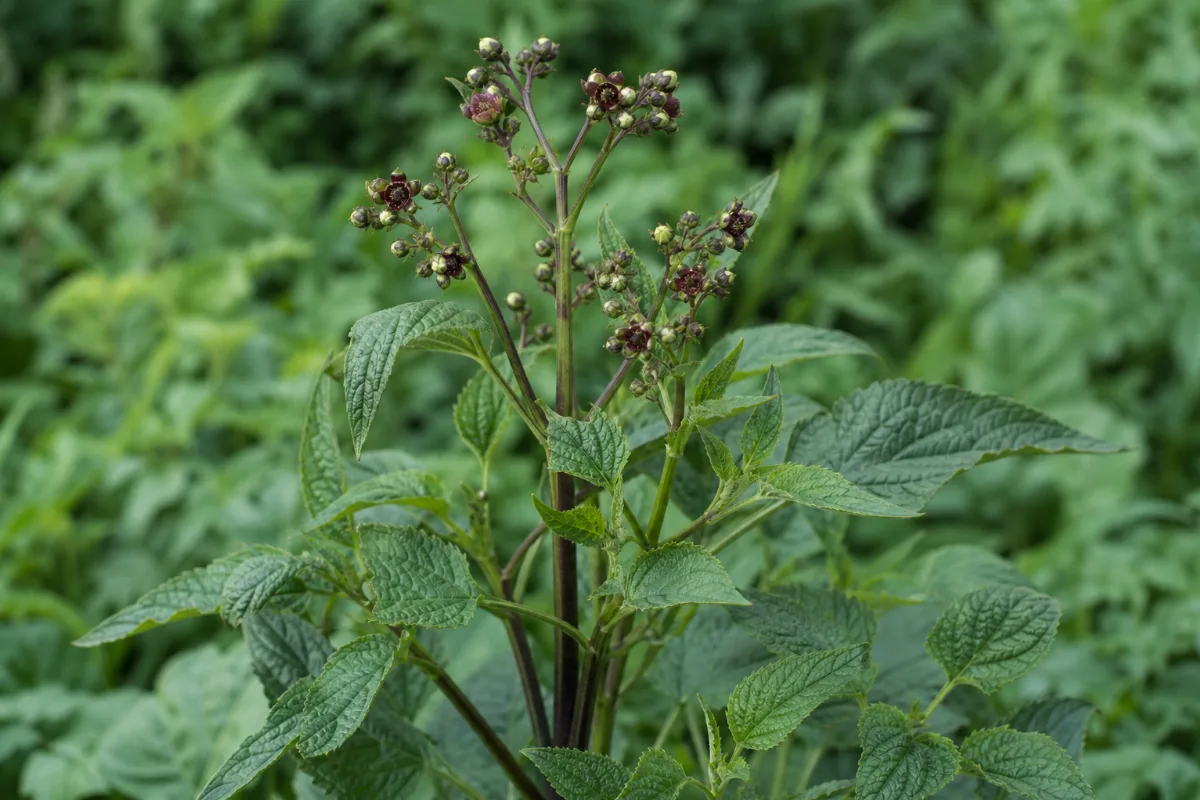
Herbs & Botanicals · Traditional skin and lymph herb
Figwort
Scrophularia nodosa · also called Knotted figwort, common figwort, woodland figwort
Figwort is a wild European plant that herbalists have long used for skin problems and swollen glands. We found no trial of it in people, so its benefits are unproven. Lab work shows anti-inflammatory compounds, and one source hints at heart-active ingredients that nobody has confirmed. If you take heart medicine such as digoxin, or are pregnant, ask a doctor or pharmacist first.
General information, not medical advice. Last substantive update · Not medically reviewed. A named clinician has not signed off on this page. How this page is made
About Figwort
Figwort (Scrophularia nodosa) is a wild European plant used by herbalists for skin and lymph complaints. Research in people is missing, lab studies suggest anti-inflammatory compounds, and its safety for the heart is an open question.
What figwort is
Figwort is a tall wild plant of damp ground. 'Figwort' is also the name of the whole genus Scrophularia, which has about 350 species. This page is mainly about knotted figwort (Scrophularia nodosa), and where a different species is meant we say so.
The Chinese medicine herb xuan shen is the root of another species, Scrophularia ningpoensis. It has a large lab literature, but it is not the same plant and the results cannot be carried over.
What it has been used for
European herbal tradition uses figwort for skin problems such as eczema, psoriasis and itching, for swollen lymph glands and swelling, and as a mild laxative. A folk-medicine survey in Transylvania also lists it among skin remedies.
Use over many years is not proof that it works. We found no randomised trial, review or meta-analysis of knotted figwort in people for any of these uses.
What the research shows
Lab work found that compounds from figwort seed pods help human skin cells grow, and that mouse immune cells treated with S. nodosa powders make less inflammation signal. A 2025 study of a five-herb mix including figwort lowered an inflammation signal in cells and was well tolerated in a few horses with wounds. None of this proves a benefit in people, and the mix cannot be credited to figwort alone.
Two small Iranian trials tested a different species, Scrophularia striata, on skin wounds around a stoma and on gum disease, and both reported improvement. Because they used another plant and had weak designs, we rate this very low and do not apply it to knotted figwort.
The heart question
One research abstract says figwort contains 'cardioactive glycosides' and has 'cardiac stimulant properties', and one practitioner source lists ventricular tachycardia as a reason to avoid it. But the study behind the abstract isolated flavonoids, not a heart glycoside, and a large review of the genus does not mention one.
So the heart risk is unproven, not ruled out. If you have a heart rhythm problem or take digoxin or other heart medicine, ask your cardiologist or pharmacist before using figwort. Foxglove, a different plant, is the one that truly contains heart glycosides.
Pregnancy, children and other cautions
No safety data exist for pregnancy, breastfeeding or children, and one practitioner source advises caution. People allergic to plants of the figwort family should avoid it. The same source lists nausea, diarrhoea or skin irritation with high or long use; this is unverified.
We found no liver-injury cases, but we also did not find a regulator monograph or a human safety study, and several safety databases were not read. Absence of reports is not proof of safety. For amounts and use, ask a doctor or pharmacist.
Figwort is not devil's claw
Devil's claw (Harpagophytum procumbens) is a different plant used for back and joint pain. Knotted figwort also contains harpagoside (about 1% of leaf dry weight in one analysis), which is why the two get mixed up. Devil's claw has its own trials and safety reviews, and they do not apply to figwort.
The Chinese herb xuan shen is another look-alike by name. Check that a product names the species and plant part.
At a glance
Traditional uses history, not proof
- European folk use for rashes, eczema, psoriasis and itching
- Swollen lymph glands and swelling
- A mild laxative
- Chinese figwort root (xuan shen, a different species) for fever, sore throat and swelling in Chinese medicine
Studied for research
- Skin complaints: insufficient (traditional use only)
- Wound healing: insufficient (lab and a horse pilot)
- Inflammation: insufficient (lab and mouse cells)
- Wounds and gum disease with a different species (S. striata): very low
Main compounds
- Harpagoside
- Aucubin
- Other iridoid glycosides
- Phenylethanoid glycosides (angoroside type)
- Flavonoids
Common forms
- Aerial parts (leaf and flower) as tea or tincture (traditional)
- Chinese figwort root (a different species)
- Not recommended or compared here
Research links: Review: the genus Scrophularia (PubMed) · Review: Scrophularia ningpoensis (PubMed) · Wound study with figwort (PubMed) · Devil's claw safety review (PubMed) · Research Library · Genes & Biomarkers Library
The plant and its history
- Accepted scientific name
- Scrophularia nodosa L. (knotted figwort); Chinese figwort is a different species, Scrophularia ningpoensis Hemsl.
- Naming authority
- GBIF species match read 2026-10-25: S. nodosa L. ACCEPTED, key 3170886; S. ningpoensis Hemsl. ACCEPTED, key 3736706. Both family Scrophulariaceae.
- Common names
- Figwort (English); Common figwort (English); Knotted figwort (English); Woodland figwort (English); Xuan shen (Chinese figwort, S. ningpoensis) (Chinese)
- Botanical family
- Scrophulariaceae. Pasdaran 2017 says the genus has about 350 species, all called figwort.
- Classification
- Plantae > Scrophulariaceae > Scrophularia > Scrophularia nodosa
- Native range
- Not verified in the sources read.
- Habitat
- A 2012 paper describes S. nodosa as growing in moist and cultivated waste ground (background text in an abstract).
- What the plant looks like
- Roots: Not verified. The Chinese herb xuan shen is the dried root of S. ningpoensis.; Stems: Not verified.; Leaves: Aerial parts (leaves, flowers) are studied for S. nodosa.; Flowers: Not verified.; Fruit: Seed pods contain wound-active iridoids in the lab (Stevenson 2002).
- Cultivation
- Not covered.
- Harvest and processing
- Not covered.
- Look-alikes and adulterants
- Name: Devil's claw (Harpagophytum procumbens); Note: A different plant (family Pedaliaceae). Shares the compound harpagoside, so they are easily mixed up. Its back-pain trials do not apply to figwort.; Name: Chinese figwort / xuan shen (Scrophularia ningpoensis); Note: Another species of the same genus, used as a root in Chinese medicine.; Name: Foxglove (Digitalis); Note: A different, poisonous heart-glycoside plant; do not assume figwort acts the same way.
- Sustainability and conservation
- Not covered. Pasdaran 2017 notes some Scrophularia species are in danger of extinction; not specific to S. nodosa.
Traditional use and history history, not clinical proof
| Tradition or era | Documented use | Source |
|---|---|---|
| European folk medicine | Skin complaints (rashes, eczema, psoriasis, itching), swelling and swollen lymph glands, and as a mild laxative, per a practitioner reference (summary-only). A seed-pod paper cites European use for healing wounds. | s-hobbs-figwort |
| Transylvanian folk dermatology (interviews 2007-2019) | S. nodosa is named among skin remedies recorded in 35 villages. | p35914644 |
| Traditional Chinese medicine (Scrophularia ningpoensis root, xuan shen) | Used for centuries to clear heat, detoxify and nourish yin; for fever, swelling, sore throat and more. This is a different species. | p33338592 |
Traditional use shows how a plant was used. It does not show that a supplement works or is safe today.
What is inside, and how it may work
What the plant contains and how those compounds act in cells and animals. Laboratory and animal mechanisms are not proven effects in people.
Main compounds
| Compound | Family | Where it is concentrated | Activity studied | Level of evidence |
|---|---|---|---|---|
| Harpagoside PubChem 5281542 | iridoid glycoside | Leaves (about 1.05% of dry weight in field plants in one analysis) 1.05% of dry weight in leaves of field-grown S. nodosa (Sesterhenn 2007) | Also the compound devil's claw is standardised to. Lab studies on figwort-family iridoids report anti-inflammatory activity; not shown in people. 14 12 20 | Laboratory research |
| Aucubin PubChem 91458 | iridoid glycoside | Leaves of lab-grown plantlets (1.67%); lower in field leaves Up to 1.67% of dry weight in lab-grown leaves | Identified in S. nodosa; no human data. 14 20 | Laboratory research |
| Angoroside C PubChem 23757181 | phenylpropanoid (phenylethanoid) glycoside | Reported from other Scrophularia species; not shown here for S. nodosa | Reviewed for anti-inflammatory activity along with acteoside and angoroside A in the genus review; lab only. 12 13 20 | Laboratory research |
| Acylated iridoid glycosides (scropolioside A, scrophuloside A4, scrovalentinoside) | iridoid glycosides | Seed pods | Made human skin fibroblasts grow in the dish at low concentration. 16 9 | Laboratory research |
| Flavonoids (seven isolated, e.g. centaurein, kaempferol glycoside, spinoside) | flavonoids | Crude extract chloroform fraction (plant part not stated) | Extract relaxed rabbit intestine in the dish. 2 | Animal research |
| Cardioactive glycosides (reported, unconfirmed) | cardiac glycosides? | Not known | Stated as a plant constituent in the background text of one abstract; no structure, name or measurement was given, and the 204-compound genus review does not list any. Treat as unconfirmed. 2 12 | Insufficient |
Mechanisms, receptors and pathways
| Target or pathway | Gene or receptor | What was found | Level |
|---|---|---|---|
| Inflammation signals (TNF-alpha, IL-1 beta, IL-6, NO) | Not specified | Fine powders including S. nodosa lowered these signals in LPS-stimulated mouse immune cells. 15 | Laboratory research |
| Skin cell growth | Not specified | Isolated seed-pod iridoids stimulated human dermal fibroblast growth at low concentrations. 16 | Laboratory research |
| Smooth-muscle movement | Muscarinic receptors (suggested) | Extract reduced rabbit gut movement; the authors suggest muscarinic receptors. 2 | Animal research |
Absorption, metabolism and elimination
- Absorption
- Not covered; no human data found.
- Distribution
- Not covered.
- Metabolism
- Not covered.
- Elimination
- Not covered.
- Bioavailability
- Not established. The Chinese root review says metabolism and mechanism data are limited.
Isolated compounds versus whole extracts
Lab findings come mostly from isolated compounds or fractions, or from other Scrophularia species. No test compared whole figwort with its parts in people.
Nutritional composition
Not a nutrient and not a food.
1 very low certainty6 not enough evidence
What was looked at
The 7 benefits and uses checked for Figwort, each with how strong the evidence is. Tap one to open it.
- Skin complaints (eczema, psoriasis, itching, rashes)Not enough evidence
- Wound healing (lab and horse pilot only)Not enough evidence
- Skin wounds and gum disease: trials of a different species (Scrophularia striata)Very low certainty
- Inflammation (lab and animal findings on figwort compounds)Not enough evidence
- Swollen lymph glands and fluid swellingNot enough evidence
- Constipation and the gutNot enough evidence
- Chinese figwort root (xuan shen): fever, sore throat, heart and other usesNot enough evidence
What is Figwort good for?
Figwort has no tested benefit in people. The rows below show the claims made for it and how weak the evidence is.
Benefits, one by one
Each card is a research question, not a promise. Tap a goal to filter. Open a card to see the studies, doses and limits.
Skin complaints (eczema, psoriasis, itching, rashes)
Not enough evidenceFigwort has long been used by herbalists for skin problems. We found no trial of knotted figwort in people with any skin condition, so we cannot say it works.
3 studiesNot applicable. No amount, preparation or form of the plant is recomm…
Studies, doses and limits
What the trials found
No randomised trial, review or meta-analysis of S. nodosa for any skin condition was found. The genus review (Pasdaran 2017) reports no human trials.
Results
None.
Effect sizes as reported
None.
Why this rating
Only traditional use and a folk-medicine survey. Use is not proof of benefit.
Form and dose studied
Not applicable. No amount, preparation or form of the plant is recommended.
Who was studied
Not applicable
Limits
We read abstracts and one practitioner summary. No trial exists to read.
Why researchers looked
European herbal tradition names figwort as a skin and 'blood-cleansing' herb. That reputation is why it is studied.
Traditional use
Rashes, eczema, psoriasis and itching are listed by a practitioner reference. A Transylvanian folk-medicine survey names S. nodosa among its skin remedies.
Proposed mechanism Laboratory research
Not shown. Lab work points to iridoid compounds with anti-inflammatory effects (see the lab-evidence row).
A proposed mechanism does not show that the effect happens in people.
Do not use figwort on broken or inflamed skin without a clinician's advice; no skin-safety studies were found. Skin irritation is listed by one practitioner source.
Wound healing (lab and horse pilot only)
Not enough evidenceLab work on compounds from figwort seed pods and a small horse study of a five-herb mix hint at a role in wound healing. This has not been tested in people.
3 studiesNot applicable. No amount, preparation or form of the plant is recomm…
Studies, doses and limits
What the trials found
No human wound trial of S. nodosa was found. Evidence is cell culture (Stevenson 2002) and a 2025 study of a five-herb mixture in cell lines and a few horses (Fehrenbach 2025).
Results
Cells: growth stimulated at the lowest concentration of isolated compounds, not different from control at the highest. Mixture: IL-8 lower, phagocytosis higher, extracts well tolerated in horses.
Effect sizes as reported
No numbers reported in the abstracts that apply to figwort alone.
Why this rating
Lab and animal work only; the 2025 extract was a mixture, so effects cannot be assigned to figwort. Not shown in people.
Form and dose studied
Not applicable. No amount, preparation or form of the plant is recommended.
Who was studied
Human skin cells and macrophage cell lines; horses
Limits
Isolated seed-pod compounds, not leaf or tea. Five-herb mixture. No people.
Why researchers looked
Old European use of figwort on wounds led researchers to test its compounds on skin cells.
Traditional use
The seed-pod paper cites ethnobotanical use of figwort in Europe for healing wounds.
Proposed mechanism Laboratory research
Three iridoid glycosides from S. nodosa seed pods made human skin fibroblasts grow in the dish. A five-herb extract lowered IL-8 and raised phagocytosis in immune cells.
A proposed mechanism does not show that the effect happens in people.
Nothing in these studies supports putting figwort on a wound.
Skin wounds and gum disease: trials of a different species (Scrophularia striata)
Very low certaintyTwo small Iranian trials tested a different figwort species, S. striata, on stoma-skin wounds and on gum disease. They were positive, but they do not tell us about knotted figwort.
2 studiesNot applicable. No amount, preparation or form of the plant is recomm…
Studies, doses and limits
What the trials found
Peristomal wound trial: 100 adults, S. striata topical solution vs chamomile ointment, once daily for 14 days, scored at day 21 (Miri 2025). Gum trial: 50 adults, S. striata mouthwash vs another mouthwash, 4 weeks (Kerdar 2019).
Results
Wound score improved more with S. striata than with chamomile ointment (p < 0.001). Mouthwash improved plaque, pocket depth and bleeding in the short term.
Effect sizes as reported
No effect sizes in the abstracts.
Why this rating
Small trials, a different species, other herbal products as comparators, and only the abstracts were read. They cannot be applied to knotted figwort or to Chinese figwort.
Form and dose studied
Not applicable. No amount, preparation or form of the plant is recommended.
Who was studied
Adults with stoma-skin wounds; adults with chronic gum disease (Iran)
Limits
No inactive control in either trial. Different species. Industry funding not stated in the abstracts.
Why researchers looked
S. striata is used in Iranian traditional medicine for wounds and gum inflammation, so researchers trialled it.
Traditional use
Iranian traditional medicine use of S. striata (stated in the mouthwash abstract).
Proposed mechanism Pharmacological theory
Not shown.
A proposed mechanism does not show that the effect happens in people.
Not used here as a reason to use knotted figwort.
Inflammation (lab and animal findings on figwort compounds)
Not enough evidenceIn the lab, iridoid compounds from the figwort family and extracts of knotted figwort calm inflammation signals. There is no human trial.
4 studiesNot applicable. No amount, preparation or form of the plant is recomm…
Studies, doses and limits
What the trials found
No human study. Mouse cells (Soulimani 2023, four plants together), a mouse pain test (Ahmad 2012) and a genus-level review (Pasdaran 2017).
Results
Mouse pain test: crude extract reduced writhing by 65.6% at the highest amount tested. Cells: at least about 20% less inflammation signals with fine powders than with extracts.
Effect sizes as reported
Not applicable to people.
Why this rating
Cells and mice only; several results are for other Scrophularia species or for plants mixed together.
Form and dose studied
Not applicable. No amount, preparation or form of the plant is recommended.
Who was studied
Mouse cells and mice
Limits
Cells and mice only. A different species for some findings.
Why researchers looked
Iridoid glycosides such as harpagoside and aucubin are found in S. nodosa and are the main suspects behind its traditional use.
Traditional use
Traditional use for hot, inflamed skin and swollen glands.
Proposed mechanism Laboratory research
Mouse immune cells treated with powders of several plants including S. nodosa made less TNF-alpha, IL-1 beta, IL-6 and NO. The genus review lists scropolioside-type iridoids as anti-inflammatory in lab and animal studies.
A proposed mechanism does not show that the effect happens in people.
None.
Swollen lymph glands and fluid swelling
Not enough evidenceFigwort is traditionally used for swollen glands and swelling. We found no study of this in people.
2 studiesNot applicable. No amount, preparation or form of the plant is recomm…
Studies, doses and limits
What the trials found
No trial, case series or review of S. nodosa for swollen glands was found.
Results
None.
Effect sizes as reported
None.
Why this rating
Traditional use only.
Form and dose studied
Not applicable. No amount, preparation or form of the plant is recommended.
Who was studied
Not applicable
Limits
Based on one practitioner summary and a genus review. Swollen glands can signal infection or serious illness and need a medical check.
Why researchers looked
The 'lymph herb' reputation is the best-known traditional claim for figwort.
Traditional use
Practitioner references list swelling and swollen lymph glands as traditional uses.
Proposed mechanism Pharmacological theory
Not shown. Nothing in the sources read explains how figwort would act on lymph glands.
A proposed mechanism does not show that the effect happens in people.
Persistent or painless swollen glands should be seen by a doctor; herbs should not delay that.
Constipation and the gut
Not enough evidenceFigwort is listed as a mild laxative in traditional use. The only related research is a lab test on rabbit intestine, where an extract slowed gut movement.
2 studiesNot applicable. No amount, preparation or form of the plant is recomm…
Studies, doses and limits
What the trials found
No human study. One rabbit-tissue study (Ahmad 2012).
Results
Chloroform fraction showed the largest relaxing effect in the dish (77.37% at the dose tested). One aqueous fraction caused a spasm-like response.
Effect sizes as reported
Not applicable to people.
Why this rating
Traditional use plus animal tissue only. The lab result (relaxation) does not obviously match a laxative use.
Form and dose studied
Not applicable. No amount, preparation or form of the plant is recommended.
Who was studied
Rabbit tissue
Limits
Animal tissue only; no people.
Why researchers looked
Traditional use as a mild laxative.
Traditional use
Constipation is listed in practitioner and pharmacopoeia-type references.
Proposed mechanism Laboratory research
In rabbit intestine in a lab bath, a crude S. nodosa extract and its fractions reduced movement. The authors suggest muscarinic receptors may be involved.
A proposed mechanism does not show that the effect happens in people.
Digestive upset (nausea, diarrhoea) is listed as a possible effect with high or long use by one practitioner source (unverified).
Chinese figwort root (xuan shen): fever, sore throat, heart and other uses
Not enough evidenceIn Chinese medicine, the root of a different figwort (Scrophularia ningpoensis, xuan shen) is used for fever, sore throat, swelling and heart conditions. Lab and animal studies are reported, but no clinical trials of the root were found.
3 studiesNot applicable. No amount, preparation or form of the plant is recomm…
Studies, doses and limits
What the trials found
Three reviews (Ren 2021, Lee 2021, Liu 2023). Only abstracts read. The reviewers call for clinical trials and toxicology studies.
Results
Not reported in the abstracts.
Effect sizes as reported
None.
Why this rating
Reviews of lab and animal work on a different species and a different plant part (root). No human trial identified in the abstracts.
Form and dose studied
Not applicable. No amount, preparation or form of the plant is recommended.
Who was studied
Cells and animals
Limits
Different species from knotted figwort. Not applicable to garden or wild S. nodosa.
Why researchers looked
Xuan shen has been used for over two thousand years and has a large modern lab literature on its iridoid and phenylpropanoid compounds.
Traditional use
Traditional Chinese medicine: clears heat, detoxifies, nourishes yin; also used for fever, swelling, constipation, sore throat, rheumatism and arthritis (reviews).
Proposed mechanism Laboratory research
Lab and animal studies report anti-inflammatory, antioxidant, liver-protective, uric-acid-lowering, heart-cell-protective, nerve-protective and immune effects. Active compounds are thought to be iridoid and phenylpropanoid glycosides, but mechanisms are not well worked out.
A proposed mechanism does not show that the effect happens in people.
The Chinese root is a different plant from knotted figwort. Do not combine information about one with the other.
Connections to the rest of health
How Figwort connects to the rest of our health knowledge graph. Every link says what kind of connection it is. A safety link (for example to the liver) is a warning, not a benefit. A study that merely mentions a topic never creates a benefit link.
Explore every connection: goals, body systems, organs, symptoms, genes
A. Wellness goals
| Connected to | Kind of connection | Evidence status | Context | Studies |
|---|---|---|---|---|
| Healthy Skin | Traditional use | Not enough evidence | Skin complaints (eczema, psoriasis, itching, rashes): Figwort has long been used by herbalists for skin problems. We found no trial of knotted figwort in people with any skin condition, so we cannot say it works. | 3 12 11 |
| Healthy Skin | Potential benefit | Not enough evidence | Wound healing (lab and horse pilot only): Lab work on compounds from figwort seed pods and a small horse study of a five-herb mix hint at a role in wound healing. This has not been tested in people. Skin wounds and gum disease: trials of a different species (Scrophularia striata): Two small Iranian trials tested a different figwort species, S. striata, on stoma-skin wounds and on gum disease. They were positive, but they do not tell us about knotted figwort. | 16 4 12 8 5 |
| Inflammation Balance | Potential benefit | Not enough evidence | Inflammation (lab and animal findings on figwort compounds): In the lab, iridoid compounds from the figwort family and extracts of knotted figwort calm inflammation signals. There is no human trial. | 15 1 12 14 |
| Detoxification Support | Traditional use | Not enough evidence | Swollen lymph glands and fluid swelling: Figwort is traditionally used for swollen glands and swelling. We found no study of this in people. | 3 12 |
| Digestive Support | Traditional use | Not enough evidence | Constipation and the gut: Figwort is listed as a mild laxative in traditional use. The only related research is a lab test on rabbit intestine, where an extract slowed gut movement. | 3 2 |
| Inflammation Balance | Traditional use | Not enough evidence | Chinese figwort root (xuan shen): fever, sore throat, heart and other uses: In Chinese medicine, the root of a different figwort (Scrophularia ningpoensis, xuan shen) is used for fever, sore throat, swelling and heart conditions. Lab and animal studies are reported, but no clinical trials of the root were found. | 13 6 7 |
B. Body systems
| Connected to | Kind of connection | Evidence status | Context | Studies |
|---|---|---|---|---|
| Integumentary System | Biological association | Not enough evidence | Studied for: Skin complaints (eczema, psoriasis, itching, rashes) Studied for: Wound healing (lab and horse pilot only) | 3 12 11 16 4 8 5 15 1 14 |
| Skin Hair Beauty | Biological association | Not enough evidence | Studied for: Skin complaints (eczema, psoriasis, itching, rashes) | 3 12 11 |
| Immune System | Biological association | Not enough evidence | Studied for: Inflammation (lab and animal findings on figwort compounds) Studied for: Swollen lymph glands and fluid swelling | 15 1 12 14 3 13 6 7 |
| Digestive System | Biological association | Not enough evidence | Studied for: Constipation and the gut | 3 2 |
| Cardiovascular System | Biological association | Not enough evidence | Studied for: Chinese figwort root (xuan shen): fever, sore throat, heart and other uses | 13 6 7 |
C. Body parts and organs
| Connected to | Kind of connection | Evidence status | Context | Studies |
|---|---|---|---|---|
| Heart | Contraindication | Not enough evidence | Reported in one abstract's background text and by one practitioner source; not confirmed. Preparation or compound: Possible cardiac glycosides (unconfirmed in S. nodosa) |
2 3 |
| Gut | Adverse effect or risk | Not enough evidence | Nausea or diarrhoea listed by one source. Preparation or compound: Whole herb, high or long use |
3 |
L. Active compounds
| Connected to | Kind of connection | Evidence status | Context | Studies |
|---|---|---|---|---|
| Harpagoside | Biological association | In vitro | Also the compound devil's claw is standardised to. Lab studies on figwort-family iridoids report anti-inflammatory activity; not shown in people. Preparation or compound: Leaves (about 1.05% of dry weight in field plants in one analysis) |
14 12 20 |
| Aucubin | Biological association | In vitro | Identified in S. nodosa; no human data. Preparation or compound: Leaves of lab-grown plantlets (1.67%); lower in field leaves |
14 20 |
| Angoroside C | Biological association | In vitro | Reviewed for anti-inflammatory activity along with acteoside and angoroside A in the genus review; lab only. Preparation or compound: Reported from other Scrophularia species; not shown here for S. nodosa |
12 13 20 |
| Acylated iridoid glycosides (scropolioside A, scrophuloside A4, scrovalentinoside) | Biological association | In vitro | Made human skin fibroblasts grow in the dish at low concentration. Preparation or compound: Seed pods |
16 9 |
| Flavonoids (seven isolated, e.g. centaurein, kaempferol glycoside, spinoside) | Biological association | Animal | Extract relaxed rabbit intestine in the dish. Preparation or compound: Crude extract chloroform fraction (plant part not stated) |
2 |
| Cardioactive glycosides (reported, unconfirmed) | Biological association | Not enough evidence | Stated as a plant constituent in the background text of one abstract; no structure, name or measurement was given, and the 204-compound genus review does not list any. Treat as unconfirmed. Preparation or compound: Not known |
2 12 |
Each connection is stored with the ingredient, the connected record, the kind of connection, the evidence status, the supporting studies, the preparation or compound involved, and a review date (last reviewed October 25, 2026).
The evidence
The research centre for Figwort. Every record here was checked against PubMed or the publisher's page; we never list a study we have not verified.
Evidence by outcome
Bars show how many studies we found for each outcome, not how well it works. People are added up across trials only (reviews are not added, to avoid double counting).
How we rate evidence
High certainty
Several well-run trials or reviews agree; further research is unlikely to change the picture much.
Moderate certainty
Good trials point the same way, but some doubt remains.
Low certainty
Small, short or inconsistent trials. The finding could change with better research.
Very low certainty
Very little or very weak human data. Treat as a possibility only.
Mixed findings
Trials or reviews disagree with each other.
Not enough evidence
Not enough human research to say either way.
Evidence against
Good research found no benefit, or found harm.
We take the reviewers' own risk-of-bias and GRADE statements where they exist, and otherwise judge from study size, design, consistency, directness and whether a product matches what is sold. Many publications do not make evidence high. Method note: We read our existing herb summary, searched PubMed, read the abstract of each PubMed record cited, and checked names in GBIF and compounds in PubChem. Pages that could not be opened are marked not verified.
Study library: every study we checked 20
| Study | Design | People | Product, dose, length | Result |
|---|---|---|---|---|
| Ahmad 2012 Biological screening of Scrophularia nodosa extract and its fractions. Pak J Pharm Sci · PMID 22459454 |
Animal tissue animal |
Lab assays and mice | S. nodosa crude extract and fractions extract (plant part not stated in the abstract) Not given in the abstract Not given in the abstract |
The extract was non-toxic in a brine shrimp test at all concentrations. The fractions showed antibacterial and antifungal effects in the dish. In mice, the crude extract reduced writhing by 65.6% at the highest amount tested. Methods, limits and fundingOutcomes: Toxicity assays, antibacterial, antifungal, pain (writhing) test Limitations: Lab and mouse data only. Brine shrimp is a crude toxicity screen, not a safety test for people. Funding and conflicts: Not stated in the abstract Read: abstract |
| Ahmad 2012 Spasmolytic effects of Scrophularia nodosa extract on isolated rabbit intestine. Pak J Pharm Sci · PMID 22186340 |
Animal tissue animal |
Isolated rabbit intestine (jejunum) in a lab bath | S. nodosa crude extract and fractions extract (plant part not stated in the abstract) Not given in the abstract Not given in the abstract |
The abstract states that S. nodosa contains saponins, cardioactive glycosides, flavonoids and others, and is traditionally used for skin disorders, with diuretic and cardiac stimulant properties. The authors isolated seven flavonoids. The extract reduced normal movement of rabbit intestine, possibly through muscarinic receptors. Methods, limits and fundingOutcomes: Smooth-muscle movement Limitations: The 'cardioactive glycosides' wording is background text in the abstract: the study isolated flavonoids, and no cardiac glycoside was identified or measured. Rabbit tissue only. Funding and conflicts: Not stated in the abstract Read: abstract |
| Christopher Hobbs (practitioner reference) 2026 Figwort, herbal therapeutics database christopherhobbs.com · Source |
Authoritative guidance |
Practitioner database entry | Figwort (S. nodosa) herb Not given here Not given here |
Lists traditional use for skin complaints (rashes, eczema, psoriasis, itching), constipation, swelling and swollen lymph glands. Lists caution in pregnancy and breastfeeding, allergy to plants of the figwort family, a ventricular tachycardia contraindication (no reason given), and nausea, diarrhoea or skin irritation with high or long use. Methods, limits and fundingOutcomes: Traditional uses and cautions Limitations: Summary-only: read for our herb summary and not re-opened for this page. The site says parts were AI-drafted, so the cautions are unverified. Read: summary-only |
| Fehrenbach 2025 Anti-Inflammatory and Regenerative Properties of Herbal Extracts: Wound Management in Equine Models. Drug Target Insights · PMID 40453653 · DOI |
Laboratory research in-vitro |
Human macrophage and keratinocyte cell lines, plus pilot cases in horses with open wounds | Extracts of five herbs including figwort (Scrophularia nodosa), alone and combined herb extracts Not given in the abstract Not given in the abstract |
The extracts did not significantly affect cell viability. They lowered IL-8 and raised phagocytic activity in macrophages. In horses they were well tolerated and associated with supported healing. The authors attribute the effects to the combined herbs. Methods, limits and fundingOutcomes: Cell viability, IL-8, phagocytosis, wound healing in horses Limitations: Five-herb mixture, cells and horses only, no controlled human data. Effects cannot be assigned to figwort alone. Funding and conflicts: Not stated in the abstract Read: abstract |
| Kerdar 2019 Clinical, in vitro and phytochemical, studies of Scrophularia striata mouthwash on chronic periodontitis disease. J Ethnopharmacol · PMID 30991136 · DOI |
Controlled trial |
50 50 adults with chronic gum disease, Iran |
Hydroalcoholic extract mouthwash of Scrophularia striata (a different species) not stated Not given in the abstract 4 weeks of follow-up · vs Irsha mouthwash (an Iranian Listerine-type rinse) |
In the short term the S. striata mouthwash improved plaque, pocket depth and bleeding. The authors report it was more potent than the comparison mouthwash for the bacterial count. Methods, limits and fundingOutcomes: Plaque index, pocket depth, bleeding on probing, S. mutans count Limitations: Different species, 50 people, one comparison rinse and no inactive control. Registered IRCT2015081323468N1. Only the abstract was read. Funding and conflicts: Not stated in the abstract Read: abstract |
| Lee 2021 Scrophulariae Radix: An Overview of Its Biological Activities and Nutraceutical and Pharmaceutical Applications. Molecules · PMID 34500684 · DOI |
Narrative review mixed |
Review of studies on S. buergeriana and S. ningpoensis roots from the last 20 years | Scrophulariae Radix (S. buergeriana and S. ningpoensis roots) root Not given in the abstract Not given in the abstract |
Records use for fever, swelling, constipation, sore throat, rheumatism and arthritis in Asia for over two thousand years. Cell and animal studies show anti-inflammatory, immune, nerve-protective and heart-protective effects. The authors call for toxicology studies and clinical trials. Methods, limits and fundingOutcomes: Biological activities in cells and animals Limitations: Abstract only. Not S. nodosa. In vitro and animal evidence. Funding and conflicts: Not stated in the abstract Read: abstract |
| Liu 2023 [Chemical constituents, pharmacological activities, processing and clinical application of traditional Chinese medicine Scrophulariae Radix: a review]. Zhongguo Zhong Yao Za Zhi · PMID 37802857 · DOI |
Narrative review mixed |
Review of Scrophulariae Radix (dried root of S. ningpoensis) | Scrophulariae Radix root Not given in the abstract Not given in the abstract |
Iridoids and phenylpropanoids are the main active constituents. Reported activities include anti-inflammatory, antioxidant, liver-protective, uric-acid-lowering and heart-cell-protective effects. The review also covers processing, toxicity and old and modern clinical use. Methods, limits and fundingOutcomes: Constituents, activities, processing, toxicity, clinical use Limitations: Chinese-language review, English abstract only read. Toxicity findings were not read. Funding and conflicts: Not stated in the abstract Read: abstract |
| Miri 2025 Assessment of the Effect of Topical 'Scrophularia Striata' Solution on Healing of Peristomal Wound in Patients Referring to Tehran Ostomy Association, 2023. Int Wound J · PMID 40258627 · DOI |
Controlled trial |
100 100 adults with skin wounds around a stoma, Tehran |
Topical solution of Scrophularia striata (a different species, not S. nodosa) not stated Applied once daily 14 days; scored at day 21 · vs Usual stoma-centre care with chamomile ointment |
Wound improvement at day 21 was greater with the S. striata solution than with chamomile ointment (p < 0.001). Methods, limits and fundingOutcomes: Ostomy Skin Tool wound score Limitations: Different species. The abstract does not describe blinding. Comparator was another herbal ointment, not an inactive one. Only the abstract was read. Funding and conflicts: Not stated in the abstract Read: abstract |
| Miyase 1999 Acylated iridoid and phenylethanoid glycosides from the aerial parts of Scrophularia nodosa. J Nat Prod · PMID 10479307 · DOI |
Chemistry n/a |
Aerial parts of S. nodosa (chemical isolation) | S. nodosa aerial parts aerial parts Not given in the abstract Not given in the abstract |
Eighteen acylated iridoid glycosides and nine phenylethanoid glycosides were isolated from the aerial parts. Eight new iridoid and two new phenylethanoid glycosides were described. Methods, limits and fundingOutcomes: Compounds isolated and named Limitations: Chemistry only, no activity or safety testing in the abstract. Funding and conflicts: Not stated in the abstract Read: abstract |
| Oltean 2014 Herbal medicine for low-back pain. Cochrane Database Syst Rev · PMID 25536022 · DOI |
Systematic review |
2050 14 randomised trials of herbal medicines for low-back pain |
Herbal medicines including devil's claw (Harpagophytum procumbens), NOT figwort various Not given in the abstract Not given in the abstract |
Devil's claw standardised to 50 or 100 mg harpagoside may be better than placebo for short-term pain (two trials, 315 people, low-quality evidence). No significant adverse events were noted in the included trials. Methods, limits and fundingOutcomes: Pain and function Limitations: About devil's claw, not figwort. Low quality evidence. Funding and conflicts: Not stated in the abstract Read: abstract |
| Papp 2022 Ethnomedicine survey on folk dermatology in Transylvania, Romania. Clin Dermatol · PMID 35914644 · DOI |
Survey |
650 650 people interviewed in 35 Transylvanian villages, 2007-2019 |
Folk skin remedies including S. nodosa not stated Not given in the abstract Not given in the abstract |
180 remedies for 45 skin problems were recorded, including 112 plants. The abstract names Scrophularia nodosa among plants with 'specific' (not overlapping) use between human and veterinary treatment; it does not say which. Methods, limits and fundingOutcomes: Plants and other remedies used for skin problems Limitations: Interview survey. Shows use, not benefit. Details for figwort were not in the abstract. Funding and conflicts: Not stated in the abstract Read: abstract |
| Pasdaran 2017 The genus Scrophularia: a source of iridoids and terpenoids with a diverse biological activity. Pharm Biol · PMID 29125010 · DOI |
Narrative review mixed |
Review of about 350 Scrophularia species (figwort genus), 1934-2017 literature | Scrophularia species (genus-level review) various Not given in the abstract Not given in the abstract |
Reports 204 compounds. Glycoside esters, iridoid glycosides and triterpenoids are the most common. Scropolioside-type iridoids showed anti-inflammatory, liver-protective and wound-healing activity in lab and animal work. The abstract reports no human trials. Methods, limits and fundingOutcomes: Chemistry, biological activity, ethnopharmacology Limitations: Genus-level, not S. nodosa alone. Abstract and full text searched for heart-glycoside wording (none found). Mostly lab and animal work. Funding and conflicts: Not stated in the abstract Read: full-text |
| Ren 2021 Pharmacology, phytochemistry, and traditional uses of Scrophularia ningpoensis Hemsl. J Ethnopharmacol · PMID 33338592 · DOI |
Narrative review mixed |
Review of botany, pharmacology, phytochemistry and safety of S. ningpoensis (Chinese figwort, xuan shen) | Scrophularia ningpoensis root (xuan shen) root Not given in the abstract Not given in the abstract |
Used in China for centuries for inflammation, hypertension, cancer and diabetes; traditionally to clear heat, detoxify and nourish yin. More than 162 compounds, mainly iridoid glycosides and phenylpropanoid glycosides. Lab studies point to heart, liver, nerve and anti-inflammatory effects. The authors say detailed toxicology and mechanism data are limited. Methods, limits and fundingOutcomes: Traditional uses, compounds, pharmacology, safety Limitations: Only the abstract was read. A different species from S. nodosa. Lab and animal findings, not human trials. Funding and conflicts: Not stated in the abstract Read: abstract |
| Sesterhenn 2007 Occurrence of iridoid glycosides in in vitro cultures and intact plants of Scrophularia nodosa L. Plant Cell Rep · PMID 16972093 · DOI |
Chemistry n/a |
Lab-grown cultures and field-grown S. nodosa plants | S. nodosa leaves, flowers, cultures leaves, flowers Not given in the abstract Not given in the abstract |
Harpagoside, aucubin and catalpol were identified. Total iridoids were about 4.9% of dry weight in field plants. Harpagoside was highest in leaves of field plants (1.05%). Aucubin was highest in leaves of lab-grown plantlets (1.67%). Methods, limits and fundingOutcomes: Iridoid glycoside content Limitations: Plant chemistry only. Content varies with growing conditions. Funding and conflicts: Not stated in the abstract Read: abstract |
| Soulimani 2023 Increased anti-inflammatory activity and enhanced phytochemical concentrations in superfine powders obtained by controlled differential sieving process from four medicinal plants. Int J Vitam Nutr Res · PMID 34814709 · DOI |
Laboratory research in-vitro |
18 Immune cells from 18 mice stimulated with LPS |
Powders and hydroethanolic extracts of rose hip, willow, S. nodosa and ivy herb powders/extracts Not given in the abstract Not given in the abstract |
Fine powders lowered inflammation markers by at least about 20% more than the hydroethanolic extracts in mouse immune cells. The result is reported for the four plants together. Methods, limits and fundingOutcomes: TNF-alpha, IL-1beta, IL-6, NO Limitations: Mouse cells, four plants, a powder-processing study. Does not show an effect of figwort in people. Funding and conflicts: Not stated in the abstract Read: abstract |
| Stevenson 2002 Wound healing activity of acylated iridoid glycosides from Scrophularia nodosa. Phytother Res · PMID 11807962 · DOI |
Laboratory research in-vitro |
Cultured human skin fibroblasts | Three acylated iridoid glycosides isolated from S. nodosa seed pods seed pods (isolated compounds) Not given in the abstract Not given in the abstract |
All three isolated compounds stimulated growth of human skin fibroblasts in the dish. The effect was strongest at the lowest concentration tested and was not different from control at the highest. The authors suggest this may explain the old European use for healing wounds. Methods, limits and fundingOutcomes: Fibroblast growth Limitations: Isolated compounds from seed pods in cell culture, not leaf or tea. No animal or human test. Funding and conflicts: Not stated in the abstract Read: abstract |
| Vlachojannis 2008 Systematic review on the safety of Harpagophytum preparations for osteoarthritic and low back pain. Phytother Res · PMID 18236448 · DOI |
Systematic review |
28 clinical trials of devil's claw (Harpagophytum procumbens), 20 reporting adverse events | Harpagophytum procumbens (devil's claw), NOT figwort root preparations Not given in the abstract Not given in the abstract |
In no double-blind study were adverse events more frequent than with placebo. Minor events occurred in around 3% of patients, mainly digestive. A few acute-toxicity reports were found; none for chronic toxicity. The authors say more safety data are needed. Methods, limits and fundingOutcomes: Adverse events Limitations: This is about devil's claw, a different plant. It is not evidence about figwort. Funding and conflicts: Not stated in the abstract Read: abstract |
| s-gbif-ningpoensis GBIF Backbone: Scrophularia ningpoensis Hemsl. (usageKey 3736706) · Source |
Reference database n/a |
Methods, limits and fundingRead: full-text | ||
| s-gbif-nodosa GBIF Backbone: Scrophularia nodosa L. (usageKey 3170886) · Source |
Reference database n/a |
Methods, limits and fundingRead: full-text | ||
| s-pubchem-figwort PubChem: harpagoside (CID 5281542), aucubin (CID 91458), angoroside C (CID 23757181) · Source |
Reference database n/a |
Methods, limits and fundingRead: full-text |
What we do not know yet
- No clinical trial of knotted figwort in people.
- Cardiac glycoside content of S. nodosa is unconfirmed.
- No human safety, pregnancy, liver or interaction data.
- Regulator documents (EMA, NCCIH, LiverTox, LactMed) were not read.
How new research is added
New studies are found by a saved PubMed search and placed in a review queue. A person reads each one before it changes any rating or safety wording.
Lab markers
What changed in blood or saliva tests during trials. A changed number is not the same as feeling or being healthier, and we give no "normal ranges".
Safety
What studies and official sources say about side effects, medicines and who should check first. Each point shows what kind of evidence it comes from.
Main points to know 3
- Heart-rhythm caution is unproven but not ruled out. One abstract on knotted figwort says the plant 'contains cardioactive glycosides' and has 'cardiac stimulant properties', and one practitioner source lists ventricular tachycardia as a reason to avoid it. But the study behind the abstract isolated flavonoids, not a cardiac glycoside, and the large genus review we searched names none. So we cannot confirm a digoxin-like action, and we cannot rule it out. If you have a heart rhythm problem or take digoxin, ask your cardiologist or pharmacist before using it. Pharmacological theory 2 3 12
- Figwort is not devil's claw. Devil's claw (Harpagophytum procumbens, a different plant) is the one with back-pain trials. Knotted figwort also contains harpagoside (about 1% of dry weight in leaves of field plants in one analysis), which is why the names get mixed up. Safety and trial results for devil's claw do not transfer to figwort. Narrative review 14 17 10
- No safety studies in people. We found no human safety trial, no case report of harm and no regulator monograph for knotted figwort. Missing reports are not proof of safety. Insufficient 12 3
Side effects 2
| Effect | How often | Severity and recovery | Evidence |
|---|---|---|---|
| Nausea, diarrhoea or skin irritation with high or long use One practitioner source (summary-only, partly AI-drafted by its own statement). No frequency data. | Not established | mild Not reported | Authoritative guidance 3 |
| Allergy in people sensitive to figwort-family plants Listed by the same single source; not verified. | Not established | unknown Not reported | Authoritative guidance 3 |
Liver
No published human liver-injury case from knotted figwort was found. LiverTox was not checked. Lab reviews describe liver-protective effects of some Scrophularia compounds in animals, which is not evidence of safety in people. 12 13
How often. No data.
Monitoring. No agency advice found. Stop and seek care for dark urine, yellow eyes or skin, or severe stomach pain.
This is a safety connection. It is not evidence that Figwort supports liver health.
Medicines and supplements 3
| With | Why it matters | Importance | Evidence | What to do |
|---|---|---|---|---|
| Digoxin and other heart-glycoside medicines prescription | Theory only: if the plant contained cardiac glycosides it could add to digoxin. One abstract states the plant contains 'cardioactive glycosides'; the study did not identify one. | No interaction study or case report was found for any Scrophularia species. The genus review (204 compounds) does not mention cardiac glycosides. | Pharmacological theory Not enough evidence 2 12 3 | If you take digoxin or any heart-rhythm medicine, ask your cardiologist or pharmacist before using figwort. |
| Medicines for blood pressure or heart failure prescription | Theory only, based on reported heart and blood-pressure effects of the Chinese root in lab studies (different species). | No human data found. | Pharmacological theory Not enough evidence 13 | Tell your pharmacist about any figwort product. |
| Laxatives or medicines that slow the gut prescription | Theory only: traditional laxative use versus a gut-relaxing result in rabbit tissue. | No data. | Pharmacological theory Not enough evidence 2 3 | No specific advice beyond asking a pharmacist. |
Who should check first 4
| Situation | Advice | Evidence |
|---|---|---|
| Ventricular tachycardia or other serious heart rhythm problems | Avoid unless a cardiologist agrees. The only source is one practitioner database, with no reason given; it is unverified. | Authoritative guidance 3 |
| Pregnancy and breastfeeding | Avoid. No safety data were found, and one practitioner source advises caution. | Authoritative guidance 3 |
| Allergy to Scrophulariaceae (figwort-family) plants | Avoid. | Authoritative guidance 3 |
| Children | No data. Do not use without a clinician. | Insufficient |
Overdose, product quality and regulators
Summary. No human toxicity data were found for knotted figwort. Lab data are thin: a brine shrimp test found the extract non-toxic at all concentrations, which is only a rough screen.
Animal. A mouse pain test used the crude extract; the abstract makes no toxicity statement.
Human doses studied. None. No amount is recommended.
High dose or long term signals. Nausea, diarrhoea and skin irritation are listed by one practitioner source for high or long use (unverified).
Overdose response. Not covered. For any suspected poisoning, call poison control (US: 1-800-222-1222).
Genotoxicity. Not covered.
Toxic plant parts. Not established. A possible cardiac-glycoside content (reported in one abstract's background text, unconfirmed) has not been located to a plant part.
The main quality risks we can document are naming mix-ups, not contaminants. Contamination of figwort products was not studied.
Mix-up with devil's claw. Both plants contain harpagoside, so they are easy to mix up. Devil's claw (Harpagophytum procumbens, family Pedaliaceae) is a different plant from knotted figwort (Scrophulariaceae). Trial and safety results for devil's claw (minor, mostly digestive side effects in about 3% in one review) cannot be applied to figwort. 17 10 14
Mix-up with Chinese figwort (xuan shen). The Chinese medicine herb is the root of S. ningpoensis, a different species from knotted figwort (aerial parts). Their chemistry and safety data are not interchangeable. 13 12
Mix-up with foxglove. Foxglove (Digitalis) is a different, poisonous plant with true heart glycosides (general knowledge, not from the sources read). Do not assume figwort acts the same way.
Heavy metals, pesticides, adulteration. No testing of figwort products was found.
| Body | Action | Date |
|---|
When to get medical help
- Fast, slow or irregular heartbeat, fainting or chest pain after using any figwort product: seek emergency care and tell the clinician what you took.
- Swelling of the face or lips, hives or difficulty breathing: emergency care (possible allergy).
- Severe or persistent vomiting or diarrhoea.
Stop the supplement and contact a clinician or emergency service. In the US, Poison Control is 1-800-222-1222.
General information only, not medical advice. Ask a clinician or pharmacist before use, especially with medicines, in pregnancy or with a health condition. See the Natural Remedy Safety guide.
Frequently asked questions
What is figwort used for?
Does figwort work for eczema or psoriasis?
Is there any human research on figwort?
Is figwort safe for the heart?
Can I take figwort with digoxin?
Is figwort safe in pregnancy or while breastfeeding?
No safety data exist, and a practitioner source advises caution. It is best avoided.
What side effects can figwort cause?
One practitioner source lists nausea, diarrhoea and skin irritation with high or long use. No systematic safety study was found.
Is figwort the same as devil's claw?
What is xuan shen?
What is in figwort?
Can figwort cause liver damage?
We found no reports of it in people, but we did not find a liver-safety database entry either. This is a gap, not reassurance.
How much should I take?
We do not give amounts because no trial supports one. Ask a doctor or pharmacist before using it.
Explore by health goal
Healthy SkinInflammation BalanceDetoxification SupportDigestive Support
Editorial transparency
- Written by
- AlternativeMed editorial team. Research compiled with AI assistance, then checked against PubMed records.
- Medical review
- None. This page has not been reviewed by a physician or pharmacist.
- First published
- 2026-10-25
- Last substantive update
- 2026-10-25
- How we research
- We read our existing herb summary, searched PubMed, read the abstract of each PubMed record cited, and checked names in GBIF and compounds in PubChem. Pages that could not be opened are marked not verified.
- How we rate evidence
- See "How we rate evidence" in the Evidence tab.
- Independence
- No product is promoted on this page. No affiliate links are shown.
Sources 20
Each source was opened and checked. Where we read only the abstract, it says so. The small numbers in the text point here.
- Ahmad M, et al.. Biological screening of Scrophularia nodosa extract and its fractions.. Pak J Pharm Sci. 2012. PMID 22459454. (abstract)
- Ahmad M, et al.. Spasmolytic effects of Scrophularia nodosa extract on isolated rabbit intestine.. Pak J Pharm Sci. 2012. PMID 22186340. (abstract)
- Christopher Hobbs (practitioner reference). Figwort, herbal therapeutics database. christopherhobbs.com. 2026. (summary-only)
- Fehrenbach GW, et al.. Anti-Inflammatory and Regenerative Properties of Herbal Extracts: Wound Management in Equine Models.. Drug Target Insights. 2025. PMID 40453653. DOI 10.33393/dti.2025.3499. (abstract)
- Kerdar T, et al.. Clinical, in vitro and phytochemical, studies of Scrophularia striata mouthwash on chronic periodontitis disease.. J Ethnopharmacol. 2019. PMID 30991136. DOI 10.1016/j.jep.2019.111872. (abstract)
- Lee HJ, et al.. Scrophulariae Radix: An Overview of Its Biological Activities and Nutraceutical and Pharmaceutical Applications.. Molecules. 2021. PMID 34500684. DOI 10.3390/molecules26175250. (abstract)
- Liu YR, et al.. [Chemical constituents, pharmacological activities, processing and clinical application of traditional Chinese medicine Scrophulariae Radix: a review].. Zhongguo Zhong Yao Za Zhi. 2023. PMID 37802857. DOI 10.19540/j.cnki.cjcmm.20230123.201. (abstract)
- Miri K, et al.. Assessment of the Effect of Topical 'Scrophularia Striata' Solution on Healing of Peristomal Wound in Patients Referring to Tehran Ostomy Association, 2023.. Int Wound J. 2025. PMID 40258627. DOI 10.1111/iwj.70516. (abstract)
- Miyase T, Mimatsu A. Acylated iridoid and phenylethanoid glycosides from the aerial parts of Scrophularia nodosa.. J Nat Prod. 1999. PMID 10479307. DOI 10.1021/np9805746. (abstract)
- Oltean H, Robbins C, van Tulder MW, Berman BM. Herbal medicine for low-back pain.. Cochrane Database Syst Rev. 2014. PMID 25536022. DOI 10.1002/14651858.CD004504.pub4. (abstract)
- Papp N, et al.. Ethnomedicine survey on folk dermatology in Transylvania, Romania.. Clin Dermatol. 2022. PMID 35914644. DOI 10.1016/j.clindermatol.2022.07.013. (abstract)
- Pasdaran A, Hamedi A. The genus Scrophularia: a source of iridoids and terpenoids with a diverse biological activity.. Pharm Biol. 2017. PMID 29125010. DOI 10.1080/13880209.2017.1397178. (full-text)
- Ren D, et al.. Pharmacology, phytochemistry, and traditional uses of Scrophularia ningpoensis Hemsl.. J Ethnopharmacol. 2021. PMID 33338592. DOI 10.1016/j.jep.2020.113688. (abstract)
- Sesterhenn K, Distl M, Wink M. Occurrence of iridoid glycosides in in vitro cultures and intact plants of Scrophularia nodosa L.. Plant Cell Rep. 2007. PMID 16972093. DOI 10.1007/s00299-006-0233-3. (abstract)
- Soulimani R, et al.. Increased anti-inflammatory activity and enhanced phytochemical concentrations in superfine powders obtained by controlled differential sieving process from four medicinal plants.. Int J Vitam Nutr Res. 2023. PMID 34814709. DOI 10.1024/0300-9831/a000739. (abstract)
- Stevenson PC, et al.. Wound healing activity of acylated iridoid glycosides from Scrophularia nodosa.. Phytother Res. 2002. PMID 11807962. DOI 10.1002/ptr.798. (abstract)
- Vlachojannis J, Roufogalis BD, Chrubasik S. Systematic review on the safety of Harpagophytum preparations for osteoarthritic and low back pain.. Phytother Res. 2008. PMID 18236448. DOI 10.1002/ptr.2314. (abstract)
- . GBIF Backbone: Scrophularia ningpoensis Hemsl. (usageKey 3736706). . . (full-text)
- . GBIF Backbone: Scrophularia nodosa L. (usageKey 3170886). . . (full-text)
- . PubChem: harpagoside (CID 5281542), aucubin (CID 91458), angoroside C (CID 23757181). . . (full-text)