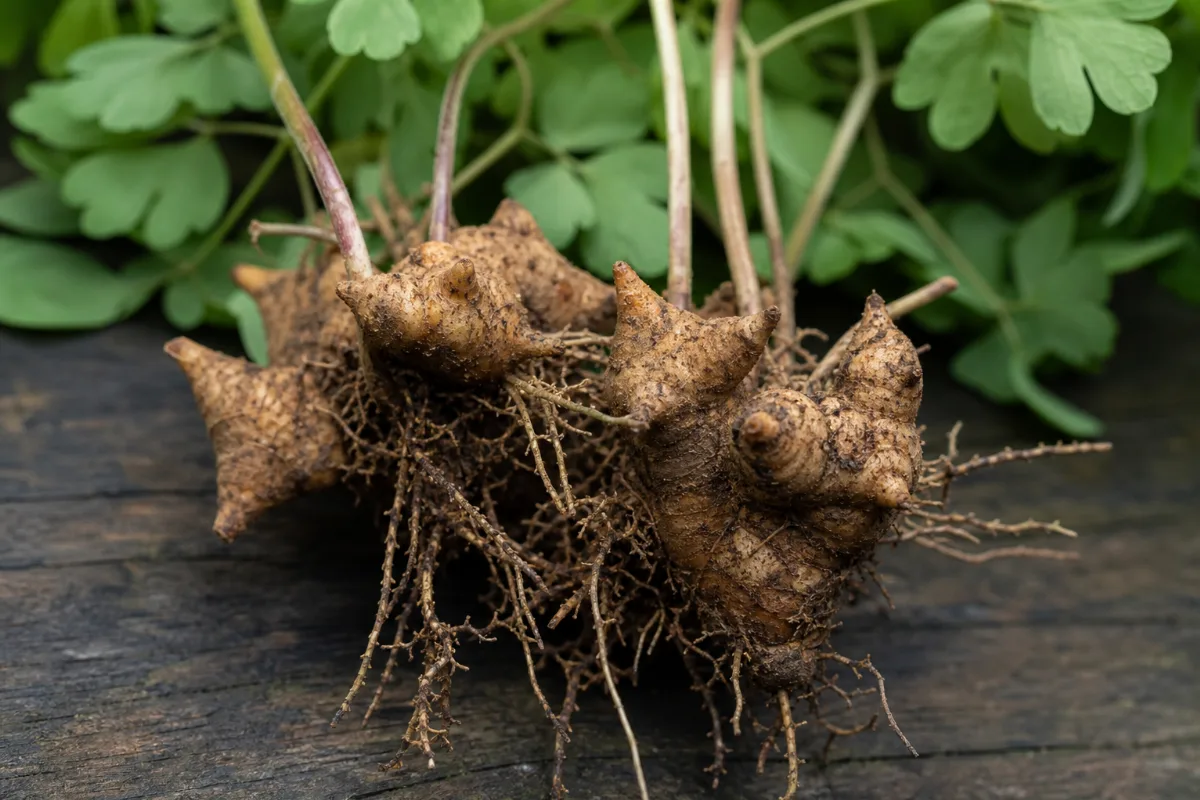
Herbs & Botanicals · Herbs · A Chinese pain herb with thin human evidence and real safety cautions
Corydalis (yan hu suo)
Corydalis yanhusuo W.T.Wang ex Z.Y.Su & C.Y.Wu; dried tuber · also called Yan hu suo, yuan hu, Rhizoma corydalis
Corydalis is the dried tuber of a Chinese poppy-family plant, traditionally used for pain. Its best-known alkaloid is tetrahydropalmatine (THP). Human evidence is limited, and safety needs care.
General information, not medical advice. Last substantive update · Not medically reviewed. A named clinician has not signed off on this page. How this page is made
About Corydalis (yan hu suo)
Corydalis (yan hu suo) is the tuber of a Chinese poppy-family plant, used for pain. Human evidence is thin and mostly from China or small studies of a two-herb formula or purified l-THP. Safety needs real care: sedation, reported liver injury, heart-rhythm effects, medicine interactions, and unreliable products.
What it is
Corydalis yanhusuo is a plant in the poppy family. The dried tuber, called yan hu suo or yuan hu, is used in traditional Chinese medicine. GBIF lists the name as accepted.
This page keeps three things apart. The first is the whole tuber (the herb). The second is Yuanhu Zhitong, a traditional two-herb formula of corydalis with Angelica dahurica. The third is purified l-tetrahydropalmatine (l-THP), also called rotundine, a single alkaloid sold as a drug or supplement in some places. Results for one do not apply to the others.
Traditional and current uses
Traditionally the tuber is used to relieve pain and to move blood and qi. The Chinese Pharmacopoeia lists the formula for stomach pain, headache, period pain and osteoarthritis pain. It is also sold in capsules, powders and liquids for pain, sleep and mood.
What is in it and how it works
The tuber contains more than 80 alkaloids. The best known is tetrahydropalmatine (THP), along with corydaline, protopine and others. THP blocks dopamine receptors in animal studies, which may explain the calming effect and also the interaction concerns.
Most of the mechanism work is in cells and animals. It has not been shown to explain effects in people.
What the research shows
Evidence is weak. The main whole-herb-type human study is a 2004 cold-water pain test in healthy people using a corydalis plus Angelica extract combination; pain scores fell. A tiny trial of a ten-ingredient product with purified l-THP beat acetaminophen for mild aches. We found no verified trial for period pain, post-operative pain, insomnia or anxiety.
Trials of purified l-THP were mostly negative or limited: it did not improve symptoms when added to antipsychotics in 63 adults, and a heroin-craving pilot of 120 people reported benefit. These do not tell us about the herb. Many studies come from China and several are small; we read abstracts only for most.
At a glance
Traditional uses history, not proof
- Traditional Chinese medicine: pain, to move blood and qi (2023 review).
- Stomach pain, headache and period pain; the two-herb formula Yuanhu Zhitong is listed in the Chinese Pharmacopoeia (Memorial Sloan Kettering).
Studied for research
- Experimental pain, very low (one small trial of an extract combination)
- Everyday aches, very low (a ten-ingredient product with purified l-THP)
- Period pain, insufficient (no verified trial)
- Sleep and anxiety, insufficient (no human trial)
- Schizophrenia add-on with purified l-THP, low (no benefit in one trial)
- Opioid craving with purified l-THP, low (one pilot)
Main compounds
- Tetrahydropalmatine (THP; l-THP is rotundine)
- Corydaline, dehydrocorybulbine, protopine, dehydrocorydaline
- More than 80 alkaloids in total (2023 review)
Common forms
- Dried or vinegar-processed tuber
- Powder, capsules, tablets, liquid extracts
- Yuanhu Zhitong formula with Angelica dahurica
- Purified l-THP (a separate product)
Research links: Corydalis liver injury case series (2023) · Cold-water pain trial of corydalis plus Angelica (2004) · Variation in corydalis supplements (2024) · Research Library · Genes & Biomarkers Library
The plant and its history
- Accepted scientific name
- Corydalis yanhusuo W.T.Wang ex Z.Y.Su & C.Y.Wu
- Naming authority
- W.T.Wang ex Z.Y.Su & C.Y.Wu
- Synonyms
- Corydalis turtschaninovii f. yanhusuo (in our earlier summary); Corydalis yanhusuo (Y.H.Chou & Chun C.Hsu) W.T.Wang (form used in Wu 2021 and Du 2022; listed as an alternative record by GBIF)
- Common names
- Corydalis (en); Yan hu suo (zh-pinyin); Yuan hu (zh-pinyin); Rhizoma corydalis (la); Fumewort (listed by WebMD as an allergy name) (en)
- Botanical family
- Papaveraceae (poppy family)
- Classification
- Plantae > Tracheophyta > Magnoliopsida > Ranunculales > Papaveraceae > Corydalis > Corydalis yanhusuo
- Native range
- China (WebMD: grows in China); not confirmed in a botanical database
- Habitat
- Not checked in a source.
- What the plant looks like
- Roots: The medicinal part is the dried tuber (rounded underground stem) (WebMD).
- Harvest and processing
- The Chinese Pharmacopoeia standard processing is stir-frying the tuber with vinegar (5 parts herb to 1 part vinegar) at low heat; vinegar processing changes the alkaloid mix and reduced toxicity in animals (Wu 2021).
- Look-alikes and adulterants
- Name: Other Corydalis species (for example C. conspersa, C. saxicola); Note: Related species also contain alkaloids and are studied separately; some products could use another species. Not documented as an adulterant in the sources read.; Name: Stephania species (for example Stephania epigaea); Note: Contain the same alkaloid THP but belong to a different family (Menispermaceae). A product's THP may come from them (Du 2022). Substitution in corydalis products is not documented in sources read.
Traditional use and history history, not clinical proof
| Tradition or era | Documented use | Source |
|---|---|---|
| Traditional Chinese medicine | Relieving pain and moving blood and qi; used for stomach pain, headache and menstrual pain. | p37729733 |
| Chinese Pharmacopoeia | The two-herb formula Yuanhu Zhitong (corydalis with Angelica dahurica) is recorded for stomach pain, rib-side pain, headache, dysmenorrhea and osteoarthritis pain; vinegar-processed tuber is the standard form. | s-msk-yuanhu-zhitong |
| Modern supplements | Sold as capsules, tablets, powders and liquids, often for pain, sleep and mood. | s-webmd-corydalis |
| EMA / HMPC history | No EU herbal monograph found. Marked not found. | s-regulators-none |
Traditional use shows how a plant was used. It does not show that a supplement works or is safe today.
What is inside, and how it may work
What the plant contains and how those compounds act in cells and animals. Laboratory and animal mechanisms are not proven effects in people.
Main compounds
| Compound | Family | Where it is concentrated | Activity studied | Level of evidence |
|---|---|---|---|---|
| Tetrahydropalmatine (THP; l-THP is also called rotundine) PubChem 72301 | Protoberberine isoquinoline alkaloid | tuber | Acts on dopamine D1 and D2 receptors; painkilling, sedative and other effects in animals; the form in the isolated-drug trials is l-THP. 15 4 | Animal research |
| Corydaline PubChem 101301 | Isoquinoline alkaloid | tuber | Listed among the main alkaloids; activity not established in people. 15 17 | Laboratory research |
| Dehydrocorybulbine PubChem 5316439 | Isoquinoline alkaloid | tuber | Studied for pain in mice and rats in titles we saw; not read. 15 8 | Animal research |
| Protopine PubChem 4970 | Isoquinoline alkaloid | tuber | Named with THP as a main bioactive alkaloid. 15 19 | Animal research |
| Dehydrocorydaline PubChem 34781 | Quaternary protoberberine alkaloid | tuber | Listed by WebMD; lab work on stomach bacteria only. 15 17 | Laboratory research |
Mechanisms, receptors and pathways
| Target or pathway | Gene or receptor | What was found | Level |
|---|---|---|---|
| Dopamine D1 and D2 receptors | DRD1, DRD2 | THP blocks dopamine receptors; in mice this mediated pain-relieving and sleep-promoting effects. This also explains the concern with dopamine medicines. Not shown to explain effects in people. 4 17 | Animal research |
| Ion channels and pain signalling | n/a | WebMD says the alkaloids may block nerve channels that carry pain signals and act on spinal pain proteins. Lab level. 17 8 | Laboratory research |
| Blood vessel relaxation | PI3K/Akt/eNOS | THP relaxed rat aorta through nitric oxide and ion channels and lowered blood pressure in rats. 4 | Animal research |
| Liver enzyme CYP3A | CYP3A4 | THP raised midazolam exposure in dogs, in line with CYP3A4 inhibition in test tubes. No human data. 22 | Animal research |
Absorption, metabolism and elimination
- Absorption
- THP is poorly absorbed from the gut and cleared quickly (Du 2022).
- Distribution
- In animals, tissue THP fell to a small fraction of peak within 12 hours; vinegar processing raised THP in heart, liver, spleen, lung and brain tissue (Wu 2021).
- Metabolism
- Not detailed in the sources read; THP may inhibit CYP3A in dogs.
- Elimination
- Rapid clearance (Du 2022).
- Bioavailability
- Low (Du 2022). Product alkaloid content varies widely (Luis 2024).
Isolated compounds versus whole extracts
The tuber holds more than 80 alkaloids (84 isolated; Feng 2023). Most clinical work is on isolated l-THP, sold as rotundine, or on the two-herb Yuanhu Zhitong formula. WebMD says research on THP used purified or prescription-strength forms, so results may not apply to store-bought corydalis, and over-the-counter products hold much smaller and more variable amounts. Vinegar processing changes the alkaloid mix, and the whole herb and isolated THP have different poisoning records: overdose and hepatitis reports involve l-THP products, while the two corydalis liver reports involve a mixed sleep aid. Treat the three as separate.
Nutritional composition
Corydalis is a medicinal herb, not a food source of vitamins or minerals.
2 low certainty2 very low certainty8 not enough evidence1 evidence against
What is Corydalis (yan hu suo) good for?
The main proposed uses and how strong the human evidence is for each. 'Very low' means one small or unclear study, 'insufficient' means no usable human evidence, and 'against' means the evidence points the other way. Purified l-THP and the formula are labelled.
Benefits, one by one
Each card is a research question, not a promise. Tap a goal to filter. Open a card to see the studies, doses and limits.
Experimental pain (cold-water test)
Very low certaintyIn one small 2004 experiment, healthy volunteers who took a corydalis plus Angelica dahurica extract rated an artificial cold-water pain as less intense. It tested a combination, in a short lab test, not a disease.
2 studiesThree different things are tested and they must not be mixed up: the …
Studies, doses and limits
What the trials found
One controlled trial of a two-herb extract combination (corydalis tuber plus Angelica dahurica root) in a cold pressor pain test. The abstract reports lower pain intensity and bothersomeness scores (both P < .01) and a dose-related effect after a single oral dose. The authors suggest it may be of value for mild to moderate pain. The abstract does not give the number of people or the dose.
Results
Pain intensity and pain bothersomeness scores fell significantly after the extract combination.
Effect sizes as reported
Both P < .01; magnitude not given in the abstract.
Why this rating
A single small experimental trial of a combination product, read from the abstract only. It cannot tell us the effect of corydalis alone, or any effect on real pain conditions.
Form and dose studied
Three different things are tested and they must not be mixed up: the whole dried tuber (the herb), the two-herb Yuanhu Zhitong formula (corydalis with Angelica dahurica), and purified l-tetrahydropalmatine (l-THP, also called rotundine). Results for one do not carry over to the others. This trial used extracts of both herbs together.
Who was studied
Healthy volunteers.
Limits
Combination of two herbs; one dose; lab pain test; no disease studied; sample size not seen.
Why researchers looked
Corydalis is a classic Chinese pain herb, so researchers tested it in a simple pain model that can be repeated in healthy people.
Traditional use
Yan hu suo is traditionally used to relieve pain and to move blood and qi (vital energy) (Feng 2023 review).
Proposed mechanism Preliminary mechanism
Alkaloids such as tetrahydropalmatine are thought to act on dopamine receptors and pain pathways. This comes from animal and lab work and has not been shown to explain the human result.
A proposed mechanism does not show that the effect happens in people.
See the safety section: sedation, liver injury reports, possible heart-rhythm effects, interactions and pregnancy cautions.
Everyday aches and discomfort (a multi-ingredient product)
Very low certaintyOne small trial of a ten-ingredient pain product that contains purified l-THP found less pain than acetaminophen in healthy people with mild aches. We cannot tell which ingredient did it, and it says nothing about corydalis tuber.
1 studiesContains isolated l-THP as one of ten ingredients; not the whole herb…
Studies, doses and limits
What the trials found
One randomized, double-blind, placebo-controlled crossover study of 27 healthy adults with unresolved aches. After 7 days, 'pain at its worst' fell 21.8% with the product versus 9.8% with acetaminophen (p = 0.026), and total musculoskeletal discomfort fell 34% (p = 0.040). The product had ten ingredients including willow bark, Angelica root, caffeine and purified l-THP.
Results
Worst pain fell more with the product than with acetaminophen; total discomfort fell 34%.
Effect sizes as reported
21.8% vs 9.8% decrease in worst pain, p = 0.026.
Why this rating
Tiny, short study of a mixed product, abstract only, one author employed by the product's company, and a post hoc subgroup finding.
Form and dose studied
Contains isolated l-THP as one of ten ingredients; not the whole herb and not the formula.
Who was studied
Healthy adults aged 22-63 with mild aches.
Limits
Ten ingredients; 7-day periods; 27 people; industry-linked.
Why researchers looked
Purified l-THP is added to some pain supplements, so the product was tested against acetaminophen and placebo.
Traditional use
Not a traditional preparation.
Proposed mechanism Pharmacological theory
Not tested for this product.
A proposed mechanism does not show that the effect happens in people.
See the safety section: sedation, liver injury reports, possible heart-rhythm effects, interactions and pregnancy cautions. Caffeine and other ingredients were also present.
Period pain (dysmenorrhea)
Not enough evidenceCorydalis is a traditional Chinese remedy for period pain and is part of the Yuanhu Zhitong formula listed for it. We found no reliable human trial for period pain, so the benefit is unproven.
3 studiesThree different things are tested and they must not be mixed up: the …
Studies, doses and limits
What the trials found
No randomized trial of corydalis for period pain was found in our PubMed searches. Memorial Sloan Kettering lists dysmenorrhea as a traditional use of the formula and says small studies exist and more research is needed; the studies it cites for pain are the cold-water test and a knee osteoarthritis study, not period pain.
Results
No human result found.
Effect sizes as reported
None
Why this rating
Tradition and animal work only; no verified human trial.
Form and dose studied
Three different things are tested and they must not be mixed up: the whole dried tuber (the herb), the two-herb Yuanhu Zhitong formula (corydalis with Angelica dahurica), and purified l-tetrahydropalmatine (l-THP, also called rotundine). Results for one do not carry over to the others.
Who was studied
Women with period pain: not tested in trials we could verify.
Limits
Search was limited; Chinese-language trials may exist that we could not find.
Why researchers looked
Period pain is one of the oldest uses of yan hu suo in Chinese medicine.
Traditional use
The Chinese Pharmacopoeia lists the Yuanhu Zhitong formula (corydalis plus Angelica dahurica) for dysmenorrhea, stomach pain, headache and osteoarthritis pain (MSK).
Proposed mechanism Preliminary mechanism
Animal studies of THP in an experimental period-pain model reported less pain and weaker uterine contractions (Du 2022 review). Not shown in women.
A proposed mechanism does not show that the effect happens in people.
Period pain that is severe, new, or getting worse needs a doctor. See the safety section: sedation, liver injury reports, possible heart-rhythm effects, interactions and pregnancy cautions. The tuber may affect menstrual flow.
Pain after surgery
Not enough evidenceWe found no human trial of corydalis for pain after an operation. Purified l-THP (rotundine) is sold over the counter as a sedative and sleep aid in Vietnam (per a 2026 hospital study), but we found no trial we could verify.
2 studiesThree different things are tested and they must not be mixed up: the …
Studies, doses and limits
What the trials found
Searches of PubMed for corydalis, Yuanhu Zhitong, tetrahydropalmatine and rotundine with post-operative pain returned no clinical trial we could confirm. Nothing is claimed.
Results
No result.
Effect sizes as reported
None
Why this rating
No usable human evidence found.
Form and dose studied
Three different things are tested and they must not be mixed up: the whole dried tuber (the herb), the two-herb Yuanhu Zhitong formula (corydalis with Angelica dahurica), and purified l-tetrahydropalmatine (l-THP, also called rotundine). Results for one do not carry over to the others.
Who was studied
None.
Limits
Absence from PubMed does not rule out Chinese-language trials.
Why researchers looked
Pain relief is the best-known use of the herb, so post-operative pain was searched for specifically.
Traditional use
Traditional use is for pain in general (stomach, head, periods).
Proposed mechanism Pharmacological theory
Not tested.
A proposed mechanism does not show that the effect happens in people.
See the safety section: sedation, liver injury reports, possible heart-rhythm effects, interactions and pregnancy cautions.
Sleep and insomnia
Not enough evidenceCorydalis and l-THP are sold for sleep, and l-THP is an over-the-counter sleep aid in Vietnam. We found no trial showing that it improves sleep. Drowsiness is a side effect, which is not the same as better sleep.
5 studiesThree different things are tested and they must not be mixed up: the …
Studies, doses and limits
What the trials found
No randomized sleep trial of corydalis or l-THP in people with insomnia was found. A heroin-withdrawal trial of l-THP reported less insomnia as one part of withdrawal symptoms, which is a different situation. A 2026 Vietnamese study of 37 people shows how widely rotundine is used as a non-prescription sedative and sleep aid, and what happens in overdose.
Results
No sleep trial.
Effect sizes as reported
None
Why this rating
No human trial of sleep; sedation seen in overdose reports and listed side effects.
Form and dose studied
Three different things are tested and they must not be mixed up: the whole dried tuber (the herb), the two-herb Yuanhu Zhitong formula (corydalis with Angelica dahurica), and purified l-tetrahydropalmatine (l-THP, also called rotundine). Results for one do not carry over to the others.
Who was studied
People with insomnia: not tested.
Limits
Sedation is a side effect, not a benefit; sleep products may contain other ingredients (one liver-injury case series involved a corydalis sleep aid).
Why researchers looked
People take it for sleep because it makes them drowsy. This is why safety with sedatives and driving matters.
Traditional use
Traditional Chinese medicine uses yan hu suo mainly for pain; sleep use is a modern supplement claim.
Proposed mechanism Animal research
In mice, THP produced pain-relieving and sleep-promoting effects through dopamine D1 and D2 receptors (reviews). Animal data only.
A proposed mechanism does not show that the effect happens in people.
Sedation can affect driving and mixes with alcohol and sedatives. Liver injury was reported with a corydalis sleep aid. See the safety section: sedation, liver injury reports, possible heart-rhythm effects, interactions and pregnancy cautions.
Anxiety and calming
Not enough evidenceCorydalis is sold for calm and mood. We found no human anxiety trial. A rat study and mouse studies exist, and these do not show a benefit in people.
2 studiesThree different things are tested and they must not be mixed up: the …
Studies, doses and limits
What the trials found
A PubMed search found a rat study of THP and anxiety (AANA Journal, 2011) but no trial in people. We list the rat study as the only lead and did not read it in full.
Results
No human result.
Effect sizes as reported
None
Why this rating
Animal evidence only.
Form and dose studied
Three different things are tested and they must not be mixed up: the whole dried tuber (the herb), the two-herb Yuanhu Zhitong formula (corydalis with Angelica dahurica), and purified l-tetrahydropalmatine (l-THP, also called rotundine). Results for one do not carry over to the others.
Who was studied
None.
Limits
Not read beyond the title of the rat study; not used as evidence.
Why researchers looked
THP blocks dopamine receptors, which is why researchers expected calming effects.
Traditional use
Not a documented traditional use for anxiety in the sources we read.
Proposed mechanism Animal research
THP acts on dopamine receptors in animals.
A proposed mechanism does not show that the effect happens in people.
See the safety section: sedation, liver injury reports, possible heart-rhythm effects, interactions and pregnancy cautions.
Add-on for schizophrenia (purified l-THP)
Low certaintyIn a 4-week trial of 63 adults with schizophrenia, adding purified l-THP to antipsychotic medicine did not improve symptoms. This is about the isolated drug, not the herb.
2 studiesIsolated l-THP 30 mg twice daily was used in the trial; this is not a…
Studies, doses and limits
What the trials found
One randomized, quadruple-masked trial (63 people, 30 mg twice daily l-THP or placebo for 4 weeks) is registered on ClinicalTrials.gov; its published paper says l-THP did not improve psychiatric symptoms. We could read the registry record but not the article, so the symptom result rests on our earlier summary. The registry record lists one serious adverse event in the placebo group and none with l-THP.
Results
No improvement in psychiatric symptoms.
Effect sizes as reported
No benefit shown; numbers not re-read.
Why this rating
One small, well-controlled trial found no benefit, but only the registry record was read here.
Form and dose studied
Isolated l-THP 30 mg twice daily was used in the trial; this is not a recommendation of any amount.
Who was studied
Adults with schizophrenia on antipsychotics.
Limits
Registry plus summary only; 4 weeks.
Why researchers looked
l-THP blocks dopamine receptors, like some antipsychotics, so it was tested as an add-on.
Traditional use
Not a traditional use.
Proposed mechanism Pharmacological theory
Dopamine receptor blockade (reviews).
A proposed mechanism does not show that the effect happens in people.
Because l-THP blocks dopamine receptors, people on antipsychotic or Parkinson's medicine need medical advice. See the safety section: sedation, liver injury reports, possible heart-rhythm effects, interactions and pregnancy cautions.
Heroin craving and withdrawal (purified l-THP)
Low certaintyA Chinese pilot trial of 120 people found that purified l-THP eased protracted withdrawal symptoms and craving and was linked to higher abstinence. It is a pilot, in a ward setting, of the isolated drug.
1 studiesIsolated l-THP; dose not in the abstract.
Studies, doses and limits
What the trials found
One randomized, double-blind, placebo-controlled pilot of 120 heroin-dependent patients: 4 weeks of l-THP lessened withdrawal symptoms (somatic, mood, insomnia, craving). Abstinence at 3 months was 47.8% (95% CI 33-67) with l-THP versus 15.2% (7-25) with placebo, among those who stayed in the trial beyond 2 weeks.
Results
Less craving and withdrawal; higher abstinence among those who stayed in.
Effect sizes as reported
Abstinence 47.8% vs 15.2%, log-rank P < 0.0005.
Why this rating
A single Chinese pilot; the abstinence comparison excludes early dropouts; abstract only.
Form and dose studied
Isolated l-THP; dose not in the abstract.
Who was studied
Heroin-dependent patients in a ward.
Limits
Pilot; dropout bias; one centre. Addiction treatment needs medical care.
Why researchers looked
l-THP has been studied for drug craving because of its action on dopamine pathways.
Traditional use
Not a traditional use.
Proposed mechanism Pharmacological theory
Dopamine receptor blockade (reviews).
A proposed mechanism does not show that the effect happens in people.
Addiction treatment must be supervised. See the safety section: sedation, liver injury reports, possible heart-rhythm effects, interactions and pregnancy cautions.
Headache and stomach pain (traditional use)
Not enough evidenceYan hu suo is traditionally used for headache and stomach pain, and the Yuanhu Zhitong formula is listed for them in the Chinese Pharmacopoeia. No human trial for these uses was found.
2 studiesThree different things are tested and they must not be mixed up: the …
Studies, doses and limits
What the trials found
No human trial for headache or stomach pain was found in our searches.
Results
No human result.
Effect sizes as reported
None
Why this rating
Tradition only.
Form and dose studied
Three different things are tested and they must not be mixed up: the whole dried tuber (the herb), the two-herb Yuanhu Zhitong formula (corydalis with Angelica dahurica), and purified l-tetrahydropalmatine (l-THP, also called rotundine). Results for one do not carry over to the others.
Who was studied
None tested.
Limits
Search limited to English-language PubMed and a few references.
Why researchers looked
These are the classic uses in Chinese medicine.
Traditional use
The Chinese Pharmacopoeia lists the formula for stomach pain, rib-side pain and headache (MSK).
Proposed mechanism Pharmacological theory
Not tested in people.
A proposed mechanism does not show that the effect happens in people.
See the safety section: sedation, liver injury reports, possible heart-rhythm effects, interactions and pregnancy cautions.
Knee osteoarthritis pain (formula)
Not enough evidenceMemorial Sloan Kettering says small studies of the two-herb formula suggest relief of knee osteoarthritis pain. We found only a study protocol, not results.
1 studiesThis is a formula of corydalis plus Angelica dahurica, not corydalis …
Studies, doses and limits
What the trials found
MSK cites a randomized controlled study of Yuanhu Zhitong dropping pills in knee osteoarthritis (Medicine, 2020). The PubMed record we found for that paper is a protocol, and we did not read results.
Results
Not read.
Effect sizes as reported
None
Why this rating
Cited by a reputable source, but we did not read results.
Form and dose studied
This is a formula of corydalis plus Angelica dahurica, not corydalis alone.
Who was studied
People with knee osteoarthritis (per MSK).
Limits
We did not read the trial.
Why researchers looked
The formula is listed in the Chinese Pharmacopoeia for osteoarthritis pain.
Traditional use
Pharmacopoeia listing for the formula (MSK).
Proposed mechanism Animal research
Mouse studies cited by MSK suggest the oral liquid acts on inflammatory signalling.
A proposed mechanism does not show that the effect happens in people.
See the safety section: sedation, liver injury reports, possible heart-rhythm effects, interactions and pregnancy cautions.
Blood pressure and heart effects
Not enough evidenceReviews say corydalis alkaloids lowered blood pressure and widened blood vessels in animals. A short human safety study of l-THP found no blood pressure or ECG changes. This is a safety topic, not a proven benefit.
4 studiesIsolated l-THP in trials.
Studies, doses and limits
What the trials found
In 24 men, a 3.5-day course of purified l-THP did not change heart rate, blood pressure or ECG compared with placebo. In a hospital series of rotundine overdose, 16.2% had prolonged QTc.
Results
No blood pressure change in the small trial; QTc prolongation in overdose.
Effect sizes as reported
No significant difference in the trial
Why this rating
Animal data plus a tiny, short safety trial; not a benefit claim.
Form and dose studied
Isolated l-THP in trials.
Who was studied
Adult men who use cocaine (trial); overdose patients (series).
Limits
Short course, men only; overdose data may not apply to usual use.
Why researchers looked
Heart effects are described in lab studies and matter for safety.
Traditional use
Not a traditional use in the sources read.
Proposed mechanism Animal research
THP relaxed rat blood vessels through nitric-oxide and ion-channel pathways (Du 2022).
A proposed mechanism does not show that the effect happens in people.
See the safety section.
Inflammation and other lab findings
Not enough evidenceReviews describe anti-inflammatory, nerve-protective and other effects of the herb's alkaloids in cells and animals. None of it has been shown in people.
3 studiesThree different things are tested and they must not be mixed up: the …
Studies, doses and limits
What the trials found
No human trials; reviews say clinical studies are needed.
Results
Lab and animal only.
Effect sizes as reported
None
Why this rating
Cell and animal studies only.
Form and dose studied
Three different things are tested and they must not be mixed up: the whole dried tuber (the herb), the two-herb Yuanhu Zhitong formula (corydalis with Angelica dahurica), and purified l-tetrahydropalmatine (l-THP, also called rotundine). Results for one do not carry over to the others.
Who was studied
None.
Limits
Review abstracts only.
Why researchers looked
Over 80 alkaloids have been found in the tuber and researchers test them in cells and animals.
Traditional use
Not applicable.
Proposed mechanism Laboratory research
Many effects in cells and animals, including actions on neurotransmitters, ion channels and inflammatory signalling (Feng 2023).
A proposed mechanism does not show that the effect happens in people.
See the safety section: sedation, liver injury reports, possible heart-rhythm effects, interactions and pregnancy cautions.
Liver-protection claims (animal only)
Evidence againstSome animal studies report that THP protects the liver or reduces liver scarring in rodents. Human reports go the other way: corydalis products have been linked to liver injury. Do not use it for liver support.
3 studiesNot applicable.
Studies, doses and limits
What the trials found
Animal and cell studies only. In people, case reports describe liver injury; see the safety section.
Results
No human benefit.
Effect sizes as reported
None
Why this rating
Human case reports point to liver injury, not protection.
Form and dose studied
Not applicable.
Who was studied
None.
Limits
Mice and rats only.
Why researchers looked
Rodent studies of THP and liver fibrosis are published, so claims of liver benefit exist online.
Traditional use
Not applicable.
Proposed mechanism Animal research
Rodent liver-fibrosis models (Du 2022).
A proposed mechanism does not show that the effect happens in people.
Liver injury has been reported in people. Do not self-treat liver disease.
Connections to the rest of health
How Corydalis (yan hu suo) connects to the rest of our health knowledge graph. Every link says what kind of connection it is. A safety link (for example to the liver) is a warning, not a benefit. A study that merely mentions a topic never creates a benefit link.
Explore every connection: goals, body systems, organs, symptoms, genes
A. Wellness goals
| Connected to | Kind of connection | Evidence status | Context | Studies |
|---|---|---|---|---|
| Calm Relaxation | Preliminary mechanism | Very low certainty | Experimental pain (cold-water test): In one small 2004 experiment, healthy volunteers who took a corydalis plus Angelica dahurica extract rated an artificial cold-water pain as less intense. It tested a combination, in a short lab test, not a disease. Everyday aches and discomfort (a multi-ingredient product): One small trial of a ten-ingredient pain product that contains purified l-THP found less pain than acetaminophen in healthy people with mild aches. We cannot tell which ingredient did it, and it says nothing about corydalis tuber. | 21 14 7 4 17 |
| Womens Wellness | Traditional use | Not enough evidence | Period pain (dysmenorrhea): Corydalis is a traditional Chinese remedy for period pain and is part of the Yuanhu Zhitong formula listed for it. We found no reliable human trial for period pain, so the benefit is unproven. | 14 4 17 |
| Calm Relaxation | Traditional use | Not enough evidence | Pain after surgery: We found no human trial of corydalis for pain after an operation. Purified l-THP (rotundine) is sold over the counter as a sedative and sleep aid in Vietnam (per a 2026 hospital study), but we found no trial we could verify. | 1 4 |
| Better Sleep | Traditional use | Not enough evidence | Sleep and insomnia: Corydalis and l-THP are sold for sleep, and l-THP is an over-the-counter sleep aid in Vietnam. We found no trial showing that it improves sleep. Drowsiness is a side effect, which is not the same as better sleep. | 17 4 5 20 6 |
| Sleep Quality | Traditional use | Not enough evidence | Sleep and insomnia: Corydalis and l-THP are sold for sleep, and l-THP is an over-the-counter sleep aid in Vietnam. We found no trial showing that it improves sleep. Drowsiness is a side effect, which is not the same as better sleep. | 17 4 5 20 6 |
| Anxiety Support | Preliminary mechanism | Not enough evidence | Anxiety and calming: Corydalis is sold for calm and mood. We found no human anxiety trial. A rat study and mouse studies exist, and these do not show a benefit in people. | 4 17 |
| Calm Relaxation | Demonstrated clinical effect | Low certainty | Add-on for schizophrenia (purified l-THP): In a 4-week trial of 63 adults with schizophrenia, adding purified l-THP to antipsychotic medicine did not improve symptoms. This is about the isolated drug, not the herb. Heroin craving and withdrawal (purified l-THP): A Chinese pilot trial of 120 people found that purified l-THP eased protracted withdrawal symptoms and craving and was linked to higher abstinence. It is a pilot, in a ward setting, of the isolated drug. | 16 2 20 |
| Digestive Support | Traditional use | Not enough evidence | Headache and stomach pain (traditional use): Yan hu suo is traditionally used for headache and stomach pain, and the Yuanhu Zhitong formula is listed for them in the Chinese Pharmacopoeia. No human trial for these uses was found. | 14 17 |
| Joint Support | Traditional use | Not enough evidence | Knee osteoarthritis pain (formula): Memorial Sloan Kettering says small studies of the two-herb formula suggest relief of knee osteoarthritis pain. We found only a study protocol, not results. | 14 |
| Heart Health | Biological association | Not enough evidence | Blood pressure and heart effects: Reviews say corydalis alkaloids lowered blood pressure and widened blood vessels in animals. A short human safety study of l-THP found no blood pressure or ECG changes. This is a safety topic, not a proven benefit. | 4 10 5 19 |
| Blood Pressure Support | Biological association | Not enough evidence | Blood pressure and heart effects: Reviews say corydalis alkaloids lowered blood pressure and widened blood vessels in animals. A short human safety study of l-THP found no blood pressure or ECG changes. This is a safety topic, not a proven benefit. | 4 10 5 19 |
| Inflammation Balance | Preliminary mechanism | Not enough evidence | Inflammation and other lab findings: Reviews describe anti-inflammatory, nerve-protective and other effects of the herb's alkaloids in cells and animals. None of it has been shown in people. | 8 19 4 |
| Liver Support | Adverse effect or risk | Evidence against | Liver-protection claims (animal only): Some animal studies report that THP protects the liver or reduces liver scarring in rodents. Human reports go the other way: corydalis products have been linked to liver injury. Do not use it for liver support. | 4 6 19 |
B. Body systems
| Connected to | Kind of connection | Evidence status | Context | Studies |
|---|---|---|---|---|
| Nervous system | Adverse effect or risk | Case report | Drowsiness and dizziness are common; overdose of l-THP caused CNS depression. A safety relationship. Preparation or compound: Isolated l-THP (rotundine) and Jin Bu Huan; sedation listed for corydalis |
17 5 11 |
| Reproductive system | Contraindication | Not enough evidence | Avoid in pregnancy and breastfeeding; may affect menstrual flow. Preparation or compound: Corydalis tuber |
17 |
| Nervous System | Biological association | Very low certainty | Studied for: Experimental pain (cold-water test) Studied for: Pain after surgery | 21 14 1 4 17 5 20 6 16 2 8 19 |
| Musculoskeletal System | Biological association | Very low certainty | Studied for: Everyday aches and discomfort (a multi-ingredient product) Studied for: Knee osteoarthritis pain (formula) | 7 14 |
| Reproductive System | Biological association | Not enough evidence | Studied for: Period pain (dysmenorrhea) | 14 4 17 |
| Sleep Recovery | Biological association | Not enough evidence | Studied for: Sleep and insomnia | 17 4 5 20 6 |
| Stress Mood | Biological association | Not enough evidence | Studied for: Anxiety and calming | 4 17 |
| Digestive System | Biological association | Not enough evidence | Studied for: Headache and stomach pain (traditional use) | 14 17 |
| Cardiovascular System | Biological association | Not enough evidence | Studied for: Blood pressure and heart effects | 4 10 5 19 |
| Hepatic System | Biological association | Evidence against | Studied for: Liver-protection claims (animal only) | 4 6 19 |
C. Body parts and organs
| Connected to | Kind of connection | Evidence status | Context | Studies |
|---|---|---|---|---|
| Liver | Adverse effect or risk | Case report | Probable liver injury in two adults after a corydalis sleep aid; hepatitis with Jin Bu Huan. A safety relationship, not a benefit. Probable liver injury in two adults; improved after stopping. A safety relationship, not a benefit. Preparation or compound: Corydalis-containing sleep aid; also Jin Bu Huan (l-THP) |
6 18 11 12 |
| Heart | Contraindication | Not enough evidence | Heart-rhythm changes are listed by WebMD and QTc was prolonged in overdose. Ask a doctor with heart disease. Preparation or compound: Corydalis; isolated l-THP |
17 5 4 |
I. Biomarkers
| Connected to | Kind of connection | Evidence status | Context | Studies |
|---|---|---|---|---|
| Pain intensity and bothersomeness (cold-water test) | Biological association | Very low certainty | Measured in trials: lowered. A lab change is not the same as a health benefit. | 21 |
| Brief Pain Inventory: pain at its worst | Biological association | Very low certainty | Measured in trials: lowered. A lab change is not the same as a health benefit. | 7 |
| Abstinence at 3 months (heroin users) | Biological association | Low certainty | Measured in trials: raised. A lab change is not the same as a health benefit. | 20 |
| Blood pressure, heart rate and ECG (safety measures) | Biological association | Low certainty | Measured in trials: no-change. A lab change is not the same as a health benefit. | 10 |
| QTc interval (heart rhythm timing) | Biological association | Low certainty | Measured in trials: raised. A lab change is not the same as a health benefit. | 5 |
J. Genes, receptors and enzymes
| Connected to | Kind of connection | Evidence status | Context | Studies |
|---|---|---|---|---|
| Dopamine D2 receptor (DRD2) | Preliminary mechanism | Animal | Blocked by THP in animal work; basis for the concern with dopamine agonist medicines. Animal and review data only. | 4 |
| CYP3A4 | Preliminary mechanism | Animal | Inhibited by THP in test tubes and in dogs; no human data. | 22 |
L. Active compounds
| Connected to | Kind of connection | Evidence status | Context | Studies |
|---|---|---|---|---|
| Tetrahydropalmatine (THP; l-THP is also called rotundine) | Biological association | Animal | Acts on dopamine D1 and D2 receptors; painkilling, sedative and other effects in animals; the form in the isolated-drug trials is l-THP. Preparation or compound: tuber |
15 4 |
| Corydaline | Biological association | In vitro | Listed among the main alkaloids; activity not established in people. Preparation or compound: tuber |
15 17 |
| Dehydrocorybulbine | Biological association | Animal | Studied for pain in mice and rats in titles we saw; not read. Preparation or compound: tuber |
15 8 |
| Protopine | Biological association | Animal | Named with THP as a main bioactive alkaloid. Preparation or compound: tuber |
15 19 |
| Dehydrocorydaline | Biological association | In vitro | Listed by WebMD; lab work on stomach bacteria only. Preparation or compound: tuber |
15 17 |
Each connection is stored with the ingredient, the connected record, the kind of connection, the evidence status, the supporting studies, the preparation or compound involved, and a review date (last reviewed October 25, 2026).
Evidence at a glance: what changed in 5 lab markers
Tap a number to show only those markers. Counts are markers, not people.
The evidence
The research centre for Corydalis (yan hu suo). Every record here was checked against PubMed or the publisher's page; we never list a study we have not verified.
Evidence by outcome
Bars show how many studies we found for each outcome, not how well it works. People are added up across trials only (reviews are not added, to avoid double counting).
How we rate evidence
High certainty
Several well-run trials or reviews agree; further research is unlikely to change the picture much.
Moderate certainty
Good trials point the same way, but some doubt remains.
Low certainty
Small, short or inconsistent trials. The finding could change with better research.
Very low certainty
Very little or very weak human data. Treat as a possibility only.
Mixed findings
Trials or reviews disagree with each other.
Not enough evidence
Not enough human research to say either way.
Evidence against
Good research found no benefit, or found harm.
We take the reviewers' own risk-of-bias and GRADE statements where they exist, and otherwise judge from study size, design, consistency, directness and whether a product matches what is sold. Many publications do not make evidence high. Method note: We started from our existing corydalis summary, then read PubMed abstracts and reviews, a registry record and public references. Items we only saw as summaries are labelled.
Study library: every study we checked 22
| Study | Design | People | Product, dose, length | Result |
|---|---|---|---|---|
| AlternativeMed research log 2026 Regulator search record: EMA/HMPC, NCCIH, LactMed, FDA for corydalis Checked 2026-10-25 · PMID regulators-none |
Authoritative guidance |
Search record | Corydalis yanhusuo tuber not applicable not applicable · vs None |
No EMA/HMPC herbal monograph for Corydalis was found (EMA search blocked with a 401; the guessed EMA herbal page returned 404). NCCIH pages for corydalis returned 404. No LactMed entry was found. No FDA review was found; WebMD states the FDA has not reviewed it. The NIH LiverTox page could not be opened (captcha). Not found Methods, limits and fundingOutcomes: Whether regulator documents exist Limitations: Absence of a page we could reach is not proof that none exists. Funding and conflicts: Own log Read: full-text |
| Authors not verified (trial lead per registry: Kelly DL) 2020 L-Tetrahydropalmatine, a Novel Dopamine Antagonist, Fails to Improve Psychiatric Symptoms as Adjunctive Treatment for Schizophrenia Schizophrenia Bulletin Open · PMID sgaa026 · DOI |
Controlled trial |
63 Adults with schizophrenia on antipsychotic medicine |
Isolated l-THP added to antipsychotic treatment isolated alkaloid not stated here 4 weeks · vs Placebo |
Per our earlier summary: no improvement in symptoms versus placebo. The article page could not be opened here (blocked), so details were not re-read. No improvement Methods, limits and fundingOutcomes: Psychiatric symptom scales Limitations: Summary only. Authors list not verified here. Funding and conflicts: Not read Read: summary-only |
| Department of Health 2009 DH finds undeclared ingredients in proprietary Chinese medicine (Sci-tica Herbal Pills recall) Hong Kong Department of Health press release · PMID hk-dh-2009 |
Authoritative guidance |
A recalled Chinese patent medicine | Product containing undeclared tetrahydropalmatine pills not applicable not applicable · vs None |
The Department of Health found undeclared tetrahydropalmatine in Sci-tica Herbal Pills and ordered a recall. It says reported toxic effects include depression of nerve, breathing and heart function in children, and hepatitis after prolonged use in adults. Recall, 26 March 2009 Methods, limits and fundingOutcomes: Regulatory finding Limitations: Press release, a single product. Not about corydalis tuber. Funding and conflicts: Government Read: full-text |
| Du 2022 A Comprehensive Review on the Chemical Properties, Plant Sources, Pharmacological Activities, Pharmacokinetic and Toxicological Characteristics of Tetrahydropalmatine Frontiers in Pharmacology · PMID 35559252 · DOI |
Systematic review animal |
Narrative review of THP research up to 2021 | Tetrahydropalmatine (isolated), found in Corydalis and Stephania isolated alkaloid not applicable not applicable · vs None |
THP occurs in Corydalis (Papaveraceae) and Stephania (Menispermaceae). It acts on dopamine D1 and D2 receptors and has painkilling, anti-addiction and other effects, mostly in animals. THP lowered blood pressure in rats. It is poorly absorbed and cleared quickly. The authors advise caution in heart disease because of possible heart and nerve toxicity, and say toxicity studies are limited. Narrative Methods, limits and fundingOutcomes: Chemistry, sources, pharmacology, pharmacokinetics, toxicity Limitations: Narrative review; mostly animal and lab data. First 100,000+ characters read. Funding and conflicts: Not stated Read: full-text |
| Duc 2026 Clinical characteristics and predictors of severe toxicity following acute rotundine poisoning: A retrospective study of 37 patients in Vietnam Toxicology Reports · PMID 42519822 · DOI |
Case series |
37 Adults and young people admitted to a Vietnamese hospital after acute rotundine (l-THP) poisoning |
Rotundine (isolated l-tetrahydropalmatine), sold over the counter in Vietnam as a sedative and sleep aid tablets (isolated alkaloid) overdose (amounts not given in the abstract) admissions April 2024 to June 2026 · vs None |
Central nervous system depression was the main finding. 5.4% had severe loss of consciousness, 16.2% had a prolonged QTc (440 ms or more), and 10.8% (4 people) needed a ventilator and intensive care. No one died. Ventilator 10.8%; QTc prolonged 16.2%; no deaths Methods, limits and fundingOutcomes: Level of consciousness, ECG, ventilation, outcome Limitations: Retrospective, single hospital, 37 people. Concerns isolated l-THP in overdose, not whole corydalis. Abstract only. Funding and conflicts: Authors report hospital support and a pending patent number (see abstract) Read: abstract |
| Engman 2023 Corydalis and Drug-Induced Liver Injury: A Series of 2 Cases ACG Case Reports Journal · PMID 38130480 · DOI |
Case series |
2 Two adults who took a corydalis-containing sleep aid sold by cannabis dispensaries |
A sleep-aid product listing corydalis as an active ingredient (other ingredients not given in the abstract) not stated not given in the abstract not stated · vs None (case report) |
In a woman without symptoms, transaminases rose and fell with use of the product and its re-use (rechallenge). A man with symptoms of liver trouble was started on the same product; his liver tests returned to normal after he stopped. Two cases; liver tests improved after stopping and rose again on re-use in one Methods, limits and fundingOutcomes: Liver blood tests (transaminases) and recovery Limitations: Only two cases. The product may have had other ingredients, so corydalis is a likely but not proven cause. Cannot give a frequency. Abstract only. Funding and conflicts: No conflict stated in the abstract Read: abstract |
| Evans 2020 Pain Bloc-R Alleviates Unresolved, Non-Pathological Aches and Discomfort in Healthy Adults-A Randomized, Double-Blind, Placebo-Controlled, Crossover Study Nutrients · PMID 32575480 · DOI |
Controlled trial |
27 Healthy adults aged 22-63 with unresolved everyday aches |
Pain Bloc-R: a multi-ingredient product (vitamins B6, B12, D, white willow bark, Angelica root, acetyl-L-carnitine, caffeine, L-theanine, benfotiamine and purified L-tetrahydropalmatine) contains isolated l-THP, not corydalis tuber not given in the abstract three 7-day periods separated by 7-day washouts · vs Placebo and acetaminophen |
'Pain at its worst' fell more with the product than with acetaminophen (21.8% vs 9.8% decrease, p = 0.026); total musculoskeletal discomfort fell 34% (p = 0.040) after 7 days. A post hoc age and sex subgroup finding was reported. Product versus acetaminophen 21.8% vs 9.8% decrease in worst pain (p = 0.026) Methods, limits and fundingOutcomes: Brief Pain Inventory and a musculoskeletal discomfort questionnaire Limitations: Small crossover study of 27 healthy people with mild aches. The product has ten ingredients, so no effect can be given to l-THP, let alone to corydalis. Short (7 days). Post hoc subgroups are weak evidence. Abstract only. Funding and conflicts: One author is an employee of LifeSeasons, the product's company (industry-linked). Read: abstract |
| Feng 2023 The composition, pharmacological effects, related mechanisms and drug delivery of alkaloids from Corydalis yanhusuo Biomedicine & Pharmacotherapy · PMID 37729733 · DOI |
Systematic review in-vitro |
Narrative review of alkaloids from C. yanhusuo | Corydalis yanhusuo tuber alkaloids (84 isolated) tuber not applicable not applicable · vs None |
Eighty-four alkaloids are described (protoberberine, aporphine, opiate-type and others). Effects on the nervous and cardiovascular systems and other targets are described, mostly in lab and animal work. The plant is traditionally used to relieve pain and move blood and qi. Narrative Methods, limits and fundingOutcomes: Composition and pharmacology Limitations: Narrative review; abstract only. Funding and conflicts: No competing interests declared Read: abstract |
| GBIF Secretariat 2026 GBIF Backbone: Corydalis yanhusuo W.T.Wang ex Z.Y.Su & C.Y.Wu (accepted) GBIF API checked 2026-10-25 · PMID 8252990 |
Authoritative guidance in-vitro |
Taxonomic record | Corydalis yanhusuo tuber not applicable not applicable · vs None |
GBIF usage key 8252990, status ACCEPTED, family Papaveraceae, genus Corydalis, exact match. An alternative record, Corydalis yanhusuo (Y.H.Chou & Chun C.Hsu) W.T.Wang, appears as the form used in Wu 2021. NCBI Taxonomy search returned taxid 458692 (not opened). Accepted Methods, limits and fundingOutcomes: Accepted name and family Limitations: None Funding and conflicts: Public database Read: full-text |
| Hassan 2017 Pharmacokinetics and Safety Assessment of l-Tetrahydropalmatine in Cocaine Users: A Randomized, Double-Blind, Placebo-Controlled Study Journal of Clinical Pharmacology · PMID 27363313 · DOI |
Controlled trial |
24 Adult men who use cocaine |
Isolated l-THP (not whole herb) isolated alkaloid 30 mg twice daily 3.5 days, then a cocaine challenge · vs Placebo |
The short course was safe and well tolerated. Side effect counts were similar (22 [48%] with l-THP, 24 [52%] with placebo). No significant differences in heart rate, blood pressure, blood counts or ECG. No significant differences in vital signs or ECG Methods, limits and fundingOutcomes: Safety, vital signs, ECG, blood tests, blood levels Limitations: Only 24 men, 20 finished, 3.5 days. Cannot show safety for long use, women, older adults, people with heart or liver disease, or whole corydalis. Abstract only. Funding and conflicts: No conflict declared Read: abstract |
| Horowitz 1996 The clinical spectrum of Jin Bu Huan toxicity Archives of Internal Medicine · PMID 8774209 |
Case series |
6 Three children and three adults poisoned by Jin Bu Huan Anodyne Tablets |
Jin Bu Huan Anodyne Tablets, found to contain levo-tetrahydropalmatine (l-THP) tablets not stated single ingestion (children); long-term use (adults) · vs None (case series) |
A single ingestion by children produced life-threatening nervous-system and heart effects. Long-term use by adults was linked to hepatitis. The package misnamed the ingredients, which delayed identifying l-THP as the cause. Six cases Methods, limits and fundingOutcomes: Neurological, heart and liver effects Limitations: Small case series of a product that is not corydalis tuber. Shows what the isolated alkaloid can do in a concentrated product. Abstract only. Funding and conflicts: Not stated Read: abstract |
| LiverTox 2012 Jin Bu Huan (LiverTox, NIH) LiverTox: Clinical and Research Information on Drug-Induced Liver Injury · PMID 31643477 |
Authoritative guidance |
Overview of reports of liver injury with Jin Bu Huan products | Jin Bu Huan products tablets not stated not stated · vs None |
The entry says Jin Bu Huan products have been implicated in more than a dozen cases of idiosyncratic, clinically apparent, acute liver injury, but that the hepatotoxicity was likely due to a contaminant rather than Jin Bu Huan itself. The full entry could not be opened; only this summary was read. More than a dozen cases (as stated) Methods, limits and fundingOutcomes: Liver injury Limitations: Summary only. LiverTox has no entry for corydalis that we could confirm. The LiverTox view (a contaminant) differs from the 1996 report that named l-THP, so the cause is not settled. Funding and conflicts: Public database Read: summary-only |
| Luis 2024 Large variability in the alkaloid content of Corydalis yanhusuo dietary supplements Frontiers in Pharmacology · PMID 39881869 · DOI |
Controlled trial in-vitro |
14 14 corydalis supplements sold online in the US (powders, capsules, liquids) |
Corydalis yanhusuo dietary supplements rhizome products not applicable not applicable · vs Lab-made extract of rhizome |
Total alkaloids ranged from not measurable to about 11 mg/g. Five products matched a lab extract (about 9.5 mg/g), the rest had much less or none. One product was highly enriched in THP (about 5 mg/g), which the authors say suggests adulteration with the isolated compound and raises concern about toxicity. One of 14 products enriched in THP Methods, limits and fundingOutcomes: Alkaloid content by HPLC Limitations: Fourteen products only; a laboratory analysis, not a clinical study. Year from the Europe PMC record. Abstract only. Funding and conflicts: Not stated in abstract Read: abstract |
| Memorial Sloan Kettering Cancer Center 2025 Yuanhu Zhitong (About Herbs) Memorial Sloan Kettering Cancer Center · PMID msk-yuanhu-zhitong |
Authoritative guidance |
Monograph on a two-herb formula (Rhizoma corydalis + Radix angelicae dahuricae) | Yuanhu Zhitong formula (not corydalis alone) formula not stated here not applicable · vs None |
Listed in the Chinese Pharmacopoeia for stomach pain, rib-side pain, headache, dysmenorrhea and osteoarthritis pain. Small studies suggest relief of experimental cold pressor pain and of knee osteoarthritis pain; more research is needed. Says adverse effects have not been reported and no herb-drug interactions are known, which is less cautious than the liver case reports. Narrative Methods, limits and fundingOutcomes: Uses, evidence, safety Limitations: Covers the formula, not corydalis alone. Its 'no adverse effects reported' is not the same as shown safe. Funding and conflicts: Non-profit cancer centre Read: full-text |
| National Library of Medicine 2026 PubChem compound records (tetrahydropalmatine, corydaline, dehydrocorybulbine, protopine, dehydrocorydaline) PubChem REST API checked 2026-10-25 · PMID pubchem |
Authoritative guidance in-vitro |
Chemical records | Corydalis alkaloids tuber not applicable not applicable · vs None |
Name lookups returned: tetrahydropalmatine CID 72301 (C21H25NO4); corydaline CID 101301 (C22H27NO4); dehydrocorybulbine CID 5316439 (C21H22NO4+); protopine CID 4970 (C20H19NO5); dehydrocorydaline CID 34781 (C22H24NO4+). The Du 2022 review quotes CID 5417 for THP; the l-form and racemic form may have separate records. Verified by API Methods, limits and fundingOutcomes: CIDs, formulas Limitations: The name lookup does not specify the left-handed (l-) form. Funding and conflicts: Public database Read: full-text |
| University of Maryland 2022 Treatment of Schizophrenia With L-tetrahydropalmatine (l-THP): a Novel Dopamine Antagonist With Anti-inflammatory and Antiprotozoal Activity (ClinicalTrials.gov record) ClinicalTrials.gov · PMID NCT02118610 |
Controlled trial |
63 Adults with schizophrenia |
Isolated l-THP added to usual medicine isolated alkaloid 30 mg twice daily 4 weeks · vs Sugar pill (placebo) |
Randomized, quadruple-masked, 63 people enrolled. The record lists one serious adverse event in the placebo group and none in the l-THP group. The published paper (Schizophrenia Bulletin Open 2020) reported that l-THP did not improve psychiatric symptoms; that paper could not be opened here and its finding comes from our earlier summary. One serious event (placebo) vs none (l-THP) Methods, limits and fundingOutcomes: Registry entry for the trial; results table partly read Limitations: Registry record only. Efficacy result is from the earlier summary, not re-read. Funding and conflicts: University of Maryland; Stanley Medical Research Institute (collaborator) Read: summary-only |
| WebMD (medically reviewed consumer reference) 2026 Corydalis Yanhusuo: Overview, Uses, Side Effects, Precautions, Interactions, Dosing and Reviews WebMD · PMID webmd-corydalis |
Authoritative guidance |
Consumer monograph | Corydalis yanhusuo dried tuber products tuber products dose text not used here not applicable · vs None |
Benefits are not well defined and evidence is limited. Common side effects: drowsiness, dizziness, upset stomach, nausea. Serious: rare allergic reactions, heart rhythm changes, liver damage. Do not drive until you know how it affects you. May add to other sedating medicines and alcohol; may block dopamine receptors and reduce dopamine agonist medicines (Parkinson's, restless legs); may slow liver breakdown of some medicines. Pregnancy: effect unknown, may affect menstrual flow, likely avoid. Breastfeeding: unknown. Research on THP used purified forms, so may not apply to store-bought products. FDA has not reviewed it. Consumer source Methods, limits and fundingOutcomes: Uses, side effects, precautions, interactions Limitations: A consumer reference, not primary research; it gives no frequencies. Funding and conflicts: Commercial publisher Read: full-text |
| Woolf 1994 Acute hepatitis associated with the Chinese herbal product jin bu huan Annals of Internal Medicine · PMID 7944049 · DOI |
Case series |
7 Seven previously healthy adults who took Jin Bu Huan Anodyne Tablets |
Jin Bu Huan Anodyne Tablets (labelled as Lycopodium serratum; not corydalis) tablets not stated mean 20 weeks (range 7-52) before hepatitis · vs None (case series) |
Acute hepatitis with fever, tiredness, nausea, itching, jaundice. Six recovered (mean 8 weeks), one was improving. Re-use in two patients brought the hepatitis back quickly. Re-challenge in two patients caused abrupt relapse Methods, limits and fundingOutcomes: Hepatitis, liver biopsy, recovery Limitations: Retrospective, seven cases. The product is not corydalis. The abstract does not name the toxic ingredient. Included because later reports found l-THP in Jin Bu Huan. Abstract only. Funding and conflicts: Not stated Read: abstract |
| Wu 2021 Processing and Compatibility of Corydalis yanhusuo: Phytochemistry, Pharmacology, Pharmacokinetics, and Safety Evidence-Based Complementary and Alternative Medicine · PMID 35003289 |
Systematic review animal |
Narrative review of Chinese and English sources up to July 2021 | Corydalis yanhusuo tuber, raw and vinegar-processed tuber dose statements not used here not applicable · vs None |
Raw extract caused mild liver toxicity, muscle tremor and kidney bleeding in animals at high amounts; vinegar processing and combining with other herbs reduced toxicity in animals. The review says C. yanhusuo has been reported to dilate coronary arteries, lower blood pressure and act against arrhythmia, notes it is not recommended in several traditional patterns including heavy menstrual bleeding, and says it should not be used with Strychnos nux-vomica because clinical reports found raised toxicity. Most studies were in animals. Narrative; no pooled effect Methods, limits and fundingOutcomes: Processing, pharmacology, pharmacokinetics, safety Limitations: Narrative review, not a systematic search with risk-of-bias rating. Most data from animals. Authors' numbers for amounts deliberately not quoted. DOI not re-verified (PMC page read). Funding and conflicts: Not stated Read: full-text |
| Yang 2008 Medication of l-tetrahydropalmatine significantly ameliorates opiate craving and increases the abstinence rate in heroin users: a pilot study Acta Pharmacologica Sinica · PMID 18565275 · DOI |
Controlled trial |
120 Heroin-dependent patients in a ward in Beijing |
Isolated l-THP (not whole herb) isolated alkaloid not given in the abstract 4 weeks of treatment, 4 weeks observation, 3-month follow-up · vs Placebo |
4 weeks of l-THP reduced the severity of protracted withdrawal symptoms (somatic, mood, insomnia, craving) compared with placebo. Abstinence at 3 months was 47.8% (95% CI 33-67) vs 15.2% (95% CI 7-25) among those who stayed in the trial past 2 weeks (log-rank P < 0.0005). Abstinence 47.8% vs 15.2% (47.8% (33-67) vs 15.2% (7-25)) Methods, limits and fundingOutcomes: Protracted withdrawal syndrome severity (including insomnia, mood, craving) and abstinence rate Limitations: Pilot study. The abstinence comparison is only among those who survived the first 2 weeks, so it is open to bias from dropouts. Single Chinese centre. Isolated drug, not the herb. Abstract only. Funding and conflicts: Funded in part by NIH extramural support (per PubMed record) Read: abstract |
| Yuan 2004 Effects of Corydalis yanhusuo and Angelicae dahuricae on cold pressor-induced pain in humans: a controlled trial Journal of Clinical Pharmacology · PMID 15496650 · DOI |
Controlled trial |
Healthy volunteers given a cold-water pain test (cold pressor test) | Extracts of Corydalis yanhusuo and Angelica dahurica (two-herb combination) tuber (corydalis) and root (angelica), as extracts not given in the abstract single oral dose · vs Not stated in the abstract (dose-related effect reported) |
Pain intensity and bothersomeness scores fell significantly after the extracts (both P < .01) and the effect rose with dose. Significant fall in both scores (P < .01); size not given in the abstract Methods, limits and fundingOutcomes: Pain intensity and pain bothersomeness scores in the cold pressor test Limitations: Abstract only. Number of people and the exact extracts are not in the abstract. It is a single-dose experimental pain test in healthy people, not a trial in any disease. It tested a combination, so the effect cannot be given to corydalis alone. Funding and conflicts: Not stated in the abstract (University of Chicago herbal research centre) Read: abstract |
| Zhao 2016 Impact of Tetrahydropalmatine on the Pharmacokinetics of Probe Drugs for CYP1A2, 2D6 and 3A Isoenzymes in Beagle Dogs Phytotherapy Research · PMID 26990021 · DOI |
Controlled trial animal |
6 Six beagle dogs |
Tetrahydropalmatine (isolated) isolated alkaloid 12 mg/kg three times daily (dogs) 4 days · vs Own baseline |
Little or no effect on caffeine or metoprolol handling. Midazolam exposure rose by up to 39% (single dose) or 57% (repeated), in line with test-tube evidence that THP blocks the liver enzyme CYP3A4. Midazolam AUC up 39-57% in dogs Methods, limits and fundingOutcomes: Blood levels of test drugs (caffeine, metoprolol, midazolam) Limitations: Dogs, not people. Suggests a possible interaction with medicines cleared by CYP3A (not shown in humans). Funding and conflicts: Not stated Read: abstract |
What we do not know yet
- What the evidence supports: a small pain-score effect of a two-herb extract in a lab test, and no benefit for schizophrenia from purified l-THP.
- What is uncertain: any benefit for period pain, sleep, anxiety or post-operative pain; how often liver injury happens; interactions in people.
- What we could not read: the schizophrenia article, the full cold-water paper, Chinese-language trials, LiverTox for corydalis, EMA pages, NCCIH, LactMed.
How new research is added
New studies are found by a saved PubMed search and placed in a review queue. A person reads each one before it changes any evidence rating.
Lab markers
What changed in blood or saliva tests during trials. A changed number is not the same as feeling or being healthier, and we give no "normal ranges".
Other 5
Pain intensity and bothersomeness (cold-water test)
Lowered in trials
Self-rated scores of how strong and how bothersome a standard cold-water pain is.
Very low certaintyResults and what it means
Why it was measured
A simple, repeatable way to test whether a substance lessens pain in healthy people.
Statistical vs. clinical meaning
A change in a lab pain score does not prove relief of real pain.
Safety implication
None for this score.
| Study | Result | People | Product |
|---|---|---|---|
| 21 | Both scores fell significantly versus control (P < .01), dose-related; values not in the abstract | Healthy volunteers | Corydalis plus Angelica dahurica extracts, single oral dose |
Brief Pain Inventory: pain at its worst
Lowered in trials
A questionnaire scoring the worst pain over a recent period.
Very low certaintyResults and what it means
Why it was measured
A common patient-reported pain measure.
Statistical vs. clinical meaning
Statistically significant but in a tiny crossover study of a mixed product; clinical importance unknown.
Safety implication
None.
| Study | Result | People | Product |
|---|---|---|---|
| 7 | 21.8% decrease with the product vs 9.8% with acetaminophen (p = 0.026) | 27 healthy adults with mild aches | Ten-ingredient product containing l-THP, 7 days |
Abstinence at 3 months (heroin users)
Raised in trials
The share of patients not using heroin at follow-up.
Low certaintyResults and what it means
Why it was measured
The main goal of anti-relapse treatment.
Statistical vs. clinical meaning
Large difference, but a pilot with exclusion of early dropouts.
Safety implication
Addiction care needs medical supervision.
| Study | Result | People | Product |
|---|---|---|---|
| 20 | 47.8% (95% CI 33-67) vs 15.2% (7-25) with placebo | 120 heroin-dependent patients | Isolated l-THP for 4 weeks |
Blood pressure, heart rate and ECG (safety measures)
No clear change in trials
Routine heart and circulation measures taken during a safety trial.
Low certaintyResults and what it means
Why it was measured
l-THP affects dopamine and ion channels, so heart effects are checked.
Statistical vs. clinical meaning
Reassuring but very small and short.
Safety implication
Not applicable to whole herb, to long use or to people with heart disease.
| Study | Result | People | Product |
|---|---|---|---|
| 10 | No significant differences versus placebo in heart rate, blood pressure or ECG | 24 adult men who use cocaine (20 finished) | Isolated l-THP twice daily for 3.5 days |
QTc interval (heart rhythm timing)
Raised in trials
A part of the ECG; a long QTc can raise the risk of dangerous heart rhythms.
Low certaintyResults and what it means
Why it was measured
A safety signal in overdose.
Statistical vs. clinical meaning
Overdose data from one hospital.
Safety implication
People with heart-rhythm problems should ask a doctor.
| Study | Result | People | Product |
|---|---|---|---|
| 5 | QTc 440 ms or more in 16.2% of 37 patients | Patients hospitalised with acute rotundine poisoning | Overdose of isolated l-THP (rotundine) |
Safety
What studies and official sources say about side effects, medicines and who should check first. Each point shows what kind of evidence it comes from.
Main points to know 6
- Three different products, three risk pictures. Whole corydalis tuber, the Yuanhu Zhitong formula and purified l-THP (rotundine) are not the same. Most hard safety data (poisoning, hospital series, drug trials) are for purified l-THP or for look-alike products. Whole-herb data are two liver case reports, reviews and animal studies. Do not assume the safety of one applies to another. Authoritative guidance 17 5 6 14
- Liver injury has been reported. Two adults developed probable drug-induced liver injury after a corydalis-containing sleep aid; liver tests improved after stopping and rose again on re-use in one. Reports of liver injury also exist for Jin Bu Huan tablets, which contain l-THP. Case series 6 18 11 12
- Sedation and driving. The most common effects are drowsiness and dizziness. WebMD advises not to drive or do tasks needing alertness until you know how it affects you. In overdose of l-THP, central nervous system depression was the main finding. Authoritative guidance 17 5
- Heart rhythm and blood pressure. WebMD lists heart rhythm changes and fainting as serious but less common effects and advises telling a doctor about heart rhythm problems. In overdose, 16.2% of 37 patients had a prolonged QTc. Reviews say the alkaloids lowered blood pressure in animals. A 3.5-day human trial of l-THP showed no blood pressure or ECG difference. Mixed 17 5 19 4 10
- Pregnancy, breastfeeding and children. Avoid in pregnancy and breastfeeding: effects are unknown and it may affect menstrual flow. Children who swallowed Jin Bu Huan (which contains l-THP) developed life-threatening nerve and heart effects. Case series 17 11
- Product quality is unreliable. In a 2024 analysis of 14 US corydalis supplements, alkaloid content ranged from none measurable to about 11 mg/g, and one product had far more THP than expected, suggesting added isolated compound. Laboratory research 13 3
Side effects 8
| Effect | How often | Severity and recovery | Evidence |
|---|---|---|---|
| Drowsiness and dizziness Listed as common by WebMD; no frequency given. | Not established | Not graded Not stated | Authoritative guidance 17 |
| Upset stomach, nausea, vomiting No frequency given. | Not established | Not graded Not stated | Authoritative guidance 17 |
| Central nervous system depression in overdose (isolated l-THP) Isolated l-THP, not whole herb. | 37 patients in one hospital study; severe loss of consciousness in 5.4%, ventilator in 10.8% | Severe in some No deaths in the series | Case series 5 |
| Prolonged QTc on ECG in overdose Isolated l-THP overdose. | 16.2% of 37 overdose patients | Not graded Not stated | Case series 5 |
| Heart rhythm changes, chest pain or fainting Listed as less common; no frequency or case report found. | Not established | Not graded Not stated | Authoritative guidance 17 |
| Severe allergic reaction WebMD says rare without numbers. | rare (WebMD; no figure) | Can be serious Not stated | Authoritative guidance 17 |
| Muscle tremor and kidney bleeding (animals, high amounts of raw extract) Animal data. Not shown in people. | Not established | Not applicable Not stated | Animal research 19 |
| Few side effects in a 3.5-day l-THP trial 24 men; 3.5 days. | 22 reports (48%) with l-THP vs 24 (52%) with placebo | Not graded Not stated | Controlled trial 10 |
Liver
Two adults developed probable drug-induced liver injury after using a cannabis-dispensary sleep aid that listed corydalis as an active ingredient: one woman without symptoms had liver enzymes rise and fall with use and re-use, and one man with symptoms recovered after stopping. The product may have had other ingredients. Separately, Jin Bu Huan Anodyne Tablets (sold as Lycopodium serratum but found to contain l-THP) were linked to acute hepatitis in seven adults after about 20 weeks of use, with relapse on re-use in two, and to nerve and heart poisoning in children. LiverTox's Jin Bu Huan summary says more than a dozen liver injury cases were reported but that the cause was likely a contaminant; a LiverTox entry for corydalis itself could not be confirmed. WebMD lists liver damage as a reported effect. In animals, high amounts of raw extract caused liver damage, and vinegar processing reduced it. 6 18 11 12 17 19
How often. No frequency can be given. The corydalis cases are two; reports of related products are about a dozen. Not finding more cases is not proof of safety.
Monitoring. No agency monitoring advice was found. Stop and get medical help for yellow skin or eyes, dark urine, pale stools, severe itching, or unusual tiredness and nausea. People with liver disease should ask a doctor before use.
- . Two adults; probable corydalis sleep-aid liver injury; improved on stopping; rechallenge positive in one 6
- . Seven adults; Jin Bu Huan hepatitis; six recovered, two relapsed on re-use (product not corydalis; l-THP content reported later) 18
This is a safety connection. It is not evidence that Corydalis (yan hu suo) supports liver health.
Medicines and supplements 8
| With | Why it matters | Importance | Evidence | What to do |
|---|---|---|---|---|
| Sedatives, sleep medicines, opioids, anxiety medicines, antihistamines additive effect | Corydalis can cause drowsiness; taking it with other drowsiness-causing medicines may add to the effect (WebMD). | Could affect driving and breathing in combination; not tested. | Authoritative guidance Low certainty 17 | Do not combine without asking a doctor or pharmacist. |
| Alcohol additive effect | WebMD says drinking alcohol may add to drowsiness; effect of alcohol on corydalis is unknown. | Not studied. | Authoritative guidance Low certainty 17 | Avoid alcohol. |
| Dopamine agonist medicines (Parkinson's disease, restless legs: pramipexole, ropinirole, rotigotine, apomorphine) pharmacodynamic opposition | Corydalis alkaloids may block dopamine receptors and so reduce how well these medicines work (WebMD). THP is a dopamine D1/D2 antagonist in animal work (Du 2022). | Could worsen symptoms; not studied in patients. | Authoritative guidance Low certainty 17 4 | Do not combine without medical advice. |
| Antipsychotic and other dopamine-blocking medicines pharmacodynamic theory | l-THP blocks dopamine receptors like some antipsychotics. In a 63-person trial it was added to antipsychotics without improving symptoms; the abstract-level safety details were not read. | Possible added dopamine-blocking effects; clinical meaning unknown. | Pharmacological theory Very low certainty 4 16 | Tell the prescriber; do not add on your own. |
| Blood pressure medicines (antihypertensives) pharmacodynamic theory | Reviews report blood-pressure-lowering effects of the alkaloids in animals. In a 3.5-day human trial of l-THP blood pressure did not differ from placebo. | Extra lowering is possible in theory; no human interaction study found. | Pharmacological theory Very low certainty 4 19 10 | Check blood pressure and ask a doctor if you take these medicines. |
| Medicines cleared by the liver enzyme CYP3A (examples: midazolam) pharmacokinetic | THP raised midazolam exposure by up to 39-57% in dogs, consistent with CYP3A4 inhibition in test tubes. WebMD says some chemicals may slow breakdown of certain medicines. | Not tested in humans. | Animal research Very low certainty 22 17 | Ask a pharmacist before combining with medicines that have narrow safety margins. |
| Strychnos nux-vomica toxicity | The 2021 review says clinical reports found raised toxicity when combined and advises against use together. | Source is a review citing clinical reports; reports not read. | Authoritative guidance Low certainty 19 | Do not combine. |
| Medicines that prolong the heart's QT interval pharmacodynamic theory | In l-THP overdose QTc was prolonged in 16.2%. No interaction study. | Theoretical. | Pharmacological theory Very low certainty 5 17 | Ask a doctor if you take QT-prolonging medicines or have heart-rhythm problems. |
Who should check first 10
| Situation | Advice | Evidence |
|---|---|---|
| Pregnancy | Avoid. Safety is unknown and WebMD says it may affect menstrual flow so should likely be avoided. We did not verify the traditional pregnancy contraindication in a source we could read. | Authoritative guidance 17 |
| Breastfeeding | Avoid; it is not known whether it passes into breast milk. No LactMed entry found. | Authoritative guidance 17 1 |
| Liver disease or past liver injury from supplements | Avoid unless a doctor agrees; liver injury has been reported. | Case series 6 17 |
| Heart rhythm problems or heart disease | Ask a doctor first; reviews advise caution and WebMD lists rhythm effects. | Authoritative guidance 17 4 |
| Kidney problems | WebMD asks people with kidney problems to tell their provider; no further detail in sources read. | Authoritative guidance 17 |
| Heavy menstrual bleeding, and some traditional patterns | The 2021 review says it is not recommended in traditional patterns including heavy menstrual bleeding and acute abdominal pain. | Traditional use 19 |
| Children | Keep out of reach. Children who swallowed Jin Bu Huan (which contains l-THP) had life-threatening effects; no safe use in children is established. | Case series 11 |
| Allergy to corydalis or fumewort | Do not use (WebMD). | Authoritative guidance 17 |
| Driving or machinery | Do not drive until you know how it affects you (WebMD). | Authoritative guidance 17 |
| Before surgery or while taking sedatives | Tell the care team; it can add to sedation. | Authoritative guidance 17 |
Overdose, product quality and regulators
Summary. Human poisoning data are for purified l-THP (rotundine) and Jin Bu Huan, not whole tuber. Reviews say toxicity studies of THP are limited.
Animal. Raw extract at high amounts caused mild liver toxicity, muscle tremor, spasms, convulsions and kidney bleeding in mice and rats; vinegar processing and combining with other herbs reduced toxicity. The toxic alkaloids are not identified (Wu 2021).
Human doses studied. A 3.5-day course of isolated l-THP in 24 men was well tolerated. No dose claims are made here.
High dose or long term signals. Hepatitis after prolonged use of Jin Bu Huan (l-THP) in adults; liver injury with a corydalis sleep aid.
Overdose response. In 37 Vietnamese patients with acute rotundine poisoning: CNS depression, QTc prolongation in 16.2%, 10.8% needed a ventilator, no deaths.
Genotoxicity. Not found in the sources read.
Toxic plant parts. The dried tuber is the medicinal part. Raw (unprocessed) tuber extract was more toxic than vinegar-processed in animals. Other parts are not described as medicine.
Quality is a real problem: alkaloid content varies enormously and some products may contain added purified THP. THP also occurs naturally in other plants such as Stephania, so look-alike or adulterated products are possible.
Wide variation in strength. In 14 US supplements, total alkaloids ranged from below measurable to about 11 mg/g; five matched a lab extract, the others were far weaker. 13
Possible added purified THP. One of the 14 products had about 5 mg/g THP, which the authors say suggests adulteration with the isolated compound. 13
Undeclared THP in a patent medicine. Hong Kong's Department of Health ordered a recall of Sci-tica Herbal Pills in 2009 after finding undeclared THP. 3
Mislabelled Jin Bu Huan. The package misnamed the ingredients, which delayed finding l-THP as the cause of poisoning. 11
Other plants with THP (Stephania, Corydalis species). THP is found in Stephania and several Corydalis species as well as C. yanhusuo, so a product's THP may come from another plant. No source we read documents substitution of Stephania or other Corydalis species in yan hu suo products. 4
| Body | Action | Date |
|---|---|---|
| FDA (US) | Sold as a dietary supplement. WebMD states the FDA has not reviewed corydalis for safety and effectiveness and does not test labels. No FDA warning found in our searches. source | 2026-10-25 |
| Chinese Pharmacopoeia (China) | Rhizoma Corydalis is a pharmacopoeia herb and Yuanhu Zhitong is recorded for stomach pain, headache, dysmenorrhea and osteoarthritis pain; vinegar stir-frying is the standard processing (per MSK and Wu 2021). source | 2026-10-25 |
| Hong Kong Department of Health (Hong Kong) | Recalled Sci-tica Herbal Pills in 2009 for undeclared tetrahydropalmatine. source | 2009-03-26 |
| Vietnam (over-the-counter status) (Vietnam) | A 2026 hospital study says rotundine (l-THP) is widely used over the counter as a sedative and sleep aid. Legal status elsewhere (including China) was not verified. source | 2026-10-25 |
When to get medical help
- Yellow skin or eyes, dark urine, pale stools, severe itching, or nausea with tiredness (possible liver injury).
- Fainting, chest pain, a very slow, fast or irregular heartbeat.
- Hard to wake, confusion, slow breathing or collapse (especially after a large amount or in a child).
- Swelling of the face or throat, hives or trouble breathing (allergy).
Stop the supplement and contact a clinician or emergency service. In the US, Poison Control is 1-800-222-1222.
General information only, not medical advice. Ask a clinician or pharmacist before use, especially with medicines, in pregnancy or with a health condition. See the Natural Remedy Safety guide.
Frequently asked questions
What is corydalis?
Is the herb the same as THP or Yuanhu Zhitong?
Does corydalis relieve pain?
Does it help period pain?
Does it help with sleep or anxiety?
Can corydalis harm the liver?
Is it safe to drive after taking it?
Not until you know how it affects you. Drowsiness and dizziness are common, and WebMD advises against driving or tasks needing alertness.
What medicines does it interact with?
Is corydalis safe in pregnancy or breastfeeding?
Avoid it. Safety is unknown, it may affect menstrual flow, and it is not known whether it passes into milk.
Can the heart be affected?
Are corydalis products reliable?
Explore by health goal
Calm RelaxationWomens WellnessBetter SleepSleep QualityAnxiety SupportDigestive SupportJoint SupportHeart HealthBlood Pressure SupportInflammation BalanceLiver Support
Editorial transparency
- Written by
- AlternativeMed editorial team. Research compiled with AI assistance, then checked against PubMed records.
- Medical review
- None. This page has not been reviewed by a physician or pharmacist.
- First published
- 2026-10-25
- Last substantive update
- 2026-10-25
- How we research
- We started from our existing corydalis summary, then read PubMed abstracts and reviews, a registry record and public references. Items we only saw as summaries are labelled.
- How we rate evidence
- See "How we rate evidence" in the Evidence tab.
- Independence
- No product is promoted on this page. No affiliate links are shown. If one is added later it will be labelled and kept apart from the evidence.
Sources 22
Each source was opened and checked. Where we read only the abstract, it says so. The small numbers in the text point here.
- AlternativeMed research log. Regulator search record: EMA/HMPC, NCCIH, LactMed, FDA for corydalis. Checked 2026-10-25. 2026. PMID regulators-none. (full-text)
- Authors not verified (trial lead per registry: Kelly DL). L-Tetrahydropalmatine, a Novel Dopamine Antagonist, Fails to Improve Psychiatric Symptoms as Adjunctive Treatment for Schizophrenia. Schizophrenia Bulletin Open. 2020. PMID sgaa026. DOI 10.1093/schizbullopen/sgaa026. (summary-only)
- Department of Health, Hong Kong. DH finds undeclared ingredients in proprietary Chinese medicine (Sci-tica Herbal Pills recall). Hong Kong Department of Health press release. 2009. PMID hk-dh-2009. (full-text)
- Du Q, Meng X, et al.. A Comprehensive Review on the Chemical Properties, Plant Sources, Pharmacological Activities, Pharmacokinetic and Toxicological Characteristics of Tetrahydropalmatine. Frontiers in Pharmacology. 2022. PMID 35559252. DOI 10.3389/fphar.2022.890078. (full-text)
- Duc ND, Khanh LNH, Sinh NP, et al.. Clinical characteristics and predictors of severe toxicity following acute rotundine poisoning: A retrospective study of 37 patients in Vietnam. Toxicology Reports. 2026. PMID 42519822. DOI 10.1016/j.toxrep.2026.102312. (abstract)
- Engman S, Puello F, Khoury K, et al.. Corydalis and Drug-Induced Liver Injury: A Series of 2 Cases. ACG Case Reports Journal. 2023. PMID 38130480. DOI 10.14309/crj.0000000000001230. (abstract)
- Evans M, Sulley AM, Crowley DC, et al.. Pain Bloc-R Alleviates Unresolved, Non-Pathological Aches and Discomfort in Healthy Adults-A Randomized, Double-Blind, Placebo-Controlled, Crossover Study. Nutrients. 2020. PMID 32575480. DOI 10.3390/nu12061831. (abstract)
- Feng JH, Chen K, Shen SY, et al.. The composition, pharmacological effects, related mechanisms and drug delivery of alkaloids from Corydalis yanhusuo. Biomedicine & Pharmacotherapy. 2023. PMID 37729733. DOI 10.1016/j.biopha.2023.115511. (abstract)
- GBIF Secretariat. GBIF Backbone: Corydalis yanhusuo W.T.Wang ex Z.Y.Su & C.Y.Wu (accepted). GBIF API checked 2026-10-25. 2026. PMID 8252990. (full-text)
- Hassan HE, Kelly D, Honick M, et al.. Pharmacokinetics and Safety Assessment of l-Tetrahydropalmatine in Cocaine Users: A Randomized, Double-Blind, Placebo-Controlled Study. Journal of Clinical Pharmacology. 2017. PMID 27363313. DOI 10.1002/jcph.789. (abstract)
- Horowitz RS, Feldhaus K, Dart RC, et al.. The clinical spectrum of Jin Bu Huan toxicity. Archives of Internal Medicine. 1996. PMID 8774209. (abstract)
- LiverTox, National Institute of Diabetes and Digestive and Kidney Diseases. Jin Bu Huan (LiverTox, NIH). LiverTox: Clinical and Research Information on Drug-Induced Liver Injury. 2012. PMID 31643477. (summary-only)
- Luis PB, Schneider C. Large variability in the alkaloid content of Corydalis yanhusuo dietary supplements. Frontiers in Pharmacology. 2024. PMID 39881869. DOI 10.3389/fphar.2024.1518750. (abstract)
- Memorial Sloan Kettering Cancer Center. Yuanhu Zhitong (About Herbs). Memorial Sloan Kettering Cancer Center. 2025. PMID msk-yuanhu-zhitong. (full-text)
- National Library of Medicine. PubChem compound records (tetrahydropalmatine, corydaline, dehydrocorybulbine, protopine, dehydrocorydaline). PubChem REST API checked 2026-10-25. 2026. PMID pubchem. (full-text)
- University of Maryland, Baltimore (Kelly DL). Treatment of Schizophrenia With L-tetrahydropalmatine (l-THP): a Novel Dopamine Antagonist With Anti-inflammatory and Antiprotozoal Activity (ClinicalTrials.gov record). ClinicalTrials.gov. 2022. PMID NCT02118610. (summary-only)
- WebMD (medically reviewed consumer reference). Corydalis Yanhusuo: Overview, Uses, Side Effects, Precautions, Interactions, Dosing and Reviews. WebMD. 2026. PMID webmd-corydalis. (full-text)
- Woolf GM, Petrovic LM, Rojter SE, et al.. Acute hepatitis associated with the Chinese herbal product jin bu huan. Annals of Internal Medicine. 1994. PMID 7944049. DOI 10.7326/0003-4819-121-10-199411150-00001. (abstract)
- Wu L, et al. (first author listed as Lingyan Wu). Processing and Compatibility of Corydalis yanhusuo: Phytochemistry, Pharmacology, Pharmacokinetics, and Safety. Evidence-Based Complementary and Alternative Medicine. 2021. PMID 35003289. (full-text)
- Yang Z, Shao YC, Li SJ, et al.. Medication of l-tetrahydropalmatine significantly ameliorates opiate craving and increases the abstinence rate in heroin users: a pilot study. Acta Pharmacologica Sinica. 2008. PMID 18565275. DOI 10.1111/j.1745-7254.2008.00817.x. (abstract)
- Yuan CS, Mehendale SR, Wang CZ, et al.. Effects of Corydalis yanhusuo and Angelicae dahuricae on cold pressor-induced pain in humans: a controlled trial. Journal of Clinical Pharmacology. 2004. PMID 15496650. DOI 10.1177/0091270004267809. (abstract)
- Zhao Y, Liang A, Zhang Y, et al.. Impact of Tetrahydropalmatine on the Pharmacokinetics of Probe Drugs for CYP1A2, 2D6 and 3A Isoenzymes in Beagle Dogs. Phytotherapy Research. 2016. PMID 26990021. DOI 10.1002/ptr.5608. (abstract)