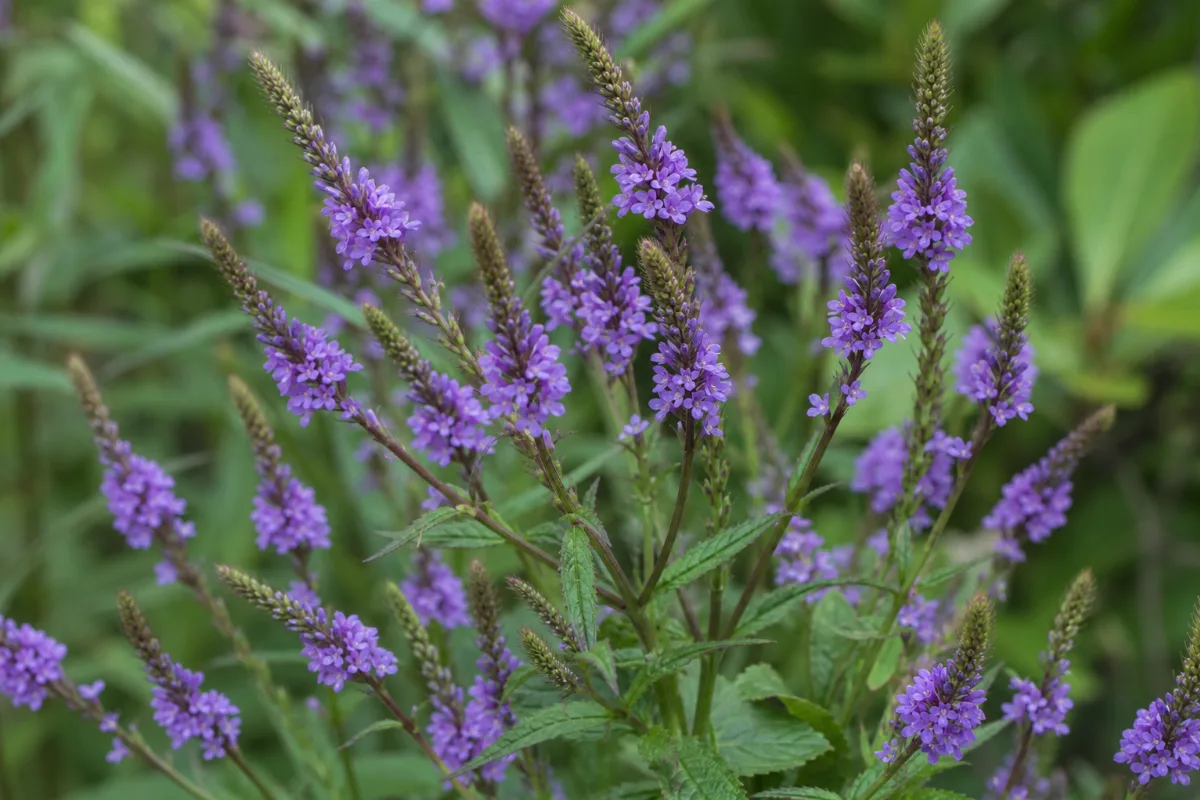
Herbs & Botanicals · Herbs · American wetland herb used traditionally for tension and sleep, with no human trials
Blue Vervain
Verbena hastata L. · also called Blue vervain, American blue vervain, swamp verbena, swamp vervain, simpler's-joy, wild hyssop, Lanzen-Eisenkraut (German), verbena azul (Spanish)
Blue vervain is a North American wildflower of damp ground whose above-ground parts are used as a tea or tincture for tension, sleep and women's health. We found no human trial of it. Most vervain research is on a different plant, European vervain (Verbena officinalis). It is not advised in pregnancy, and large doses are said to cause vomiting.
General information, not medical advice. Last substantive update · Not medically reviewed. A named clinician has not signed off on this page. How this page is made
About Blue Vervain
Blue vervain (Verbena hastata) is a North American wetland herb with a folk reputation for calming and sleep. No human trial of it was found. Most vervain research is on European vervain, a different plant. Pregnancy is the clearest caution.
What it is
Blue vervain (Verbena hastata L.) is a wildflower of the vervain family that grows in damp meadows, thickets and shores across North America. The above-ground parts are used as a tea or tincture. Old herbals also describe the roots as more active and as causing vomiting.
Its main compound groups are iridoids (verbenalin and hastatoside), flavonoids and tannins, per herbal sources. A 2021 lab study found its essential oil rich in 1-octen-3-ol.
Not the same as European vervain
European vervain (Verbena officinalis) is a different species. It has a European Pharmacopoeia monograph and nearly all the published research. Lemon verbena (Aloysia citrodora) is a third, unrelated plant. Many articles and labels just say 'vervain'. Read the Latin name before comparing results.
In this profile, anything from European vervain or from a combination product is labelled as such.
What the research shows
PubMed holds almost nothing on Verbena hastata: a plant-oil chemistry paper and a one-page 19th-century article. No human trial was found, so every use is rated insufficient.
Related human research is indirect. A rinse of European vervain improved gum scores in a 260-person trial. A five-plant product that includes a vervain herb helped acute sinusitis symptoms in older trials but missed its main goal in a large chronic sinusitis trial. Neither result can be assigned to blue vervain.
At a glance
Traditional uses history, not proof
- Calming and sleep, as a tea or tincture
- Fevers, coughs and digestion in old herbals (leaves and roots)
- Period pain and breast milk flow, as vervain in general
Studied for research
- Calming, sleep, mood: no human trial, insufficient
- Sinus symptoms: five-plant combination product only, insufficient for blue vervain
- Gum inflammation: European vervain rinse, one trial, insufficient for blue vervain
Main compounds
- Iridoids (verbenalin, hastatoside)
- Flavonoids and tannins
- Essential oil (1-octen-3-ol, palmitic acid)
Common forms
- Dried above-ground parts as tea
- Tincture (alcohol extract)
- Capsules of powdered herb (check the Latin name)
Research links: NIH LactMed: Vervain (European vervain, breastfeeding) · EBSCO: Vervain's therapeutic uses · GBIF: Verbena hastata · Research Library · Genes & Biomarkers Library
The plant and its history
- Accepted scientific name
- Verbena hastata L.
- Naming authority
- L. (Linnaeus), Sp. Pl. 20 (1753); ACCEPTED in the GBIF backbone (key 2925527), exact match, species rank.
- Synonyms
- Verbena hastata var. hastata; Verbena hastata var. paniculata (Lam.) Farw.; Verbena hastata f. rosea (Coleman) R.H.Cheney
- Common names
- Blue vervain (English); American blue vervain (English); Swamp verbena (English); Simpler's-joy (English); Wild hyssop (English); Lanzen-Eisenkraut (German); Blauwe verbena (Dutch)
- Botanical family
- Verbenaceae (vervain family)
- Classification
- Plantae > Tracheophyta > Magnoliopsida > Lamiales > Verbenaceae > Verbena > Verbena hastata
- Native range
- North America: British Columbia to Quebec and Nova Scotia, south to California, Texas and Florida (PFAF; original source not opened).
- Habitat
- Moist meadows, thickets, shores, ditches and marshes (PFAF quoting USDA and Gray's Manual).
- What the plant looks like
- Roots: Not verified in the sources read.; Stems: Not verified in the sources read.; Leaves: Not verified; 'hastata' means spear-shaped, per the Latin name, not a source read.; Flowers: Not verified in the sources read; common name refers to blue-purple flowers.; Fruit: Not relevant to medicinal use.
- Cultivation
- Not verified in the sources read.
- Harvest and processing
- Not verified. Modern products use the above-ground parts (Hobbs, EBSCO).
- Look-alikes and adulterants
- Name: Verbena officinalis (European vervain, common vervain); Note: A different accepted species (GBIF key 2925529) with its own Pharmacopoeia monograph (Verbenae herba) and most of the research. Its results are not blue vervain's.; Name: Aloysia citrodora (lemon verbena); Note: A different plant sold as 'verbena' in tea; it has an EMA monograph. Not a vervain.
- Sustainability and conservation
- Not assessed in the sources read.
The plant and the parts used

Traditional use and history history, not clinical proof
| Tradition or era | Documented use | Source |
|---|---|---|
| North American and European folk herbalism | Tonic, sweating herb, expectorant and emetic; for fevers, coughs, cramps, headaches, worms and nerves (Grieve and others, quoted by PFAF; leaves and roots, roots stronger). | s-pfaf-verbena-hastata |
| Modern herbal practice | Tea or tincture of above-ground parts for nerves, sleep, periods and milk flow; EBSCO lists these as proposed uses with limited evidence (species not named). | s-ebsco-vervain |
| US industry safety review | AHPA added a blue vervain entry to its Botanical Safety Handbook in March 2022. | s-ahpa-bsh-blue-vervain |
| EU regulation | No EMA monograph found for this species. The Pharmacopoeia Verbenae herba monograph covers European vervain. | p32937665 |
Traditional use shows how a plant was used. It does not show that a supplement works or is safe today.
What is inside, and how it may work
What the plant contains and how those compounds act in cells and animals. Laboratory and animal mechanisms are not proven effects in people.
Main compounds
| Compound | Family | Where it is concentrated | Activity studied | Level of evidence |
|---|---|---|---|---|
| Verbenalin (cornin) PubChem 73467 | iridoid glycoside | Reported for vervain herb (Hobbs, LactMed); amount in blue vervain not given. | Not shown for blue vervain; lab work on the compound elsewhere is not cited. 2 13 17 | Laboratory research |
| Hastatoside PubChem 92043450 | iridoid glycoside | Named for vervain herb (Hobbs, LactMed); the name echoes the species. | Not shown for blue vervain. 2 13 17 | Laboratory research |
| Verbascoside (acteoside) PubChem 5281800 | phenylpropanoid glycoside | Named for the European species (LactMed, 2020 review). | Not shown for blue vervain. 13 9 17 | Laboratory research |
| Apigenin and luteolin (as glycosides) PubChem 5280443 | flavonoids | Found in European vervain extract (rat study). | Authors of the rat study suggest these glycosides could explain pregnancy toxicity; this is a suggestion, not shown for blue vervain. 5 17 | Animal research |
| 1-Octen-3-ol PubChem 18827 | alcohol in essential oil | Essential oil of Verbena hastata (part not given in the abstract). Up to 29% of the oil; palmitic acid up to 22%. | Aroma chemistry; no health effect tested. 10 17 | Laboratory research |
Mechanisms, receptors and pathways
| Target or pathway | Gene or receptor | What was found | Level |
|---|---|---|---|
| No mechanism studied for blue vervain | None | We found no mechanism study of Verbena hastata. For the European species, a 2020 review reports antioxidant, antimicrobial, anti-inflammatory, neuroprotective, analgesic and anticonvulsant effects in lab and animal work. Lab and animal only; not blue vervain. 9 | Laboratory research |
Absorption, metabolism and elimination
- Absorption
- Not studied for blue vervain in people.
- Distribution
- Not studied.
- Metabolism
- Not studied.
- Elimination
- Not studied.
- Bioavailability
- Unknown. LactMed notes no data on passage of vervain components into breast milk.
Isolated compounds versus whole extracts
Blue vervain is a mixture of iridoids, phenylpropanoids, flavonoids and oil. No study compares single compounds with the whole herb. Sinus trials used a five-plant extract, so no effect can be assigned to the vervain part.
Nutritional composition
Used as a medicinal tea or tincture, not a food. PFAF says seeds and leaves have been used as food or tea substitute (secondary source).
9 not enough evidence
What is Blue Vervain good for?
The main proposed uses and how strong the human evidence is for each. 'Insufficient' means there is not enough research to say. For blue vervain itself, every use is insufficient.
Benefits, one by one
Each card is a research question, not a promise. Tap a goal to filter. Open a card to see the studies, doses and limits.
Calming and nervous tension
Not enough evidenceBlue vervain is an old American and European folk herb for tension and restlessness. We found no human trial of blue vervain for any calming use.
2 studiesTraditional teas and tinctures, never tested in people for this use.
Studies, doses and limits
What the trials found
No human trial of Verbena hastata was found in PubMed, which lists only a plant-oil chemistry paper and a one-page 1854 article. The 2024 EBSCO reference article describes calming uses as traditional with limited evidence and does not name the species.
Results
No measured result.
Effect sizes as reported
None.
Why this rating
Traditional use only; no human data.
Form and dose studied
Traditional teas and tinctures, never tested in people for this use.
Who was studied
Not applicable.
Limits
No trial exists, so benefit, dose and who might respond are unknown.
Why researchers looked
Herbal writers describe it as a calming nerve herb.
Traditional use
Tea or tincture of the above-ground parts for nerves and tension. A long history of use is not evidence of benefit.
Proposed mechanism Pharmacological theory
No mechanism is established for blue vervain. Iridoids (verbenalin, hastatoside) are linked by one herbal writer to calming properties, which is theory.
A proposed mechanism does not show that the effect happens in people.
Large doses are said to cause vomiting and diarrhoea, and it is not advised in pregnancy (see Safety).
Sleeplessness
Not enough evidenceUsed traditionally for poor sleep. No human sleep trial of blue vervain, and none of the European vervain, was found.
1 studiesNot studied.
Studies, doses and limits
What the trials found
EBSCO lists insomnia as a proposed use with limited meaningful evidence. We found no sleep trial of either vervain species.
Results
No measured result.
Effect sizes as reported
None.
Why this rating
No human data.
Form and dose studied
Not studied.
Who was studied
Not applicable.
Limits
Nothing to judge. Do not rely on it for ongoing sleep problems; talk to a clinician.
Why researchers looked
Insomnia is a listed traditional use for vervain.
Traditional use
Evening tea or tincture in folk herbalism.
Proposed mechanism Pharmacological theory
None shown.
A proposed mechanism does not show that the effect happens in people.
Large doses are said to cause vomiting and diarrhoea, and it is not advised in pregnancy (see Safety).
Anxiety, low mood and seizures (animal studies of European vervain)
Not enough evidenceEarly animal studies of European vervain (Verbena officinalis), not blue vervain, hint at calming and anti-seizure effects. They do not show an effect in people.
2 studiesExtracts of V. officinalis in animals, not blue vervain.
Studies, doses and limits
What the trials found
The 2020 Planta Medica review summarizes lab and animal work on V. officinalis. EBSCO says animal studies from 2016 and 2020 hint at effects on anxiety, depression and seizures and are too early to show it works. No human trial.
Results
Animal and lab only.
Effect sizes as reported
None.
Why this rating
Animal work on a different species; no human trial.
Form and dose studied
Extracts of V. officinalis in animals, not blue vervain.
Who was studied
Mice and rats.
Limits
Different species; results in animals often fail in people; dose in animals not a human dose.
Why researchers looked
Animal studies are the only calming-related research on the genus.
Traditional use
European vervain has been used for depression after illness or childbirth (EBSCO).
Proposed mechanism Animal research
A 2020 review of the European species reports neuroprotective, analgesic and anticonvulsant effects in lab and animal studies.
A proposed mechanism does not show that the effect happens in people.
Large doses are said to cause vomiting and diarrhoea, and it is not advised in pregnancy (see Safety).
Low mood after illness or childbirth
Not enough evidenceTraditional use for low spirits during recovery. No trial of blue vervain.
2 studiesNot studied.
Studies, doses and limits
What the trials found
No human trial. Do not use for depression in place of care; postnatal low mood needs a clinician, and pregnancy and breastfeeding safety are not established.
Results
No measured result.
Effect sizes as reported
None.
Why this rating
Traditional use only.
Form and dose studied
Not studied.
Who was studied
Not applicable.
Limits
No evidence; safety in nursing mothers not established (LactMed, EBSCO).
Why researchers looked
Named as a traditional use of vervain.
Traditional use
EBSCO: used for depression, especially after illness or childbirth.
Proposed mechanism Pharmacological theory
None shown.
A proposed mechanism does not show that the effect happens in people.
Do not treat depression with an untested herb alone.
Sinus and chest congestion (a five-plant combination, not blue vervain)
Not enough evidenceThe best human trials involve Sinupret, a German five-plant product that contains a vervain herb as one part. They are not trials of blue vervain, and the vervain in the product is not stated to be the American species.
3 studiesStandardised five-plant product (BNO 1012, 1016, 101); not tea or a s…
Studies, doses and limits
What the trials found
A systematic review of Sinupret (BNO-101) found, as an add-on to antibiotics, patient-rated cure of 61.1% vs 34.5% on placebo after 2 weeks (2 trials, 159 vs 160). A 12-week trial of 929 people with chronic sinusitis missed its main goal; a benefit appeared only in a subgroup chosen afterwards. An open trial in 292 children found faster symptom relief when added to standard care.
Results
Combination product beat placebo in older acute-sinusitis trials; mixed in chronic sinusitis.
Effect sizes as reported
Cured: 61.1% vs 34.5% (acute, add-on to antibiotics). Chronic sinusitis main outcome: not better than placebo.
Why this rating
For blue vervain: no data. The combination evidence is low to moderate at best and several trials are company-linked; it cannot be credited to one ingredient.
Form and dose studied
Standardised five-plant product (BNO 1012, 1016, 101); not tea or a single herb.
Who was studied
Adults and children with sinusitis.
Limits
Combination; vervain species not named in the abstracts; company-linked; open-label child trial.
Why researchers looked
A vervain herb is one of five ingredients in a widely used German cold and sinus product.
Traditional use
Blue vervain was a folk remedy for coughs and fevers in North America (PFAF, quoting older herbals).
Proposed mechanism Pharmacological theory
Unknown. The effect, if any, cannot be assigned to the vervain part.
A proposed mechanism does not show that the effect happens in people.
Sinus symptoms that are severe, last over 10 days or come with high fever need medical care.
Gum inflammation (gingivitis), European vervain rinse
Not enough evidenceA trial of a European vervain (Verbena officinalis) mouth rinse found better gum scores than brushing alone. It was a different species and was rinsed, not swallowed.
1 studiesDecoction used as a rinse for 28 days; amount not in the abstract.
Studies, doses and limits
What the trials found
In a double-blind multicentre trial of 260 adults with chronic gingivitis, a V. officinalis decoction rinse plus brushing and flossing improved the Gingival Index and Plaque Index more than brushing and flossing alone at 14 and 28 days (P < .001).
Results
Better gum and plaque scores at 2 and 4 weeks.
Effect sizes as reported
P < .001 vs control; size of difference not in the abstract.
Why this rating
For blue vervain: no data. For the European rinse: one trial, abstract-only, no placebo rinse described.
Form and dose studied
Decoction used as a rinse for 28 days; amount not in the abstract.
Who was studied
Adults with chronic generalized gingivitis.
Limits
Different species; one trial; control did not get a placebo rinse as far as the abstract shows.
Why researchers looked
Vervain decoctions are used traditionally for mouth and gum problems.
Traditional use
Folk use for sore mouth and gums (general).
Proposed mechanism Laboratory research
Not established; the review lists antimicrobial and anti-inflammatory lab effects of the European species.
A proposed mechanism does not show that the effect happens in people.
Rinsing is not swallowing; swallowed doses carry the cautions in Safety.
Breast milk flow
Not enough evidenceVervain has a reputation for boosting breast milk. LactMed says no scientifically valid clinical trials support this and that safety for nursing mothers and infants is not established.
2 studiesNot studied.
Studies, doses and limits
What the trials found
LactMed (for European vervain) found no valid trials and no data on passage into milk. EBSCO says the same about limited evidence and unestablished safety.
Results
No measured result.
Effect sizes as reported
None.
Why this rating
No trials.
Form and dose studied
Not studied.
Who was studied
Breastfeeding mothers.
Limits
Safety in the baby is unknown. Milk supply needs proper feeding support first, as LactMed notes.
Why researchers looked
Its main traditional claim in some herbal books.
Traditional use
Traditional galactogogue (milk-promoting herb).
Proposed mechanism Pharmacological theory
None shown.
A proposed mechanism does not show that the effect happens in people.
Avoid unless a clinician agrees; pregnancy caution applies (see Safety).
Period pain and women's health
Not enough evidenceTraditional use for cramps and periods. No trial of blue vervain. The traditional claim that it stimulates the womb is also the reason pregnancy is avoided.
3 studiesNot studied.
Studies, doses and limits
What the trials found
No human trial. A rat study of a European vervain extract showed harm to pregnancies at very high doses.
Results
No measured result.
Effect sizes as reported
None.
Why this rating
Traditional use only.
Form and dose studied
Not studied.
Who was studied
Not applicable.
Limits
Do not use if pregnant or trying to conceive.
Why researchers looked
Named traditional uses: menstrual pain.
Traditional use
Folk herbalism for cramps and delayed periods.
Proposed mechanism Traditional use
One practitioner source attributes uterotonic (womb-stimulating) effects; no study seen.
A proposed mechanism does not show that the effect happens in people.
Uterine-stimulant warning (traditional).
Digestion, appetite, fevers and coughs
Not enough evidenceOld herbals call vervain a bitter tonic, sweating herb and expectorant. These are traditional uses with no testing in people.
2 studiesLeaves and roots in old herbals; modern supplements use above-ground …
Studies, doses and limits
What the trials found
No human trial found. Large doses of the plant are said to cause vomiting and diarrhoea.
Results
No measured result.
Effect sizes as reported
None.
Why this rating
Traditional use only.
Form and dose studied
Leaves and roots in old herbals; modern supplements use above-ground parts.
Who was studied
Not applicable.
Limits
Roots described as emetic (vomit-inducing).
Why researchers looked
Listed traditional uses: appetite and digestion, fevers, coughs, cramps, headaches, worms.
Traditional use
Grieve and Foster and Duke (via PFAF): tonic, diaphoretic, expectorant, emetic; roots more active than leaves.
Proposed mechanism Traditional use
None shown.
A proposed mechanism does not show that the effect happens in people.
Vomiting and diarrhoea at large doses.
Connections to the rest of health
How Blue Vervain connects to the rest of our health knowledge graph. Every link says what kind of connection it is. A safety link (for example to the liver) is a warning, not a benefit. A study that merely mentions a topic never creates a benefit link.
Explore every connection: goals, body systems, organs, symptoms, genes
A. Wellness goals
| Connected to | Kind of connection | Evidence status | Context | Studies |
|---|---|---|---|---|
| Calm Relaxation | Traditional use | Not enough evidence | Calming and nervous tension: Blue vervain is an old American and European folk herb for tension and restlessness. We found no human trial of blue vervain for any calming use. | 3 2 |
| Stress Reduction | Traditional use | Not enough evidence | Calming and nervous tension: Blue vervain is an old American and European folk herb for tension and restlessness. We found no human trial of blue vervain for any calming use. | 3 2 |
| Better Sleep | Traditional use | Not enough evidence | Sleeplessness: Used traditionally for poor sleep. No human sleep trial of blue vervain, and none of the European vervain, was found. | 3 |
| Sleep Quality | Traditional use | Not enough evidence | Sleeplessness: Used traditionally for poor sleep. No human sleep trial of blue vervain, and none of the European vervain, was found. | 3 |
| Anxiety Support | Preliminary mechanism | Not enough evidence | Anxiety, low mood and seizures (animal studies of European vervain): Early animal studies of European vervain (Verbena officinalis), not blue vervain, hint at calming and anti-seizure effects. They do not show an effect in people. | 9 3 |
| Mood Balance | Preliminary mechanism | Not enough evidence | Anxiety, low mood and seizures (animal studies of European vervain): Early animal studies of European vervain (Verbena officinalis), not blue vervain, hint at calming and anti-seizure effects. They do not show an effect in people. | 9 3 |
| Mood Balance | Traditional use | Not enough evidence | Low mood after illness or childbirth: Traditional use for low spirits during recovery. No trial of blue vervain. | 3 13 |
| Immune Support | Potential benefit | Not enough evidence | Sinus and chest congestion (a five-plant combination, not blue vervain): The best human trials involve Sinupret, a German five-plant product that contains a vervain herb as one part. They are not trials of blue vervain, and the vervain in the product is not stated to be the American species. Gum inflammation (gingivitis), European vervain rinse: A trial of a European vervain (Verbena officinalis) mouth rinse found better gum scores than brushing alone. It was a different species and was rinsed, not swallowed. | 11 14 16 8 |
| Womens Wellness | Traditional use | Not enough evidence | Breast milk flow: Vervain has a reputation for boosting breast milk. LactMed says no scientifically valid clinical trials support this and that safety for nursing mothers and infants is not established. Period pain and women's health: Traditional use for cramps and periods. No trial of blue vervain. The traditional claim that it stimulates the womb is also the reason pregnancy is avoided. | 13 3 2 5 |
| Digestive Support | Traditional use | Not enough evidence | Digestion, appetite, fevers and coughs: Old herbals call vervain a bitter tonic, sweating herb and expectorant. These are traditional uses with no testing in people. | 15 3 |
B. Body systems
| Connected to | Kind of connection | Evidence status | Context | Studies |
|---|---|---|---|---|
| Reproductive system | Contraindication | Not enough evidence | Uterine-stimulant warning; rat toxicity at high doses. Uterine-stimulant warning; avoid in pregnancy. Preparation or compound: Vervain herb (blue and European) |
2 5 |
| Digestive system | Adverse effect or risk | Not enough evidence | Vomiting and diarrhoea at large doses (USDA text). Preparation or compound: Blue vervain herb and root |
15 |
| Nervous System | Biological association | Not enough evidence | Studied for: Calming and nervous tension Studied for: Sleeplessness | 3 2 9 |
| Stress Mood | Biological association | Not enough evidence | Studied for: Calming and nervous tension Studied for: Anxiety, low mood and seizures (animal studies of European vervain) | 3 2 9 13 |
| Sleep Recovery | Biological association | Not enough evidence | Studied for: Sleeplessness | 3 |
| Respiratory System | Biological association | Not enough evidence | Studied for: Sinus and chest congestion (a five-plant combination, not blue vervain) | 11 14 16 |
| Digestive System | Biological association | Not enough evidence | Studied for: Gum inflammation (gingivitis), European vervain rinse Studied for: Digestion, appetite, fevers and coughs | 8 15 3 |
| Reproductive System | Biological association | Not enough evidence | Studied for: Breast milk flow Studied for: Period pain and women's health | 13 3 2 5 |
I. Biomarkers
| Connected to | Kind of connection | Evidence status | Context | Studies |
|---|---|---|---|---|
| Sinusitis Major Symptom Score (combination product trial) | Biological association | Low certainty | Measured in trials: no-change. A lab change is not the same as a health benefit. | 14 |
| Gingival Index and Plaque Index (European vervain rinse) | Biological association | Low certainty | Measured in trials: lowered. A lab change is not the same as a health benefit. | 8 |
L. Active compounds
| Connected to | Kind of connection | Evidence status | Context | Studies |
|---|---|---|---|---|
| Verbenalin (cornin) | Biological association | In vitro | Not shown for blue vervain; lab work on the compound elsewhere is not cited. Preparation or compound: Reported for vervain herb (Hobbs, LactMed); amount in blue vervain not given. |
2 13 17 |
| Hastatoside | Biological association | In vitro | Not shown for blue vervain. Preparation or compound: Named for vervain herb (Hobbs, LactMed); the name echoes the species. |
2 13 17 |
| Verbascoside (acteoside) | Biological association | In vitro | Not shown for blue vervain. Preparation or compound: Named for the European species (LactMed, 2020 review). |
13 9 17 |
| Apigenin and luteolin (as glycosides) | Biological association | Animal | Authors of the rat study suggest these glycosides could explain pregnancy toxicity; this is a suggestion, not shown for blue vervain. Preparation or compound: Found in European vervain extract (rat study). |
5 17 |
| 1-Octen-3-ol | Biological association | In vitro | Aroma chemistry; no health effect tested. Preparation or compound: Essential oil of Verbena hastata (part not given in the abstract). |
10 17 |
Each connection is stored with the ingredient, the connected record, the kind of connection, the evidence status, the supporting studies, the preparation or compound involved, and a review date (last reviewed October 25, 2026).
Evidence at a glance: what changed in 2 lab markers
Tap a number to show only those markers. Counts are markers, not people.
The evidence
The research centre for Blue Vervain. Every record here was checked against PubMed or the publisher's page; we never list a study we have not verified.
Evidence by outcome
Bars show how many studies we found for each outcome, not how well it works. People are added up across trials only (reviews are not added, to avoid double counting).
How we rate evidence
High certainty
Several well-run trials or reviews agree; further research is unlikely to change the picture much.
Moderate certainty
Good trials point the same way, but some doubt remains.
Low certainty
Small, short or inconsistent trials. The finding could change with better research.
Very low certainty
Very little or very weak human data. Treat as a possibility only.
Mixed findings
Trials or reviews disagree with each other.
Not enough evidence
Not enough human research to say either way.
Evidence against
Good research found no benefit, or found harm.
We take the reviewers' own risk-of-bias and GRADE statements where they exist, and otherwise judge from study size, design, consistency, directness and whether a product matches what is sold. Many publications do not make evidence high. Method note: We searched PubMed for Verbena hastata and related vervain and sinus-product studies, read the abstract of every PubMed study cited, read the EBSCO reference article, and read summaries of the Hobbs herbal database and the Plants For A Future page. Plant names were checked in GBIF and NCBI Taxonomy and compounds in PubChem. Not verified: EMA and NCCIH pages for blue vervain were not found; LiverTox was not read; the AHPA safety rating was not seen. Certainty ratings are the compiler's reading.
Study library: every study we checked 17
| Study | Design | People | Product, dose, length | Result |
|---|---|---|---|---|
| American Herbal Products Association 2022 AHPA blog note: blue vervain entry added to the Botanical Safety Handbook (March 2022) American Herbal Products Association · Source |
Authoritative guidance |
Not applicable | AHPA blog note: blue vervain entry added to the Botanical Safety Handbook (March 2022) unspecified Not applicable Not applicable · vs Not applicable |
Notes a blue vervain entry was added to the Botanical Safety Handbook in March 2022. The safety class was not shown on the page. Entry exists; rating not seen Methods, limits and fundingOutcomes: Safety and use statements Limitations: Rating not visible; carried from our earlier summary and not re-opened. Funding and conflicts: Not stated Read: summary-only |
| Christopher Hobbs Vervain, Herbal Therapeutics Database (Christopher Hobbs) Christopher Hobbs · Source |
Traditional use |
Not applicable | Vervain, Herbal Therapeutics Database (Christopher Hobbs) unspecified Not applicable Not applicable · vs Not applicable |
Page covers Verbena hastata (blue vervain). Says vervain is generally considered safe at recommended doses; not recommended in pregnancy because of uterotonic effects that could stimulate uterine contractions; rarely mild gastrointestinal upset or allergic reactions; advises caution with sedatives, anticoagulants or medicines metabolized by the liver; lists iridoid glycosides (verbenalin, hastatoside), flavonoids and tannins. Practitioner-written caution; no study cited in the text we read Methods, limits and fundingOutcomes: Safety and use statements Limitations: Commercial herbal database page, read through a page summary, not a peer-reviewed or regulator source. Funding and conflicts: Not stated Read: page-summary |
| EBSCO CAM Review Board 2024 Vervain's therapeutic uses (EBSCO Research Starters) EBSCO CAM Review Board · Source |
Reference article |
Not applicable | Vervain's therapeutic uses (EBSCO Research Starters) unspecified Not applicable Not applicable · vs Not applicable |
Describes traditional use for breast milk flow, insomnia and menstrual pain with limited evidence; early animal work on anxiety, depression and seizures; says safety is not thoroughly established, may not be safe in pregnancy, safety in nursing women, young children and severe liver or kidney disease unknown; says leaf and flower are the parts used. The article does not name its species. Safety is not well tested; evidence is early Methods, limits and fundingOutcomes: Safety and use statements Limitations: Species not named, so it may describe European vervain; page read 2026-10-25. Funding and conflicts: Not stated Read: full-text |
| EMA 2026 EMA herbal medicines search for Verbena hastata and Verbena officinalis EMA · Source |
Authoritative guidance |
Not applicable | EMA herbal medicines search for Verbena hastata and Verbena officinalis unspecified Not applicable Not applicable · vs Not applicable |
No EU herbal monograph or HMPC assessment was found for Verbena hastata, Verbena officinalis or Verbenae herba in a web search on 2026-10-25. The only EMA verbena monograph found is for lemon verbena (Aloysia citrodora), a different plant. The EMA site itself was not browsed in full. Not found Methods, limits and fundingOutcomes: Safety and use statements Limitations: Absence in a search is not proof that nothing exists. Funding and conflicts: Not stated Read: summary-only |
| Fateh 2019 Prenatal developmental toxicity evaluation of Verbena officinalis during gestation period in female Sprague-Dawley rats. Chem Biol Interact · PMID 30807743 · DOI |
Animal research animal |
50 Pregnant rats |
Verbena officinalis extract by mouth unspecified 500, 1000, 2000 and 3000 mg/kg a day Gestation days 6 to 20 · vs Untreated control rats |
At 2000 and 3000 mg/kg, mothers gained less weight and foetuses had lower weight, more pre- and post-implantation loss and incomplete bone formation. The authors conclude use of V. officinalis in pregnancy is not safe. They cite a case report of an abortifacient effect. Dose-related harm to rat pregnancy at high doses (None) Methods, limits and fundingOutcomes: Mother and foetus outcomes Limitations: Rats, very high doses, the European species; not blue vervain; does not give a safe human amount. Funding and conflicts: Not stated in the abstract Read: abstract |
| Fateh 2019 Mutagenicity and genotoxicity effects of Verbena officinalis leaves extract in Sprague-Dawley Rats. J Ethnopharmacol · PMID 30738113 · DOI |
Animal and lab mixed |
Bacteria (Ames test) and rats | Aqueous extract of Verbena officinalis leaves leaf 500, 1000 and 2000 mg/kg a day for rats 3 days · vs Water; cyclophosphamide as positive control |
The extract was mutagenic in two bacterial strains but did not raise micronuclei in rat bone marrow. Mixed: mutagenic in a bacteria test, not in the rat test (None) Methods, limits and fundingOutcomes: Mutation in bacteria; micronuclei in rat bone marrow Limitations: Lab and animal work on the European species; not blue vervain. Funding and conflicts: Not stated in the abstract Read: abstract |
| GBIF 2026 GBIF backbone: Verbena hastata L. GBIF · Source |
Database record |
Not applicable | GBIF backbone: Verbena hastata L. unspecified Not applicable Not applicable · vs Not applicable |
ACCEPTED species, exact match, key 2925527, family Verbenaceae, order Lamiales, published in Sp. Pl. 20 (1753). Vernacular names include American blue vervain, swamp verbena, Simpler's-joy and wild hyssop. Verbena officinalis L. is a separate accepted species (key 2925529). Name verified Methods, limits and fundingOutcomes: Safety and use statements Limitations: Checked by API on 2026-10-25. Funding and conflicts: Not stated Read: full-text |
| Grawish 2016 Short-term effects of Verbena officinalis Linn decoction on patients suffering from chronic generalized gingivitis: Double-blind randomized controlled multicenter clinical trial. Quintessence Int · PMID 26824082 · DOI |
Controlled trial |
260 Adults with chronic generalized gingivitis |
Mouth rinse with a decoction of Verbena officinalis (European vervain) unspecified Not stated in the abstract 28 days · vs Brushing and flossing only (control group) |
Both groups improved. The vervain-rinse group improved more than the control group at day 14 and day 28 (P < .001). The authors report no adverse effects. Better gum and plaque scores than brushing alone; size of difference not given in the abstract (None) Methods, limits and fundingOutcomes: Gingival Index and Plaque Index at day 14 and 28 Limitations: Different species from blue vervain; a mouth rinse not swallowed; the abstract does not describe a placebo rinse or the size of the difference; short. Funding and conflicts: Not stated in the abstract Read: abstract |
| Kubica 2020 Verbena officinalis (Common Vervain) - A Review on the Investigations of This Medicinally Important Plant Species. Planta Med · PMID 32937665 · DOI |
Narrative review mixed |
Not applicable | Verbena officinalis herb extracts and constituents aerial parts / herb Not applicable Not applicable · vs Not applicable |
V. officinalis is rich in iridoids, phenylpropanoid glycosides, phenolic acids, flavonoids, terpenoids and essential oil. The Verbenae herba monograph has been in the European Pharmacopoeia since 2008. Lab and animal studies suggest antioxidant, antimicrobial, anti-inflammatory, neuroprotective, analgesic and anticonvulsant effects. Lab and animal findings only for the European species (None) Methods, limits and fundingOutcomes: Chemistry, traditional use, lab and animal studies Limitations: Review of the European species, mostly lab and animal work; not blue vervain. Funding and conflicts: No conflict declared Read: abstract |
| Lawson 2021 The Volatile Phytochemistry of Seven Native American Aromatic Medicinal Plants. Plants (Basel) · PMID 34070663 · DOI |
Chemical analysis in-vitro |
Lab analysis of plant oil | Essential oil of Verbena hastata made by steam distillation aerial parts (as reported; part not given in the abstract) Not applicable Not applicable · vs Not applicable |
The oil of Verbena hastata was rich in 1-octen-3-ol (up to 29%) and palmitic acid (up to 22%). The oil was reported for the first time in this study. Chemistry only; no health effect tested (None) Methods, limits and fundingOutcomes: Oil composition Limitations: Lab chemistry; no link to a health effect; the abstract does not name the plant part. Funding and conflicts: No conflict declared Read: abstract |
| Melzer 2006 Systematic review of clinical data with BNO-101 (Sinupret) in the treatment of sinusitis. Forsch Komplementmed · PMID 16645287 · DOI |
Systematic review |
About 900 patients with sinusitis, mostly young adult men | BNO-101 (Sinupret): five-plant combination of gentian root, primula flower, sorrel herb, elder flower and Verbenae herba combination Not stated in the abstract 2 weeks in the main trials · vs Placebo, ambroxol, N-acetylcysteine, Myrtol |
Added to antibiotics, the formula beat placebo after 2 weeks in 2 trials (159 vs 160 patients): 'cured' 61.1% vs 34.5%. Versus ambroxol there was no difference overall. Adverse events were similar to placebo. Better than placebo as an add-on to antibiotics, in a combination product (None) Methods, limits and fundingOutcomes: Patient-rated cure and symptoms Limitations: Five-herb combination with a vervain herb as one part (1 of 5, ratio 1:3:3:3:3); the abstract does not say which Verbena species; not a trial of blue vervain. Some authors may have industry ties; the abstract does not say. Funding and conflicts: Not stated in the abstract Read: abstract |
| NCCIH 2026 NCCIH herbs: vervain / blue vervain NCCIH · Source |
Authoritative guidance |
Not applicable | NCCIH herbs: vervain / blue vervain unspecified Not applicable Not applicable · vs Not applicable |
No NCCIH page for vervain or blue vervain was found (the guessed addresses /health/vervain and /health/blue-vervain returned 404). Not found Methods, limits and fundingOutcomes: Safety and use statements Limitations: Absence of a page is not proof of safety. Funding and conflicts: Not stated Read: summary-only |
| National Institute of Child Health and Human Development (LactMed) 2024 Vervain (Drugs and Lactation Database, LactMed record) Drugs and Lactation Database (LactMed) · PMID 30000912 |
Authoritative guidance |
Breastfeeding mothers and infants | Vervain, Verbena officinalis (European vervain) unspecified Not applicable Not applicable · vs Not applicable |
No data exist on excretion of any vervain component into breast milk or on safety and efficacy in nursing mothers or infants. No scientifically valid clinical trials support its use to boost milk. Vervain is GRAS as a food in the US. It is well tolerated, but gastrointestinal and allergic reactions have been reported. It names iridoid glycosides (verbenalin, hastatoside), verbascoside and flavonoids as components. No data in nursing mothers; GI and allergic reactions reported (None) Methods, limits and fundingOutcomes: Breastfeeding safety Limitations: Record is for Verbena officinalis, not blue vervain (V. hastata); applied here by genus with that label. Funding and conflicts: Public record Read: abstract |
| Palm 2017 Assessment of efficacy and safety of the herbal medicinal product BNO 1016 in chronic rhinosinusitis. Rhinology · PMID 28214913 · DOI |
Controlled trial |
929 Adults with chronic rhinosinusitis |
BNO 1016 (Sinupret extract), a five-plant combination that includes a vervain herb combination Two dose levels (values not in the abstract) 12 weeks · vs Placebo |
The extract was not better than placebo on the main outcome. A post-hoc analysis of people with a higher baseline score and disease for over 1 year found a benefit. The authors call safety and tolerability good. Main outcome missed; benefit only in a post-hoc subgroup (None) Methods, limits and fundingOutcomes: Major Symptom Score at weeks 8 and 12 Limitations: Combination product, not blue vervain; main goal missed; the benefit is from a subgroup chosen after the fact; company-linked. Funding and conflicts: Authors from Bionorica SE (the maker); funding not stated in the abstract Read: abstract |
| Plants For A Future Verbena hastata (Plants For A Future / temperate.theferns.info) Plants For A Future · Source |
Traditional use |
Not applicable | Verbena hastata (Plants For A Future / temperate.theferns.info) unspecified Not applicable Not applicable · vs Not applicable |
Quotes the USDA Plants Database: blue vervain can interfere with blood pressure medications and hormone therapy; large doses will induce vomiting and diarrhoea. Lists leaves and roots as emetic, tonic and others (Grieve), roots more active than leaves (Foster and Duke). Range: North America, British Columbia to Quebec and south to California, Texas and Florida; wet meadows, thickets and shores. Secondary quotes of older sources; no human data Methods, limits and fundingOutcomes: Safety and use statements Limitations: Secondary database quoting USDA and older herbals; original USDA text not opened. Funding and conflicts: Not stated Read: page-summary |
| Popovych 2020 An open-label, multicentre, randomized comparative study of efficacy, safety and tolerability of the 5 plant - extract BNO 1012 in the Delayed Antibiotic Prescription Method in children, aged 6 to 11 years with acute viral and post-viral rhinosinusitis. Am J Otolaryngol · PMID 32593046 · DOI |
Controlled trial |
292 Children aged 6 to 11 with acute viral or post-viral rhinosinusitis |
BNO 1012, a five-plant extract (Sinupret family) combination Not stated in the abstract Not stated in the abstract · vs Standard symptomatic treatment only (open label, no placebo) |
Added to standard care, the extract reduced runny nose, congestion and post-nasal drip at visit 2 (p < 0.005), with about 3 days of 'therapeutic benefit' in week 1. The abstract states 1.81-fold fewer antibiotic prescriptions. Faster symptom relief as an add-on in children (None) Methods, limits and fundingOutcomes: Physician-rated nasal symptoms, self-scored runny nose and headache, antibiotic prescriptions Limitations: Open-label, no placebo; combination product; not blue vervain; company-linked product. Funding and conflicts: Not stated in the abstract Read: abstract |
| PubChem 2026 PubChem records: verbenalin, hastatoside, verbascoside, apigenin, luteolin, 1-octen-3-ol PubChem · Source |
Database record |
Not applicable | PubChem records: verbenalin, hastatoside, verbascoside, apigenin, luteolin, 1-octen-3-ol unspecified Not applicable Not applicable · vs Not applicable |
CIDs: verbenalin 73467 (C17H24O10), hastatoside 92043450 (C17H24O11), verbascoside 5281800, apigenin 5280443, luteolin 5280445, 1-octen-3-ol 18827. Compound identity only Methods, limits and fundingOutcomes: Safety and use statements Limitations: Identity only; amounts in blue vervain not given. Funding and conflicts: Not stated Read: full-text |
What we do not know yet
- No human trial of Verbena hastata for any use.
- Most vervain research is on European vervain, not blue vervain, and cannot be assumed to apply.
- Sinus trials used a five-plant combination; the vervain part cannot be separated.
- No human safety, liver, interaction or pregnancy data; no EMA or NCCIH page; LiverTox not read.
- Nausea and blood-pressure statements come from a secondary database quoting USDA; the original was not opened.
How new research is added
New studies are found by a saved PubMed search and placed in a review queue. A person reads each one before it changes any rating or safety wording.
Lab markers
What changed in blood or saliva tests during trials. A changed number is not the same as feeling or being healthier, and we give no "normal ranges".
Other 2
Sinusitis Major Symptom Score (combination product trial)
No clear change in trials
A symptom score for sinusitis used as the main outcome in a 12-week trial.
Low certaintyResults and what it means
Why it was measured
Shows how bad sinus symptoms feel.
Statistical vs. clinical meaning
A symptom score, not a lab marker. Subgroup result chosen after the fact.
Safety implication
Authors report good tolerability.
| Study | Result | People | Product |
|---|---|---|---|
| 14 | Not superior to placebo on the main outcome at weeks 8 and 12; better in a post-hoc subgroup. Values not in the abstract. | 929 adults with chronic rhinosinusitis | BNO 1016, five-plant combination |
Gingival Index and Plaque Index (European vervain rinse)
Lowered in trials
Dentist-scored scales for gum redness and bleeding, and for plaque on teeth.
Low certaintyResults and what it means
Why it was measured
Standard measures of gum health.
Statistical vs. clinical meaning
Dentist scores of gum health; one trial.
Safety implication
No adverse effects reported by the authors.
| Study | Result | People | Product |
|---|---|---|---|
| 8 | Lower scores with the vervain rinse than control at day 14 and 28 (P < .001); sizes not given in the abstract. | 260 adults with gingivitis | Verbena officinalis decoction rinse |
Safety
What studies and official sources say about side effects, medicines and who should check first. Each point shows what kind of evidence it comes from.
Main points to know 5
- Pregnancy: avoid. Practitioner sources say vervain may stimulate the womb and is not recommended in pregnancy; EBSCO says there is reason to believe it may be unsafe. The only controlled data are in rats given very high doses of European vervain, which caused foetal weight loss, pregnancy loss and incomplete bone formation. No human pregnancy study exists. Traditional use 2 3 5
- Large doses: vomiting and diarrhoea. A plant database quoting the USDA says large doses of blue vervain induce vomiting and diarrhoea, and old herbals call the root emetic. Practitioner and LactMed sources describe milder stomach upset and allergic reactions as occasional. No study gives a dose threshold. Traditional use 15 2 13
- Breastfeeding: not established. LactMed (European vervain) has no data on excretion into milk or on safety for mothers or infants. EBSCO says the same. Authoritative guidance 13 3
- Blood pressure and hormone medicines. The USDA-derived text says blue vervain can interfere with blood pressure medicines and hormone therapy. No study or mechanism is given. Traditional use 15
- Little safety testing. EBSCO says vervain has not had meaningful modern safety testing. AHPA added a blue vervain entry to its Botanical Safety Handbook in March 2022; the safety class was not seen. Authoritative guidance 3 1
Side effects 4
| Effect | How often | Severity and recovery | Evidence |
|---|---|---|---|
| Vomiting and diarrhoea at large doses Secondary quote of the USDA plants database; no clinical report found. | Not established | moderate Not reported | Traditional use 15 |
| Mild stomach upset or nausea Hobbs says 'rarely'; LactMed says well tolerated with GI and allergic reactions reported (European vervain). No frequency data. | Not established | mild Not reported | Traditional use 2 13 |
| Allergic reactions No details on type or number. | Not established | mild to unknown Not reported | Authoritative guidance 13 2 |
| Few side effects with a five-plant sinus product containing a vervain herb Adverse events similar to placebo in the review. Combination product, not blue vervain. | Not established | mild Not applicable | Systematic review 11 14 |
Liver
We found no case report of liver injury from blue vervain or European vervain in the sources read. A LiverTox record was not opened (the page was not read), so none is cited. EBSCO says safety in people with severe liver or kidney disease is unknown. Hobbs advises caution with medicines processed by the liver. 3 2
How often. No data. Not finding reports is not proof of safety.
Monitoring. No agency monitoring advice found. People with liver or kidney disease should ask a clinician first.
This is a safety connection. It is not evidence that Blue Vervain supports liver health.
Medicines and supplements 5
| With | Why it matters | Importance | Evidence | What to do |
|---|---|---|---|---|
| Blood pressure medicines prescription | Not given. | Unknown; stated as possible interference. | Traditional use Not enough evidence 15 | Ask a doctor or pharmacist; do not change blood pressure medicine because of a herb. |
| Hormone therapy (oestrogen, contraceptive hormones) prescription | Not given. The European species contains flavonoids (apigenin, luteolin) but no hormone effect was tested for blue vervain. | Unknown; stated as possible interference. | Traditional use Not enough evidence 15 5 | Ask a doctor or pharmacist. |
| Sedatives and sleep medicines prescription | Theory only, based on a calming reputation. | Unknown | Pharmacological theory Not enough evidence 2 | Caution advised by Hobbs; ask a pharmacist. |
| Blood thinners (anticoagulants) prescription | Theory only. No study found; the one anticoagulant-herb review found (2000 title) was not opened. | Unknown | Pharmacological theory Not enough evidence 2 | Caution advised by Hobbs; tell the clinician managing the blood thinner. |
| Medicines broken down by the liver prescription | Theory only. No enzyme (CYP) study of blue vervain found. | Unknown | Pharmacological theory Not enough evidence 2 | Ask a pharmacist. |
Who should check first 4
| Situation | Advice | Evidence |
|---|---|---|
| Pregnancy or trying to conceive | Avoid. Uterine-stimulant warning from practitioner sources; EBSCO also warns; rat toxicity data for the European species. | Traditional use 2 3 5 |
| Breastfeeding | Avoid unless a clinician agrees; safety not established. | Authoritative guidance 13 3 |
| Young children, and people with severe liver or kidney disease | Safety unknown (EBSCO); ask a clinician. | Authoritative guidance 3 |
| Taking blood pressure, hormone, blood-thinning or sedative medicines | Ask a pharmacist first. | Traditional use 15 2 |
Overdose, product quality and regulators
Summary. No human toxicity study of blue vervain was found. The European species shows harm to rat pregnancies at very high doses and a mixed mutagenicity result.
Animal. Rats given European vervain extract at 2000 and 3000 mg/kg a day in pregnancy had lower body-weight gain, and their foetuses had lower weight, more implantation loss and incomplete bone formation. In another study, an aqueous extract was mutagenic in two bacterial strains but did not raise micronuclei in rat bone marrow.
Human doses studied. None for blue vervain.
High dose or long term signals. Large doses are said to cause vomiting and diarrhoea (USDA text via PFAF). No long-term data.
Overdose response. No overdose report found.
Genotoxicity. Mixed for European vervain (positive in bacteria, negative in rats). Not tested for blue vervain.
Toxic plant parts. Old herbals call the roots emetic and more active than the leaves. Modern products use the above-ground parts.
No contamination or adulteration study of blue vervain products was found.
Species mix-ups. Capsules and teas sold as 'vervain' may be European vervain (Verbena officinalis), a different species with its own traditions and studies, or lemon verbena (Aloysia citrodora), a different plant. Labels should give the Latin name. 7
| Body | Action | Date |
|---|---|---|
| NIH LactMed (United States) | Vervain (Verbena officinalis) record, updated 2024: no data in nursing mothers; GI and allergic reactions reported; GRAS as a food. Not a record for blue vervain. source | 2024-08-15 |
When to get medical help
- Repeated vomiting or diarrhoea after taking it, especially with dizziness or dehydration.
- Pregnancy cramps, bleeding or fluid loss after using it.
- Rash, swelling of lips or face, trouble breathing.
Stop the supplement and contact a clinician or emergency service. In the US, Poison Control is 1-800-222-1222.
General information only, not medical advice. Ask a clinician or pharmacist before use, especially with medicines, in pregnancy or with a health condition. See the Natural Remedy Safety guide.
Frequently asked questions
Does blue vervain work for anything?
Is blue vervain the same as vervain?
Can blue vervain help with sleep or anxiety?
Does it help with sinus problems?
Is blue vervain safe in pregnancy?
Is it safe while breastfeeding?
Not known. LactMed has no data for vervain in nursing mothers or babies, and advises that milk-supply problems need proper feeding support.
Can it make you feel sick?
Does it affect blood pressure or hormones?
The same USDA-derived text says it can interfere with blood pressure medicines and hormone therapy. No study or mechanism is given, so treat it as a caution and ask a pharmacist.
Does it interact with other medicines?
No tested interactions exist. One practitioner source advises caution with sedatives, blood thinners and medicines processed by the liver. This is theory, not evidence.
Has any regulator approved it?
Is it safe for children or people with liver or kidney disease?
Unknown. EBSCO says safety in young children and in severe liver or kidney disease is not established.
What should I ask a doctor or pharmacist?
Ask about amounts and about any medicines you take, especially for blood pressure, hormones, sleep or blood thinning. Also check the label names Verbena hastata.
Explore by health goal
Mood BalanceImmune SupportWomens WellnessCalm RelaxationStress ReductionBetter SleepSleep QualityAnxiety SupportDigestive Support
Editorial transparency
- Written by
- AlternativeMed editorial team. Research compiled with AI assistance, then checked against PubMed records.
- Medical review
- None. This page has not been reviewed by a physician or pharmacist.
- First published
- 2026-10-25
- Last substantive update
- 2026-10-25
- How we research
- We searched PubMed for Verbena hastata and related vervain and sinus-product studies, read the abstract of every PubMed study cited, read the EBSCO reference article, and read summaries of the Hobbs herbal database and the Plants For A Future page. Plant names were checked in GBIF and NCBI Taxonomy and compounds in PubChem. Not verified: EMA and NCCIH pages for blue vervain were not found; LiverTox was not read; the AHPA safety rating was not seen. Certainty ratings are the compiler's reading.
- How we rate evidence
- See "How we rate evidence" in the Evidence tab.
- Independence
- No product is promoted on this page. No affiliate links are shown.
Sources 17
Each source was opened and checked. Where we read only the abstract, it says so. The small numbers in the text point here.
- American Herbal Products Association. AHPA blog note: blue vervain entry added to the Botanical Safety Handbook (March 2022). American Herbal Products Association. 2022. (summary-only)
- Christopher Hobbs. Vervain, Herbal Therapeutics Database (Christopher Hobbs). Christopher Hobbs. . (page-summary)
- EBSCO CAM Review Board. Vervain's therapeutic uses (EBSCO Research Starters). EBSCO CAM Review Board. 2024. (full-text)
- EMA. EMA herbal medicines search for Verbena hastata and Verbena officinalis. EMA. 2026. (summary-only)
- Fateh AH, Mohamed Z, Chik Z, et al.. Prenatal developmental toxicity evaluation of Verbena officinalis during gestation period in female Sprague-Dawley rats.. Chem Biol Interact. 2019. PMID 30807743. DOI 10.1016/j.cbi.2019.02.016. (abstract)
- Fateh AH, Mohamed Z, Chik Z, et al.. Mutagenicity and genotoxicity effects of Verbena officinalis leaves extract in Sprague-Dawley Rats.. J Ethnopharmacol. 2019. PMID 30738113. DOI 10.1016/j.jep.2019.02.007. (abstract)
- GBIF. GBIF backbone: Verbena hastata L.. GBIF. 2026. (full-text)
- Grawish ME, Anees MM, Elsabaa HM, et al.. Short-term effects of Verbena officinalis Linn decoction on patients suffering from chronic generalized gingivitis: Double-blind randomized controlled multicenter clinical trial.. Quintessence Int. 2016. PMID 26824082. DOI 10.3290/j.qi.a35521. (abstract)
- Kubica P, Szopa A, Dominiak J, et al.. Verbena officinalis (Common Vervain) - A Review on the Investigations of This Medicinally Important Plant Species.. Planta Med. 2020. PMID 32937665. DOI 10.1055/a-1232-5758. (abstract)
- Lawson SK, Satyal P, Setzer WN. The Volatile Phytochemistry of Seven Native American Aromatic Medicinal Plants.. Plants (Basel). 2021. PMID 34070663. DOI 10.3390/plants10061061. (abstract)
- Melzer J, Saller R, Schapowal A, et al.. Systematic review of clinical data with BNO-101 (Sinupret) in the treatment of sinusitis.. Forsch Komplementmed. 2006. PMID 16645287. DOI 10.1159/000091969. (abstract)
- NCCIH. NCCIH herbs: vervain / blue vervain. NCCIH. 2026. (summary-only)
- National Institute of Child Health and Human Development (LactMed). Vervain (Drugs and Lactation Database, LactMed record). Drugs and Lactation Database (LactMed). 2024. PMID 30000912. (abstract)
- Palm J, Steiner I, Abramov-Sommariva D, et al.. Assessment of efficacy and safety of the herbal medicinal product BNO 1016 in chronic rhinosinusitis.. Rhinology. 2017. PMID 28214913. DOI 10.4193/Rhin16.103. (abstract)
- Plants For A Future. Verbena hastata (Plants For A Future / temperate.theferns.info). Plants For A Future. . (page-summary)
- Popovych VI, Beketova HV, Koshel IV, et al.. An open-label, multicentre, randomized comparative study of efficacy, safety and tolerability of the 5 plant - extract BNO 1012 in the Delayed Antibiotic Prescription Method in children, aged 6 to 11 years with acute viral and post-viral rhinosinusitis.. Am J Otolaryngol. 2020. PMID 32593046. DOI 10.1016/j.amjoto.2020.102564. (abstract)
- PubChem. PubChem records: verbenalin, hastatoside, verbascoside, apigenin, luteolin, 1-octen-3-ol. PubChem. 2026. (full-text)