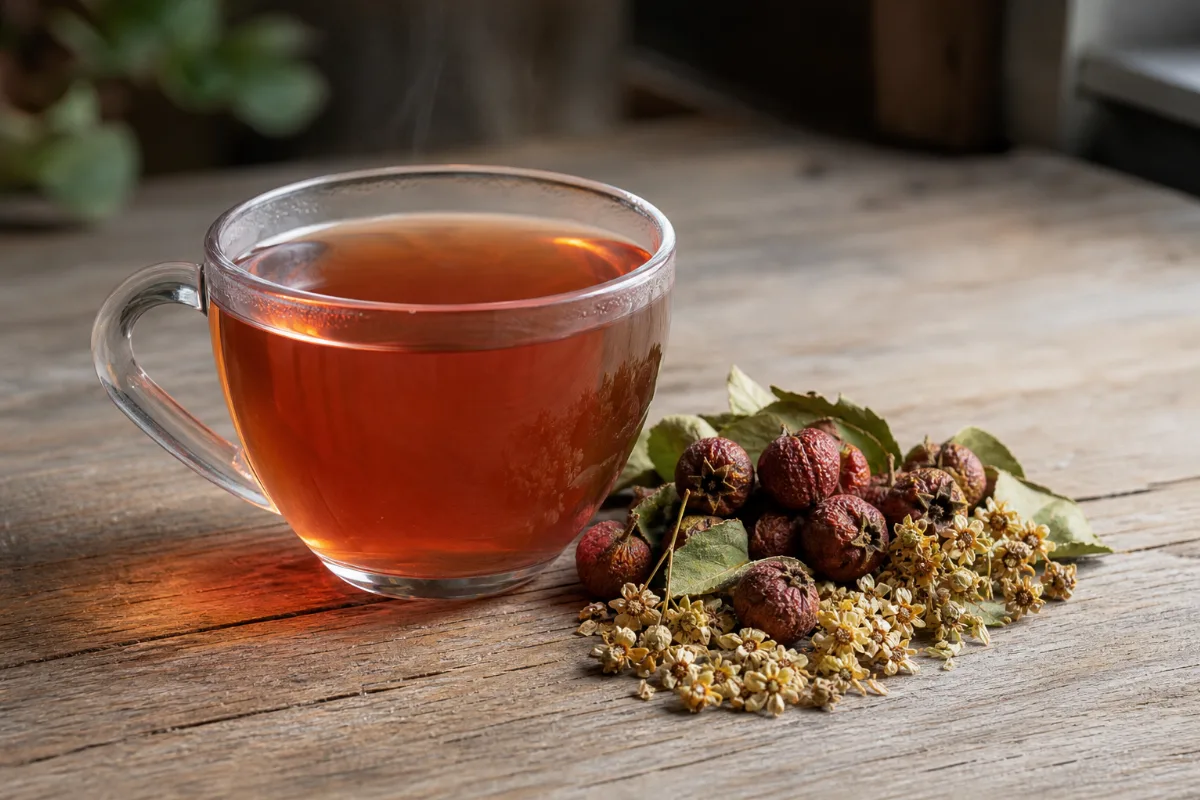
Herbal Teas & Extracts · Herbal tea
Hawthorn Tea
Crataegus monogyna and Crataegus laevigata · also called Hawthorn berry tea, hawthorn leaf and flower tea, may tree tea. Not the same as hawthorn extract capsules or tincture.
Hawthorn tea is a drink made from the leaf, flower or berry of hawthorn shrubs. People drink it for the heart, calm and sleep. No human trial of the tea itself was found. The heart-failure trials tested standardised extracts, which are a different product, and their results are mixed. Hawthorn can interact with heart medicines, so never use it in place of care for chest pain or heart failure.
General information, not medical advice. Last substantive update · Not medically reviewed. A named clinician has not signed off on this page. How this page is made
About Hawthorn Tea
Hawthorn tea is a hot-water drink made from the leaf, flower or berry of hawthorn shrubs. No human trial of the tea itself was found. The heart-failure trials used standardised extracts and gave mixed results. Safety comes first: hawthorn is not a treatment for chest pain or heart failure, it may add to digoxin, beta-blocker and blood-pressure medicines, and it is not recommended in pregnancy.
What it is
Hawthorn tea comes from shrubs of the rose family. Two species, Crataegus monogyna and Crataegus laevigata, are the ones used in Europe. GBIF accepts both as species. Tea can be made from the leaf and flower or from the berries, and tea bags may mix parts, so check the label.
A rat study found a hawthorn leaf-and-flower tea rich in plant compounds called flavonoids and procyanidins. These are not shown to explain any effect in people.
Tea, extract or tincture?
A cup of tea is a weak water extract. The EU monograph lists a herbal tea, several extracts and a tincture as separate forms. The heart-failure trials used standardised leaf-and-flower extracts. Do not carry results from an extract over to tea, or the reverse.
Sweetened hawthorn drinks and three-ingredient anxiety tablets have also been tested. They are not plain tea either.
What the research shows
Tea: no human trial found. Heart failure (extract): Cochrane pooled 10 trials in 855 people and found 5.35 W more workload than placebo and better breathlessness. HERB CHF in 120 people on modern treatment found no gain in walking distance. SPICE in 2,681 people found no difference in heart events. A favourable review of one extract was written by authors with fees from its maker.
Blood pressure: results are mixed, from small trials of extracts and drinks. Anxiety: one industry-linked trial of a three-ingredient product. Cholesterol and sugar: one null trial of a sweetened drink.
Quality and contamination
The proven quality problem is substitution: products labelled tejocote root were mostly yellow oleander. No survey of heavy metals, pesticides or adulteration in ordinary hawthorn tea was found, so quality is unknown, not shown good. Check the label for the plant (Crataegus monogyna or laevigata) and the part used.
Regulators and status
EU (EMA/HMPC, 2016): traditional herbal medicine, with a herbal tea among the listed forms, for temporary nervous heart complaints and for mild stress and sleep. NCCIH (US) says the evidence in heart failure is conflicting and warns about tejocote root products. The FDA yellow oleander list is described by NCCIH; the FDA page itself was not opened. LiverTox and LactMed were not opened.
At a glance
Traditional uses history, not proof
- The EU lists hawthorn leaf with flower, including as a herbal tea, as a traditional medicine for temporary nervous heart complaints such as palpitations, after a doctor has ruled out serious conditions.
- The EU also lists it as a traditional aid for mild mental stress and sleep.
- The Cochrane review notes that the German Commission E approved leaf-and-flower extracts for NYHA stage II heart failure (second-hand; the text was not read).
Studied for research
- Hawthorn tea in people: no trial found, insufficient
- Heart failure symptoms and exercise (extract only), mixed
- Heart failure events (extract only), low
- Nervous palpitations (traditional use only), insufficient
- Blood pressure (extracts and drinks), mixed
- Stress, anxiety and sleep (three-ingredient product), very low
- Cholesterol, blood sugar and weight (sweetened drink), insufficient
- Gut inflammation (rats only), insufficient
Main compounds
- Flavonoids
- Procyanidins
- Vitexin-2-O-rhamnoside
Common forms
- Leaf and flower tea
- Berry tea
- Tea bags
- Standardised extracts, capsules and tinctures (different products, not tea)
Research links: EMA herbal monograph on hawthorn leaf and flower (PDF) · NCCIH: Hawthorn · Cochrane review: hawthorn extract in heart failure (abstract) · SPICE trial (abstract) · HERB CHF trial (abstract) · Digoxin and hawthorn interaction study (abstract) · Research Library · Genes & Biomarkers Library
What it is and its history
- Accepted scientific name
- Crataegus monogyna Jacq. and Crataegus laevigata (Poir.) DC.
- Naming authority
- Both are accepted species names in GBIF.
- Synonyms
- Crataegus laevigata is also written Crataegus oxyacantha in many papers; the name oxyacantha is used for different species by different sources.
- Common names
- Hawthorn tea (English); May tree tea (English)
- Family or group
- Rosaceae (the rose family)
- Classification
- Plantae > Rosales > Rosaceae > Crataegus > Crataegus monogyna; Crataegus laevigata
- Native range
- Not checked.
- Habitat
- Not checked.
- What it looks like
- Roots: Not used for tea. Root products sold as 'tejocote' are a separate, risky matter.; Stems: Not checked.; Leaves: Leaf with flower is the part in the EU monograph.; Flowers: Used with the leaf.; Fruit: Berries (haws) are also used for tea.
- Cultivation
- Not checked.
- Harvest and processing
- Not described in the sources read.
- Look-alikes and adulterants
- Name: Tejocote root products (Crataegus mexicana, as labelled); Note: Tested products sold under this name were yellow oleander.; Name: Other Crataegus species such as C. pinnatifida; Note: Different species; results do not carry over.; Name: Hawthorn extract capsules, WS 1442 and tinctures; Note: Concentrated products used in the heart-failure trials; not tea.
- Sustainability and conservation
- Not checked.
Photographs
Traditional use and history history, not clinical proof
| Tradition or era | Documented use | Source |
|---|---|---|
| Europe, traditional and modern medicinal use | Hawthorn leaf with flower is recognised in the European Union as a traditional herbal medicine for temporary heart complaints linked to nervousness (such as palpitations, after a doctor has ruled out serious conditions) and for mild mental stress and to aid sleep. The monograph lists a herbal tea among the forms. The EMA's basis is traditional use, not trials. | s-ema-hmpc-hawthorn |
| Germany: approved extracts for mild heart weakness | The Cochrane review states that the German Commission E approved extracts of hawthorn leaf with flower for patients with heart failure graded NYHA stage II. The Commission E text itself was not read. | p18254076 |
Traditional use shows how it was used. It does not show that it works or is safe today.
What is inside, and how it may work
What it contains and how those compounds act in cells and animals. Laboratory and animal mechanisms are not proven effects in people.
Main compounds
| Compound | Family | Where it is concentrated | Activity studied | Level of evidence |
|---|---|---|---|---|
| Flavonoids and procyanidins (for example vitexin-2-O-rhamnoside) | polyphenols | Leaf and flower A rat-study hawthorn tea was rich in total phenolic compounds, flavonoids and proanthocyanidins, with vitexin-2-O-rhamnoside as the main compound found (Nascimento 2021). | Antioxidant and blood-vessel effects in lab work. Not shown to explain any effect in people. 11 | Lab |
| Oligomeric procyanidins | polyphenols | Leaf and flower Some extracts are standardised to oligomeric procyanidins, a feature of extracts rather than a cup of tea. | Used as a marker for extract strength. 5 | Label |
Mechanisms, receptors and pathways
| Target or pathway | Gene or receptor | What was found | Level |
|---|---|---|---|
| Heart-cell calcium (lab) | Na+/K+ ATPase (suggested) | Hawthorn extracts raised calcium inside rat heart cells, with no added response when digoxin was present, which the authors read as a shared site of action. 6 | Lab |
| Colon inflammation (rat study of a tea) | n/a | A hawthorn tea lowered inflammation markers and raised antioxidant enzyme activity in rats with colitis. 11 | Animal research |
Absorption, metabolism and elimination
- Absorption
- Not covered for tea. A pregnant-rat paper notes low absorption of some hawthorn constituents by mouth and calls for absorption studies.
- Distribution
- Not covered.
- Metabolism
- Not covered.
- Elimination
- Not covered.
- Bioavailability
- Not covered for tea.
Isolated compounds versus whole extracts
Tea (hot-water infusion), standardised extracts, capsules and tinctures are different products with different strengths. The heart-failure trials used standardised extracts. The only tea study found was in rats. Do not carry extract results over to tea.
Nutritional composition
Hawthorn tea is not a source of essential nutrients in the sources read.
2 mixed findings1 low certainty1 very low certainty4 not enough evidence
What is Hawthorn Tea good for?
The uses people ask about and how strong the human evidence is for each. No human trial of the tea itself was found, so most ratings come from extracts and are labelled that way.
Benefits, one by one
Each card is a research question, not a promise. Tap a goal to filter. Open a card to see the studies, doses and limits.
Hawthorn tea itself: human trials
Not enough evidenceNo trial of hawthorn tea in people was found. The only tea study found was in rats with chemically induced colitis. Everything positive below comes from extracts or traditional use, not from drinking tea.
2 studiesTea itself: not tested in people.
Studies, doses and limits
What the trials found
A PubMed search for hawthorn or Crataegus with tea or infusion found no human trial of a hawthorn tea. A rat study (Nascimento 2021) gave a tea made from Crataegus oxyacantha leaves and flowers by tube for 21 days to rats with induced colitis. It shortened colon lesions and lowered two inflammation markers. This is a rat study of the gut and says nothing about heart use in people.
Results
No human tea trial found; rat tea study only.
Effect sizes as reported
Not applicable.
Why this rating
No human trial of the tea.
Form and dose studied
Tea itself: not tested in people.
Who was studied
Not applicable (no human tea trial).
Limits
Only rats; the tea was given by tube.
Why researchers looked
Hawthorn leaf, flower and berry have long been made into tea in Europe.
Traditional use
The EU herbal monograph lists a herbal tea of hawthorn leaf with flower as a traditional-use form. Traditional use means long use, not proof from trials.
Proposed mechanism Animal research
The leaf and flower contain flavonoid and procyanidin compounds. A rat study measured them in a tea. No tea effect in people is shown.
A proposed mechanism does not show that the effect happens in people.
Hawthorn can interact with heart and blood-pressure medicines and is not a replacement for heart treatment. See the Safety tab.
Chronic heart failure: exercise capacity and symptoms (extract only)
Mixed findingsOlder pooled trials of hawthorn leaf-and-flower extract, mostly added to usual heart-failure drugs, found small gains in workload and breathlessness. A later trial in people on modern treatment found no gain. These were extracts, not tea. Heart failure needs a doctor.
4 studiesExtracts only, not tea.
Studies, doses and limits
What the trials found
Cochrane 2008 pooled 10 of 14 trials (855 people): maximal workload was 5.35 W higher than placebo (95% CI 0.71 to 10.00), and breathlessness and fatigue improved. A 2003 meta-analysis of 8 trials (632 people) found 7 W more workload (CI 3 to 11). In contrast, the HERB CHF trial (120 people with NYHA II to III heart failure on standard treatment, 6 months) found no difference in 6-minute walk distance (P=0.61) or quality of life, and more total adverse events on hawthorn (P=0.02), mostly not heart-related. A review of the extract WS 1442 reports benefit but its authors have fees from the maker.
Results
Small gains in older pooled trials; no gain in HERB CHF.
Effect sizes as reported
Workload +5.35 W (Cochrane).
Why this rating
Older small trials were positive; the newer trial on modern treatment was null; all used extracts; one favourable review is industry-linked.
Form and dose studied
Extracts only, not tea.
Who was studied
Adults with chronic heart failure, mostly NYHA II to III.
Limits
Extract products, not tea. Older trials. Industry-linked favourable review.
Why researchers looked
Hawthorn extract is approved as a medicine for mild heart weakness in some European countries.
Traditional use
The Cochrane review notes the German Commission E approved hawthorn leaf-and-flower extracts for NYHA stage II heart failure.
Proposed mechanism Lab
Lab work suggests hawthorn compounds act on heart muscle and blood vessels. Not shown to explain the trial results.
A proposed mechanism does not show that the effect happens in people.
Hawthorn can interact with heart and blood-pressure medicines and is not a replacement for heart treatment. See the Safety tab.
Chronic heart failure: deaths, hospital stays and worsening (extract only)
Low certaintyThe largest trial (2,681 people) found no difference in heart events between an extract and placebo. A look back at a smaller trial hinted at faster early worsening on hawthorn. Neither is a test of tea.
2 studiesStandardised extract only.
Studies, doses and limits
What the trials found
SPICE (Holubarsch 2008): 2,681 adults with NYHA II to III heart failure and ejection fraction 35% or lower took an extract or placebo for 24 months on top of standard drugs. Time to first cardiac event was 620 versus 606 days (event rates 27.9% versus 28.9%; HR 0.95, 95% CI 0.82 to 1.10; p=0.476), so no difference. Cardiac death trended lower (HR 0.89, CI 0.73 to 1.09; not significant). In a subgroup with ejection fraction 25% or higher, sudden cardiac death was lower (HR 0.59, CI 0.37 to 0.94). Adverse events were comparable. A look back at the smaller HERB CHF trial (Zick 2008) found progression in 46.6% versus 43.3% (OR 1.14, CI 0.56 to 2.35), but early progression was 3.9 times more likely on the extract (CI 1.1 to 13.7), and 3.2 times in people with ejection fraction 35% or lower (CI 1.3 to 8.3).
Results
SPICE: no difference in the main outcome (HR 0.95).
Effect sizes as reported
HR 0.95 (0.82 to 1.10).
Why this rating
One large trial with a null main result; an exploratory subgroup; a small look-back analysis pointing the other way.
Form and dose studied
Standardised extract only.
Who was studied
Adults with heart failure on standard drugs.
Limits
Extract, not tea. Subgroup results are exploratory.
Why researchers looked
Doctors want to know whether a heart-failure add-on lowers deaths and hospital stays, not just symptoms.
Traditional use
Not described in the sources read.
Proposed mechanism Not established
Not established.
A proposed mechanism does not show that the effect happens in people.
Hawthorn can interact with heart and blood-pressure medicines and is not a replacement for heart treatment. See the Safety tab.
Nervous palpitations (traditional use)
Not enough evidenceThe EU lists hawthorn leaf and flower as a traditional herbal medicine for temporary nervous heart complaints such as palpitations, only after a doctor has ruled out serious conditions. This status rests on long use, not on trials of tea.
1 studiesTea is a listed traditional form.
Studies, doses and limits
What the trials found
No trial of hawthorn tea for palpitations was found. The EMA monograph says to see a doctor if symptoms last more than 2 weeks, worsen, or come with swollen ankles or legs, heart-area pain spreading to the arms, upper belly or neck, or breathlessness.
Results
No trial; traditional-use status only.
Effect sizes as reported
Not applicable.
Why this rating
Based on traditional use, not on trial data.
Form and dose studied
Tea is a listed traditional form.
Who was studied
Adults only (EU).
Limits
Traditional use is not proof.
Why researchers looked
Traditional use in Europe for a pounding heartbeat linked to nervousness.
Traditional use
EU monograph: traditional use only, adults, after serious conditions are excluded by a doctor.
Proposed mechanism Not established
Not established.
A proposed mechanism does not show that the effect happens in people.
Hawthorn can interact with heart and blood-pressure medicines and is not a replacement for heart treatment. See the Safety tab.
Blood pressure
Mixed findingsSmall trials of hawthorn extracts and drinks give mixed results for blood pressure. One pooled analysis reports a lower systolic number, but the figures in its abstract do not add up cleanly. None used plain hawthorn tea.
4 studiesExtracts and sweetened drinks; none plain tea.
Studies, doses and limits
What the trials found
A 2025 pooled analysis of 6 placebo-controlled trials (428 people, 10 weeks to 6 months) reports systolic pressure 6.65 mmHg lower than placebo (printed interval -11.72 to 1.59, which crosses zero, so the wording and numbers disagree) and diastolic 7.19 mmHg lower, not significant. A UK trial in 79 adults with type 2 diabetes on blood-pressure drugs found diastolic pressure fell more on an extract (85.6 to 83.0 mmHg) than on placebo (84.5 to 85.0; P=0.035), with no group difference in systolic (P=0.329) and no herb-drug interaction found. A 40-day team-randomised trial in heat-exposed workers gave a hawthorn drink plus vitamin C: systolic 7.41 and diastolic 7.93 mmHg lower than a salted-water control. A Hong Kong crossover trial of 61 people with a sweetened hawthorn fruit extract drink found no significant difference from placebo.
Results
Mixed: some small falls, some null.
Effect sizes as reported
Systolic about -6.65 mmHg pooled (as printed).
Why this rating
Small, varied trials, extracts and mixed drinks, one pooled analysis with inconsistent numbers, no plain tea.
Form and dose studied
Extracts and sweetened drinks; none plain tea.
Who was studied
Adults with raised blood pressure, diabetes, or heat exposure.
Limits
Not tea; the vitamin C drink trial cannot separate hawthorn; the pooled interval is inconsistent.
Why researchers looked
Hawthorn relaxes blood vessels in lab work, so people ask about blood pressure.
Traditional use
Folk use for blood pressure is described in reviews; not checked further.
Proposed mechanism Lab
Blood-vessel relaxing effects shown in lab work. Not shown to explain the trials.
A proposed mechanism does not show that the effect happens in people.
Hawthorn can interact with heart and blood-pressure medicines and is not a replacement for heart treatment. See the Safety tab.
Stress, anxiety and sleep
Very low certaintyThe EU lists hawthorn leaf and flower as a traditional aid for mild stress and sleep. The only trial found tested a three-part product (hawthorn, California poppy and magnesium), so it cannot show that hawthorn works alone.
2 studiesCombination tablet, not tea.
Studies, doses and limits
What the trials found
Hanus 2004: 264 adults with mild to moderate generalised anxiety took a fixed combination of Crataegus oxyacantha, California poppy and magnesium or placebo for 3 months. Total Hamilton anxiety score fell 10.6 versus 8.9 points (p=0.005) and self-rated anxiety fell 38.5 versus 29.2 (p=0.005). Adverse events were 11.5% versus 9.7%, mostly mild. The product is made by the company named in the abstract. No sleep trial of hawthorn alone was found.
Results
Small gain for a three-ingredient product.
Effect sizes as reported
Score fall 10.6 vs 8.9 points.
Why this rating
One industry-linked trial of a combination; no plain hawthorn trial.
Form and dose studied
Combination tablet, not tea.
Who was studied
Adults with mild to moderate anxiety.
Limits
Cannot separate the hawthorn.
Why researchers looked
Hawthorn tea is traditionally used as a calming evening drink.
Traditional use
EU monograph: traditional use for mild mental stress and to aid sleep, adolescents over 12 and adults.
Proposed mechanism Not established
Not established.
A proposed mechanism does not show that the effect happens in people.
Hawthorn can interact with heart and blood-pressure medicines and is not a replacement for heart treatment. See the Safety tab.
Cholesterol, blood sugar and weight
Not enough evidenceThe one trial found of a hawthorn drink in people with mildly high blood pressure or blood fats did not beat placebo on cholesterol, blood sugar or weight.
1 studiesSweetened fruit extract drink, not tea.
Studies, doses and limits
What the trials found
A Hong Kong crossover trial of 61 people compared a sweetened hawthorn fruit extract drink with a placebo drink of the same sugar for 8 weeks each. Total cholesterol and systolic pressure rose with both. Fasting glucose rose significantly with placebo only. Body weight rose 0.42 kg on hawthorn and 0.94 kg on placebo (not significant). The authors say the results did not show significant effects of the hawthorn drink compared with placebo.
Results
No significant difference from placebo.
Effect sizes as reported
None.
Why this rating
One small crossover trial, null result, sweetened extract drink.
Form and dose studied
Sweetened fruit extract drink, not tea.
Who was studied
Adults with mild high blood pressure and/or blood fats.
Limits
Added sugar may have hidden effects.
Why researchers looked
Hawthorn fruit is sometimes taken for blood fats.
Traditional use
Not described in the sources read.
Proposed mechanism Not established
Not established.
A proposed mechanism does not show that the effect happens in people.
Hawthorn can interact with heart and blood-pressure medicines and is not a replacement for heart treatment. See the Safety tab.
Gut inflammation (rat study only)
Not enough evidenceA hawthorn leaf-and-flower tea eased induced colitis in rats. This is a lab animal result and does not show anything for people.
1 studiesTea given by tube to rats.
Studies, doses and limits
What the trials found
Nascimento 2021 gave a tea made from Crataegus oxyacantha leaves and flowers to rats with chemically induced colitis for 21 days. The tea and the drug mesalamine both shortened colon lesions and lowered two inflammation markers. Tissue scoring did not change. No human colitis study was found.
Results
Rat result only.
Effect sizes as reported
Not applicable.
Why this rating
Animals only.
Form and dose studied
Tea given by tube to rats.
Who was studied
Rats.
Limits
No human data.
Why researchers looked
Hawthorn compounds are antioxidant in the lab.
Traditional use
Not described in the sources read.
Proposed mechanism Animal research
The authors report lower inflammation and oxidative stress markers in the colon of rats.
A proposed mechanism does not show that the effect happens in people.
Hawthorn can interact with heart and blood-pressure medicines and is not a replacement for heart treatment. See the Safety tab.
Connections to the rest of health
How Hawthorn Tea connects to the rest of our health knowledge graph. Every link says what kind of connection it is. A safety link (for example to the liver) is a warning, not a benefit. A study that merely mentions a topic never creates a benefit link.
Explore every connection: goals, body systems, organs, symptoms, genes
A. Wellness goals
| Connected to | Kind of connection | Evidence status | Context | Studies |
|---|---|---|---|---|
| Heart Health | Not enough evidence | Hawthorn tea itself: human trials: No trial of hawthorn tea in people was found. The only tea study found was in rats with chemically induced colitis. Everything positive below comes from extracts or traditional use, not from drinking tea. Nervous palpitations (traditional use): The EU lists hawthorn leaf and flower as a traditional herbal medicine for temporary nervous heart complaints such as palpitations, only after a doctor has ruled out serious conditions. This status rests on long use, not on trials of tea. | 27 11 | |
| Heart Health | Mixed findings | Chronic heart failure: exercise capacity and symptoms (extract only): Older pooled trials of hawthorn leaf-and-flower extract, mostly added to usual heart-failure drugs, found small gains in workload and breathlessness. A later trial in people on modern treatment found no gain. These were extracts, not tea. Heart failure needs a doctor. Chronic heart failure: deaths, hospital stays and worsening (extract only): The largest trial (2,681 people) found no difference in heart events between an extract and placebo. A look back at a smaller trial hinted at faster early worsening on hawthorn. Neither is a test of tea. | 14 13 25 10 9 24 16 20 7 23 | |
| Stress Relief | Not enough evidence | Nervous palpitations (traditional use): The EU lists hawthorn leaf and flower as a traditional herbal medicine for temporary nervous heart complaints such as palpitations, only after a doctor has ruled out serious conditions. This status rests on long use, not on trials of tea. | 27 | |
| Blood Pressure Support | Mixed findings | Blood pressure: Small trials of hawthorn extracts and drinks give mixed results for blood pressure. One pooled analysis reports a lower systolic number, but the figures in its abstract do not add up cleanly. None used plain hawthorn tea. | 16 20 7 23 | |
| Stress Relief | Very low certainty | Stress, anxiety and sleep: The EU lists hawthorn leaf and flower as a traditional aid for mild stress and sleep. The only trial found tested a three-part product (hawthorn, California poppy and magnesium), so it cannot show that hawthorn works alone. | 8 27 | |
| Sleep Support | Very low certainty | Stress, anxiety and sleep: The EU lists hawthorn leaf and flower as a traditional aid for mild stress and sleep. The only trial found tested a three-part product (hawthorn, California poppy and magnesium), so it cannot show that hawthorn works alone. | 8 27 | |
| Cholesterol Support | Not enough evidence | Cholesterol, blood sugar and weight: The one trial found of a hawthorn drink in people with mildly high blood pressure or blood fats did not beat placebo on cholesterol, blood sugar or weight. | 23 | |
| Blood Sugar Balance | Not enough evidence | Cholesterol, blood sugar and weight: The one trial found of a hawthorn drink in people with mildly high blood pressure or blood fats did not beat placebo on cholesterol, blood sugar or weight. | 23 | |
| Digestive Health | Not enough evidence | Gut inflammation (rat study only): A hawthorn leaf-and-flower tea eased induced colitis in rats. This is a lab animal result and does not show anything for people. | 11 |
B. Body systems
| Connected to | Kind of connection | Evidence status | Context | Studies |
|---|---|---|---|---|
| Cardiovascular System | Biological association | Not enough evidence | Studied for: Hawthorn tea itself: human trials Studied for: Chronic heart failure: exercise capacity and symptoms (extract only) | 27 11 14 13 25 10 9 24 16 20 7 23 |
| Nervous System | Biological association | Not enough evidence | Studied for: Nervous palpitations (traditional use) Studied for: Stress, anxiety and sleep | 27 8 |
| Metabolism Weight | Biological association | Not enough evidence | Studied for: Cholesterol, blood sugar and weight | 23 |
| Digestive System | Biological association | Not enough evidence | Studied for: Gut inflammation (rat study only) | 11 |
E. Health conditions
| Connected to | Kind of connection | Evidence status | Context | Studies |
|---|---|---|---|---|
| Heart failure | Mixed findings | Do not self-treat; medical care first. Preparation or compound: Extract (not tea) |
9 25 24 | |
| Pregnancy | Contraindication | Low certainty | Not recommended (EU); animal results conflict. Preparation or compound: Hawthorn |
27 1 |
I. Biomarkers
| Connected to | Kind of connection | Evidence status | Context | Studies |
|---|---|---|---|---|
| Maximal workload on an exercise test | Biological association | Mixed findings | Measured in trials: increased. A lab change is not the same as a health benefit. | 14 13 |
| Six-minute walk distance | Biological association | Low certainty | Measured in trials: unchanged. A lab change is not the same as a health benefit. | 25 |
| Time to first cardiac event | Biological association | Low certainty | Measured in trials: unchanged. A lab change is not the same as a health benefit. | 9 |
| Heart failure progression | Biological association | Low certainty | Measured in trials: mixed. A lab change is not the same as a health benefit. | 24 |
| Systolic blood pressure | Biological association | Mixed findings | Measured in trials: mixed. A lab change is not the same as a health benefit. | 16 7 23 |
| Diastolic blood pressure | Biological association | Low certainty | Measured in trials: decreased. A lab change is not the same as a health benefit. | 20 |
| Hamilton anxiety score | Biological association | Very low certainty | Measured in trials: decreased. A lab change is not the same as a health benefit. | 8 |
L. Active compounds
| Connected to | Kind of connection | Evidence status | Context | Studies |
|---|---|---|---|---|
| Flavonoids and procyanidins (for example vitexin-2-O-rhamnoside) | Biological association | Lab | Antioxidant and blood-vessel effects in lab work. Not shown to explain any effect in people. Preparation or compound: Leaf and flower |
11 |
| Oligomeric procyanidins | Biological association | Label | Used as a marker for extract strength. Preparation or compound: Leaf and flower |
5 |
Each connection is stored with the ingredient, the connected record, the kind of connection, the evidence status, the supporting studies, the preparation or compound involved, and a review date (last reviewed October 25, 2026).
Evidence at a glance: what changed in 2 lab markers
Tap a number to show only those markers. Counts are markers, not people.
The evidence
The research centre for Hawthorn Tea. Every record here was checked against PubMed or the publisher's page; we never list a study we have not verified.
Evidence by outcome
Bars show how many studies we found for each outcome, not how well it works. People are added up across trials only (reviews are not added, to avoid double counting).
How we rate evidence
High certainty
Several well-run trials or reviews agree; further research is unlikely to change the picture much.
Moderate certainty
Good trials point the same way, but some doubt remains.
Low certainty
Small, short or inconsistent trials. The finding could change with better research.
Very low certainty
Very little or very weak human data. Treat as a possibility only.
Mixed findings
Trials or reviews disagree with each other.
Not enough evidence
Not enough human research to say either way.
Evidence against
Good research found no benefit, or found harm.
We take the reviewers' own risk-of-bias and GRADE statements where they exist, and otherwise judge from study size, design, consistency, directness and whether a product matches what is sold. Many publications do not make evidence high. Method note: We searched PubMed for hawthorn or Crataegus with tea or infusion and found no human tea trial. We read the abstracts of about 26 papers, the EMA hawthorn monograph (text of the PDF) and the NCCIH hawthorn page, checked the MMWR yellow oleander report on PMC, and checked the plant names in GBIF. The FDA list, LiverTox, LactMed and the EMA assessment report were not opened. Only abstracts were read for most papers. Certainty ratings are the compiler's own reading. One review of an extract has authors with fees from its manufacturer, and the anxiety product is made by the company named in its abstract. No study is cited that we could not verify.
Study library: every study we checked 29
| Study | Design | People | Product, dose, length | Result |
|---|---|---|---|---|
| Aguilera-Rodríguez 2023 Teratogen Potential Evaluation of the Aqueous and Hydroalcoholic Leaf Extracts of Crataegus oxyacantha in Pregnancy Rats. Plants (Basel, Switzerland) · PMID 37376012 · DOI |
Animal study rat |
Pregnant rats and their pups | Water and alcohol-water leaf extracts of Crataegus oxyacantha leaf Not given on this page 5 days late in pregnancy · vs Untreated |
Both extracts caused short-term cell and genetic damage. Only the water extract showed a teratogenic effect (harm to the developing young). The authors conclude the extracts should not be given in pregnancy. Water extract harmed offspring in rats Methods, limits and fundingOutcomes: Genetic damage, liver markers, malformations Limitations: Animal study at high doses; water extract is closest to tea but is not a tea made like a drink. Funding and conflicts: No conflicts stated Read: abstract |
| Assi 2023 Tejocote Root's Role in Symptomatic Mobitz Type 1 Heart Block: A Compelling Case Report. Cureus · PMID 37842399 · DOI |
Case report |
1 A 30-year-old woman |
Tejocote root bought in Mexico as a laxative (product not tested) root as labelled Not given on this page Not stated · vs None |
She had fatigue, dizziness, chest pressure, nausea and vomiting, a detectable digoxin level, sinus slowing and Mobitz type 1 heart block. A single dose of atropine resolved the block. Heart block, resolved Methods, limits and fundingOutcomes: Heart rhythm Limitations: One case; product not analysed. Funding and conflicts: None Read: abstract |
| Berland 2023 Notes from the Field: Online Weight Loss Supplements Labeled as Tejocote (Crataegus mexicana) Root, Substituted with Yellow Oleander (Cascabela thevetia) - United States, 2022. MMWR. Morbidity and mortality weekly report · PMID 37708076 · DOI |
Case series product analysis |
10 Ten online products labelled as tejocote root, bought in December 2022 |
Weight-loss supplements labelled 'tejocote (Crataegus mexicana) root' root (as labelled) Not given on this page n/a · vs Authenticated tejocote root |
Nine of the 10 products were yellow oleander (Cascabela thevetia), with no evidence of tejocote root. 9 of 10 products were yellow oleander Methods, limits and fundingOutcomes: Chemical analysis of the products Limitations: Online products bought at one time. This is a mislabelling problem, not about real hawthorn tea. Funding and conflicts: No conflicts stated Read: full-text (PMC) |
| Dahmer 2010 Health effects of hawthorn. American family physician · PMID 20148500 |
Review review |
General readers/clinicians | Hawthorn leaf, flower, berry Not given on this page n/a · vs n/a |
A review says hawthorn is well tolerated, with vertigo and dizziness the most common side effects, and notes theoretical interactions with antiarrhythmics, blood-pressure medicines, digoxin and cholesterol medicines. It recommends proven conventional therapies for heart failure until long-term safety and effectiveness of hawthorn are proven. Keep proven treatments Methods, limits and fundingOutcomes: Overview of health effects and interactions Limitations: Review from 2010; no new data. Funding and conflicts: Not stated Read: abstract |
| Daniele 2006 Adverse-event profile of Crataegus spp.: a systematic review. Drug safety · PMID 16752934 · DOI |
Systematic review |
5577 Patients in 24 studies of hawthorn single-ingredient products |
Hawthorn leaf-and-flower and berry preparations (mostly extracts WS 1442 and LI 132) leaf, flower, berry Extract amounts varied; not given on this page 3 to 24 weeks · vs Varied |
Of 29 studies, 24 were included, with data from 5,577 patients. 166 adverse events were reported, mostly mild to moderate; eight severe events were with the LI 132 extract. The most frequent were gut complaints (24), dizziness or vertigo (15), palpitation (11), headache (9) and migraine (8). No drug interactions were reported. The authors say hawthorn seems well tolerated but unsupervised use can cause problems, especially with other medicines. 166 events in 5,577 patients (counts, not rates) Methods, limits and fundingOutcomes: Adverse events and drug interactions Limitations: Counts, not rates; extracts, not tea; mostly heart-failure patients. Funding and conflicts: Not stated in the abstract Read: abstract |
| Dasgupta 2010 Interference of hawthorn on serum digoxin measurements by immunoassays and pharmacodynamic interaction with digoxin. Archives of pathology & laboratory medicine · PMID 20670141 · DOI |
Laboratory study lab |
Blood samples and rat heart cells | Hawthorn extracts (2 brands) not stated Not given on this page Lab · vs None |
Hawthorn interfered with one digoxin immunoassay (Digoxin III) but not the Tina-Quant assay. Both extracts raised calcium inside rat heart cells, with no added response when digoxin was present, which suggests they may act at the same site. The authors advise a person on digoxin to avoid hawthorn. Blood-test interference with one assay Methods, limits and fundingOutcomes: Digoxin blood-test readings; calcium inside rat heart cells Limitations: Laboratory work, not a test in patients. Funding and conflicts: Not stated in the abstract Read: abstract |
| Du 2024 Effect of vitamin C and hawthorn beverage formula on blood pressure and oxidative stress in heat-exposed workers: a cluster-randomized controlled trial. Asia Pacific journal of clinical nutrition · PMID 39209360 · DOI |
Randomised controlled trial |
Heat-exposed workers (4 shift teams) | Hawthorn beverage plus a vitamin C tablet (a combination, not plain tea) fruit (as a beverage) Not given on this page 40 days · vs Slightly salted water |
Compared with the control group, systolic pressure was 7.41 mmHg lower, diastolic 7.93 mmHg lower, and the urine oxidative-stress marker was lower by 0.232 (log scale) at day 41 (all p<0.05). SBP -7.41, DBP -7.93 mmHg vs control Methods, limits and fundingOutcomes: Blood pressure and a urine marker of oxidative stress Limitations: Whole teams, not individuals, were randomised; vitamin C was given too; a beverage, not a plain hawthorn tea; control drink was salted water. Funding and conflicts: No conflicts stated Read: abstract |
| Hanus 2004 Double-blind, randomised, placebo-controlled study to evaluate the efficacy and safety of a fixed combination containing two plant extracts (Crataegus oxyacantha and Eschscholtzia californica) and magnesium in mild-to-moderate anxiety disorders. Current medical research and opinion · PMID 14741074 · DOI |
Randomised controlled trial |
264 Adults with mild to moderate generalised anxiety |
Fixed combination of Crataegus oxyacantha, California poppy and magnesium (a three-part product) hawthorn part not stated Combination tablets 3 months · vs Placebo |
Total Hamilton anxiety score fell 10.6 points on the combination and 8.9 on placebo (p=0.005); self-rated anxiety fell 38.5 and 29.2 (p=0.005). 11.5% on the combination and 9.7% on placebo had adverse events, mostly mild digestive or psychological. Score fall 10.6 vs 8.9 points Methods, limits and fundingOutcomes: Hamilton anxiety scores, self-rated anxiety, safety Limitations: Three ingredients together; this cannot show hawthorn works alone. Not tea. Funding and conflicts: Product is made and sold by the company named in the abstract (industry-linked) Read: abstract |
| Holubarsch 2008 The efficacy and safety of Crataegus extract WS 1442 in patients with heart failure: the SPICE trial. European journal of heart failure · PMID 19019730 · DOI |
Randomised controlled trial |
2681 Adults with NYHA class II or III heart failure and low ejection fraction (35% or lower), on standard drugs |
Standardised hawthorn leaf-and-flower extract (WS 1442), not tea leaf and flower Standardised extract; amount not given on this page 24 months · vs Placebo |
Average time to first cardiac event was 620 days on the extract and 606 on placebo (event rates 27.9% and 28.9%; HR 0.95, 95% CI 0.82 to 1.10; p=0.476). The trend to fewer cardiac deaths (HR 0.89, CI 0.73 to 1.09) was not significant. In the subgroup with ejection fraction 25% or higher, sudden cardiac death was lower (HR 0.59, CI 0.37 to 0.94; p=0.025). Adverse events were comparable in both groups. The authors call the extract safe in people on optimal medication. Primary outcome no difference; HR 0.95 (95% CI 0.82 to 1.10) Methods, limits and fundingOutcomes: Time to first cardiac event (primary), cardiac death, sudden cardiac death, safety Limitations: Subgroup finding was not the main question. Extract, not tea. Authors of a later review of this extract report fees from the manufacturer for conducting and writing for this trial; this abstract does not state funding. Funding and conflicts: Funding not stated in the abstract; authors of a later review report fees from the manufacturer for conducting and writing for SPICE Read: abstract |
| Holubarsch 2018 Benefit-Risk Assessment of Crataegus Extract WS 1442: An Evidence-Based Review. American journal of cardiovascular drugs : drugs, devices, and other interventions · PMID 29080984 · DOI |
Review human review |
Heart failure patients in trials of one extract | Standardised hawthorn leaf-and-flower extract (WS 1442), not tea leaf and flower Not given on this page Varied · vs Mixed |
A review concluded that the extract (WS 1442) raised functional capacity, eased symptoms and improved quality of life in NYHA class II or III heart failure, and rated its benefit-risk as positive, with no drug interactions seen. Review says benefit-risk positive Methods, limits and fundingOutcomes: Benefit-risk review of one extract Limitations: Narrative review on one brand of extract; three authors report fees from the manufacturer (Dr. Willmar Schwabe) for the SPICE study; independent reviews are more mixed. Funding and conflicts: Industry-linked: authors received honoraria from the manufacturer Read: abstract |
| Nascimento 2021 Chemoprevention with a tea from hawthorn (Crataegus oxyacantha) leaves and flowers attenuates colitis in rats by reducing inflammation and oxidative stress. Food chemistry: X · PMID 34712949 · DOI |
Animal study rat |
Rats with chemically induced colitis | Hawthorn tea made from Crataegus oxyacantha leaves and flowers leaf and flower Not given on this page 21 days by gavage · vs Mesalamine drug and untreated colitis rats |
The tea and mesalamine both shortened colon lesions and lowered myeloperoxidase and interleukin-1 beta. The tea raised glutathione reductase and catalase activity. Tissue scoring did not change. The authors say the tea can be effective against colitis in these rats. Lesion length shorter; scores unchanged Methods, limits and fundingOutcomes: Colon lesion length, inflammation and oxidative stress markers Limitations: Rats, not people. Given by tube, not as a drink. Shows nothing about human colitis. Funding and conflicts: No competing interests stated Read: abstract |
| Palmer 2019 Crataegus mexicana (Tejocote) Exposure Associated with Cardiotoxicity and a Falsely Elevated Digoxin Level. Journal of medical toxicology : official journal of the American College of Medical Toxicology · PMID 31407210 · DOI |
Case report |
1 A 16-year-old girl |
Tejocote root weight-loss supplement (product not tested) root as labelled Not given on this page Single exposure · vs None |
After eating eight pieces she was drowsy and vomiting, with a heart rate of 38 and Mobitz type 1 heart block. Digoxin assay read 0.7 ng/mL although she took no digoxin. She received digoxin antibody treatment without clear benefit and recovered about 29 hours after ingestion. Heart block, recovered Methods, limits and fundingOutcomes: Heart rhythm, digoxin assay Limitations: One case; the product was not analysed, and other tejocote root products have tested as yellow oleander. Funding and conflicts: None Read: abstract |
| Pittler 2003 Hawthorn extract for treating chronic heart failure: meta-analysis of randomized trials. The American journal of medicine · PMID 12798455 · DOI |
Meta-analysis |
632 People with chronic heart failure (NYHA I to III) |
Hawthorn extract monopreparations leaf and flower Extracts; amounts not given on this page Varied · vs Placebo |
13 trials met the rules; 8 trials with 632 patients were pooled. Maximal workload was 7 W higher (95% CI 3 to 11). The pressure-heart rate product fell. Breathlessness and fatigue improved. Side effects infrequent, mild and transient. Workload +7 W (95% CI 3 to 11) Methods, limits and fundingOutcomes: Maximal workload, pressure-heart rate product, symptoms Limitations: Earlier, overlapping set of trials with the Cochrane review; extracts, not tea. Funding and conflicts: Not stated in the abstract Read: abstract |
| Pittler 2008 Hawthorn extract for treating chronic heart failure. The Cochrane database of systematic reviews · PMID 18254076 · DOI |
Systematic review |
855 People with chronic heart failure (NYHA classes I to III) |
Hawthorn leaf-and-flower extracts (monopreparations) leaf and flower Extracts; amounts not given on this page Varied · vs Placebo |
14 double-blind placebo-controlled trials were included, 10 trials with 855 patients were pooled, mostly as an add-on to usual treatment. Maximal workload was higher by 5.35 W (95% CI 0.71 to 10.00; n=380). Exercise tolerance was higher by 122.76 W x min (CI 32.74 to 212.78; n=98). The pressure-heart rate product fell (CI -30.46 to -7.98; n=264). Symptoms such as breathlessness and fatigue improved (CI -8.68 to -2.26; n=239). No data on deaths or heart events apart from one trial with three deaths on hawthorn and one on control. Side effects were infrequent, mild and temporary. Workload +5.35 W; symptoms improved (95% CI 0.71 to 10.00 (workload)) Methods, limits and fundingOutcomes: Maximal workload, exercise tolerance, pressure-heart rate product, symptoms, deaths and events Limitations: Trials were small and mostly old; extracts, not tea; no event data. Funding and conflicts: None known stated Read: abstract |
| Shatoor 2021 Opposite Modulatory Effects of Crataegus aronia Aqueous Extract on Platelet Aggregation in Rats. Chinese journal of integrative medicine · PMID 32418179 · DOI |
Animal study rat |
Rats | Crataegus aronia aqueous (water) extract not stated Not given on this page 7 days · vs Vehicle |
The lower dose reduced platelet clumping; the very high dose had the opposite effect. Opposite effects at low and high dose Methods, limits and fundingOutcomes: Platelet clumping Limitations: Rats; a different species of hawthorn; no human data. Funding and conflicts: Not stated Read: abstract |
| Szikora 2025 Hawthorn (Crataegus spp.) Clinically Significantly Reduces Blood Pressure in Hypertension: A Meta-Analysis of Randomized Placebo-Controlled Clinical Trials. Pharmaceuticals (Basel, Switzerland) · PMID 40732315 · DOI |
Meta-analysis |
428 People with high blood pressure (6 placebo-controlled trials) |
Hawthorn preparations (mostly extracts) varied Varied between trials 10 weeks to 6 months · vs Placebo |
Systolic pressure fell by a mean 6.65 mmHg versus placebo (printed 95% CI -11.72 to 1.59) and diastolic pressure fell 7.19 mmHg (CI -15.17 to 0.79), which the authors report as not significant. The printed systolic interval crosses zero, which does not fit the word 'significant', so the numbers may contain a typing slip. The authors say larger trials are needed. SBP -6.65 mmHg (as printed) (95% CI -11.72 to 1.59 (as printed)) Methods, limits and fundingOutcomes: Systolic and diastolic blood pressure Limitations: Small, varied trials; the abstract's interval does not match its wording. Funding and conflicts: No conflicts stated Read: abstract |
| Tankanow 2003 Interaction study between digoxin and a preparation of hawthorn (Crataegus oxyacantha). Journal of clinical pharmacology · PMID 12817526 |
Randomised crossover trial |
8 Healthy volunteers |
Hawthorn leaf-and-flower extract WS 1442 given with digoxin leaf and flower Standardised extract; amount not given on this page 21 days · vs Digoxin alone for 10 days |
No statistically significant differences in any digoxin pharmacokinetic measure (for example AUC 79 versus 73 mcg.h/L, p>0.05). The authors say hawthorn and digoxin may be given together safely at the doses and form studied. No change in digoxin levels Methods, limits and fundingOutcomes: Digoxin blood levels and clearance Limitations: Only 8 healthy people; an extract, not tea; says nothing about heart patients or other medicines. Funding and conflicts: Not stated in the abstract (the extract is a manufacturer product) Read: abstract |
| Tassell 2010 Hawthorn (Crataegus spp.) in the treatment of cardiovascular disease. Pharmacognosy reviews · PMID 22228939 · DOI |
Review review |
General readers/clinicians | Hawthorn preparations leaf, flower, berry Not given on this page n/a · vs n/a |
A review of mechanisms, clinical trials and safety says trials were inconsistent in design but mostly positive, that theoretical drug interactions have not been seen in practice, and that side effects are infrequent and mild. It also mentions a retrospective study (Zick) suggesting a negative outcome in heart failure. Mostly positive trials, mixed quality Methods, limits and fundingOutcomes: Overview of trials, mechanisms and safety Limitations: Review from 2010; positive wording is the authors' own. Funding and conflicts: No conflicts declared Read: abstract |
| Theuer 2026 When herbal supplements cause heart problems: Clinical case report and forensic toxicological analysis. Toxicology reports · PMID 41883558 · DOI |
Case report |
1 A 42-year-old woman |
Weight-loss supplement labelled 'Tejocote root', bought in the USA root as labelled Not given on this page Not stated · vs None |
She had nausea, vomiting, low blood pressure, slow heart rate (51 a minute) and first-degree heart block. Mass spectrometry and DNA barcoding found yellow oleander (Thevetia peruviana) and no Crataegus mexicana in the supplement. Slow heart rate lasted five days and everything resolved by day nine. Yellow oleander found, no tejocote Methods, limits and fundingOutcomes: Chemical analysis and heart rhythm Limitations: One case. Funding and conflicts: None Read: abstract |
| Walker 2006 Hypotensive effects of hawthorn for patients with diabetes taking prescription drugs: a randomised controlled trial. The British journal of general practice : the journal of the Royal College of General Practitioners · PMID 16762125 |
Randomised controlled trial |
79 Adults with type 2 diabetes, 71% on blood-pressure drugs, average 4.4 diabetes or blood-pressure drugs |
Hawthorn extract (Crataegus laevigata) leaves, flowers and berries as described Extract; amount not given on this page 16 weeks · vs Placebo |
Diastolic pressure fell more on hawthorn (85.6 to 83.0 mmHg) than on placebo (84.5 to 85.0; P=0.035). Systolic pressure fell 3.6 versus 0.8 mmHg, no group difference (P=0.329). No herb-drug interaction was found. Minor health complaints fell in both groups. Diastolic difference, P=0.035 Methods, limits and fundingOutcomes: Blood pressure, wellbeing, blood tests Limitations: One modest trial; extract, not tea. Funding and conflicts: Research funded as described in the paper; not stated in the abstract Read: abstract |
| Woerdenbag 2024 Analysis of Adverse Reactions Associated with the Use of Crataegus-Containing Herbal Products. Pharmaceuticals (Basel, Switzerland) · PMID 39598401 · DOI |
Systematic review human report data |
Reports in the WHO VigiBase (1,527) and a Dutch centre (13), plus 37 clinical studies | Crataegus-containing products varied Not given on this page 1970 to 2023 · vs None |
The scoping review found only a few minor stomach and heart events in 23 single-herb and 14 multi-herb studies. The most reported reaction groups were stomach, skin, general, heart and nervous system. In 277 reports where a single-herb product was the only suspect, 12.6% were graded serious. 12.6% of 277 single-herb reports serious Methods, limits and fundingOutcomes: Adverse reactions Limitations: Spontaneous reports cannot show cause or how common a reaction is. The abstract does not list the serious events. Funding and conflicts: No conflicts stated Read: abstract |
| Yao 2008 A reproductive screening test of hawthorn. Journal of ethnopharmacology · PMID 18485639 · DOI |
Animal study rat |
Pregnant rats | Hawthorn extract at 56 times the human dose not stated Not given on this page Gestation days 1-8 or 8-15 · vs Untreated |
Hawthorn did not have an adverse effect on embryonic development in vivo or in vitro. The authors say this may be due to low absorption of some constituents and that absorption studies are needed to verify safety. No harm seen in rats Methods, limits and fundingOutcomes: Embryo and fetal development Limitations: Animal study; says nothing certain about people. Funding and conflicts: Not stated Read: abstract |
| Zeng 2024 Effects of Hawthorn Fruit Extract Drink in Chinese Patients With Mild Hypertension and/or Hyperlipidaemia: A Randomized, Double-Blind, Placebo-Controlled, Crossover Study. Dose-response : a publication of International Hormesis Society · PMID 39583031 · DOI |
Randomised crossover trial |
61 Chinese adults with mild high blood pressure and/or high blood fats |
Hawthorn fruit extract drink (sweetened) fruit Not given on this page 8 weeks per drink · vs Placebo drink with the same sugar |
Body weight rose 0.42 kg on hawthorn and 0.94 kg on placebo (not significant). Systolic pressure and total cholesterol rose with both drinks. Fasting glucose rose significantly with placebo only. The authors say the results did not show significant effects of the hawthorn drink compared with placebo, with a trend toward fewer adverse metabolic effects. No significant difference from placebo Methods, limits and fundingOutcomes: Blood fats, blood sugar, blood pressure, weight, side effects Limitations: A sweetened fruit extract drink, not plain tea; the authors say a longer trial without added calories is needed. Funding and conflicts: No conflicts stated Read: abstract |
| Zick 2008 The effect of Crataegus oxycantha Special Extract WS 1442 on clinical progression in patients with mild to moderate symptoms of heart failure. European journal of heart failure · PMID 18490196 · DOI |
Retrospective analysis |
Patients from the HERB CHF trial (mild to moderate heart failure) | Standardised hawthorn leaf-and-flower extract (WS 1442), not tea leaf and flower Standardised extract; amount not given on this page 6 months · vs Placebo |
Progression occurred in 46.6% on the extract and 43.3% on placebo (OR 1.14, 95% CI 0.56 to 2.35; p=0.86). Patients on the extract were 3.9 times more likely (CI 1.1 to 13.7; p=0.035) to have early progression, and 6.4 times after adjustment (CI 1.5 to 26.5). In people with ejection fraction 35% or lower the risk was 3.2 times higher (CI 1.3 to 8.3). The authors conclude the extract does not reduce progression and appears to increase early risk. Early progression OR 3.9 (95% CI 1.1 to 13.7) Methods, limits and fundingOutcomes: Time to heart failure progression (death, hospital stay or sustained increase in water pills) Limitations: After-the-fact analysis of a small trial. The much larger SPICE trial did not show this harm. Funding and conflicts: Research support from the US NIH (extramural); no conflicts reported Read: abstract |
| Zick 2009 Hawthorn Extract Randomized Blinded Chronic Heart Failure (HERB CHF) trial. European journal of heart failure · PMID 19789403 · DOI |
Randomised controlled trial |
120 Ambulatory adults with NYHA class II to III chronic heart failure on conventional treatment |
Hawthorn extract (as described in the abstract), not tea not stated in the abstract Extract; amount not given on this page 6 months · vs Placebo |
No significant differences in 6-minute walk distance (P=0.61) or in quality of life, functional capacity, neurohormones, oxidative stress or inflammation. A modest difference in ejection fraction favoured hawthorn (P=0.04). There were significantly more adverse events in the hawthorn group (P=0.02), most not related to the heart. The authors conclude hawthorn gave no symptom or function benefit when added to standard therapy. No difference in walk distance (P=0.61) Methods, limits and fundingOutcomes: Change in 6-minute walk distance (primary), quality of life, peak oxygen use, NYHA class, ejection fraction, adverse events Limitations: Small trial; extract, not tea. Funding and conflicts: Research support from the US National Institutes of Health (extramural) Read: abstract |
| n/a NCCIH (NIH): Hawthorn NCCIH · Source |
Authoritative guidance n/a |
n/a | n/a n/a n/a n/a · vs n/a |
Says there is little or no quality evidence on hawthorn for most conditions, conflicting evidence in heart failure, and not enough evidence for heart disease, angina, abnormal heartbeat or artery plaque. Notes that in January 2024 the FDA published a list of products labelled tejocote root that actually contain toxic yellow oleander. Side effects can include dizziness, nausea, vomiting, diarrhoea and muscle pain. No research tested use beyond 16 weeks. Little is known about pregnancy or breastfeeding. Methods, limits and fundingLimitations: Page read on 2026-10-25; no date shown. The FDA list itself was not opened. Read: full-text |
| n/a 2016 European Union herbal monograph on Crataegus spp., folium cum flore (EMA/HMPC/159075/2014), 5 April 2016 European Medicines Agency · Source |
Authoritative guidance n/a |
n/a | n/a n/a n/a n/a · vs n/a |
Traditional-use monograph for hawthorn leaf with flower. Forms listed include a herbal tea (comminuted herbal substance for oral use) and several extracts. Indications: temporary nervous heart complaints such as palpitations, after serious conditions have been excluded by a doctor, and mild mental stress and to aid sleep. Contraindication: hypersensitivity. Interactions none reported; undesirable effects none known. Pregnancy and breastfeeding use not recommended. Not recommended under 18 for the heart indication; not established under 12 for the stress and sleep indication. See a doctor immediately for swollen ankles or legs, pain in the heart area that may spread to the arms, upper belly or neck, or breathlessness. See a doctor if symptoms last more than 2 weeks. No overdose reported. Methods, limits and fundingLimitations: Monograph PDF text was read on 2026-10-25. The assessment report was not re-opened. Traditional use means long use, not proof from trials. Read: full-text |
| n/a 2026 GBIF Backbone Taxonomy: Crataegus monogyna Jacq. (usage key 9220780), checked 2026-10-25 GBIF · Source |
Reference database n/a |
n/a | n/a n/a n/a n/a · vs n/a |
Accepted species, family Rosaceae, order Rosales (GBIF API match, status ACCEPTED, exact match). Methods, limits and fundingLimitations: Taxonomic database record. Read: full-text |
| n/a 2026 GBIF Backbone Taxonomy: Crataegus laevigata (Poir.) DC. (usage key 8252683), checked 2026-10-25 GBIF · Source |
Reference database n/a |
n/a | n/a n/a n/a n/a · vs n/a |
Accepted species, family Rosaceae, order Rosales (GBIF API match, status ACCEPTED, exact match). Methods, limits and fundingLimitations: Taxonomic database record. Read: full-text |
What we do not know yet
- What the evidence supports: heart-failure trials of standardised extracts, with mixed results; nothing on the tea itself.
- No human trial of hawthorn tea for any health outcome was found.
- Interaction advice rests on extract trials, one small digoxin study, lab work and theory.
- No contamination survey of ordinary hawthorn tea was found.
- LiverTox, LactMed, the EMA assessment report and the FDA yellow oleander list were not opened.
How new research is added
New studies are found by a saved PubMed search and placed in a review queue. A person reads each one before it changes any evidence rating or safety wording. New publications never change ratings automatically.
Lab markers
What changed in blood or saliva tests during trials. A changed number is not the same as feeling or being healthier, and we give no "normal ranges".
Other 7
Maximal workload on an exercise test
Increased in trials
The most effort a person can reach on an exercise bike test, in watts.
Mixed findingsResults and what it means
Why it was measured
To see whether hawthorn extract improves exercise ability in heart failure.
Statistical vs. clinical meaning
Small gains in older trials; a surrogate outcome, not how long people live.
Safety implication
Extract, not tea.
Six-minute walk distance
Unchanged in trials
How far a person can walk in 6 minutes.
Low certaintyResults and what it means
Why it was measured
A simple measure of everyday heart-failure fitness.
Statistical vs. clinical meaning
The one trial with this outcome found nothing.
Safety implication
Extract, not tea.
| Study | Result | People | Product |
|---|---|---|---|
| 25 | No difference between groups (P=0.61) | 120 people with NYHA II to III heart failure on standard treatment | Hawthorn extract versus placebo, 6 months |
Time to first cardiac event
Unchanged in trials
Time until a first heart-related event such as cardiac death or hospital stay.
Low certaintyResults and what it means
Why it was measured
The main question for any heart-failure add-on.
Statistical vs. clinical meaning
No difference in the main outcome.
Safety implication
Extract, not tea.
| Study | Result | People | Product |
|---|---|---|---|
| 9 | 620 versus 606 days; HR 0.95 (95% CI 0.82 to 1.10; p=0.476) | 2,681 adults with heart failure | Standardised extract versus placebo, 24 months |
Heart failure progression
Mixed results in trials
Death, hospital stay or a sustained rise in water pills.
Low certaintyResults and what it means
Why it was measured
To check for harm as well as benefit.
Statistical vs. clinical meaning
After-the-fact analysis; not confirmed by SPICE.
Safety implication
A reason for care in heart failure.
| Study | Result | People | Product |
|---|---|---|---|
| 24 | Overall 46.6% versus 43.3% (OR 1.14, 0.56 to 2.35); early progression 3.9 times more likely on the extract (1.1 to 13.7) | HERB CHF patients | Standardised extract versus placebo, 6 months |
Systolic blood pressure
Mixed results in trials
The top blood pressure number.
Mixed findingsResults and what it means
Why it was measured
To see whether hawthorn lowers blood pressure.
Statistical vs. clinical meaning
Results differ between trials.
Safety implication
Can add to blood-pressure medicines; see Safety.
| Study | Result | People | Product |
|---|---|---|---|
| 16 | Mean 6.65 mmHg lower than placebo as printed (interval -11.72 to 1.59, inconsistent) | 6 trials, 428 people | Hawthorn preparations |
| 7 | 7.41 mmHg lower than control at day 41 | Heat-exposed workers | Hawthorn beverage plus vitamin C |
| 23 | Rose with both hawthorn and placebo; no significant difference | 61 adults | Sweetened hawthorn fruit extract drink |
Diastolic blood pressure
Decreased in trials
The bottom blood pressure number.
Low certaintyResults and what it means
Why it was measured
Same question as systolic.
Statistical vs. clinical meaning
One modest trial.
Safety implication
See Safety for blood-pressure medicines.
| Study | Result | People | Product |
|---|---|---|---|
| 20 | 85.6 to 83.0 mmHg on extract versus 84.5 to 85.0 on placebo (P=0.035) | 79 adults with type 2 diabetes, 16 weeks | Hawthorn extract |
Hamilton anxiety score
Decreased in trials
A doctor-rated anxiety score.
Very low certaintyResults and what it means
Why it was measured
To test calming claims.
Statistical vs. clinical meaning
Combination product.
Safety implication
None beyond mild events reported.
| Study | Result | People | Product |
|---|---|---|---|
| 8 | Fell 10.6 points versus 8.9 on placebo (p=0.005) | 264 adults with mild to moderate anxiety | Hawthorn, California poppy and magnesium combination |
Safety
What studies and official sources say about side effects, medicines and who should check first. Each point shows what kind of evidence it comes from.
Main points to know 8
- Do not treat heart failure, chest pain or palpitations on your own with hawthorn tea. The biggest risk is delay. Heart failure, angina and chest pain need a diagnosis and proven treatment. The EU monograph allows hawthorn leaf and flower, including as a herbal tea, only as a traditional medicine for temporary nervous heart complaints such as palpitations, and only after a doctor has ruled out serious conditions. It says to see a doctor immediately for swollen ankles or legs, pain in the heart area that may spread to the arms, upper belly or neck, or breathlessness, and to see a doctor if symptoms last more than 2 weeks. NCCIH says the evidence in heart failure is conflicting and that there is not enough evidence for heart disease, angina or abnormal heartbeat. The best trials were of extracts: SPICE (2,681 people) found no difference in the main outcome (HR 0.95, 95% CI 0.82 to 1.10) and HERB CHF (120 people) found no gain in walking distance. No study measured the harm of delaying care, so that risk comes from medical guidance, not a trial. Authoritative guidance 27 26 9 25 4
- Heart and blood-pressure medicines: digoxin, beta-blockers, nitrates and others. Hawthorn compounds raise heart-cell calcium and relax blood vessels in lab work, so doctors worry about added effects with digoxin, beta-blockers, calcium-channel blockers, nitrates, other blood-pressure medicines and antiarrhythmic drugs. The EU monograph lists interactions as none reported. In trials of extracts, many patients took several heart medicines and no interactions were reported, but those trials did not test interactions on purpose, and none tested tea. For digoxin, a small study in 8 healthy volunteers found no change in digoxin levels with an extract, while a laboratory study found hawthorn can disturb one digoxin blood test and advised people on digoxin to avoid hawthorn. Hawthorn may also lower blood pressure a little, so dizziness on standing is plausible with blood-pressure medicines. Ask your prescriber or pharmacist before drinking it regularly. Mixed 27 17 6 20 16 9 5
- Pregnancy, breastfeeding and children. The EU monograph says safety in pregnancy and breastfeeding has not been established and use is not recommended. It does not recommend use under 18 for the heart indication, and says use under 12 for the stress and sleep indication has not been established. NCCIH says little is known about pregnancy and breastfeeding. Animal findings conflict: one rat study at 56 times the human dose found no harm to embryo development, while another found the water leaf extract had a teratogenic effect and both extracts caused short-term genetic damage. These are animal results at high doses. No human pregnancy study was found. Authoritative guidance 27 26 22 1
- Everyday side effects are mild in trials. A review of 24 studies of single-ingredient hawthorn products (5,577 patients analysed) counted 166 adverse events, mostly mild to moderate. The most frequent were stomach complaints, dizziness or vertigo, palpitation, headache and migraine. Eight severe events were all with one extract (LI 132). The Cochrane review describes events as infrequent, mild and temporary. NCCIH lists dizziness, nausea, vomiting, diarrhoea and muscle pain. The EU monograph says undesirable effects are none known. The counts are not rates, and the trials were mostly in heart-failure patients taking extracts, not tea drinkers. Systematic review 5 14 26 27
- A small signal of faster heart-failure worsening in one trial (extract). A look back at the HERB CHF data found early heart-failure progression was 3.9 times more likely on the extract (95% CI 1.1 to 13.7), and 3.2 times in people whose heart pumped out 35% or less of its blood per beat (CI 1.3 to 8.3), although overall progression was similar (46.6% versus 43.3%). HERB CHF also had significantly more total adverse events on hawthorn (P=0.02), most not heart-related. The analysis was not planned in advance, the numbers were small, and the much larger SPICE trial did not show harm. NCCIH cites this signal. Both trials used extracts, so they say nothing certain about tea. Controlled trial 24 25 9 26
- Products sold as tejocote root for weight loss have been poisonous: yellow oleander, not hawthorn tea. Tests of 10 online products labelled tejocote (Crataegus mexicana) root found 9 were yellow oleander, a heart poison, and none was tejocote root. Case reports describe a 16-year-old with a heart rate of 38 and heart block, a 30-year-old woman with heart block, and a 42-year-old woman in Europe whose supplement tested as yellow oleander with no Crataegus. NCCIH says the FDA published a list in January 2024 of such products and warned they may be fatal. A tea of true hawthorn leaf, flower or berry is a different product, but a label alone does not prove which plant is inside. Do not use any product sold as tejocote root, Nuez de la India or a weight-loss root. Case series 3 12 2 19 26
- Tea, extract and tincture are not the same product. The heart-failure trials used standardised leaf-and-flower extracts. The EU monograph lists a herbal tea of the leaf with flower, several extracts and a tincture as separate traditional-use forms. No trial of the tea was found, so extract results should not be carried over to a cup of tea, and a tea's strength depends on the plant parts and how it is made. The safety signals above come from extract trials and case reports. Authoritative guidance 27 9 25
- Surgery, bleeding and long use. No regulator advice and no human study on hawthorn before surgery or with blood thinners was found. A rat study found a low dose of a hawthorn water extract reduced platelet clumping and a very high dose did the opposite. Tell the surgeon and anaesthetist about any hawthorn product. NCCIH says no research has tested use beyond 16 weeks, although SPICE followed people for 24 months. Pharmacological theory 15 26 9
Side effects 10
| Effect | How often | Severity and recovery | Evidence |
|---|---|---|---|
| Dizziness or vertigo Trials were in heart-failure patients taking extracts, so some dizziness may come from the illness or other medicines. | 15 events in 24 studies reviewed (a count, not a rate) | mild Presumed reversible | Systematic review 5 26 |
| Nausea, vomiting, diarrhoea, stomach complaints NCCIH also lists muscle pain. | 24 stomach events in 24 studies reviewed (a count, not a rate) | mild Presumed reversible | Systematic review 5 26 |
| Headache and migraine Counts, not rates. | Headache 9 and migraine 8 events in 24 studies reviewed (counts) | mild Presumed reversible | Systematic review 5 |
| Palpitations (awareness of the heartbeat) A reason for care, because palpitations can come from the heart conditions people try to treat. New or worse palpitations should be checked by a doctor. | 11 events in 24 studies reviewed (a count) | mild to moderate Not stated | Systematic review 5 |
| Allergic reaction Hypersensitivity is the only contraindication in the EU monograph. | Not established | moderate Not stated | Authoritative guidance 27 |
| Severe adverse events with the LI 132 extract The abstract does not name them. | 8 severe events reported | serious Not stated in the abstract | Systematic review 5 |
| More total adverse events than placebo in one add-on trial Most were not heart-related. SPICE found comparable events. | P=0.02 in HERB CHF | unspecified Unknown | Controlled trial 25 |
| Possible faster early heart-failure progression After-the-fact analysis of a small trial; the larger SPICE trial did not confirm it. | 3.9 times more likely early progression (95% CI 1.1 to 13.7) in a look-back analysis | serious Unknown | Controlled trial 24 9 |
| Serious reports in the WHO drug-safety database Spontaneous reports cannot show cause or a rate. | 12.6% of 277 reports where a single-herb product was the only suspect were graded serious | serious Not stated | Systematic review 21 |
| Heart poisoning from mislabelled 'tejocote root' products (yellow oleander) Slow heart rate, heart block, vomiting, low blood pressure. A contamination and mislabelling problem, not a property of true hawthorn. | 9 of 10 tested products | serious Recovered in the reports with supportive care, atropine or other treatment | Case series 3 12 2 19 |
Liver
No published human case of liver injury from hawthorn was found in the sources read. The NIH LiverTox entry could not be opened, so no likelihood score is given. Not finding reports is not proof of safety. 5 21
How often. No frequency was found.
Monitoring. No agency monitoring advice was found. Stop and get care for yellow skin or eyes, dark urine, pale stools or severe itching.
This is a safety connection. It is not evidence that Hawthorn Tea supports liver health.
Medicines and supplements 6
| With | Why it matters | Importance | Evidence | What to do |
|---|---|---|---|---|
| Digoxin (digitalis) prescription | Lab: hawthorn extract raised calcium inside rat heart cells without adding to digoxin's effect, so both may act at the same site. In test tubes hawthorn made one digoxin blood test misread (Digoxin III) but not another (Tina-Quant). | In 8 healthy volunteers, an extract for 21 days did not change digoxin levels or clearance. The laboratory authors advise people on digoxin to avoid hawthorn. Digoxin has a narrow safety margin. | Rct and lab Low certainty 17 6 | If you take digoxin, tell your cardiologist before using hawthorn tea regularly. The lab may need a digoxin test that hawthorn does not disturb. |
| Beta-blockers (such as carvedilol, metoprolol) prescription | Theory: hawthorn may slow or relax the heart and vessels, which could add to a beta-blocker. | No direct test was found. The EU monograph lists interactions as none reported. Extract trials in heart failure included many patients on beta-blockers without reported interactions, but they did not test the question. | Pharmacological theory Not enough evidence 27 9 4 | Tell your prescriber. Report a very slow pulse, fainting or new dizziness. |
| Blood-pressure medicines (ACE inhibitors, ARBs, diuretics, calcium-channel blockers) prescription | Theory: hawthorn can lower blood pressure a little, which could add to these medicines. | In 79 people with type 2 diabetes taking an average of 4.4 diabetes or blood-pressure drugs, an extract showed no herb-drug interaction. A pooled analysis suggests hawthorn lowers systolic pressure, though its printed numbers are inconsistent. No study tested calcium-channel blockers. | Rct and theory Low certainty 20 16 27 | Have your blood pressure checked if you add hawthorn. Do not reduce your prescribed medicine on your own. |
| Nitrates (such as nitroglycerin) and erectile-dysfunction medicines prescription | Theory: added blood-vessel widening and blood-pressure lowering. | Reviews list theoretical interactions with antiarrhythmics, blood-pressure medicines and digoxin; no human study of nitrates or erectile-dysfunction medicines with hawthorn was found. | Pharmacological theory Not enough evidence 4 18 | Do not use hawthorn instead of angina treatment. Ask a pharmacist before combining. |
| Antiarrhythmic drugs (such as amiodarone) and other heart-rhythm drugs prescription | Theory: hawthorn has effects on heart rhythm in lab studies. | Reviews list theoretical interactions; none has been shown in practice in the sources read. | Pharmacological theory Not enough evidence 4 18 | Tell your cardiologist. Report fainting, a very slow or irregular pulse. |
| Blood thinners and antiplatelet drugs (warfarin, apixaban, aspirin, clopidogrel) prescription | Theory: a possible effect on platelets. In rats a low dose of a water extract reduced platelet clumping and a very high dose did the opposite. | No human trial of hawthorn with blood thinners was found. | Animal and theory Not enough evidence 15 | Tell your doctor or anticoagulant clinic before starting. Report unusual bruising or bleeding. |
Who should check first 7
| Situation | Advice | Evidence |
|---|---|---|
| Allergy to hawthorn (Crataegus) | Do not use. The EU monograph lists hypersensitivity as the contraindication. | Authoritative guidance 27 |
| Heart failure, angina or chest pain that is not diagnosed or not monitored by a doctor | Do not self-treat. Hawthorn tea is not a replacement for prescribed treatment. Use only after a doctor has excluded serious conditions (EU). | Authoritative guidance 27 26 |
| Pregnancy and breastfeeding | Avoid. Safety has not been established (EU); animal results conflict. | Authoritative guidance 27 22 1 |
| Children and teenagers | Not recommended under 18 for the heart indication, and not established under 12 for the stress and sleep indication (EU). | Authoritative guidance 27 |
| Taking digoxin, beta-blockers, nitrates or several heart or blood-pressure medicines | Ask the prescriber first. Most worries are theory, but hawthorn can lower blood pressure a little and can disturb one digoxin test. | Mixed 6 17 4 |
| Upcoming surgery | Tell the surgeon and anaesthetist. No guidance or human data on stopping before surgery was found. | Pharmacological theory 15 |
| Any product sold as tejocote root, Nuez de la India or a weight-loss 'root' | Do not use. Most tested tejocote-root products held yellow oleander, a heart poison. | Case series 3 26 |
Overdose, product quality and regulators
Summary. True hawthorn leaf, flower and berry preparations have mild side effects in trials, and the EU reports no overdose. The serious poisonings in the literature are from products sold as tejocote root that tested as yellow oleander. Cancer and reproduction tests are largely missing.
Animal. Pregnant-rat studies conflict (see pregnancy). A rat study found the water extract of C. oxyacantha leaf cytotoxic and genotoxic in the short term.
Human doses studied. Trials used standardised extracts for 3 to 24 weeks (24 months in SPICE). None used tea.
High dose or long term signals. The EU monograph says no overdose has been reported. NCCIH says no research has tested use beyond 16 weeks.
Overdose response. For true hawthorn, no overdose case was found.
Genotoxicity. Short-term genetic damage in rats with leaf extracts (one study).
Toxic or hazardous parts. Leaf, flower and berry are the parts used. Seeds and root were not assessed in the sources read. 'Tejocote root' products are a separate problem (yellow oleander).
The proven quality problem is substitution, not dirt: products sold as tejocote root were mostly yellow oleander. For ordinary hawthorn teas we found no survey of adulteration, heavy metals or pesticides, so quality is unknown rather than known to be good.
Tejocote root products replaced by yellow oleander. Of 10 online products labelled tejocote root bought in December 2022 and tested, 9 were yellow oleander and none was tejocote root. 3
Laboratory-confirmed poisoning. A 42-year-old woman with a slow heart rate and heart block took a 'Tejocote root' supplement bought in the USA. Mass spectrometry and DNA barcoding found yellow oleander and no Crataegus. Standard toxicology screens do not look for plant heart poisons. 19
Blood tests for digoxin can be fooled. Hawthorn extracts and plant heart poisons can cross-react with some digoxin blood tests. A tejocote case showed a digoxin reading of 0.7 ng/mL in a person who took no digoxin. 12 6
Heavy metals, pesticides, tea bag quality. Not found for hawthorn tea in the sources read.
| Body | Action | Date |
|---|---|---|
| European Medicines Agency, Committee on Herbal Medicinal Products (HMPC) (European Union) | Herbal monograph on Crataegus spp., leaf and flower (EMA/HMPC/159075/2014): traditional use only. Includes a herbal tea. For temporary nervous heart complaints such as palpitations after serious conditions have been excluded by a doctor, and for mild mental stress and to aid sleep. Contraindication: hypersensitivity. Interactions none reported; undesirable effects none known; pregnancy and breastfeeding not recommended; no overdose reported. source | 2016-04-05 |
| NIH National Center for Complementary and Integrative Health (NCCIH) (United States) | Hawthorn page: conflicting evidence in heart failure; not enough evidence for heart disease, angina, abnormal heartbeat or artery plaque. Warns about products labelled tejocote root that contain toxic yellow oleander. Lists side effects, no research beyond 16 weeks, little known in pregnancy and breastfeeding. source |
When to get medical help
- Chest pain or pressure, especially spreading to the arm, upper belly or neck, or sudden breathlessness: call emergency services now. Do not drink hawthorn tea instead of getting care.
- Swollen ankles or legs, new tiredness or breathlessness: see a doctor soon. Heart failure needs proper assessment and treatment.
- Fainting, a very slow pulse, vomiting, drowsiness or confusion after any product sold as tejocote root, Nuez de la India or a weight-loss root: go to the emergency department or call a poison centre now. Bring the packet.
- Palpitations that are new, worse, or come with dizziness, fainting or chest discomfort: get a doctor to check your heart rhythm.
- Dizziness or faintness on standing after adding hawthorn to blood-pressure or heart medicines: sit or lie down, avoid driving, and call your doctor the same day.
- Swelling of the face or throat, trouble breathing or widespread hives: get emergency help.
- Heart-failure symptoms getting worse after you started hawthorn: stop it and see your doctor.
Stop using the product and contact a clinician or emergency service. In the US, Poison Control is 1-800-222-1222.
General information only, not medical advice. Ask a clinician or pharmacist before use, especially with medicines, in pregnancy or with a health condition. See the Natural Remedy Safety guide.
Frequently asked questions
What is hawthorn tea?
Does hawthorn tea help the heart?
Can I use hawthorn tea for heart failure or chest pain?
Is hawthorn tea safe with digoxin?
Does hawthorn tea interact with beta-blockers or blood-pressure medicines?
Does hawthorn tea lower blood pressure?
Does hawthorn tea help anxiety or sleep?
Is hawthorn tea safe in pregnancy, breastfeeding or for children?
What side effects can hawthorn cause?
Can hawthorn make heart failure worse?
What is tejocote root and is it hawthorn tea?
Explore by health goal
Heart HealthStress ReliefBlood Pressure SupportSleep SupportCholesterol SupportBlood Sugar BalanceDigestive Health
Editorial transparency
- Written by
- AlternativeMed editorial team. Research compiled with AI assistance, then checked against PubMed records.
- Medical review
- None. This page has not been reviewed by a physician or pharmacist.
- First published
- 2026-10-25
- Last substantive update
- 2026-10-25
- How we research
- We searched PubMed for hawthorn or Crataegus with tea or infusion and found no human tea trial. We read the abstracts of about 26 papers, the EMA hawthorn monograph (text of the PDF) and the NCCIH hawthorn page, checked the MMWR yellow oleander report on PMC, and checked the plant names in GBIF. The FDA list, LiverTox, LactMed and the EMA assessment report were not opened. Only abstracts were read for most papers. Certainty ratings are the compiler's own reading. One review of an extract has authors with fees from its manufacturer, and the anxiety product is made by the company named in its abstract. No study is cited that we could not verify.
- How we rate evidence
- See "How we rate evidence" in the Evidence tab.
- Independence
- No product is promoted on this page. No affiliate links are shown. This page is information, not a recommendation to drink or take anything.
Sources 29
Each source was opened and checked. Where we read only the abstract, it says so. The small numbers in the text point here.
- Aguilera-Rodríguez FR, Zamora-Perez AL, Gutiérrez-Hernández R et al.. Teratogen Potential Evaluation of the Aqueous and Hydroalcoholic Leaf Extracts of Crataegus oxyacantha in Pregnancy Rats.. Plants (Basel, Switzerland). 2023. PMID 37376012. DOI 10.3390/plants12122388. (abstract)
- Assi H, Najera C, Aboudawoud O et al.. Tejocote Root's Role in Symptomatic Mobitz Type 1 Heart Block: A Compelling Case Report.. Cureus. 2023. PMID 37842399. DOI 10.7759/cureus.45228. (abstract)
- Berland N, Kababick J, Santos C et al.. Notes from the Field: Online Weight Loss Supplements Labeled as Tejocote (Crataegus mexicana) Root, Substituted with Yellow Oleander (Cascabela thevetia) - United States, 2022.. MMWR. Morbidity and mortality weekly report. 2023. PMID 37708076. DOI 10.15585/mmwr.mm7237a3. (full-text (PMC))
- Dahmer S, Scott E. Health effects of hawthorn.. American family physician. 2010. PMID 20148500. (abstract)
- Daniele C, Mazzanti G, Pittler MH et al.. Adverse-event profile of Crataegus spp.: a systematic review.. Drug safety. 2006. PMID 16752934. DOI 10.2165/00002018-200629060-00005. (abstract)
- Dasgupta A, Kidd L, Poindexter BJ et al.. Interference of hawthorn on serum digoxin measurements by immunoassays and pharmacodynamic interaction with digoxin.. Archives of pathology & laboratory medicine. 2010. PMID 20670141. DOI 10.5858/2009-0404-OA.1. (abstract)
- Du W, Zhang S, Yang J et al.. Effect of vitamin C and hawthorn beverage formula on blood pressure and oxidative stress in heat-exposed workers: a cluster-randomized controlled trial.. Asia Pacific journal of clinical nutrition. 2024. PMID 39209360. DOI 10.6133/apjcn.202412_33(4).0005. (abstract)
- Hanus M, Lafon J, Mathieu M. Double-blind, randomised, placebo-controlled study to evaluate the efficacy and safety of a fixed combination containing two plant extracts (Crataegus oxyacantha and Eschscholtzia californica) and magnesium in mild-to-moderate anxiety disorders.. Current medical research and opinion. 2004. PMID 14741074. DOI 10.1185/030079903125002603. (abstract)
- Holubarsch CJ, Colucci WS, Meinertz T et al.. The efficacy and safety of Crataegus extract WS 1442 in patients with heart failure: the SPICE trial.. European journal of heart failure. 2008. PMID 19019730. DOI 10.1016/j.ejheart.2008.10.004. (abstract)
- Holubarsch CJF, Colucci WS, Eha J. Benefit-Risk Assessment of Crataegus Extract WS 1442: An Evidence-Based Review.. American journal of cardiovascular drugs : drugs, devices, and other interventions. 2018. PMID 29080984. DOI 10.1007/s40256-017-0249-9. (abstract)
- Nascimento RPD, Machado APDF, Lima VS et al.. Chemoprevention with a tea from hawthorn (Crataegus oxyacantha) leaves and flowers attenuates colitis in rats by reducing inflammation and oxidative stress.. Food chemistry: X. 2021. PMID 34712949. DOI 10.1016/j.fochx.2021.100139. (abstract)
- Palmer KG, Lebin JA, Cronin MT et al.. Crataegus mexicana (Tejocote) Exposure Associated with Cardiotoxicity and a Falsely Elevated Digoxin Level.. Journal of medical toxicology : official journal of the American College of Medical Toxicology. 2019. PMID 31407210. DOI 10.1007/s13181-019-00727-w. (abstract)
- Pittler MH, Schmidt K, Ernst E. Hawthorn extract for treating chronic heart failure: meta-analysis of randomized trials.. The American journal of medicine. 2003. PMID 12798455. DOI 10.1016/s0002-9343(03)00131-1. (abstract)
- Pittler MH, Guo R, Ernst E. Hawthorn extract for treating chronic heart failure.. The Cochrane database of systematic reviews. 2008. PMID 18254076. DOI 10.1002/14651858.CD005312.pub2. (abstract)
- Shatoor AS, Shati A, Humayed SA et al.. Opposite Modulatory Effects of Crataegus aronia Aqueous Extract on Platelet Aggregation in Rats.. Chinese journal of integrative medicine. 2021. PMID 32418179. DOI 10.1007/s11655-020-3187-3. (abstract)
- Szikora Z, Mátyus RO, Szabó BV et al.. Hawthorn (Crataegus spp.) Clinically Significantly Reduces Blood Pressure in Hypertension: A Meta-Analysis of Randomized Placebo-Controlled Clinical Trials.. Pharmaceuticals (Basel, Switzerland). 2025. PMID 40732315. DOI 10.3390/ph18071027. (abstract)
- Tankanow R, Tamer HR, Streetman DS et al.. Interaction study between digoxin and a preparation of hawthorn (Crataegus oxyacantha).. Journal of clinical pharmacology. 2003. PMID 12817526. (abstract)
- Tassell MC, Kingston R, Gilroy D et al.. Hawthorn (Crataegus spp.) in the treatment of cardiovascular disease.. Pharmacognosy reviews. 2010. PMID 22228939. DOI 10.4103/0973-7847.65324. (abstract)
- Theuer T, Faber K, Oberli L et al.. When herbal supplements cause heart problems: Clinical case report and forensic toxicological analysis.. Toxicology reports. 2026. PMID 41883558. DOI 10.1016/j.toxrep.2026.102239. (abstract)
- Walker AF, Marakis G, Simpson E et al.. Hypotensive effects of hawthorn for patients with diabetes taking prescription drugs: a randomised controlled trial.. The British journal of general practice : the journal of the Royal College of General Practitioners. 2006. PMID 16762125. (abstract)
- Woerdenbag HJ, Ursidae M, Ekhart C et al.. Analysis of Adverse Reactions Associated with the Use of Crataegus-Containing Herbal Products.. Pharmaceuticals (Basel, Switzerland). 2024. PMID 39598401. DOI 10.3390/ph17111490. (abstract)
- Yao M, Ritchie HE, Brown-Woodman PD. A reproductive screening test of hawthorn.. Journal of ethnopharmacology. 2008. PMID 18485639. DOI 10.1016/j.jep.2008.03.020. (abstract)
- Zeng W, Chu TTW, Fok BSP et al.. Effects of Hawthorn Fruit Extract Drink in Chinese Patients With Mild Hypertension and/or Hyperlipidaemia: A Randomized, Double-Blind, Placebo-Controlled, Crossover Study.. Dose-response : a publication of International Hormesis Society. 2024. PMID 39583031. DOI 10.1177/15593258241303136. (abstract)
- Zick SM, Gillespie B, Aaronson KD. The effect of Crataegus oxycantha Special Extract WS 1442 on clinical progression in patients with mild to moderate symptoms of heart failure.. European journal of heart failure. 2008. PMID 18490196. DOI 10.1016/j.ejheart.2008.04.008. (abstract)
- Zick SM, Vautaw BM, Gillespie B et al.. Hawthorn Extract Randomized Blinded Chronic Heart Failure (HERB CHF) trial.. European journal of heart failure. 2009. PMID 19789403. DOI 10.1093/eurjhf/hfp116. (abstract)
- n/a. NCCIH (NIH): Hawthorn. NCCIH. . (full-text)
- n/a. European Union herbal monograph on Crataegus spp., folium cum flore (EMA/HMPC/159075/2014), 5 April 2016. European Medicines Agency. 2016. (full-text)
- n/a. GBIF Backbone Taxonomy: Crataegus monogyna Jacq. (usage key 9220780), checked 2026-10-25. GBIF. 2026. (full-text)
- n/a. GBIF Backbone Taxonomy: Crataegus laevigata (Poir.) DC. (usage key 8252683), checked 2026-10-25. GBIF. 2026. (full-text)