Coconut Oil (as Food): Nutrients, What Research Shows and Safety
Coconut oil as a food: USDA fat profile (about 82% saturated), pooled trials on LDL and HDL cholesterol, health claims checked, allergy and official fat limits.
Content last updated . This page has not been medically reviewed.
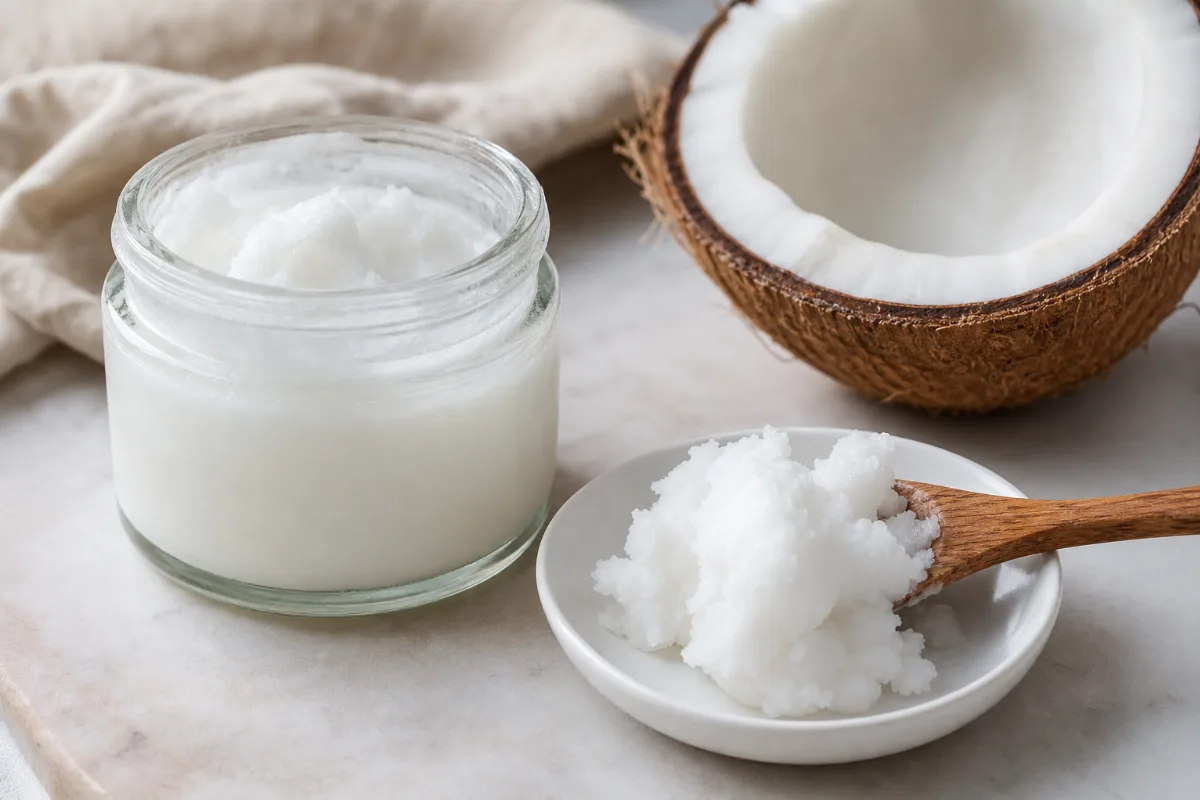
Coconut oil is a fat pressed from the kernel of mature coconuts, the fruit of the coconut palm, Cocos nucifera. It is sold as virgin (unrefined) or refined coconut oil. [11] This page is about coconut oil as a food. Skin, hair and oil-pulling uses are covered in Natural Ingredients, and the fruit in coconut.
Read this first
- It is the most saturated common cooking oil. USDA lists 82.5 g of saturated fat in 100 g. One tablespoon (13.6 g) has about 11 g, which is 56% of the Daily Value for saturated fat. [1]
- Pooled trials show higher LDL ("bad") cholesterol than with non-tropical vegetable oils, and higher HDL too. [2] The American Heart Association (2017) advised against using coconut oil, according to Harvard's Nutrition Source. [13]
- Health claims are mostly unproven. For weight loss, blood sugar and Alzheimer's disease we found mixed or very low certainty evidence, and some of it concerns pure MCT oil, not coconut oil from the shop. [4] [8] [11] [13]
- Official US advice places coconut oil outside the "oils" group because of its saturated fat. [14]
- Allergy: coconut allergy is uncommon. The FDA removed coconut from its tree nut allergen list in 2025, but it must still appear in ingredient lists. [17] For trouble breathing or swelling of the face or throat, call 911 (or your local emergency number).
What is in it (USDA values)
The values below are for coconut oil (USDA FoodData Central item 171412, SR Legacy). [1] The serving column is the USDA household portion of 1 tablespoon, 13.6 g. [1]
| Nutrient | Per 100 g | Per 1 tablespoon (13.6 g) | % Daily Value per serving |
|---|---|---|---|
| Energy | 892 kcal | 121 kcal | not set |
| Total fat | 99.06 g | 13.5 g | 17% |
| Saturated fat | 82.48 g | 11.2 g | 56% |
| Monounsaturated fat | 6.33 g | 0.86 g | no DV |
| Polyunsaturated fat | 1.70 g | 0.23 g | no DV |
| Linoleic acid (omega-6) | 1.68 g | 0.23 g | no DV |
| Alpha-linolenic acid (ALA, omega-3) | 0.019 g | 0.003 g | no DV |
| Phytosterols | 86 mg | 11.7 mg | no DV |
| Vitamin E (alpha-tocopherol) | 0.11 mg | 0.01 mg | 0% |
| Total trans fat | 0.028 g | 0.004 g | no DV |
% Daily Value uses the FDA 2016 Daily Values; the serving figures are the 100 g values multiplied by 0.136. USDA also lists a vitamin D figure for several oils; we could not confirm it from a second source, so we do not show it and do not treat oils as a vitamin D source. [1]
Fatty acids: lauric acid is the main fat in coconut oil. It has been described as acting both like a medium-chain and a long-chain fat in the body, and results for pure medium-chain fats cannot be applied to coconut oil. [11] Virgin coconut oil contains more vitamin E and polyphenols than copra (refined) oil. [11] We did not read a trial showing these compounds offset the saturated fat.
What research says
| Health goal | What the sources found | Strength of evidence | What was studied |
|---|---|---|---|
| LDL and HDL cholesterol | A pooled analysis of 16 trials found coconut oil raised LDL by 10.47 mg/dL and HDL by 4.00 mg/dL compared with non-tropical vegetable oils. [2] A second analysis of 12 studies also found higher LDL than plant oils and lower LDL than animal oils. [3] A review of reviews called the adverse effect on blood lipids consistent and strong. [6] | Established for LDL and HDL as blood measures (not heart attack outcomes) | Randomized trials, coconut oil against other fats |
| A mixed result | A 2022 analysis of 7 trials found no significant LDL change (-1.67 mg/dL) and a small HDL rise, but the authors rated bias high and the evidence very low certainty. [4] A 2025 analysis of virgin coconut oil (14 trials) found lower triglycerides and higher HDL with no change in other lipids. [5] | Mixed | Fewer trials; virgin coconut oil in the second |
| Compared with other oils (overview) | An umbrella review found low to very low certainty that coconut and palm oil raise total cholesterol, LDL and HDL. [7] | Mixed (low certainty) | Reviews of many oils |
| Weight loss | A 2023 analysis of 9 trials found a small drop (0.75 kg) against other fats; a 2025 analysis of 15 trials found no clinically meaningful effect; a 2022 analysis found no significant change in weight. [9] [4] | Mixed, effects small | Randomized trials |
| Blood sugar | A 2022 analysis of 18 studies found coconut fat did not help glycemic control and long-term intake raised an insulin resistance score. [8] An umbrella review rated the claim "very low certainty." [7] | No good evidence of benefit | Interventional trials |
| Alzheimer's disease and memory | A 2024 analysis of 7 studies reported better cognitive scores with coconut oil, but its abstract does not say which products were used or how large the trials were. [10] A 2019 narrative review said limited evidence does not support use for Alzheimer's disease. [11] | Insufficient evidence | Small trials; products unclear |
| Heart disease outcomes | Proper evidence not found. The sources we read measured cholesterol, not heart attacks. | Insufficient evidence | Not applicable |
Eaten as food vs MCT oil. Harvard's Nutrition Source notes that many studies behind the benefit claims used 100% MCT oil, and that supermarket coconut oil is mostly lauric acid. [13] Populations often cited as healthy eaters of coconut, such as in the Philippines and Polynesia, eat whole coconut meat or cream, not processed oil, and differ in other ways. [13] See MCT oil.
How much is a normal serving
The USDA household portion is 1 tablespoon (13.6 g), about 121 kcal and 11 g of saturated fat. [1] This is information, not a prescription. Official limits on saturated fat from all foods:
- Dietary Guidelines for Americans 2020 to 2025: less than 10% of calories a day from age 2, replacing it with unsaturated fats. Coconut, palm kernel and palm oil are not counted as "oils" because of their saturated fat, and the guidelines suggest cooking with vegetable oil in place of butter, lard or coconut oil. [14] The 2025 to 2030 edition keeps the 10% ceiling. [18]
- WHO (2023): no more than 10% of energy from saturated fat for people 2 and older. [15]
- AHA (as summarized by Harvard): 6% of calories, about 13 g on a 2,000-calorie diet, for people at risk of or living with heart disease. [13]
- NHS: men no more than 30 g and women no more than 20 g of saturated fat a day; coconut oil and coconut cream are on its high-saturated-fat list. [16]
Safety, allergy and medicines
- Saturated fat and cholesterol: see above. People with high LDL or heart disease should ask their clinician or dietitian about coconut oil. [12] [13]
- Allergy: in 2025 the FDA updated its guidance and removed coconut, with several other nuts, from the list of tree nuts that must be declared as an allergen; coconut must still be named in the ingredient list. [17] A 2023 study cited by the Academy of Nutrition and Dietetics suggests about 1 in 260 Americans may have a coconut allergy, and fewer than half have a doctor's diagnosis. [17] See food allergy basics.
- Diabetes: the trials did not show a blood sugar benefit, and long-term coconut fat raised an insulin resistance score. [8]
- Medicines: we did not find a source describing a direct interaction between coconut oil as food and a medicine. See foods and medicine interactions.
- Pregnancy, breastfeeding, children: we did not read official advice specific to coconut oil. The saturated fat limit starts at age 2 in US guidelines. [14] See foods in pregnancy.
- Kidney disease: USDA lists almost no minerals in the oil. [1] We read no kidney-diet advice about it; ask your clinician.
- Calories: 121 kcal per tablespoon. [1]
- Heating: a simulated-kitchen test compared palm, olive and soybean oils, not coconut oil. [19] We give no smoke-point number we did not read; see smoke points and cooking with oil.
Choosing, storing and food safety
- Virgin vs refined: refined, bleached and deodorized copra oil had less effect on total and LDL cholesterol than butter fat, but not less than unsaturated plant oils. [11] A pooled analysis saw a better lipid profile with the virgin form, but the evidence was limited. [3]
- Storage: we read no official rule for coconut oil. Follow the label. Oil that smells off or looks moldy should not be eaten.
- Labels: "coconut oil" on an ingredient list means a coconut allergen is present. [17]
Related pages
Health connections for Coconut Oil (as Food)
What research links to eating or drinking this food, and how strong the evidence is. Many studies are observational or use juice, powder, oil or extracts rather than the food as eaten; each card says which.
Coconut oil and LDL and HDL cholesterol
Clinically supportedA pooled analysis of 16 trials found coconut oil raised LDL by 10.47 mg/dL and HDL by 4.00 mg/dL compared with non-tropical vegetable oils. A second analysis of 12 studies also found higher LDL than plant oils and lower LDL than animal oils.
Supplements: A measured blood effect that goes the unfavorable way for LDL; not a heart attack outcome. A smaller 2022 analysis of 7 trials found no significant LDL change but rated the evidence very low certainty.
Coconut oil and heart disease outcomes
Not enough evidenceProper evidence not found: the sources we read measured cholesterol, not heart attacks or strokes.
Supplements: No outcome trial read.
Coconut oil and body weight
Preliminary or mixedA 2023 analysis of 9 trials found a small drop (0.75 kg) against other fats; a 2025 analysis of 15 trials found no clinically meaningful effect; a 2022 analysis found no significant weight change.
Supplements: Small and inconsistent effects.
Coconut oil and blood sugar
Not enough evidenceA 2022 analysis of 18 studies found coconut fat did not help glycemic control, and long-term intake raised an insulin resistance score.
Supplements: No good evidence of benefit.
Coconut oil and Alzheimer's disease or memory
Not enough evidenceA 2024 analysis of 7 studies reported better cognitive scores, but the abstract does not say which products or how large the studies were. A 2019 narrative review said limited evidence does not support use for Alzheimer's disease.
Supplements: Not enough evidence; products unclear.
Virgin versus refined coconut oil
Preliminary or mixedVirgin coconut oil contains more vitamin E and polyphenols; a 2025 analysis of 14 trials of virgin coconut oil found lower triglycerides and higher HDL with no change in other lipids, and a 2020 analysis saw a better lipid profile with the virgin form.
Supplements: Small effects; still a saturated fat.
Medium-chain fat claims versus coconut oil
Not enough evidenceHarvard's Nutrition Source notes that many supportive studies used 100 percent MCT oil, and that coconut oil is mostly lauric acid, which behaves partly like a long-chain fat.
Supplements: Claims need coconut oil trials.
Connected topics
Open a group to see how each topic connects and how strong the evidence is.
Health goals (2)
- Cholesterol BalanceDocumented risk
Pooled trials found coconut oil raised LDL (10.47 mg/dL) and HDL compared with non-tropical vegetable oils.
- Heart HealthDocumented risk
Via higher LDL and saturated fat; no outcome trial was read. The AHA advised against coconut oil in 2017 (per Harvard).
Body systems (2)
- Cardiovascular SystemDocumented risk
Same as heart and circulation.
- Heart & CirculationDocumented risk
Raises LDL cholesterol in pooled trials.
Body parts (1)
- HeartDocumented risk
Through LDL; outcome trials not read.
Root causes (1)
- Poor DietDocumented risk
High saturated fat load per tablespoon (56 percent of Daily Value).
Habits (1)
- Balanced NutritionDocumented risk
Official guidance puts coconut oil with fats to limit and uses unsaturated oils as the swap.
Biomarkers (2)
- LDL CholesterolClinically supported
Raised LDL by about 10 mg/dL in a pooled analysis of 16 trials.
- HDL CholesterolClinically supported
Raised HDL by about 4 mg/dL; this rise has not been shown to offset the LDL rise.
Conditions & symptoms (2)
- HyperlipidemiaDocumented risk
Raises LDL cholesterol; people with high cholesterol should ask a clinician.
- Food AllergyDocumented risk
Coconut allergy is uncommon but real; coconut is no longer in the FDA tree nut list.
Documented risks and interactions (3)
- Saturated fat and official limits. One tablespoon (13.6 g) has about 11 g of saturated fat, 56 percent of the Daily Value. US guidelines limit saturated fat to less than 10 percent of calories from age 2 and do not count coconut oil as an "oil"; WHO also says 10 percent; the AHA advised against coconut oil in 2017 (as summarized by Harvard).
- Coconut allergy. The FDA removed coconut from its tree nut list in 2025; coconut must still be named in ingredient lists. A 2023 study cited by the Academy of Nutrition and Dietetics suggests about 1 in 260 Americans may have a coconut allergy, fewer than half doctor-diagnosed.
- Calories from coconut oil. One tablespoon (13.6 g) has about 121 kcal by USDA.
Frequently asked questions
Is coconut oil healthy?
It is a very saturated fat. Pooled trials found it raised LDL cholesterol compared with non-tropical vegetable oils. [2] The American Heart Association advised against it in 2017, as summarized by Harvard. [13] A small amount as an occasional flavor is a choice for you and your clinician.
Does coconut oil help you lose weight?
Results were small and mixed: one analysis saw a 0.75 kg drop against other fats, others saw no meaningful change. [9] [4]
Is virgin coconut oil better than refined?
It has more vitamin E and polyphenols, and one analysis saw a better lipid profile with it, but it is still a saturated fat and the evidence is limited. [11] [3] [5]
Is coconut a tree nut allergy?
The FDA removed coconut from its tree nut list in 2025. [17] Coconut allergy exists but is uncommon. If you have any food allergy, ask your allergist. Call 911 for trouble breathing or swelling of the face or throat.
Is coconut oil good for Alzheimer's disease?
Proper evidence not found. A 2024 analysis reported better scores in 7 studies, but a 2019 review said limited evidence does not support its use. [10] [11]
References
- U.S. Department of Agriculture. FoodData Central: Oil, coconut (SR Legacy, FDC 171412). April 2018 release. Read 2026-10-24.
- Neelakantan N et al. The Effect of Coconut Oil Consumption on Cardiovascular Risk Factors: A Systematic Review and Meta-Analysis of Clinical Trials. Circulation 2020 (abstract read via Europe PMC). Read 2026-10-24.
- Teng M et al. Impact of coconut oil consumption on cardiovascular health: a systematic review and meta-analysis. Nutr Rev 2020 (abstract read via Europe PMC). Read 2026-10-24.
- Duarte AC et al. The effects of coconut oil on the cardiometabolic profile: a systematic review and meta-analysis of randomized clinical trials. 2022 (abstract read via Europe PMC). Read 2026-10-24.
- Zhang Y et al. The effect of virgin coconut oil (VCO) on cardiovascular disease risk factors: a systematic review and meta-analysis. 2025 (abstract read via Europe PMC). Read 2026-10-24.
- Jayawardena R et al. Health effects of coconut oil: Summary of evidence from systematic reviews and meta-analysis of interventional studies. 2021 (abstract read via Europe PMC). Read 2026-10-24.
- Voon PT et al. Health Effects of Various Edible Vegetable Oil: An Umbrella Review. Adv Nutr 2024 (abstract read via Europe PMC). Read 2026-10-24.
- Dhanasekara CS et al. Effects of consumption of coconut oil or coconut on glycemic control and insulin sensitivity: A systematic review and meta-analysis of interventional trials. 2022 (abstract read via Europe PMC). Read 2026-10-24.
- Swarnamali H et al. Coconut oil consumption and bodyweight reduction: a systematic review and meta-analysis. 2023; and Gaeini Z et al. Dose-dependent effect of coconut oil supplementation on obesity indices. 2025 (abstracts read via Europe PMC). Read 2026-10-24.
- Bafail D et al. Impact of Coconut Oil and Its Bioactive Metabolites in Alzheimer's Disease and Dementia: A Systematic Review and Meta-Analysis. 2024 (abstract read via Europe PMC). Read 2026-10-24.
- Wallace TC. Health Effects of Coconut Oil: A Narrative Review of Current Evidence. J Am Coll Nutr 2019 (abstract read via Europe PMC). Read 2026-10-24.
- Sacks FM et al. Dietary Fats and Cardiovascular Disease: A Presidential Advisory From the American Heart Association. Circulation 2017 (abstract read via Europe PMC). Read 2026-10-24.
- Harvard T.H. Chan School of Public Health. The Nutrition Source: Coconut oil. No page date shown. Read 2026-10-24.
- U.S. Department of Agriculture and U.S. Department of Health and Human Services. Dietary Guidelines for Americans, 2020-2025. Chapter 1 (oils and saturated fat). Read 2026-10-24.
- World Health Organization. WHO updates guidelines on fats and carbohydrates. 17 July 2023. Read 2026-10-24.
- NHS. Different fats in food (saturated, monounsaturated and polyunsaturated). Read 2026-10-24.
- Academy of Nutrition and Dietetics (eatright.org). Coconut is no longer a tree nut allergen. Published 26 May 2026. Read 2026-10-24.
- U.S. Department of Health and Human Services and U.S. Department of Agriculture. Dietary Guidelines for Americans, 2025-2030. Page 4. Read 2026-10-24.
- Chiang KM et al. Particulate matters, aldehydes, and polycyclic aromatic hydrocarbons produced from deep-frying emissions: comparisons of three cooking oils with distinct fatty acid profiles. 2022 (abstract read via Europe PMC). Read 2026-10-24.