Avocado Oil: Nutrients, What Research Shows and Safety
Avocado oil as a food: USDA fat profile, what reviews and lab studies found, why labels are hard to trust, heating, calories, and latex-fruit allergy notes.
Content last updated . This page has not been medically reviewed.
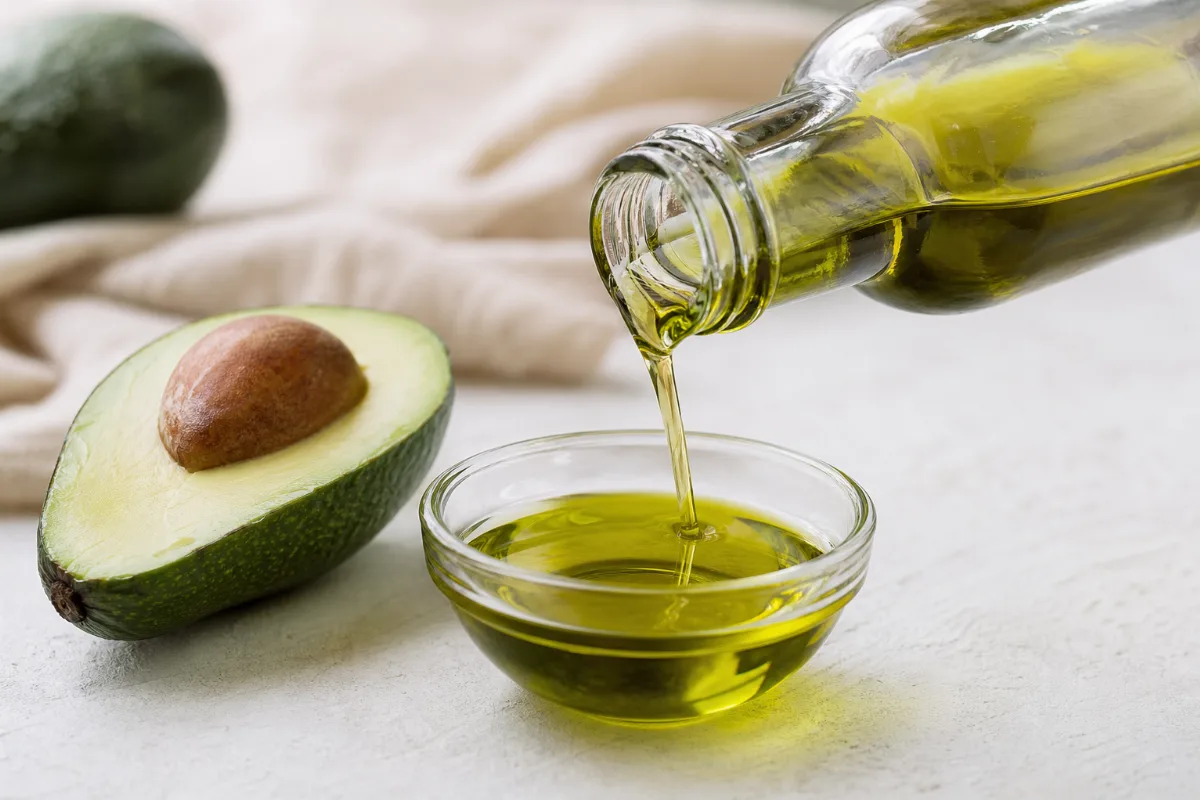
Avocado oil is pressed from the pulp of the avocado fruit, Persea americana. Commercial samples are sold as extra virgin or refined oil, [4] and it is eaten on salads and used for cooking. [3] This page is about the oil as a food. The whole fruit is a different food, covered on our avocado page, and the skin-care oil is covered in Essential Oils.
Read this first
- It is mostly monounsaturated fat. USDA lists about 71 g of monounsaturated fat and 11.6 g of saturated fat in 100 g. [1] That fits the general advice to favor unsaturated fats over saturated fats. [5] [6]
- It is not low in calories. One tablespoon (14 g) has about 124 kcal. [1] Oils add energy quickly.
- Direct evidence for avocado oil is thin. In the sources we read, reviews call the health findings promising but say more research is needed. [2] We did not find a trial that compared avocado oil with olive oil in people.
- Labels can be unreliable. In one 2025 lab study of commercial avocado oils, only 40% of samples met the fatty acid standards used. [4]
- Allergy: people allergic to natural rubber latex are often sensitized to avocado fruit, and some react after eating it. We did not find a source on the refined oil. [11] For trouble breathing or swelling of the face or throat, call 911 (or your local emergency number).
What is in it (USDA values)
The values below are for avocado oil (USDA FoodData Central item 173573, SR Legacy). [1] The serving column is the USDA household portion of 1 tablespoon, 14 g. [1]
| Nutrient | Per 100 g | Per 1 tablespoon (14 g) | % Daily Value per serving |
|---|---|---|---|
| Energy | 884 kcal | 124 kcal | not set |
| Total fat | 100 g | 14 g | 18% |
| Saturated fat | 11.56 g | 1.62 g | 8% |
| Monounsaturated fat | 70.55 g | 9.88 g | no DV |
| Polyunsaturated fat | 13.49 g | 1.89 g | no DV |
| Protein, carbohydrate, fiber | 0 g | 0 g | 0% |
| Sodium, potassium | 0 mg | 0 mg | 0% |
% Daily Value uses the FDA 2016 Daily Values; the serving figures are the 100 g values multiplied by 0.14. USDA lists no value for vitamin E, vitamin K, omega-3 (ALA) or trans fat in this item. USDA also lists a vitamin D figure for several oils; we could not confirm it from a second source, so we do not show it and do not treat oils as a vitamin D source. [1]
Plant compounds: a lab study of avocado oil heated to different temperatures measured phytosterols, chlorophylls and carotenoids and found they broke down faster as the temperature rose. [3] That is laboratory chemistry. We did not find a trial showing these compounds change health when someone eats the oil.
What research says
| Health goal | What the sources found | Strength of evidence | What was studied |
|---|---|---|---|
| Blood sugar and cholesterol | A 2025 review of experimental and clinical studies says avocado oil may help blood sugar control and fat metabolism, and calls for more research because oil composition varies by avocado variety. [2] | Insufficient evidence (promising, but the review gives no pooled result in its abstract) | Mixed experimental and clinical studies; oil, not the fruit |
| Replacing saturated fat with unsaturated fat | The American Heart Association (2017) concluded that lowering saturated fat and replacing it with unsaturated fats, especially polyunsaturated fats, lowers cardiovascular disease. [5] | Established for the swap in general, but avocado oil itself was not singled out in the abstract we read | Trials of polyunsaturated vegetable oils; cohort studies |
| Compared with olive oil | Proper evidence not found in the sources we read. | Insufficient evidence | No head-to-head trial found |
| Weight loss, skin, joints, "detox" | Proper evidence not found in the sources we read. | No good evidence of benefit found | Not applicable |
| Stability when heated | In a lab test, oxidation of the oil and loss of carotenoids, chlorophylls and sterols rose with temperature (room temperature, 100 C, 180 C). [3] | Lab only | Oil heated in a lab, not cooking trials |
| Quality of bottles on sale | In a 2025 analysis of commercial samples, only 40% met the fatty acid standards used. The samples with the most faults lined up with declared blends containing canola or safflower oil. [4] | A quality finding, not a health finding | Lab analysis of commercial oils |
Eaten as food vs other forms. An umbrella review of 48 reviews of vegetable oils reported cholesterol-lowering effects for canola, virgin olive and rice bran oil, and cholesterol-raising effects for coconut and palm oil. Avocado oil is not named in its summary. [10] The avocado fruit has its own trials; results for the fruit do not transfer to the oil, which has no fiber. See the avocado page.
How much is a normal serving
The USDA household portion is 1 tablespoon (14 g), about 124 kcal. [1] This is information, not a prescription. For context, the Dietary Guidelines for Americans 2020 to 2025 put oils at 27 grams a day in the 2,000-calorie Healthy U.S.-Style pattern, and say they should replace solid fats, not add to them. [6] The 2025 to 2030 edition says to prioritize oils with essential fatty acids, such as olive oil, and keep saturated fat to no more than 10% of calories. [7] WHO (2023) also says no more than 10% of energy from saturated fat for people 2 and older. [8] NHS says saturated fat should not exceed 30 g a day for men and 20 g for women. [9]
Safety, allergy and medicines
- Calories: an oil is almost pure fat, so energy adds up fast. [1] Weight advice is outside this page.
- Latex-fruit allergy: in a 1999 lab and patient study, more than half of people with latex allergy were sensitized to avocado fruit, and about 10 to 20% reported reactions after eating it; a protein shared with latex (a chitinase with a hevein domain) was the cause. [11] That study was about the fruit. We did not find a source on whether refined avocado oil carries these proteins, so people with latex allergy should ask their allergist. See food allergy basics.
- Medicines: we did not find a source describing an interaction between avocado oil and a medicine. USDA lists no vitamin K value for the oil. [1] For general food and medicine questions see foods and medicine interactions.
- Heated oil: heating changes any oil. [3] In a simulated-kitchen test of deep-frying, palm, olive and soybean oils gave off different amounts of particles and aldehydes, with olive oil lowest; avocado oil was not tested. [12]
- Pregnancy, breastfeeding, children: we did not read official advice specific to avocado oil. The general saturated fat limit applies from age 2. [6] See foods in pregnancy.
- Kidney disease and diabetes: USDA lists 0 mg potassium, 0 mg phosphorus and 0 g carbohydrate for the oil. [1] Energy and the overall diet still matter; ask your clinician. See foods and kidney disease.
Choosing, storing and food safety
- Check what you buy. Because blends and faulty bottles were found, the label alone is not proof of purity. [4] A bottle with a single ingredient and a clear harvest or best-before date is easier to judge, but we read no official standard to point you to.
- Heat and age change the oil. Lab results show oxidation rising with temperature. [3] We read no official storage rule for avocado oil; follow the bottle.
- No sourced smoke-point numbers. We do not give a number we did not read. See smoke points and cooking with oil.
Related pages
Health connections for Avocado Oil
What research links to eating or drinking this food, and how strong the evidence is. Many studies are observational or use juice, powder, oil or extracts rather than the food as eaten; each card says which.
Avocado oil as a source of monounsaturated fat
Established roleAvocado oil is mostly monounsaturated fat (about 71 g in 100 g by USDA) with 11.6 g of saturated fat. It supplies energy and fat, not vitamins or minerals in notable amounts.
Supplements: This is food composition, not a supplement claim. USDA lists no vitamin E, vitamin K or omega-3 value for this item.
Replacing saturated fat with unsaturated fat
Preliminary or mixedThe American Heart Association concluded that replacing saturated fat with unsaturated fats, especially polyunsaturated fats, lowers cardiovascular disease. Avocado oil itself was not singled out in the abstract we read.
Supplements: General principle only; no direct trial of avocado oil on heart events was found.
Avocado oil and blood sugar or blood fats
Not enough evidenceA 2025 review says avocado oil may help blood sugar control and fat metabolism, but its abstract gives no pooled result and says more research is needed.
Supplements: Evidence is not strong enough to recommend it for any condition.
Avocado oil compared with olive oil
Not enough evidenceProper evidence not found in the sources we read: no trial compared the two in people.
Supplements: No head-to-head evidence.
Heating avocado oil
Lab or animal research onlyIn a lab test, oxidation of avocado oil and loss of carotenoids, chlorophylls and sterols increased as temperature rose from room temperature to 100 C and 180 C.
Supplements: Not a health outcome.
Connected topics
Open a group to see how each topic connects and how strong the evidence is.
Health goals (1)
- Heart HealthPreliminary or mixed
Lower in saturated fat than butter or coconut oil by USDA values; the general swap to unsaturated fat is supported by the AHA, but no avocado oil trial on heart events was found.
Body systems (1)
- Heart & CirculationPreliminary or mixed
Fat-type guidance (unsaturated over saturated) applies in general; avocado oil not tested directly.
Body parts (1)
- HeartPreliminary or mixed
General unsaturated-fat guidance; avocado oil not tested directly.
Root causes (1)
- Poor DietPreliminary or mixed
Choosing unsaturated oils in place of saturated fats is part of official dietary advice.
Habits (1)
- Balanced NutritionPreliminary or mixed
Oils fit within a healthy pattern in limited amounts; calories still count.
Conditions & symptoms (1)
- Food AllergyDocumented risk
Avocado fruit cross-reacts with latex allergy; no source read on the refined oil.
Documented risks and interactions (3)
- Mislabeled and faulty bottles. In a 2025 lab study of commercial avocado oil, only 40 percent of samples met the fatty acid standards used, and the worst samples aligned with declared blends containing canola or safflower oil.
- Latex-fruit allergy and avocado. More than half of people with latex allergy were sensitized to avocado fruit in a 1999 study and about 10 to 20 percent reported reactions after eating it. We found no source on refined avocado oil.
- Calories from avocado oil. One tablespoon (14 g) has about 124 kcal by USDA, nearly all from fat.
Frequently asked questions
Is avocado oil healthier than olive oil?
Proper evidence not found in the sources we read. We found no trial that compared the two in people. Both are mostly monounsaturated fat by USDA values. [1]
Is avocado oil good for the heart?
Replacing saturated fat with unsaturated fat lowers cardiovascular risk, according to the American Heart Association. [5] A 2025 review calls avocado oil promising for blood sugar and fat metabolism but says more research is needed. [2]
Is the avocado oil I buy really pure?
Not always. In a 2025 lab study of commercial samples, only 40% met the fatty acid standards used, and blends with canola or safflower oil were suspected in the worst samples. [4]
Can people with a latex allergy use avocado oil?
Avocado fruit is a known cross-reaction for people with latex allergy. [11] We did not find a source on the refined oil, so ask an allergist. Call 911 for trouble breathing or swelling of the face or throat.
Does avocado oil have vitamin E?
USDA lists no vitamin E value for this item. [1] We therefore do not call it a vitamin E source.
References
- U.S. Department of Agriculture. FoodData Central: Oil, avocado (SR Legacy, FDC 173573). April 2018 release. Read 2026-10-24.
- Drakpa D et al. Avocado Oil: Recent Advances in Its Anti-diabetic Potential. 2025 (abstract read via Europe PMC). Read 2026-10-24.
- Resende LMB et al. Changes in quality and phytochemical contents of avocado oil under different temperatures. 2019 (abstract read via Europe PMC). Read 2026-10-24.
- Marín-Obispo LM et al. Fatty acids and fatty alcohol esters as novel markers of authenticity and extraction method of commercial avocado oil. 2025 (abstract read via Europe PMC). Read 2026-10-24.
- Sacks FM et al. Dietary Fats and Cardiovascular Disease: A Presidential Advisory From the American Heart Association. Circulation 2017 (abstract read via Europe PMC). Read 2026-10-24.
- U.S. Department of Agriculture and U.S. Department of Health and Human Services. Dietary Guidelines for Americans, 2020-2025. Chapter 1 (oils, saturated fat, and the 2,000-calorie pattern table). Read 2026-10-24.
- U.S. Department of Health and Human Services and U.S. Department of Agriculture. Dietary Guidelines for Americans, 2025-2030. Page 4. Read 2026-10-24.
- World Health Organization. WHO updates guidelines on fats and carbohydrates. 17 July 2023. Read 2026-10-24.
- NHS. Different fats in food (saturated, monounsaturated and polyunsaturated). Read 2026-10-24.
- Voon PT et al. Health Effects of Various Edible Vegetable Oil: An Umbrella Review. Adv Nutr 2024 (abstract read via Europe PMC). Read 2026-10-24.
- Posch A et al. Class I endochitinase containing a hevein domain is the causative allergen in latex-associated avocado allergy. 1999 (abstract read via Europe PMC). Read 2026-10-24.
- Chiang KM et al. Particulate matters, aldehydes, and polycyclic aromatic hydrocarbons produced from deep-frying emissions: comparisons of three cooking oils with distinct fatty acid profiles. 2022 (abstract read via Europe PMC). Read 2026-10-24.