Prunes (Dried Plums): Nutrients, What Research Shows and Safety
What prunes (dried plums) contain, what trials show for constipation and bone density, and the sugar, potassium, vitamin K and bowel-comfort points to know.
Content last updated . This page has not been medically reviewed.
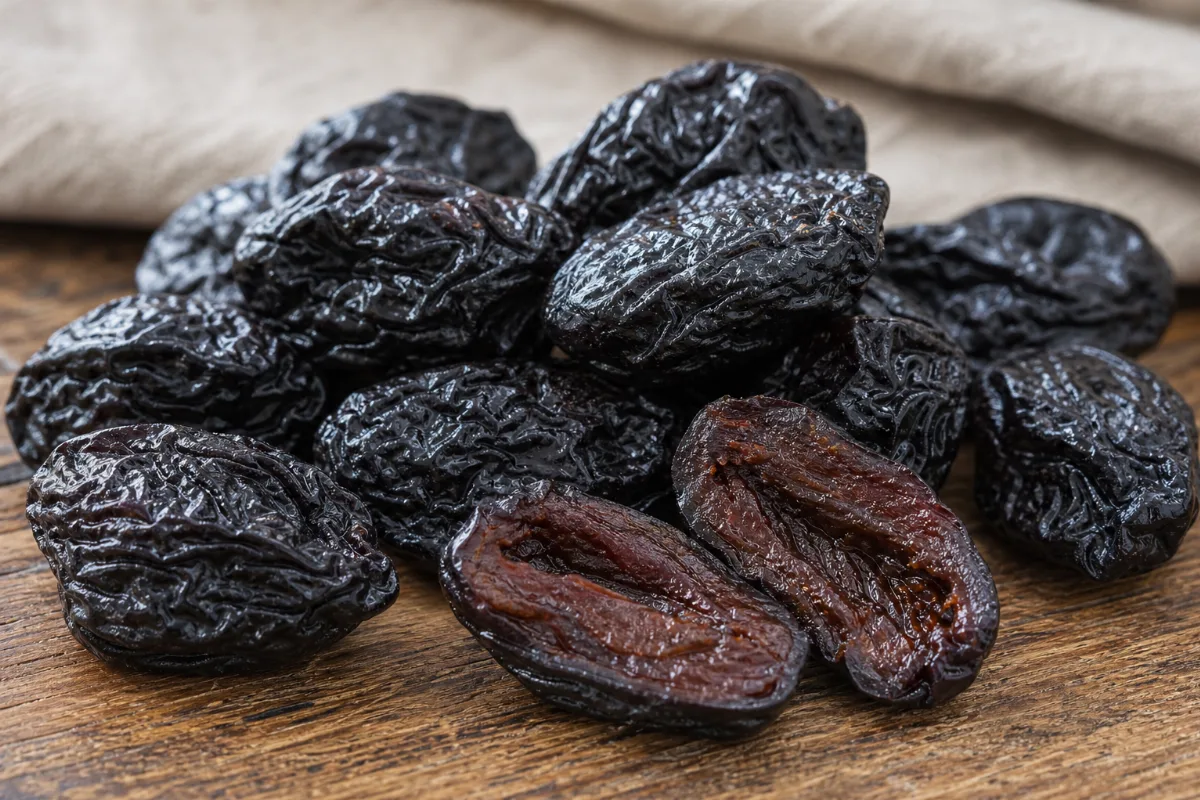
Prunes are dried plums, the fruit of Prunus domestica in the rose family (Rosaceae). The fruit is dried whole, usually with the pit removed, and the soft, sweet flesh is eaten. People eat prunes mainly for bowel regularity, and more recently for bone health. This page keeps the whole dried fruit apart from supplements and hype, and says what the research does and does not show. Fresh plums are on their own page: see Plums.
Read this first
- Prunes are an everyday food. A true food allergy is possible with any food. For trouble breathing or swelling of the face or throat, call 911. See food allergy basics and emergency signs.
- Prunes are the food with the most constipation trials we read, but the results are mixed: one small trial found more complete bowel movements than psyllium, while a 2025 dietitian guideline found no difference from psyllium on stool consistency or straining, on very low certainty evidence [2][3]. They can cause loose stools or gas in some people because the fruit contains sorbitol, a sugar alcohol [14].
- Prunes are concentrated: 100 g gives 38 g of sugars and 732 mg of potassium [1]. People with kidney disease, people who take potassium-raising medicines, people managing blood sugar, and people on warfarin should ask a clinician or pharmacist (details below).
- Bone results are mixed: some 12-month trials show less bone loss with prunes, but a 2026 meta-analysis found only a borderline effect, and one trial in men found none [6][7][8][9].
What is in it (USDA values)
Prunes (dried plums), uncooked, USDA FoodData Central item 168162 (SR Legacy). Serving shown: 1 cup, pitted (174 g). One pitted prune is 9.5 g. [1]
| Nutrient | Per 100 g | Per 1 cup, pitted (174 g) | % Daily Value per serving |
|---|---|---|---|
| Energy | 240 kcal | 418 kcal | no Daily Value set |
| Fiber (total dietary) | 7.1 g | 12.4 g | 44% |
| Total sugars | 38.13 g | 66.3 g | no Daily Value set |
| Potassium | 732 mg | 1,274 mg | 27% |
| Vitamin K | 59.5 µg | 103.5 µg | 86% |
| Copper | 0.28 mg | 0.49 mg | 54% |
| Manganese | 0.30 mg | 0.52 mg | 23% |
| Magnesium | 41 mg | 71 mg | 17% |
| Vitamin B-6 | 0.20 mg | 0.35 mg | 20% |
| Riboflavin (B2) | 0.19 mg | 0.33 mg | 25% |
| Vitamin A (RAE) | 39 µg | 68 µg | 8% |
| Vitamin C | 0.6 mg | 1.0 mg | 1% |
% Daily Value uses the FDA 2016 Daily Values; values vary with variety, ripeness and storage. [1] A single pitted prune (9.5 g) gives about 0.7 g of fiber and about 5.7 µg of vitamin K by the same calculation. Our USDA file lists beta-carotene (394 µg per 100 g) and lutein plus zeaxanthin (148 µg per 100 g), which are plant pigments in the carotenoid family [1]. It does not list polyphenol values. We did not read a source that measured the plant compounds of dried plums specifically, so we do not describe them here and we make no antioxidant claim. Vitamin C is almost absent from prunes (1% of the Daily Value per cup), unlike fresh fruit such as citrus.
What research says
| Health goal | What the sources found | Strength of evidence | What was studied |
|---|---|---|---|
| Constipation | In an 8-week crossover trial of 40 adults with chronic constipation, dried plums (50 g twice daily) gave more complete spontaneous bowel movements per week than psyllium (11 g twice daily), and better stool consistency; straining and overall symptoms did not differ. Both gave about 6 g of fiber per day. [2] A 2025 British Dietetic Association guideline (75 trials reviewed) includes two statements on prunes: both say prunes made no difference compared with psyllium (on stool consistency and on straining), and both rest on very low certainty evidence. It also says the prune trials were not designed to show prunes work as well as psyllium. [3] A review notes prunes are among the least commonly recommended dietary strategies in current guidelines. [13] | Mixed (small trials, very low certainty guideline evidence) | Dried plums as food, adults with mild to moderate constipation; small single-blind trial |
| Bowel symptoms after rectal cancer surgery | In one trial (118 completed), 27.3% of people eating prunes daily for 2 weeks had low anterior resection syndrome (bowel disturbance after surgery) versus 74.6% with no prunes. [4] | Insufficient evidence (one non-placebo trial, a very specific group) | Prunes, after rectal cancer surgery |
| Constipation in older women | In 105 older women with constipation, Thai abdominal massage gave larger gains in constipation severity than 50 g of prunes twice a week for 8 weeks, while prunes gave the larger quality-of-life gain. [5] | Insufficient evidence | Prunes, older women |
| Bone loss after menopause | In the 12-month Prune Study (235 women, average age 62), total hip bone density fell 1.1% in the control group and 0.3% in the 50 g group; 41% of the 100 g group dropped out. [6] Bone structure in the lower leg (cortical density, estimated strength) fell in controls but not in the prune groups. [7] A 2026 meta-analysis of 11 trials (747 people) found only a borderline lumbar spine effect with very high variation, and no clear effect at other sites or on bone-turnover markers. [8] | Mixed | Prunes (50 g or 100 g daily), postmenopausal women |
| Bone health in men | In a 12-month trial of 66 men, 100 g of prunes did not change bone density, though some bone-turnover markers fell. [10] A 2026 12-month trial of 59 men aged 55 to 80 also found no change in total or lumbar spine density beyond calcium and vitamin D alone. [9] | No good evidence of benefit (bone density); markers only | Prunes, men |
| Blood cholesterol and blood sugar | A 2024 meta-analysis of plum products found LDL cholesterol was 12.5 mg/dL lower, with no clear change in the other blood fats; the authors rated the evidence very low to moderate. [11] In the Prune Study, neither dose changed blood sugar control or blood lipids over 12 months. [12] | Mixed | Plum products (fresh, dried, juice, extracts) in adults; prunes in postmenopausal women |
| Weight and belly fat | In the Prune Study, belly (android) fat mass rose in controls but not in the 100 g group; the authors said prunes may help prevent increases in central fat. [12] | Insufficient evidence (secondary analysis) | Prunes, postmenopausal women |
| Prevention of heart disease, cancer or diabetes | Proper evidence not found in the sources we read for prunes specifically. | Insufficient evidence | Not applicable |
Eaten as food vs taken as a supplement or extract. The trials above gave whole dried plums (prunes) as a food. Some pooled analyses mixed prunes with fresh plums, juice and extracts [11], so their results do not transfer cleanly to prunes. We did not find trials of prune powders, capsules or extracts in the sources we read, so we make no claim about them. Eating more of a food that is rich in a nutrient is not proof that the food treats a disease, and studies that compare people by how much fruit they eat show associations only. Several prune trials compared prunes with a no-prune control group, so people knew what they were eating, which can affect symptom reports.
How much is a normal serving
- USDA household portions for prunes: 1 cup pitted (174 g) and 1 pitted prune (9.5 g). [1] These are measuring units, not a recommended amount.
- For dried fruit, one-half cup counts as one cup of fruit in MyPlate-style fruit groups. The University extension guide we read (revised November 2018) says adults are advised about 1.5 to 2 cups of fruit a day, depending on age and sex, and that whole fruit is preferred over juice when possible because it has more fiber. [17] This is general information, not a prescription; see the current figure at MyPlate.gov (we could not open that site ourselves).
- The prune trials above used set daily amounts: 50 g or 100 g daily in the bone trials [6][7][9][10], 50 g twice daily in the constipation trial [2], 50 g twice a week in the older-women trial [5]. That is what the studies tested, not advice.
- Dried fruit is concentrated: about 240 kcal and 38 g of sugars per 100 g, versus about 46 kcal and 10 g of sugars in raw plums (see Plums). Fresh, frozen, canned and dried produce each have their own pros and cons; see fresh, frozen and canned produce.
- Prune juice is a different product with less fiber than whole fruit. See fruit juice vs whole fruit. We did not find a trial comparing juice with whole prunes in the sources we read.
- Cooking and stewing effects on nutrients: Proper evidence not found in the sources we read.
Safety, allergy and medicines
- Loose stools, gas and cramps. Prunes are used because they loosen the bowel [2]. The NHS notes that fruit containing sorbitol helps soften stools, which also explains why large amounts may cause diarrhea, gas or cramps [14]. We did not find a source we could read that gave a tolerance amount for sorbitol in prunes, so we give none. People with irritable bowel syndrome may react to sorbitol-containing foods; ask a dietitian. See foods for gut health and bloating.
- See a doctor, not only a prune. The NHS advises seeing a GP for constipation that does not improve, blood in the stool, unexplained weight loss, tummy pain or a sudden change in bowel habit. [14]
- Kidney disease, potassium and medicines. Prunes hold 732 mg of potassium per 100 g and about 1,274 mg per cup [1]. MedlinePlus says that in chronic kidney disease the kidneys may not remove extra potassium, that some medicines can raise potassium levels, and that people with kidney disease may need a special diet [16]. The page we read does not name the medicines, so ask your pharmacist whether yours are among them (for example, ACE inhibitors, ARBs or potassium-sparing diuretics are often asked about). See foods, kidney disease, potassium and oxalates.
- Warfarin and vitamin K. MedlinePlus says sudden changes in vitamin K intake can change how warfarin works and that you may need to eat about the same amount every day [15]. Prunes contain 59.5 µg per 100 g (86% of the Daily Value per cup) [1]; the page we read lists green leafy vegetables, not prunes, as the main sources [15]. Keep intake steady and tell your prescriber if you plan to eat prunes regularly. See foods and medicine interactions.
- Sugar and diabetes. There are 38 g of sugars per 100 g [1]. In a 12-month trial, prunes did not change blood sugar control in postmenopausal women [12], but that is one group. People managing diabetes can see foods for blood sugar control and should ask their care team about portions.
- Allergy. Prunes come from a plant in the same genus (Prunus) as peach, apricot and cherry. We did not find a source we could read that tested prunes in people allergic to peach, so we cannot say how often cross-reactions happen. If you have reacted to peach or other stone fruit, ask an allergist. For emergency signs see food allergy basics.
- Sulphites in dried fruit. Some dried fruit has added sulphites, which can trigger breathing symptoms in some people with asthma. We could not open an FDA or other official sulphite page in our checks, so we cannot cite a threshold. Read the ingredient label if you are sensitive.
- Pesticide residues, pits, pregnancy. Proper evidence not found in the sources we read for dried plums specifically (we could not read a USDA Pesticide Data Program report on prunes). For pregnancy, see foods in pregnancy. Check packs for stray pit fragments even when labeled pitted.
- Bone trials had drop-outs. In the 100 g trial arm, 41% of women dropped out, versus 10% (control) and 15% (50 g) [6]. The abstract we read does not say why.
Choosing, storing and food safety
- Packaged dried fruit is not washed at home. The FDA advises rinsing fresh produce under running water, without soap or produce wash. [18]
- The FDA advises keeping produce that will be eaten raw apart from raw meat, poultry and seafood, and cutting away bruised or damaged parts. [18]
- We did not find an official source we could read on shelf life of opened dried fruit, so check the pack label.
Related pages
Health connections for Prunes (Dried Plums)
What research links to eating or drinking this food, and how strong the evidence is. Many studies are observational or use juice, powder, oil or extracts rather than the food as eaten; each card says which.
Bowel regularity and constipation
Preliminary or mixedIn an 8-week crossover trial of 40 adults with chronic constipation, dried plums gave more complete bowel movements per week than psyllium. A 2025 dietitian guideline includes two statements on prunes, mostly on low-certainty evidence.
Supplements: The trials used whole dried plums as food, not extracts. One small single-blind trial plus guideline statements of low certainty; not a treatment for constipation that persists or has warning signs.
Bone loss after menopause
Preliminary or mixedIn the 12-month Prune Study (235 women), 50 g of prunes a day reduced loss of hip bone density and kept lower-leg bone structure from declining. A 2026 meta-analysis found only a borderline effect at the lumbar spine with very high variation.
Supplements: Results come from whole prunes; 41% of the 100 g group dropped out. Not shown to prevent fractures.
Bone health in men
Not enough evidenceA 12-month trial of 66 men (100 g a day) and a 2026 trial of 59 men found no change in bone density, though some bone-turnover markers moved.
Supplements: No good evidence of benefit on bone density in men.
Blood cholesterol and blood sugar
Preliminary or mixedA 2024 meta-analysis of plum products found lower LDL cholesterol (about 12.5 mg/dL) with no clear change in other blood fats, rated very low to moderate quality. In the Prune Study, prunes did not change blood sugar control or lipids over 12 months.
Supplements: The pooled analysis mixed fresh plums, dried plums, juice and extracts, so it does not describe prunes alone.
Bowel symptoms after rectal cancer surgery
Not enough evidenceOne trial (118 completed) found low anterior resection syndrome in 27.3% of people eating prunes for 2 weeks versus 74.6% without prunes.
Supplements: One non-placebo trial in a very specific group; not enough to draw conclusions.
Belly fat and weight
Not enough evidenceIn the Prune Study's secondary analysis, belly (android) fat mass rose in controls but not in the 100 g group. The authors said prunes may help prevent increases in central fat.
Supplements: Insufficient evidence; not a weight-loss food.
Antioxidant and anti-inflammatory claims
Not enough evidenceThe sources we read did not measure plant-compound levels in prunes or show that they prevent disease. Proper evidence not found.
Supplements: No evidence tested; relevance is not evidence.
Stone-fruit allergy and sulphites (unverified)
Not enough evidencePrunes come from the same genus as peach and cherry; we found no readable source testing cross-reaction in prunes or giving a sulphite threshold for dried fruit.
Supplements: Unknown; read labels and ask an allergist if you have reacted to stone fruit.
Connected topics
Open a group to see how each topic connects and how strong the evidence is.
Health goals (2)
- Digestive SupportClinically supported
Studied for easing constipation in adults; not a substitute for medical care if constipation persists.
- Bone HealthPreliminary or mixed
Some 12-month trials show less bone loss in postmenopausal women; a 2026 meta-analysis found only a borderline effect and trials in men found none.
Body systems (5)
- Digestive SystemClinically supported
Prunes have the best human evidence for easing mild to moderate constipation: one 40-person trial beat psyllium, and a dietitian guideline includes two prune statements, mostly low certainty.
- Gut HealthClinically supported
Prunes have the best human evidence for easing mild to moderate constipation: one 40-person trial beat psyllium, and a dietitian guideline includes two prune statements, mostly low certainty.
- Bones, Joints & MusclesPreliminary or mixed
Bone density trials in postmenopausal women are mixed; no fracture outcomes shown.
- Kidney & UrinaryDocumented risk
Prunes are high in potassium; people with kidney disease may need to limit potassium, per MedlinePlus.
- Musculoskeletal SystemPreliminary or mixed
Bone density trials in postmenopausal women are mixed; no fracture outcomes shown.
Body parts (5)
- BonesPreliminary or mixed
Bone density and bone structure were the outcomes in the Prune Study and later trials.
- ColonClinically supported
The studied effect is on stool frequency and consistency; it works through fiber and sorbitol in the bowel.
- GutClinically supported
Bowel regularity is the main studied use.
- KidneysDocumented risk
Prunes are high in potassium; people with kidney disease may need to limit potassium, per MedlinePlus.
- Large IntestineClinically supported
The studied effect is on stool frequency and consistency; it works through fiber and sorbitol in the bowel.
Functional actions (1)
- Digestive SupportClinically supported
Studied for easing constipation in adults; evidence is from a small trial and low-certainty guideline statements.
Root causes (1)
- Medication Side EffectsDocumented risk
Vitamin K intake should stay steady for people on warfarin, and potassium-rich foods matter with medicines that raise potassium; prunes are high in both.
Conditions & symptoms (5)
- Chronic ConstipationClinically supported
The trial and the 2025 British Dietetic Association guideline concern chronic constipation in adults; most guideline evidence is low certainty.
- ConstipationClinically supported
A small crossover trial and low-certainty guideline statements support prunes for mild to moderate constipation in adults; see a clinician for persistent constipation or warning signs.
- Chronic Kidney InsufficiencyDocumented risk
MedlinePlus says people with chronic kidney disease may need to limit potassium; prunes hold 732 mg per 100 g.
- DiarrheaDocumented risk
The sorbitol and fiber that ease constipation can cause loose stools in larger amounts.
- HyperkalemiaDocumented risk
Prunes are high in potassium; people with kidney disease or on potassium-raising medicines should ask a clinician.
Documented risks and interactions (4)
- Loose stools, gas and cramps. The same sorbitol that eases constipation can cause diarrhea, gas or cramps in larger amounts, and people with irritable bowel syndrome may react. We found no sourced tolerance amount.
- Potassium: kidney disease and some medicines. Prunes hold 732 mg potassium per 100 g (about 1,274 mg per cup). MedlinePlus says in chronic kidney disease extra potassium may build up and some medicines raise potassium, so a special diet may be needed.
- Vitamin K and warfarin. Prunes contain 59.5 ug vitamin K per 100 g (86% of the Daily Value per cup). MedlinePlus says sudden changes in vitamin K intake can change how warfarin works, so intake should stay steady.
- Sugar content and diabetes. Prunes have 38 g of sugars per 100 g. In a 12-month trial, prunes did not change blood sugar control in postmenopausal women.
Frequently asked questions
Do prunes really help constipation?
In an 8-week trial of 40 adults with constipation, prunes gave more complete bowel movements per week than psyllium. [2] A British Dietetic Association guideline includes two statements on prunes; both found no difference from psyllium, on very low certainty evidence. [3] Constipation that persists or comes with blood, pain or weight loss needs a clinician. [14]
How many prunes should I eat?
We do not give amounts. The studies used set daily amounts, such as 50 g twice daily for constipation [2] and 50 g or 100 g daily for bone trials [6], but that is what was tested, not advice. Large amounts can cause loose stools or gas. [14]
Do prunes protect your bones?
Results are mixed. A 12-month trial in postmenopausal women found less hip and leg bone loss with prunes [6][7], but a 2026 meta-analysis found only a borderline effect at the lumbar spine [8], and two trials in men found no change in bone density [9][10].
Are prunes high in sugar and potassium?
Yes, per gram, because they are dried: 38 g of sugars and 732 mg of potassium per 100 g. [1] People with kidney disease or on potassium-raising medicines, and people managing blood sugar, should ask their clinician. [16]
Are prunes the same as fresh plums?
No. Prunes are dried and concentrated, and nearly all the trials used prunes. See Plums for the fresh fruit. Results for prunes should not be assumed for fresh plums.
References
- U.S. Department of Agriculture. FoodData Central: Plums, dried (prunes), uncooked (FDC 168162, SR Legacy). April 2018 release. Read 2026-10-23.
- Attaluri A et al. Randomised clinical trial: dried plums (prunes) vs. psyllium for constipation. Aliment Pharmacol Ther 2011. PMID 21323688. Abstract read 2026-10-23.
- Dimidi E et al. British Dietetic Association guidelines for the dietary management of chronic constipation in adults. J Hum Nutr Diet 2025. PMID 41081513. Abstract read 2026-10-23.
- Pyo DH et al. Effects of prune consumption on the incidence of low anterior resection syndrome: a randomized controlled trial. Ann Coloproctol 2025. PMID 41382254. Abstract read 2026-10-23.
- Assadollahzadeh A et al. Comparative effects of traditional Thai abdominal massage versus prune consumption on constipation and quality of life in elderly women. Aging Clin Exp Res 2025. PMID 41288808. Abstract read 2026-10-23.
- De Souza MJ et al. Prunes preserve hip bone mineral density in a 12-month randomized controlled trial in postmenopausal women: the Prune Study. Am J Clin Nutr 2022. PMID 35798020. Abstract read 2026-10-23.
- Koltun KJ et al. Prunes preserve cortical density and estimated strength of the tibia in a 12-month randomized controlled trial in postmenopausal women: The Prune Study. Osteoporos Int 2024. PMID 38349471. Abstract read 2026-10-23.
- Effects of Prunes on Bone Density in Humans: A Systematic Review and Meta-Analysis of Randomized Controlled Trials. Nutrients 2026. PMID 42123941. Abstract read 2026-10-23.
- Ormsbee LT et al. Prune Consumption and Bone Health in Older Men: A One-Year Randomized Controlled Trial. Nutrients 2026. PMID 42356242. Abstract read 2026-10-23.
- Hooshmand S et al. Effects of 12 Months Consumption of 100 g Dried Plum (Prunes) on Bone Biomarkers, Density, and Strength in Men. J Med Food 2022. PMID 34714130. Abstract read 2026-10-23.
- The effects of plum products consumption on lipid profile in adults: a systematic review and dose-response meta-analysis. Food Sci Nutr 2024. PMID 38726435. Abstract read 2026-10-23.
- Damani JJ et al. Effects of Prune (Dried Plum) Supplementation on Cardiometabolic Health in Postmenopausal Women: An Ancillary Analysis of a 12-Month Randomized Controlled Trial, The Prune Study. J Nutr 2024. PMID 38490532. Abstract read 2026-10-23.
- Dimidi E. Dietary management of chronic constipation: a review of evidence-based strategies and clinical guidelines. Proc Nutr Soc 2025. PMID 40888045. Abstract read 2026-10-23.
- NHS. Constipation. Last reviewed 26 October 2023. Read 2026-10-23.
- MedlinePlus. Vitamin K. Reviewed January 21, 2025. Read 2026-10-23.
- MedlinePlus. Potassium. Read 2026-10-23.
- New Mexico State University Extension. MyPlate: The Fruit Group: Focus on Fruits. Revised November 2018. Read 2026-10-23.
- U.S. Food and Drug Administration. Selecting and Serving Produce Safely. Current as of 2024-03-05. Read 2026-10-23.