Gooseberries: Nutrients, What Research Shows and Safety
What gooseberries contain (USDA values), what research does and does not show, and how they differ from Indian gooseberry (amla) and cape gooseberry.
Content last updated . This page has not been medically reviewed.
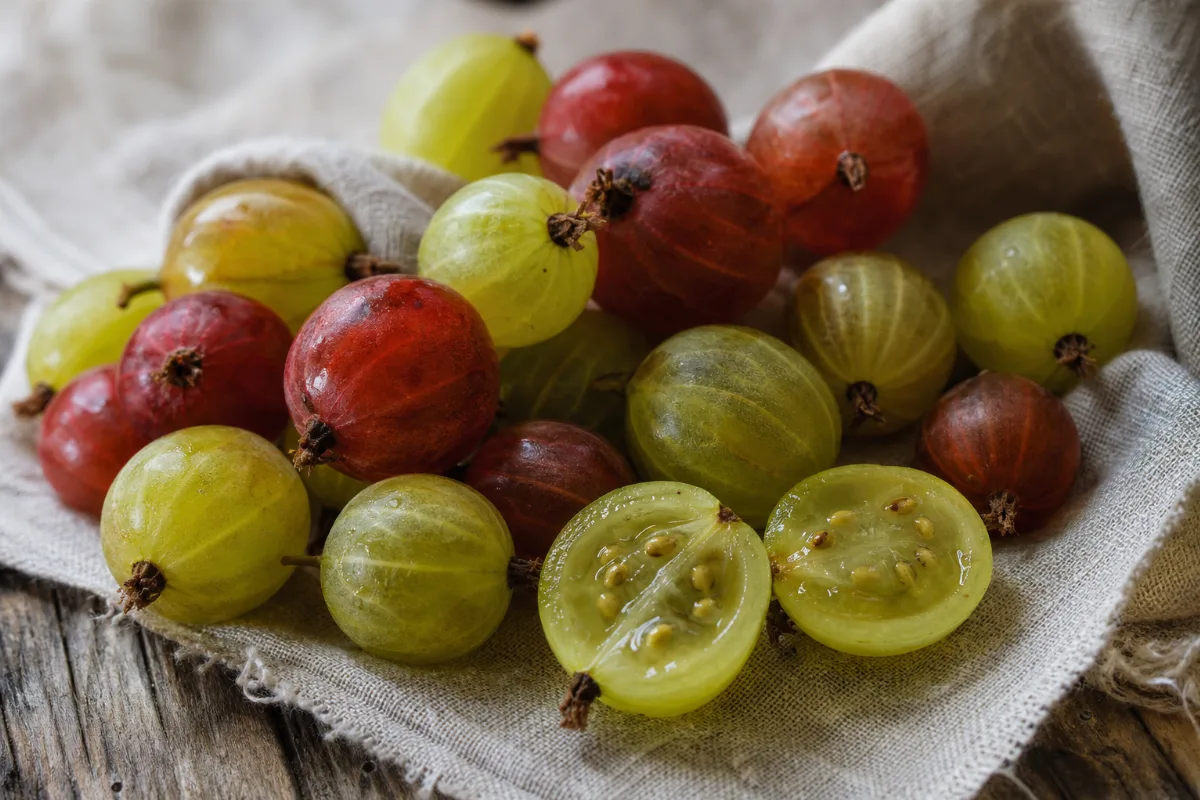
Gooseberries are the tart berries of Ribes uva-crispa, a thorny shrub in the gooseberry family (Grossulariaceae), a close relative of currants. The whole berry is eaten, usually cooked into jams, pies and sauces, though ripe ones can be eaten raw. People eat them for vitamin C and fiber. This page keeps the food apart from supplements and from hype, and it is honest that very little human research on gooseberries themselves exists.
Not the same plant: Indian gooseberry (amla, Phyllanthus emblica) is a different plant with its own page: Amla. Cape gooseberry (golden berry, Physalis peruviana) is also a different plant. The research and nutrition numbers here are for European-type gooseberry (Ribes uva-crispa) only.
Read this first
- Gooseberries are an ordinary food. We found no gooseberry-specific safety warning in the sources we read, but any food can cause an allergic reaction. For trouble breathing or swelling of the face or throat, call 911. See food allergy basics and emergency signs.
- One US cup (150 g) of raw gooseberries has about 46% of the Daily Value for vitamin C and about 23% for fiber (USDA). [1]
- Evidence summary: we found no human trials of gooseberry fruit. The lab studies we read show plant pigments and antioxidant activity in a test tube, which does not show a health benefit in people. [4][5][6]
- Vitamin C, which gooseberries supply, is essential and prevents scurvy; that is a statement about the nutrient, not proof that gooseberries treat any disease. [2][3]
What is in it (USDA values)
Gooseberries, raw (USDA FoodData Central 173030, SR Legacy). [1] Serving: 1 cup (150 g). Per-serving numbers are the USDA per-100 g value multiplied by 1.5 and rounded. USDA lists no value for sugars or vitamin K in this item, so they are not shown.
| Nutrient | Per 100 g | Per 1 cup (150 g) | % Daily Value per cup |
|---|---|---|---|
| Energy | 44 kcal | 66 kcal | n/a |
| Carbohydrate | 10.18 g | 15.3 g | 6% |
| Fiber | 4.3 g | 6.5 g | 23% |
| Vitamin C | 27.7 mg | 41.6 mg | 46% |
| Copper | 0.07 mg | 0.11 mg | 12% |
| Manganese | 0.14 mg | 0.21 mg | 9% |
| Vitamin B6 | 0.08 mg | 0.12 mg | 7% |
| Potassium | 198 mg | 297 mg | 6% |
| Magnesium | 10 mg | 15 mg | 4% |
| Vitamin E (alpha-tocopherol) | 0.37 mg | 0.56 mg | 4% |
| Folate (DFE) | 6 mcg | 9 mcg | 2% |
| Vitamin A (RAE) | 15 mcg | 23 mcg | 3% |
% Daily Value uses the FDA 2016 Daily Values; values vary with variety, ripeness and storage.
Lab work on Estonian-grown gooseberries measured flavonoids and anthocyanins (red pigments) and total phenols; red berries had more of these than green ones. [4] This was a laboratory extraction study, not a study in people. Plant compounds are also reported to have antiviral activity in cell culture; no people were involved. [5] Cooking, long storage and light exposure reduce vitamin C in foods in general. [3]
What research says
| Health goal | What the sources found | Strength of evidence | What was studied |
|---|---|---|---|
| Vitamin C status and scurvy | Too little vitamin C causes scurvy, and the body cannot store it, so it is needed from the diet. [2][3] Gooseberries are a source of vitamin C (USDA). [1] | Established (deficiency; nutrient role, not specific to gooseberries) | Vitamin C in general |
| Fiber and digestion | A cup provides about 23% of the fiber Daily Value (USDA). [1] We did not find a trial of gooseberries for bowel health. | Insufficient evidence | Nutrient values only |
| Antioxidant activity | Gooseberry extracts show free-radical scavenging in the lab, higher in red than green berries. [4] | Lab or animal only | Laboratory extracts |
| Fighting viruses | Fruit and leaf extracts reduced respiratory syncytial virus in cell culture. [5] | Lab or animal only | Cell culture, no people |
| Heart health, liver, blood fats and similar traditional uses | A 2025 review of Ribes (currant) plants says many species are poorly characterized and that safety studies and rigorous clinical trials are limited. [6] | Insufficient evidence | Review of lab, animal and limited human work, mostly on blackcurrant |
Eaten as food vs taken as a supplement or extract. The antiviral and antioxidant findings used laboratory extracts, which are not the same as eating berries. No trial we read tested a gooseberry supplement in people. Observational studies of fruit intake in general are not specific to gooseberries and cannot prove cause. Proper evidence not found in the sources we read for gooseberries and any disease outcome.
How much is a normal serving
The USDA household portion for raw gooseberries is 1 cup (150 g). [1] This is information, not a prescription. We could not read the MyPlate page for an official daily fruit figure, so we do not quote one. Gooseberries are often sold as jam, pie filling or canned in syrup, and these usually have added sugar; check the label. Cooking and storage lower vitamin C. [3] See fresh, frozen and canned produce and fruit juice vs whole fruit.Safety, allergy and medicines
- Allergy. We found no gooseberry-specific allergy source. Any fruit can cause a reaction; seek emergency help for breathing trouble or swelling of the face or throat. See anaphylaxis and severe allergic reactions.
- Medicines. We found no source describing medicine interactions with gooseberries as a food, so we make no claim either way. A pharmacist can check; see foods and medicine interactions. USDA lists no vitamin K value for this item. [1]
- Potassium. A cup has about 6% of the potassium Daily Value (USDA). [1] People with kidney disease or on certain blood pressure medicines should ask about potassium; see kidney disease, potassium and oxalates. We did not read a gooseberry-specific source for this.
- Vitamin C from food. NHS says more than 1,000 mg a day, from supplements, can cause stomach pain, diarrhea and gas. [2] MedlinePlus says high doses can rarely cause kidney stones. [3] These are about supplements, not berries.
- Not Indian gooseberry. Amla has its own evidence and cautions; do not apply this page to it. See Amla.
- Pregnancy. We found no gooseberry-specific warning. Large vitamin C doses are not recommended in pregnancy per MedlinePlus; that concerns supplements. [3] See foods in pregnancy.
- Sugar and pesticides. USDA lists no sugars value for this item. [1] We did not find a gooseberry-specific pesticide residue source: Proper evidence not found.
Choosing, storing and food safety
- Choose fruit that is not bruised or damaged; cut away damaged areas and discard rotten fruit. [7]
- Rinse under running water, without soap or produce wash, and dry with a clean towel. Washing reduces bacteria but does not remove them all. [7]
- Refrigerate perishable produce at 40°F or below. [7]
Related pages
Health connections for Gooseberries
What research links to eating or drinking this food, and how strong the evidence is. Many studies are observational or use juice, powder, oil or extracts rather than the food as eaten; each card says which.
Vitamin C intake and scurvy prevention
Deficiency linkGooseberries supply vitamin C (about 46% of the Daily Value in a cup). Too little vitamin C causes scurvy.
Supplements: Food sources help cover needs; no gooseberry trial exists.
Fiber and bowel regularity
Not enough evidenceA cup has about 6.5 g of fiber, about 23% of the Daily Value.
Supplements: We found no trial of gooseberries for bowel health.
Antioxidant activity (lab)
Lab or animal research onlyGooseberry extracts scavenge free radicals in the lab, more in red than green berries.
Supplements: Lab findings do not show benefit in people.
Antiviral activity in cell culture
Lab or animal research onlyFruit and leaf extracts reduced respiratory syncytial virus in cell culture.
Supplements: No human evidence.
Traditional and wider Ribes uses
Not enough evidenceA 2025 review says many Ribes species are poorly characterized and safety studies and rigorous clinical trials are limited.
Supplements: No good evidence of benefit for gooseberry fruit.
Not Indian gooseberry (amla)
Not enough evidenceIndian gooseberry (Phyllanthus emblica) and cape gooseberry (Physalis peruviana) are different plants; findings do not transfer.
Supplements: Not applicable; clarification.
Vitamin C loss with cooking and storage
Not enough evidenceCooking, long storage and light exposure reduce vitamin C in foods; gooseberries are often cooked.
Supplements: Not applicable; information.
Connected topics
Open a group to see how each topic connects and how strong the evidence is.
Functional actions (1)
- AntioxidantLab or animal research only
Gooseberry extracts show antioxidant activity in the lab; this is not proof of benefit in people.
Root causes (1)
- Nutrient DeficiencyDeficiency link
Gooseberries supply vitamin C, and too little vitamin C causes scurvy; this is about the nutrient, not a gooseberry trial.
Conditions & symptoms (1)
- ScurvyDeficiency link
Lack of vitamin C causes scurvy; gooseberries are a vitamin C source, but no gooseberry trial exists.
Documented risks and interactions (3)
- Allergy and medicines: no specific data. We found no gooseberry-specific allergy or medicine-interaction source; any food can trigger a reaction.
- Very high vitamin C from supplements. More than 1,000 mg a day from supplements can cause stomach pain and diarrhea; high doses can rarely cause kidney stones. This concerns supplements, not berries.
- Washing and storing fresh fruit. Rinse under running water, no soap; refrigerate perishable produce at 40 F or below.
Frequently asked questions
Is a gooseberry the same as amla (Indian gooseberry)?
No. Gooseberry is Ribes uva-crispa; Indian gooseberry (amla) is Phyllanthus emblica, a different plant with different research. See our Amla page.
Are gooseberries high in vitamin C?
A cup of raw gooseberries has about 41.6 mg, roughly 46% of the Daily Value. [1] Cooking and storage lower vitamin C in foods in general. [3]
Do gooseberries prevent or treat any disease?
We found no human trials of gooseberry fruit. Lab studies show antioxidant and antiviral activity in extracts, which does not show a benefit in people. [4][5][6]
Are red and green gooseberries different?
In one lab study, red gooseberries had more anthocyanins, total phenols and antioxidant activity than green ones. [4] That does not show a difference in health effects.
Are gooseberries safe to eat?
They are an ordinary food, and we found no gooseberry-specific warning in the sources we read. Allergy is possible with any food, so ask a clinician if you have had reactions to fruit.
References
- U.S. Department of Agriculture. Gooseberries, raw (FoodData Central 173030, SR Legacy). April 2018 release. Read 2026-10-23.
- NHS. Vitamin C. Read 2026-10-23.
- MedlinePlus. Vitamin C. Read 2026-10-23.
- Hussain S et al. Natural pigments (anthocyanins and chlorophyll) and antioxidants profiling of European red and green gooseberry (Ribes uva-crispa L.) extracted using green techniques. Curr Res Food Sci 2023. PMID 38034946. Abstract read 2026-10-23.
- Dogan HH et al. Short communication: antiviral activity of Ribes uva-crispa L. extracts in vitro. Pak J Pharm Sci 2020. PMID 33191245. Abstract read 2026-10-23.
- Izteleuova EY et al. The current state of knowledge on Ribes spp. (currant) plants. Plants (Basel) 2025. PMID 41157753. Abstract read 2026-10-23.
- U.S. Food and Drug Administration. Selecting and Serving Produce Safely. Read 2026-10-23.