Vetiver Oil: Evidence, Safety and How It Is Used
Vetiver oil is a deep, earthy oil from the roots of a grass. What the small human trials found, one fragrance-safety opinion on a related product, and what sources do not say.
Content last updated . This page has not been medically reviewed.
Safety first. Natural products can cause side effects and interact with medicines. Read essential oil safety before you use anything on this page.
Safety first. This page is about smelling vetiver oil or applying a diluted form to skin, as aromatherapy sources describe. It is not advice to swallow any essential oil. For a swallowing accident, call Poison Help at 1-800-222-1222 (US); call 911 for collapse, seizure or trouble breathing. Human safety information for the plain oil is limited in the sources we read, so a lack of warnings is not proof of safety.
Which plant and part
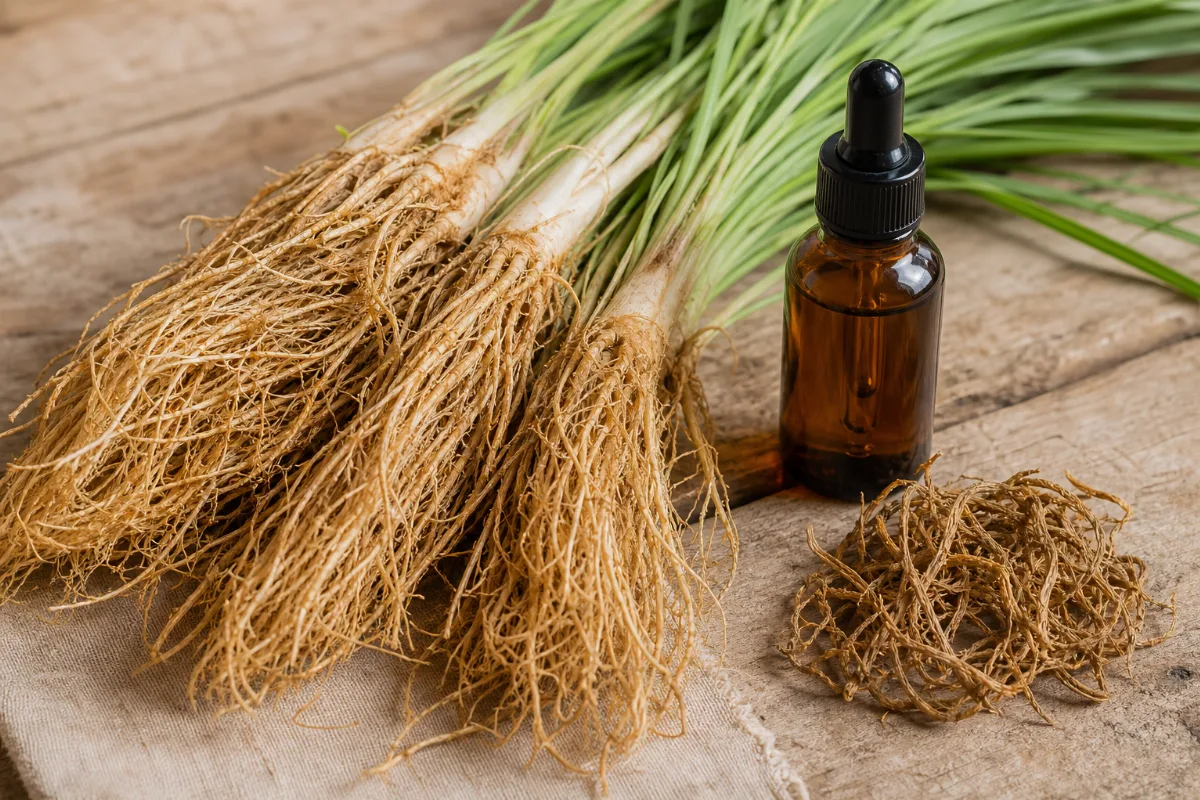
Vetiver is a perennial grass, Chrysopogon zizanioides (L.) Roberty (Poaceae), an accepted name in GBIF. [1] Many papers use the older name Vetiveria zizanioides. GBIF also holds a separate record for that name, so check which name a paper uses. [2] The oil comes from the roots: a fragrance-safety opinion names its material as a "Vetiveria zizanioides root extract". [3] One review describes demand for vetiver oil in fragrance, cosmetic and aromatherapy sectors, among others. [4]Related earthy oils are patchouli oil, sandalwood oil and cedarwood oil. Check any bottle with the label guide.
Traditional use
A 2025 review says vetiver roots and oil have been part of traditional medicine across India and Asia, used for anti-inflammatory, analgesic, antimicrobial and wound-healing purposes. [5] We did not read a source naming specific peoples, regions or periods, so we cannot describe the traditions more precisely. This is traditional use only. It is not proof of benefit.What research shows
Most vetiver studies are in cells and animals. The same review summarizes in vitro assays, cell lines, animal models and a few clinical studies, and lists its own limits. [5] Lab results do not show effects in people; see human studies versus lab research.| Question | What the source found | Strength of evidence | Population and form studied |
|---|---|---|---|
| Attention at a screen task | People who breathed the volatile compounds from a small amount of cut roots had faster reaction times; the effect was not seen at the higher amount. [6] | Promising but limited | Healthy volunteers; cut roots, not bottled oil |
| Fatigue and sleep in nurses | After 4 weeks of nightly aromatherapy massage, fatigue and sleep scores improved in the vetiver group, and also in the placebo (jojoba oil) group, though less. [7] | Promising but limited (single-blind, small groups, self-rated outcomes) | 96 completers of 108 intensive care nurses; massage |
| Mosquito repellent | A vetiver oil repellent gave 51.9% protection in a semi-field test; in a community trial its reported effect was similar to placebo. [8] | Mixed to no good evidence in real-world use | Anopheles dirus; 457 community participants |
| Other claims (cancer cells, antimicrobial) | Reported in cells, animals and computer analyses. [5] | Preclinical (cells or animals) | Not human evidence |
Both human studies measured short-term results: reaction time in one, self-rated fatigue and sleep in the other. See essential oils for sleep, focus, memory and energy and mosquitoes, bugs and lice.
Proper evidence not found: we searched PubMed for human trials of vetiver oil on anxiety, pain and skin conditions and found nothing usable beyond the studies above.
Safety
- Skin sensitization: for a different, processed material (acetylated vetiver oil, used in perfume), the EU's SCCS noted it is a moderate skin sensitizer in test animals, while judging it safe in cosmetics at the concentrations proposed by the fragrance industry. [3] That opinion is about acetylated vetiver oil, not the plain oil, and it does not tell us how plain oil behaves.
- General: the FDA says many plants contain materials that can irritate or cause allergic reactions on the skin. [9] See skin reactions and allergy.
- Medicines, pregnancy and breastfeeding, children, liver and kidney, surgery: not described for vetiver oil in the sources we read. Ask a pharmacist or clinician; see medicine interactions and pregnancy and breastfeeding. Tell a surgical team about oils you use.
- Sustainability: conservation of vetiver is not described in the sources we read. For plants where sources do give concerns, see sustainability and conservation of oil source plants.
Uses studied and safety checks for Vetiver Oil
Read the safety checks first. Each card says whether a finding comes from people or only from the lab, which way the oil was used (scent, on skin or swallowed) and how strong the evidence is. A finding for one way of using an oil does not carry over to another.
Check before you use (4)
- Skin sensitization (acetylated vetiver oil, EU opinion). The EU's SCCS noted acetylated vetiver oil is a moderate skin sensitizer in test animals, while judging it safe in cosmetics at the concentrations proposed by the fragrance industry. This is a processed material, not plain oil.
- Sprays and diffusing: inhalation safety not assessed. The SCCS did not assess inhalation of acetylated vetiver oil because no data were provided, and said an inhalation assessment would be needed for sprayable products.
- Undiluted use on skin. Poison Control advises diluting potent essential oils in a carrier oil and not using them on damaged skin; the Tisserand Institute says not to apply undiluted essential oils to skin. The FDA says many plant materials can irritate or cause allergic reactions on skin.
- Swallowing: poison center advice. Poison Control warns that some essential oils are poisonous if swallowed and that breathing an oil into the lungs can cause pneumonia.
Vetiver root scent and attention
Preliminary or mixedIn a small experiment, people who breathed the volatile compounds from a small amount of cut vetiver roots had faster reaction times on a screen task; the effect was not seen with a larger amount.
Supplements: Not about bottled oil; benefit for focus not established.
Vetiver massage and fatigue or sleep in intensive care nurses
Preliminary or mixedIn a single-blind trial, 96 nurses finished 4 weeks of nightly aromatherapy massage; fatigue and sleep scores improved in the vetiver group, and also in the placebo (jojoba oil) group, though less.
Supplements: Massage with oil; the placebo group improved too.
Mosquito repellent
Preliminary or mixedVetiver oil gave 51.9% protection in a semi-field test, compared with 95.75% for DEET; in a 457-person community trial, vetiver ratings were similar to placebo.
Supplements: Skin repellent only; DEET far more protective in the same study.
Anti-inflammatory, pain, antimicrobial and cancer claims
Lab or animal research onlyA 2025 review lists anti-inflammatory, pain, antimicrobial and anticancer findings from cells, animals and computer analyses, with only a few clinical studies.
Supplements: Traditional and lab findings only.
Connected topics
Open a group to see how each topic connects and how strong the evidence is.
Body systems (1)
- Skin, Hair & BeautyDocumented risk
A regulator opinion on acetylated vetiver oil notes moderate skin sensitization in test animals; plain-oil skin data was not found.
Body parts (1)
- SkinDocumented risk
Skin sensitization potential noted by the SCCS for the acetylated material; the FDA warns plant materials can irritate skin.
Frequently asked questions
Is vetiver oil proven to help sleep?
No. A single-blind trial in intensive care nurses found improvement with vetiver aromatherapy massage, but the placebo group improved too, and the outcomes were self-rated. [7]
Does vetiver repel mosquitoes?
In a semi-field test it gave moderate protection, but in a community trial participants' ratings were similar to placebo. [8]
What is the difference between vetiver oil and acetylated vetiver oil?
Acetylated vetiver oil is a chemically treated fragrance material that regulators have assessed separately. [3] Do not apply its findings to plain oil.
Which plant does vetiver oil come from?
A grass, Chrysopogon zizanioides, also written Vetiveria zizanioides in many papers; the oil comes from its roots. [1] [3]
Is it safe to swallow vetiver oil?
This site does not advise swallowing essential oils. For an accident, call Poison Help at 1-800-222-1222 (US).
References
- GBIF Secretariat. Chrysopogon zizanioides (L.) Roberty, GBIF Backbone Taxonomy. Name checked through the GBIF species match service. Read 2026-10-22.
- GBIF Secretariat. Vetiveria zizanioides Stapf, GBIF Backbone Taxonomy. Name checked through the GBIF species match service; the service returned this as a separate accepted record. Read 2026-10-22.
- SCCS. Final opinion on the safety of fragrance ingredient Acetylated Vetiver Oil (Vetiveria zizanioides root extract acetylated), submission III. Regul Toxicol Pharmacol. 2019. PubMed 31176744. Read 2026-10-22.
- Barcellos-Silva IGC et al. Vetiver, Vetiveria zizanioides (L.) Nash: biotechnology, biorefineries, and the production of volatile phytochemicals. Plants. 2025. PubMed 40431000. Read 2026-10-22.
- Gunasekar CJ et al. Pharmacological and therapeutic potential of Chrysopogon zizanioides (vetiver): a comprehensive review. Biomolecules. 2025. PubMed 41008619. Read 2026-10-22.
- Matsubara E et al. Volatiles emitted from the roots of Vetiveria zizanioides suppress the decline in attention during a visual display terminal task. Biomed Res. 2012. PubMed 23124250. Read 2026-10-22.
- Burkev FG et al. The effect of aromatherapy on fatigue and sleep quality in intensive care nurses: a randomised placebo-controlled trial. Nurs Crit Care. 2026. PubMed 42630137. Read 2026-10-22.
- Saeung M et al. Protective efficacy and user acceptability of DEET and vetiver essential oil repellents against Anopheles dirus. J Med Entomol. 2026. PubMed 42762484. Read 2026-10-22.
- U.S. Food and Drug Administration. Aromatherapy. Read 2026-10-22.