Rosemary Oil
Rosemary oil (Salvia rosmarinus): what small trials say about hair loss, memory and mood, how it differs from rosemary leaf, and safety points for skin, children, pregnancy and pets.
Content last updated . This page has not been medically reviewed.
Safety first. Natural products can cause side effects and interact with medicines. Read essential oil safety before you use anything on this page.
Safety first. Rosemary oil is a concentrated essential oil and is not for swallowing. If a child or pet may have swallowed any essential oil, call Poison Help at 1-800-222-1222 (US); call 911 for collapse, a seizure or trouble breathing. [1] Poison Control also says many essential oils can cause rashes on skin, and that any allergic reaction with difficulty breathing is a medical emergency. [1] See Poisoning: what to do first.
What rosemary oil is
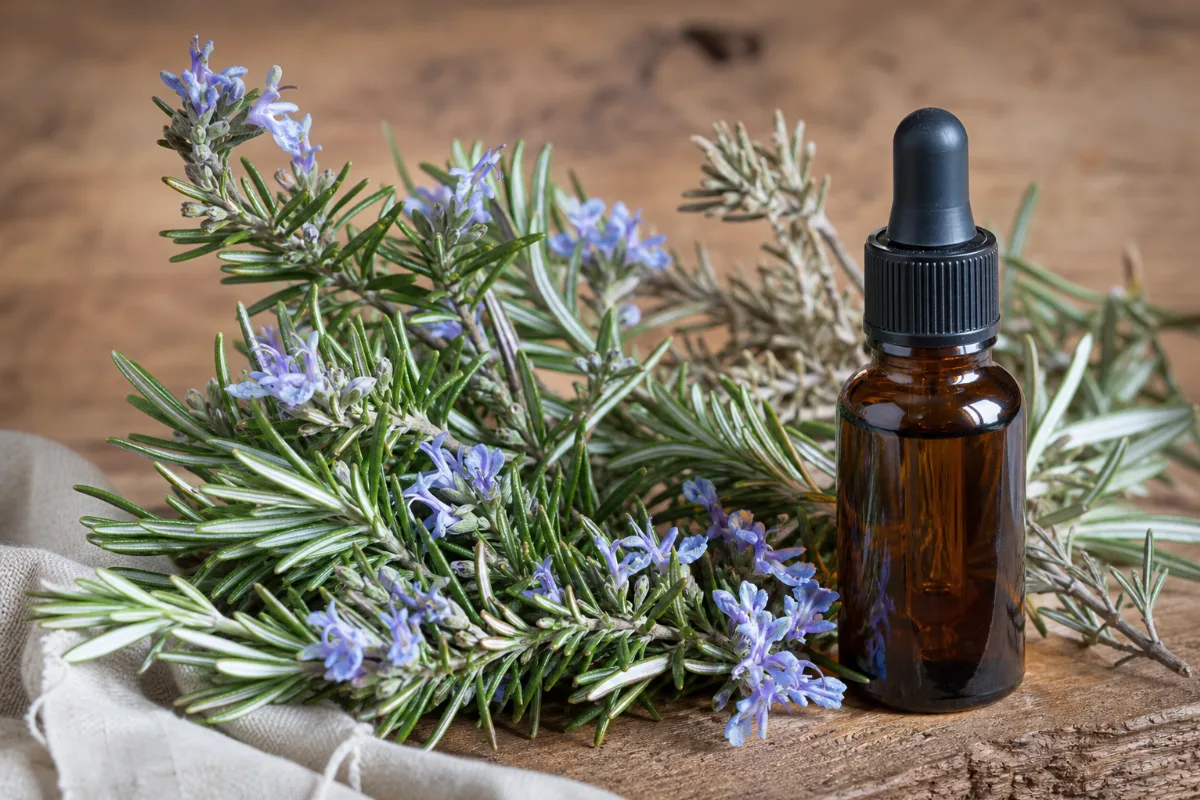
Rosemary oil is the essential oil of the rosemary plant, a strongly scented herb. Rosemary as a herb and food is covered in Rosemary (herbs and botanicals). This page is about the oil, and a result for the leaf, a tea, a food amount or an extract does not carry over to the oil.Which plant, which part
The plant was long named Rosmarinus officinalis L. GBIF now treats that as a synonym of the accepted name Salvia rosmarinus Spenn., in the mint family (Lamiaceae). [2][3] The older name is still used by the European Medicines Agency (EMA) and in a 2015 hair trial. [4][5] The oil is a distilled product of the plant, and the preparation in a study (oil, leaf, extract or scented water) matters.Traditional use
Traditional use only, not proof. The EMA accepts rosemary leaf (not the oil) for dyspepsia, mild digestive spasms, minor muscle and joint pain and minor circulation problems, based only on traditional medicinal use of at least 30 years and not on clinical trials. [4] Sources we read give no region-specific history for the oil.What research shows
Research on rosemary oil in people is small. A 2025 review of non-prescription treatments for hair loss included rosemary oil among 13 studies and said these products have limited evidence on safety and efficacy. [6]| Use | What the source found | Strength of evidence | Population and form studied |
|---|---|---|---|
| Hair loss (androgenetic alopecia) | In a 6-month randomized trial, hair count rose significantly from baseline in both the rosemary oil group and the 2% minoxidil group, with no significant difference between them. [5] | Promising but limited | 100 people with androgenetic alopecia, 50 per group; rosemary oil applied to the scalp (the abstract does not give the exact preparation) and no placebo group described [5] |
| Memory, anxiety, sleep | In a 4-week trial, older adults with diabetes who inhaled lavender or rosemary scored better than a control group on cognition, anxiety and sleep scores. [7] | Promising but limited | 63 adults aged 65 and over; inhaled aromatherapy, rosemary and lavender groups [7] |
| Pain, circulation, digestion, cancer, infection | Proper evidence not found. We read no controlled human trial of rosemary oil for these uses. Laboratory and animal findings are not evidence of effect in people. | Preclinical (cells or animals) or traditional use only | Not applicable |
Hair-growth claims are discussed in Essential oils for hair growth and scalp. Memory and focus claims are in Essential oils for focus, memory and energy.
Forms, and why the form matters
Sources we read describe rosemary oil used on the scalp (trial), inhaled (trial) and in other products. We give no dilution or amount. Strength and carrier differ by product, and a clinician or pharmacist can advise. See diluting essential oils: what sources say.Cats and dogs
The ASPCA lists the rosemary plant as non-toxic to dogs, cats and horses. [8] That listing covers the plant and says nothing about concentrated oil, and we found no veterinary guidance on rosemary oil itself. See essential oils and pets.Official statements
- EMA committee on herbal medicines (EU), summary adopted 2025 and published 2026: rosemary leaf accepted for traditional use only. [4]
Uses studied and safety checks for Rosemary Oil
Read the safety checks first. Each card says whether a finding comes from people or only from the lab, which way the oil was used (scent, on skin or swallowed) and how strong the evidence is. A finding for one way of using an oil does not carry over to another.
Check before you use (4)
- Seizure caution. A 2019 systematic review names rosemary among oils whose internal use can cause epileptic seizures because of compounds such as 1,8-cineole, camphor or thujone. We found no source in which smelling the oil caused a seizure.
- Scalp itching and skin allergy. In the hair trial, scalp itching was higher than at baseline in both groups. EMA lists hypersensitivity such as contact dermatitis for rosemary leaf medicines. Poison Control says rashes are the most common allergic reaction to essential oils.
- Pregnancy, breastfeeding, children and liver conditions (leaf statements). EMA says rosemary leaf medicines should not be used in pregnancy or breastfeeding, under age 12, or with bile duct obstruction, gallbladder inflammation, gallstones or any liver disease.
- Swallowing any essential oil. Poison Control advises calling 1-800-222-1222 (US) if someone swallows an essential oil, and says choking on an oil can cause pneumonia if it enters the lungs. Rosemary oil is not named on that page.
Rosemary oil on the scalp for hair loss (androgenetic alopecia)
Preliminary or mixedIn a 6-month randomized trial of 100 people, hair count rose significantly from baseline with rosemary oil and with 2% minoxidil, with no significant difference between them; nothing changed at 3 months.
Supplements: Small trial, no placebo group described in the abstract; not a replacement for medical care.
Smelling rosemary for memory, anxiety and sleep (inhaled)
Preliminary or mixedIn a 4-week trial of 63 adults aged 65 and over with diabetes, those inhaling rosemary (or lavender) scored better on cognition, anxiety and sleep scales than at baseline, and the control group's anxiety scores rose.
Supplements: Inhaled scent only.
Lavender-rosemary inhaler and test anxiety in students
Preliminary or mixedA 2023 crossover trial in 45 chiropractic students found no statistically significant difference in change in test anxiety between a lavender and rosemary inhaler and a distilled water inhaler.
Supplements: Blend and nasal inhaler only; a negative result.
Rosemary leaf traditional uses (not the oil)
Not enough evidenceEMA accepts rosemary leaf for indigestion, mild digestive spasms, minor muscle and joint pain and minor circulation problems on traditional use of at least 30 years, not trials.
Supplements: Traditional use only; not about the oil.
Cats and dogs
Not enough evidenceThe ASPCA lists the rosemary plant as non-toxic to dogs, cats and horses, and says nothing about essential oil. Poison Control says to keep oil bottles out of reach of children and pets.
Supplements: Oil safety for pets not established in sources we read.
Connected topics
Open a group to see how each topic connects and how strong the evidence is.
Health goals (1)
- Hair SupportPreliminary or mixed
One 6-month trial showed hair count rising with rosemary oil, similar to minoxidil 2%; a 2025 review calls the evidence limited.
Body systems (1)
- Skin, Hair & BeautyPreliminary or mixed
Scalp use for hair loss in one trial; scalp itching reported.
Body parts (2)
Conditions & symptoms (1)
- Androgenetic AlopeciaPreliminary or mixed
One 6-month randomized trial (100 people) found hair count rose with rosemary oil, similar to minoxidil 2%; 2025 review says evidence is limited.
Frequently asked questions
Does rosemary oil help hair growth?
One 6-month trial of 100 people found hair counts rose with rosemary oil and with minoxidil 2%, with no significant difference. [5] A 2025 review said evidence for such products is limited. [6]
Is rosemary oil safe to use on the scalp?
Scalp itching occurred in the trial. [5] Skin allergy is possible with essential oils. [1] See skin reactions and allergy.
Does smelling rosemary improve memory?
A small 4-week trial in older adults with diabetes reported better cognition scores, but it was small and short. [7]
Is rosemary oil safe in pregnancy?
Not shown. The EMA advises against rosemary leaf medicines in pregnancy. [4] Ask a clinician.
Can I swallow rosemary oil?
We do not advise swallowing any essential oil. Call Poison Help at 1-800-222-1222 after a swallowing incident. [1]
More details: evidence, limits and cautions
The details behind this page: cautions, limits of the evidence and where sources disagree. Open any note to read it.
Safety
- Scalp and skin. In the hair trial, scalp itching was higher than at baseline in both groups, and was more frequent with minoxidil. [5] The EMA lists a hypersensitivity reaction such as contact dermatitis for rosemary leaf medicines and says not to apply them to broken or irritated skin. [4]
- Pregnancy and breastfeeding. The EMA says rosemary leaf medicines should not be used in pregnancy or breastfeeding. [4] That statement is about the leaf, and safety of the oil in pregnancy is not described in the sources we read. See pregnancy and breastfeeding.
- Children. The EMA says rosemary leaf medicines should not be used under age 12. [4] Oil-specific guidance for children was not found in the sources we read.
- Liver conditions. The EMA says not to use rosemary leaf with bile duct obstruction, gallbladder inflammation, gallstones or any liver disease. [4] Again this is the leaf.
- Medicines. The EMA says no interactions with other medicines had been described in the literature at the time of assessment for the leaf. [4] This is lack of reports, not proof of safety. See how interactions work.
- Seizure disorders: a seizure caution for rosemary oil was not stated in the sources we read. We therefore cannot say either way; people with epilepsy should ask a clinician (epilepsy and oils).
- Surgery: tell the surgical team about any oil product.
References
- Essential oils: Poisonous when misused (Poison Control). https://www.poison.org/articles/essential-oils. Read 2026-10-23.
- GBIF species match: Rosmarinus officinalis (synonym; GBIF Backbone Taxonomy, API). https://api.gbif.org/v1/species/match?name=Rosmarinus%20officinalis. Read 2026-10-23.
- GBIF species record: Salvia rosmarinus Spenn. (GBIF Backbone Taxonomy, API). https://api.gbif.org/v1/species/10902460. Read 2026-10-23.
- Rosmarini folium, rosemary leaf: summary for the public (EMA HMPC, adopted 2025, published 2026). https://www.ema.europa.eu/en/medicines/herbal/rosmarini-folium. Read 2026-10-23.
- Rosemary oil vs minoxidil 2% for the treatment of androgenetic alopecia: a randomized comparative trial. Skinmed, 2015 (PMID 25842469). https://pubmed.ncbi.nlm.nih.gov/25842469/. Read 2026-10-23.
- Do non-prescription products help in managing androgenic alopecia? Skin Appendage Disord, 2025 (PMID 40475103). https://pubmed.ncbi.nlm.nih.gov/40475103/. Read 2026-10-23.
- The effect of lavender and rosemary aromatherapy application on cognitive functions, anxiety, and sleep quality in the elderly with diabetes. Explore (NY), 2024 (PMID 39047346). https://pubmed.ncbi.nlm.nih.gov/39047346/. Read 2026-10-23.
- Toxic and Non-toxic Plants: Rosemary (ASPCA). https://www.aspca.org/pet-care/animal-poison-control/toxic-and-non-toxic-plants/rosemary. Read 2026-10-23.