Helichrysum Oil: Evidence, Safety and How It Is Used
What helichrysum (immortelle) oil is, what laboratory and animal studies show, why skin and scar claims lack human trials of the oil, and the allergy points to know.
Content last updated . This page has not been medically reviewed.
Safety first. Natural products can cause side effects and interact with medicines. Read essential oil safety before you use anything on this page.
Safety first. Do not swallow essential oils. Poison Control says some are poisonous if swallowed or absorbed through the skin, and children may be more susceptible. [1] If one has been swallowed, call Poison Help at 1-800-222-1222; call 911 for collapse, a seizure or trouble breathing. [1] Helichrysum belongs to the daisy family (Asteraceae), and an allergic reaction to its extracts has been reported. [2] See essential oil safety.
What helichrysum oil is
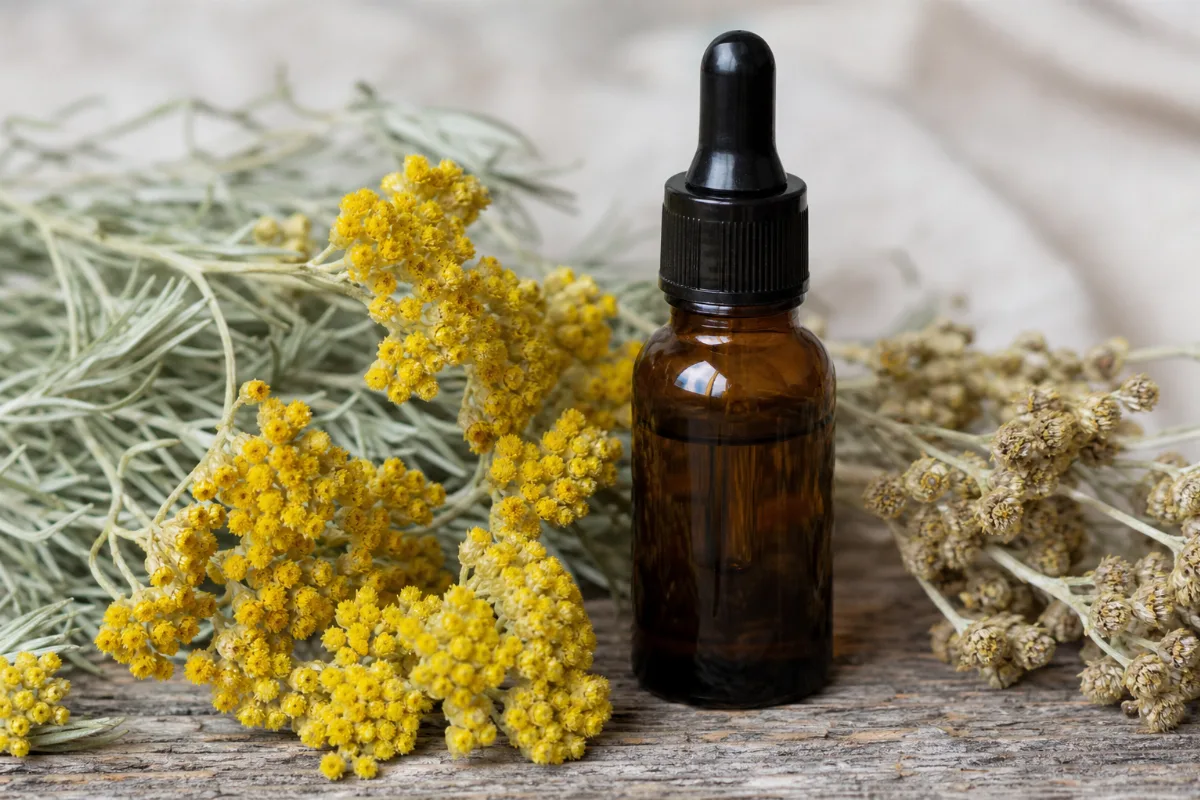
Helichrysum oil is an essential oil from Helichrysum italicum (Roth) G. Don, a plant in the Asteraceae family. [3] It is sometimes sold as "immortelle" oil. [4] A review describes it as a typical Mediterranean plant found on Sardinia, Corsica, the Iberian Peninsula, the Adriatic islands and the Balkan Peninsula, mostly collected from wild plants, with cultivation growing because of rising demand. [5]Name traps. Other plants in the genus Helichrysum are different species. The sandy everlasting, Helichrysum arenarium, has a very different oil: one analysis found fatty acids and nonanal as its main components, against γ-curcumene and selinenes in H. italicum flower oil. [6] A review of the antimicrobial literature lists neryl acetate, α-pinene and γ-curcumene as dominant compounds in H. italicum oil samples. [5] The French allergy study below refers to a flower absolute, which is made differently from an essential oil; see absolutes, hydrosols and infused oils.
Traditional use
A review reports that flowers and leaves of H. italicum have been used in traditional medicine in Italy, Spain, Portugal and Bosnia and Herzegovina for allergies, colds, cough, skin, liver and gallbladder complaints, inflammation, infections and sleeplessness. [2] The oil has been used traditionally as an expectorant. [4] These are records of use. The review's own conclusion is that most traditionally claimed applications are not yet scientifically proven. [2]What research shows (by use)
Nearly all of the research is laboratory or animal work. Aromatherapy and skin trials are also hard to blind and often small.| Claim | What the source found | Strength of evidence | Population and form |
|---|---|---|---|
| Skin redness and protection | In 2023, textiles impregnated with a supercritical CO2 extract of the plant were tested on irritated skin of volunteers; they caused no irritation, and one fabric showed greater skin protection. [7] A review says anti-redness and photoprotective effects of its flavonoids were shown in animals and humans. [2] | Promising but limited; not an essential oil | Human volunteers; extract and flavonoids, not the oil |
| Inflammation | Plant extracts reduced swelling in mouse models. [8] | Preclinical (animals and cells) | Extracts, not oil |
| Germs | A review of 20 papers on antibacterial, antibiofilm and antifungal activity of the oil. [5] In one veterinary study the oil showed no antifungal effect up to 10% in the lab portion. [9] | Preclinical; mixed | Laboratory tests, not infections in people |
| Scars, bruises, wounds | A systematic review found only three studies of essential-oil products on scars and wounds, and its abstract does not name helichrysum. [10] | Proper evidence not found for the oil | Not applicable |
Proper evidence not found for helichrysum oil improving scars, bruising, wounds, stretch marks or skin conditions in people. In the sources we read we found no human trial of the oil for these uses. A review of the plant states that clinical trials are needed. [2] An experiment in a dish or in rats is not evidence of effect in people.
Safety: who should be careful
- Allergy. In a French study of 42 patients allergic to their own essential oils, two cases were attributed to a helichrysum flower absolute; most were due to lavender, tea tree and ravintsara oils. [11] A review reports a case of allergic reaction to its extracts. [2] Poison Control advises diluting potent oils in a carrier oil, not using them on damaged skin, and washing off and stopping if a rash appears. [1] The sources we read did not test cross-reactions with other daisy-family plants; people with such allergies should ask a clinician. See skin reactions.
- Medicines. A review notes one flavonoid from the plant inhibited some CYP liver-enzyme isoforms in laboratory work; what this means for people is not established in the sources we read. [2] If you take medicines cleared by liver enzymes, ask a pharmacist. See medication interactions.
- Pregnancy, breastfeeding, babies and children. The sources we read did not address helichrysum oil, which is not proof of safety. See pregnancy and breastfeeding.
- Pets. Not described in the sources we read; see essential oils and pets.
- Toxicity in the lab. The review reports the plant did not show significant cytotoxicity or genotoxicity in the studies it covered. [2] That is not a safety guarantee for the oil on human skin. Separately, one analysis found the essential oil from H. italicum flowers toxic to brine shrimp in a laboratory test (LC50 about 16 micrograms per mL); this is a lab result in small animals, not a measure of risk to people. [6]
Quality
Composition differs between species and samples, and Poison Control notes it can be hard to know the species, concentration or contaminants in an essential oil. [1] Check that the label gives Helichrysum italicum and the plant part. See quality testing.Uses studied and safety checks for Helichrysum Oil (Immortelle)
Read the safety checks first. Each card says whether a finding comes from people or only from the lab, which way the oil was used (scent, on skin or swallowed) and how strong the evidence is. A finding for one way of using an oil does not carry over to another.
Check before you use (6)
- Skin allergy (daisy family; flower absolute). In a French study of 42 people allergic to their own essential oils, two cases were attributed to a helichrysum flower absolute (most were lavender, tea tree and ravintsara). A review reports a case of allergic reaction to its extracts; the plant is in the daisy family.
- Cats and dogs (and birds). A US animal poison center says essential oils can poison all species, with cats and birds at greatest risk; signs include drooling, vomiting, lethargy and irritation. It does not name helichrysum.
- Children and babies. Poison Control says children have thin skin and immature livers, which may make them more vulnerable to toxic effects. No oil-specific child source was found.
- Swallowing: poison center advice. Poison Control says essential oils can cause serious poisoning when misused and to contact poison control if an oil is swallowed. US: 1-800-222-1222. No swallowing instructions are given on this site.
- Using undiluted on skin. Poison Control says diluting a potent oil in a carrier oil is the best way to avoid a bad reaction from direct skin contact. Tisserand Institute (dilution page) says undiluted use on skin is neither sensible nor necessary and gives general ranges, not oil-specific maximums. Charts differ between sources.
- Medicine interactions (liver enzymes, lab data). A review notes one flavonoid from the plant inhibited some CYP liver-enzyme forms in lab work; what this means for people is not established.
Helichrysum oil and scars, bruises or wounds (skin)
Not enough evidenceNo human trial of the oil for scars, bruising or wounds was found. A systematic review found only three studies of essential-oil products on scars and wounds and its abstract does not name helichrysum.
Supplements: Proper evidence not found.
Helichrysum extract and irritated skin (not the oil)
Preliminary or mixedIn 2023, fabrics impregnated with a CO2 extract of the plant caused no irritation on volunteers' irritated skin, and one showed greater skin protection. A review says anti-redness and sun-protective effects of its flavonoids were seen in animals and humans.
Supplements: Extract, not oil; small volunteer test.
Inflammation in animals
Lab or animal research onlyPlant extracts reduced swelling in mouse models.
Supplements: Lab and animal only.
Germ-killing in the lab (respiratory bacteria, fungi)
Lab or animal research onlyA 2024 review of 20 papers describes antibacterial, antibiofilm and antifungal activity of the oil in the lab; a 2022 lab study tested respiratory bacteria. In a dog study the oil showed no antifungal effect up to 10%.
Supplements: Lab only.
Lab toxicity signals
Lab or animal research onlyA review says the plant did not show significant cytotoxicity or genotoxicity in the studies it covered, while one analysis found the flower oil toxic to brine shrimp in a lab bioassay. Neither is a guarantee about human skin.
Supplements: Lab only.
Connected topics
Open a group to see how each topic connects and how strong the evidence is.
Body parts (1)
- SkinDocumented risk
Two cases in a 42-patient French allergy study were attributed to a helichrysum flower absolute; a review reports an allergic reaction to its extracts.
Functional actions (1)
- Anti-InflammatoryLab or animal research only
Plant extracts reduced swelling in mouse models; no human trial of the oil found.
Conditions & symptoms (1)
- Dermatitis, Allergic ContactDocumented risk
Two cases attributed to a helichrysum absolute and a reported reaction to extracts.
Frequently asked questions
Does helichrysum oil help scars or bruises?
Proper evidence not found. The scar and wound review did not name helichrysum, and we found no human trial of the oil in the sources we read. [10]
Is helichrysum the same as immortelle?
Immortelle is a name used for Helichrysum italicum oil, but other Helichrysum species have different oils, so check the botanical name. [4] [6]
Can helichrysum oil cause an allergic reaction?
Yes. Allergic reactions to extracts and cases attributed to a helichrysum absolute have been reported. [2] [11]
Can I swallow helichrysum oil?
No. Poison Control warns about swallowing essential oils; call Poison Help at 1-800-222-1222 if one has been swallowed. [1]
Does helichrysum oil kill germs?
It has shown antibacterial and antifungal activity in laboratory studies, which is not the same as treating an infection in people. [5]
References
- Poison Control (America's Poison Centers). Essential oils: Poisonous when misused. Read 2026-10-23.
- Antunes Viegas D, et al. Helichrysum italicum: from traditional use to scientific data. J Ethnopharmacol, 2014. Read 2026-10-23.
- GBIF Secretariat. GBIF species match: Helichrysum italicum. Read 2026-10-23.
- Balazs VL, et al. Immortelle (Helichrysum italicum (Roth) G. Don) Essential Oil Showed Antibacterial and Biofilm Inhibitory Activity against Respiratory Tract Pathogens. Molecules, 2022 (laboratory study). Read 2026-10-23.
- Sovljanski O, et al. Antibacterial and Antifungal Potential of Helichrysum italicum (Roth) G. Don Essential Oil. Antibiotics (Basel), 2024. Read 2026-10-23.
- Judzentiene A, et al. Antioxidant and Toxic Activity of Helichrysum arenarium and Helichrysum italicum Essential Oils and Extracts. Molecules, 2022. Read 2026-10-23.
- Maksimovic S, et al. Towards a modern approach to traditional use of Helichrysum italicum in dermatological conditions: In vivo testing supercritical extract on artificially irritated skin. J Ethnopharmacol, 2023. Read 2026-10-23.
- Sala A, et al. Anti-inflammatory and antioxidant properties of Helichrysum italicum. J Pharm Pharmacol, 2002 (extracts, animal and laboratory models). Read 2026-10-23.
- Nardoni S, et al. Clinical and mycological evaluation of an herbal antifungal formulation in canine Malassezia dermatitis. J Mycol Med, 2014 (dogs; a mixture of six oils). Read 2026-10-23.
- Wang JC, et al. Effects of Essential Oils on Scars and Wound Healing: A Systematic Review. Facial Plast Surg, 2023. Read 2026-10-23.
- Allergic contact dermatitis from essential oil in consumer products: Mode of uses and value of patch tests with an essential oil series. Contact Dermatitis, 2023 (French study, 42 patients). Read 2026-10-23.