Hops (Humulus lupulus): Uses, Evidence and Safety
Hops (Humulus lupulus) beyond beer: what European regulators and trials say about sleep, stress and menopause, the estrogen-like compound, and who should ask first.
Content last updated . This page has not been medically reviewed.
Safety first. Supplements can cause side effects and interact with medicines. Read mushroom safety and interactions before you use any mushroom product.
What is Hops good for?
What the body uses it for, and how strong the evidence is. A normal job in the body is not proof that extra supplements add benefit; each card says which.
Traditional use for mild mental stress and sleep
Preliminary or mixedEuropean regulators accept hop flower preparations for easing mild mental stress and helping sleep, based on long-standing use rather than clinical trials.
Supplements: Traditional-use status only: clinical trial evidence is described as insufficient, and the clinical studies reviewed used hops together with valerian.
Sleep (valerian-hops combinations)
Preliminary or mixedOne small 2025 trial of a valerian-hops extract found a little more sleep time than placebo in people with occasional sleep problems.
Supplements: Small feasibility trial of one branded combination; it cannot show what hops does alone. Hops products differ by extract, so a result for one product does not carry over to another.
Stress, anxiety and low mood scores (hops alone)
Preliminary or mixedA small crossover pilot in young adults with at least mild symptoms found lower anxiety, depression and stress scores after 4 weeks of a hop extract than after placebo.
Supplements: Single pilot study in healthy young adults using one dry extract; needs larger confirmation.
Menopausal symptoms and hot flashes
Preliminary or mixedTwo small trials of hop extracts reported fewer menopausal symptoms than placebo, but results were not consistent over time.
Supplements: Mixed, short trials of specific extracts; a review calls the results promising but asks for more evidence.
Bone density after menopause
Not enough evidenceA one-year trial in women with osteopenia saw bone density rise from the start, but the difference from placebo was not statistically significant.
Supplements: No clear benefit over placebo shown. The abstract does not report side effects.
Interactions and side effects not well described
Not enough evidenceThe EMA summary says no side effects had been reported at the time of its assessment. That does not prove there are none, and sedative or hormone-medicine interactions are not documented in the sources read.
Supplements: Absence of reports is not proof of safety; ask a pharmacist if you take sedatives or hormone medicines.
Connected topics
Open a group to see how each topic connects and how strong the evidence is.
Health goals (5)
- Better SleepPreliminary or mixed
Traditional use to aid sleep; trials were mainly valerian-hops combinations, so hops alone is unproven.
- Calm & RelaxationPreliminary or mixed
Hops are accepted in Europe for easing mild mental stress based on traditional use; one small pilot found lower stress scores. Hops products differ by extract, so a result for one product does not carry over to another.
- Menopause SupportPreliminary or mixed
Two small trials reported fewer menopausal symptoms, but results were mixed over time.
- Stress ReductionPreliminary or mixed
Traditional-use status for mild mental stress; a small 4-week pilot found lower stress scores than placebo.
- Anxiety SupportPreliminary or mixed
One small pilot reported lower anxiety scores in young adults; not confirmed by larger trials.
Body systems (2)
- Sleep & RecoveryPreliminary or mixed
Traditional use to aid sleep; human evidence is mostly from valerian-hops combinations.
- Stress & MoodPreliminary or mixed
Traditional use for mild mental stress and one small pilot on stress, anxiety and mood scores.
Functional actions (3)
- CalmingPreliminary or mixed
Traditional use for mild mental stress; small pilot support. Not confirmed by large trials.
- Sleep RegulationPreliminary or mixed
Traditional sleep-aid use; combination trials only, so hops alone is unproven.
- Stress ReductionPreliminary or mixed
Lower stress scores than placebo in one small pilot; traditional use for mental stress.
Root causes (3)
- Poor SleepPreliminary or mixed
Traditional aid for sleep; small combination trial found about 22 more minutes a day. Hops alone unproven.
- Chronic StressPreliminary or mixed
Hops are used for mild mental stress (traditional) and a small pilot showed lower stress scores. They do not treat the cause of stress.
- Hormone DeclinePreliminary or mixed
Used for menopausal symptoms in small trials with mixed results; it does not restore hormone levels.
Conditions & symptoms (5)
- Hot FlushesPreliminary or mixed
A 2016 trial reported fewer hot flashes than placebo; a 2006 trial showed benefit at 6 weeks but not clearly at 12.
- Menopausal SymptomPreliminary or mixed
Two small trials of hop extracts gave mixed results for menopausal symptoms.
- SleeplessnessPreliminary or mixed
Hops are traditionally used to aid sleep; trials were of valerian-hops combinations and small.
- AnxietyPreliminary or mixed
One small pilot found lower anxiety scores; not confirmed.
- Stress, PsychologicalPreliminary or mixed
Traditional use for mild mental stress; one small pilot found lower stress scores.
Documented risks and interactions (3)
- Plant estrogen (8-prenylnaringenin). Hops contain 8-prenylnaringenin, described as a potent plant estrogen. Long-term safety of using it as a treatment still needs study.
- Age limit and when to see a doctor. The EMA summary says hop products are for adults and adolescents over 12, and to consult a doctor or qualified practitioner if symptoms last more than two weeks or get worse.
- Pregnancy, breastfeeding and driving cautions. The site page reports that the European monograph does not recommend hop products in pregnancy or breastfeeding and says they may impair driving.
Key cautions first
- European regulators do not recommend hop medicines in pregnancy or breastfeeding, because safety has not been established. [1]
- The European monograph says hop products may impair the ability to drive and use machines. [1]
- Hops contain 8-prenylnaringenin, described as a potent plant estrogen (phytoestrogen). [2] Reviews say long-term safety of this compound still needs study. [3] If you have a hormone-sensitive condition, ask your clinician first (see herbs and hormone-sensitive conditions).
- Hops products are not the same as beer. Nothing on this page applies to drinking beer.
Overview
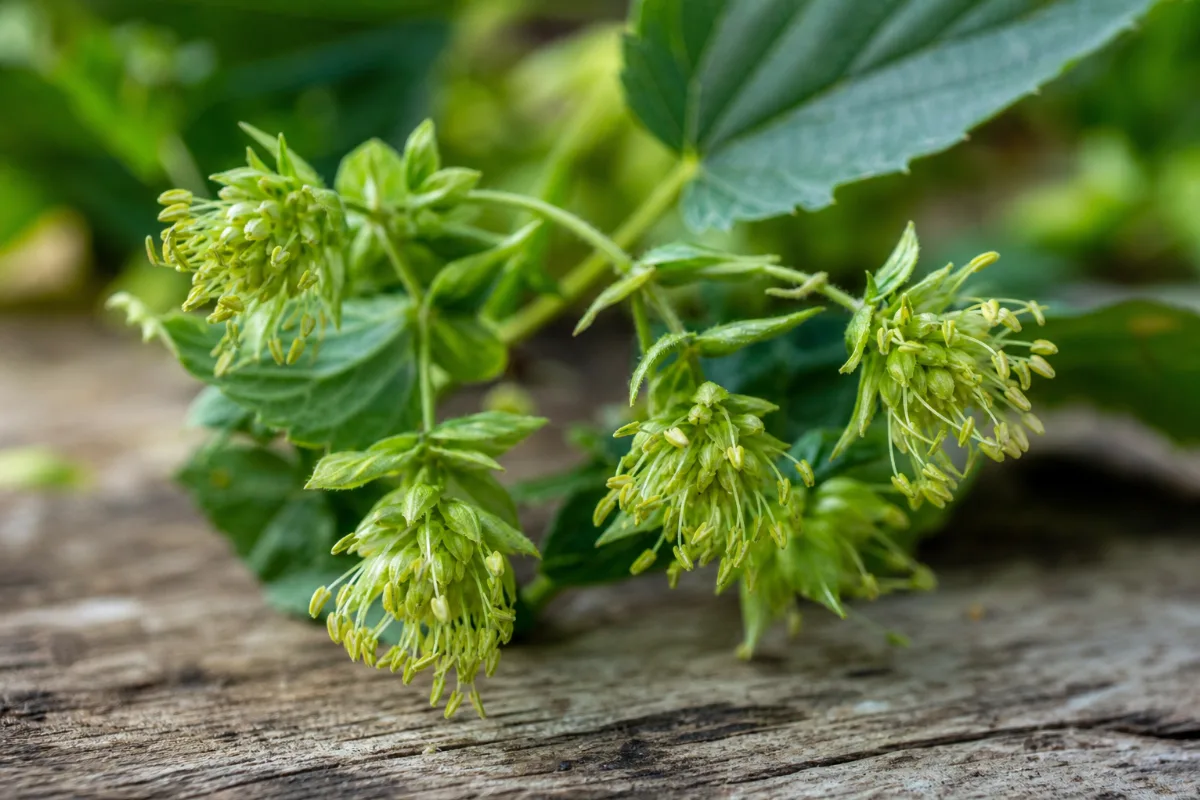
Hops are the cone-like flowers of a climbing plant, best known as a key ingredient in brewing. [3] The same plant has a separate life as a herbal product used in teas, tinctures, capsules and tablets, often in combination with valerian. This page looks at what regulators and published studies say about those herbal products. It does not give amounts for a person. For the tea as a product, see hops tea.Names, parts and look-alikes
The accepted scientific name is Humulus lupulus L., in the family Cannabaceae. [4] The part used in herbal medicine is the flower (cone), which European regulators call hop strobile (the Latin drug name is Lupuli flos). [5] A study on one hop preparation does not automatically apply to another. Plant parts and species on a label matter: see botanical names and plant parts on labels.Traditional use (not proof of effect)
The European Medicines Agency's committee on herbal medicines (HMPC) recognizes a traditional herbal medicinal use for relief of mild symptoms of mental stress and to aid sleep, based on long-standing use. [5] "Traditional use" is a regulatory category: the committee said the effectiveness is plausible and that there is evidence of safe use for at least 30 years (including at least 15 years in the EU), although there is insufficient evidence from clinical trials. [5] The monograph was adopted on 6 May 2014. [1] The EMA page lists a call for scientific data as ongoing. [5]What research shows
| Use | What the source found | Strength of evidence | Population and form studied |
|---|---|---|---|
| Sleep (hops alone) | The EMA committee reviewed laboratory studies that supported hops for aiding sleep, but the clinical studies it considered used hops together with valerian, so firm conclusions on hops itself could not be drawn. [5] | Preclinical support; human evidence for hops alone: Proper evidence not found in the sources we read | Laboratory studies; valerian-hops combinations |
| Sleep (valerian-hops combinations) | A 2025 randomized feasibility trial in 40 people with occasional sleep problems found about 21.7 more minutes of sleep per day on average with a valerian-hops extract than placebo, with no significant change in daytime thinking or mood measures. [6] Some authors were affiliated with a company's medical department. [6] | Promising but limited | Adults with occasional insomnia; one combination extract; 21 days |
| Sleep (overview) | A review of 16 studies found 12 reported some improvement with valerian alone or with hops, but designs differed a lot and the authors asked for better trials. [7] A 2025 scoping review called over-the-counter insomnia products promising but inconclusive. [8] | Mixed / promising but limited | Adults; mostly combinations |
| Stress, mood | In a small crossover pilot of 36 young adults with at least mild symptoms, a 4-week hops dry extract lowered anxiety, depression and stress scores more than placebo. [9] | Promising but limited (pilot) | Healthy young adults; one dry extract |
| Menopausal symptoms | A 2006 trial in 67 women found a hop extract was better than placebo at 6 weeks but not at 12 weeks for the overall score, and the higher amount worked less well than the lower one. [2] A 2016 trial of 120 women reported fewer hot flashes with hop tablets than placebo over 12 weeks. [10] | Mixed | Women with menopausal symptoms; hop extract or tablets |
| Bone density | In a one-year trial of 100 postmenopausal women with osteopenia, total-body bone density rose versus the start, but the difference versus placebo was not statistically significant (p = 0.08). [11] Several authors declared they were employees of a company. [11] | Insufficient evidence | Postmenopausal women with osteopenia; extract standardized to 8-prenylnaringenin |
Most of these trials were small, short, and used specific extracts. A result for one extract does not carry over to a tea or a different capsule. For the wider picture see herbs for sleep: what research shows and herbs for menopause symptoms.
Forms and why they matter
The European monograph covers hop strobile as a herbal tea, powdered herb, liquid extracts, tinctures and a dry extract, all taken by mouth. [1] The EMA says it should only be used in adults and adolescents over 12, and that if symptoms last more than two weeks a doctor or qualified practitioner should be consulted. [5] The monograph lists extracts made with different solvents (ethanol, sweet wine, methanol), so products can differ, which is one reason trial results do not transfer between products. [1]Safety
- Medicines: The EMA monograph lists no reported interactions. [1] That is not proof that none exist. Interactions with sedatives, hormone medicines or other medicines were not described in the other sources we read, so ask a pharmacist, and see how interactions work.
- Side effects: The EMA says no side effects had been reported at the time of its assessment, and the monograph says no adverse effects are known. [5][1] The 2025 scoping review of 51 trials of over-the-counter insomnia products reported mostly mild, short-lived side effects and no serious adverse events across all studies. [8]
- Pregnancy and breastfeeding: not recommended in the EMA monograph because of insufficient data. [1] See pregnancy and breastfeeding.
- Children: not recommended under 12 because of a lack of adequate data. [1]
- Hormone-sensitive conditions: the estrogen-like compound is the reason for this caution; specific guidance for cancer or endometriosis was not described in the sources we read, so ask your clinician. [3]
- Liver, kidney, depression and surgery: these points were not described in the sources we read. Tell your surgical team about any herb before a procedure (see supplements before surgery).
Quality
Products differ in what is in them. Read the label for the plant part and extract type and see quality testing and certifications.Frequently asked questions
Is the hops in a supplement the same as the hops in beer?
No. The herbal products covered by European regulators are hop strobile preparations such as teas, extracts and tinctures, not beer. [5]
Does hops help with sleep?
Regulators accept a traditional use to aid sleep, but the clinical studies the EMA reviewed combined hops with valerian, so the effect of hops alone is unclear. [5] Small trials of valerian-hops combinations are promising but limited. [6]
Is hops safe in pregnancy?
The European monograph says safety in pregnancy and breastfeeding has not been established and use is not recommended. [1]
Does hops act like estrogen?
Hops contain 8-prenylnaringenin, described as a potent plant estrogen, [2] and a review calls for more work on the safety risks of its therapeutic use. [3]
Can hops make me drowsy for driving?
The European monograph says hop products may impair the ability to drive and use machines. [1]
References
- European Medicines Agency (EMA), HMPC. Community herbal monograph on Humulus lupulus L., flos. EMA/HMPC/682384/2013, adopted 6 May 2014. Read 2026-10-22.
- Heyerick A, et al. A first prospective, randomized, double-blind, placebo-controlled study on the use of a standardized hop extract to alleviate menopausal discomforts. Maturitas 2006. PubMed. Read 2026-10-22.
- Štulíková K, Karabín M, Nešpor J, Dostálek P. Therapeutic perspectives of 8-prenylnaringenin, a potent phytoestrogen from hops. Molecules 2018. PubMed. Read 2026-10-22.
- GBIF Backbone Taxonomy, species match: Humulus lupulus. Read 2026-10-22.
- European Medicines Agency (EMA), HMPC. Lupuli flos (hop strobile): herbal medicinal product, summary for the public. Summary EMA/304459/2016, published 2016. Read 2026-10-22.
- Schicktanz N, et al. Effects of a valerian-hops extract combination on sleep duration and daytime cognitive and psychological parameters in occasional insomnia: a randomized controlled feasibility trial. Brain Behav 2025. PubMed. Read 2026-10-22.
- Salter S, Brownie S. Treating primary insomnia: the efficacy of valerian and hops. Aust Fam Physician 2010. PubMed. Read 2026-10-22.
- Salame A, et al. Over-the-counter products for insomnia in adults: a scoping review of randomised controlled trials. Sleep Med 2025. PubMed. Read 2026-10-22.
- Kyrou I, et al. Effects of a hops (Humulus lupulus L.) dry extract supplement on self-reported depression, anxiety and stress levels in apparently healthy young adults: a randomized, placebo-controlled, double-blind, crossover pilot study. Hormones (Athens) 2017. PubMed. Read 2026-10-22.
- Aghamiri V, et al. The effect of hop (Humulus lupulus L.) on early menopausal symptoms and hot flashes: a randomized placebo-controlled trial. Complement Ther Clin Pract 2016. PubMed. Read 2026-10-22.
- Lecomte M, et al. Effect of a hop extract standardized in 8-prenylnaringenin on bone health and gut microbiome in postmenopausal women with osteopenia: a one-year randomized, double-blind, placebo-controlled trial. Nutrients 2023. PubMed. Read 2026-10-22.