Jiaogulan (Gynostemma) (Gynostemma pentaphyllum): Evidence, Safety and How It Is Used
Jiaogulan (Gynostemma pentaphyllum) is a Chinese vine used as tea and extract; this guide covers small human trials, a platelet case report, and unanswered safety questions.
Content last updated . This page has not been medically reviewed.
Safety first. Supplements can cause side effects and interact with medicines. Read mushroom safety and interactions before you use any mushroom product.
What is Jiaogulan good for?
What the body uses it for, and how strong the evidence is. A normal job in the body is not proof that extra supplements add benefit; each card says which.
Stress-related anxiety
Preliminary or mixedIn one 8-week trial of 72 stressed but healthy adults, a leaf extract lowered one anxiety score (trait anxiety) more than placebo. Other anxiety scales and stress hormones did not differ.
Supplements: One small trial with mixed results; not shown to treat an anxiety disorder, and the result may not apply to tea or other products.
Fatigue and exercise performance
Preliminary or mixedIn a 12-week trial of 100 healthy adults, a specific gypenoside L-containing extract was linked to higher VO2 max and O2 pulse and less perceived fatigue than control.
Supplements: Promising but limited; one trial, one extract, healthy adults.
Blood lipids
Not enough evidenceA review of 22 trials (2,407 people with dyslipidemia) judged the evidence for effects on cholesterol and triglycerides very low certainty, with many trials at some or high risk of bias.
Supplements: Evidence is too weak to say it helps; it is not a replacement for prescribed lipid-lowering medicines.
Traditional use (diabetes, liver fibrosis, high blood pressure, high lipids)
Not enough evidenceGynostemma is described as a traditional Chinese medicine used clinically for conditions such as diabetes, hepatic fibrosis, hypertension and hyperlipidemia.
Supplements: No trial evidence for these uses was found in the sources read.
Short-term safety in trials
Preliminary or mixedThe anxiety trial found no causal link between the extract and adverse reactions over 8 weeks, and the lipid review judged use beyond 8 weeks to appear safe, with fewer adverse events than lipid drugs.
Supplements: Reassuring in trials but not proof of long-term safety.
Connected topics
Open a group to see how each topic connects and how strong the evidence is.
Health goals (5)
- Anxiety SupportPreliminary or mixed
One 8-week trial of a leaf extract in stressed healthy adults lowered one anxiety score more than placebo; other measures did not differ. Not tested in anxiety disorders.
- Endurance SupportPreliminary or mixed
In one trial a specific extract was linked to higher VO2 max; one trial, healthy adults only.
- Physical StaminaPreliminary or mixed
In one trial a specific extract was linked to higher VO2 max and O2 pulse; more studies are needed.
- Reduce FatiguePreliminary or mixed
One 12-week trial of a specific extract found less perceived fatigue than control in healthy adults.
- Stress ReductionPreliminary or mixed
One 8-week trial of a leaf extract in stressed healthy adults lowered one anxiety score more than placebo; other measures did not differ.
Body systems (2)
- Energy & FatiguePreliminary or mixed
One trial of a specific extract found less perceived fatigue and higher VO2 max in healthy adults.
- Stress & MoodPreliminary or mixed
One 8-week trial of a leaf extract in stressed healthy adults lowered one anxiety score more than placebo; other measures did not differ.
Functional actions (1)
- Stress ReductionPreliminary or mixed
One 8-week trial of a leaf extract in stressed healthy adults lowered one anxiety score more than placebo; other measures did not differ.
Root causes (2)
- Chronic StressPreliminary or mixed
The anxiety trial enrolled adults under chronic stress; results were mixed.
- Medication Side EffectsDocumented risk
One report of back pain with duloxetine and one case of very low platelets are on record; both are single reports.
Conditions & symptoms (4)
- AnxietyPreliminary or mixed
One trial in stressed healthy adults (not people with an anxiety disorder) found a lower trait anxiety score; other scales did not differ.
- FatiguePreliminary or mixed
One 12-week trial of a specific extract found lower perceived fatigue than control in healthy adults.
- Stress, PsychologicalPreliminary or mixed
Same single trial in adults under chronic stress; stress hormone markers did not differ from placebo.
- ThrombocytopeniaDocumented risk
One case report links more than three months of use to a very low platelet count that recovered after stopping; how common this is is unknown.
Documented risks and interactions (2)
- Low platelet count (thrombocytopenia): one case report. A 2025 case report describes a patient whose platelet count fell to 6.0 x 10^9/L after more than three months of use and rose to 156 x 10^9/L after stopping. The authors advise monitoring platelets in long-term users.
- Possible interaction with antidepressants. A review of adverse-event reports listed one report of back pain when Gynostemma was combined with duloxetine, and advises monitoring adverse events when adaptogens and antidepressants are combined.
Quick safety points
- Platelets and bleeding. A 2025 case report described a patient whose platelet count fell to 6.0 x 10^9/L after more than three months of Gynostemma pentaphyllum and rebounded after stopping. The authors say people on long-term use should have platelet counts monitored. [1] This is one case, so it shows a possibility, not how common it is. If you bruise or bleed easily, or take blood thinners, ask a clinician.
- Antidepressants. A review of adverse-event reports listed one report of back pain with Gynostemma and duloxetine; it advises monitoring adverse events when adaptogens and antidepressants are combined. [2] Never stop a prescribed antidepressant on your own; ask the prescriber or pharmacist. If you are in distress or thinking about harming yourself in the US, call or text 988.
- Pregnancy, breastfeeding, children, liver and kidney conditions, surgery and immune conditions: not described in the sources we read. See pregnancy and breastfeeding and supplements before surgery.
What jiaogulan is
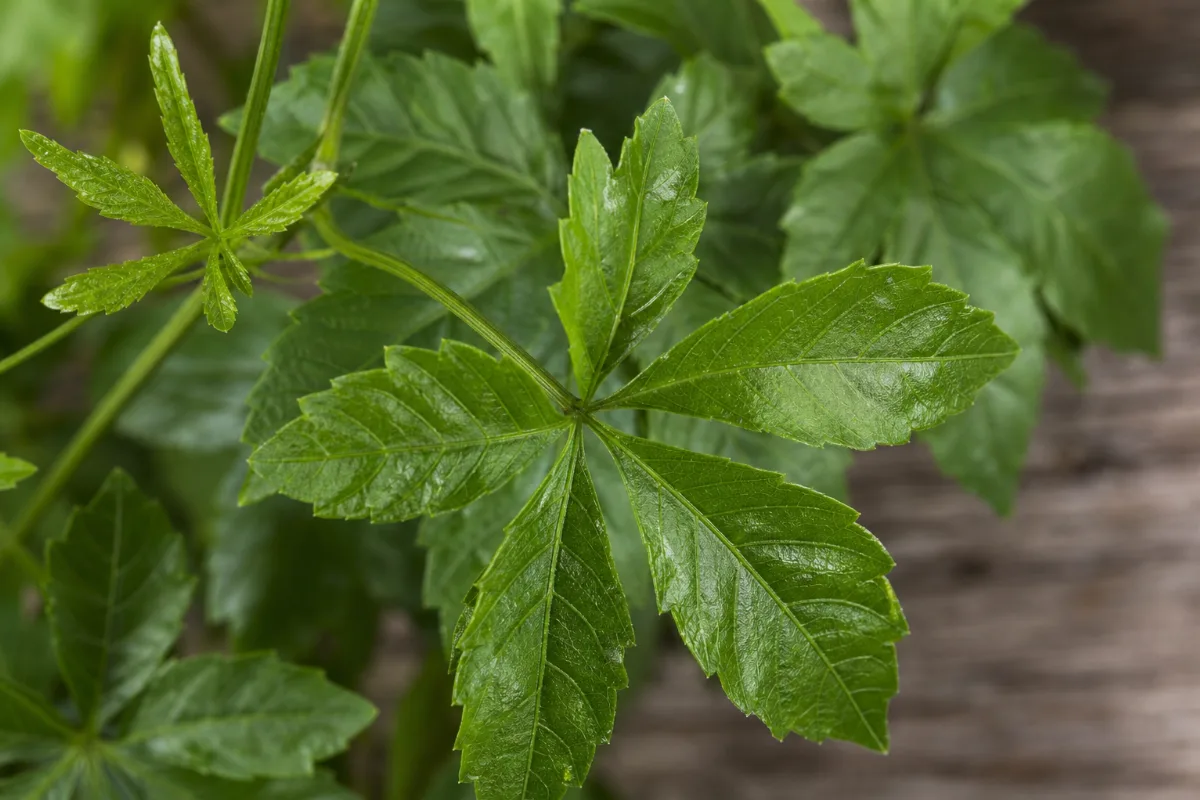
Jiaogulan is Gynostemma pentaphyllum (Thunb.) Makino, in the cucumber family (Cucurbitaceae); GBIF lists this as the accepted name. [3] The trials below used leaf extracts. [4]Is jiaogulan an adaptogen?
"Adaptogen" is a contested term; see What are adaptogens?. The adverse-event review above lists Gynostemma among the adaptogens it studied, but the review's authors choose that grouping; no regulator category is described in the sources we read. [2] Treat the label as a marketing grouping.Traditional use (not proof)
One case report describes Gynostemma pentaphyllum as a prominent traditional Chinese medicine used clinically for conditions such as diabetes, hepatic fibrosis, hypertension and hyperlipidemia. [1] Further detail on traditional use, periods and regions was not described in the sources we read. Traditional use is not evidence of benefit.What research shows
| Use | What the source found | Strength of evidence | Population and form |
|---|---|---|---|
| Stress-related anxiety | In an 8-week placebo-controlled trial, trait anxiety score fell 16.8% more than on placebo; other anxiety scales and stress markers showed no significant difference. [4] | Promising but limited (single trial; one primary outcome) | 72 healthy Korean adults with chronic stress; ethanol leaf extract |
| Fatigue and physical performance | After 12 weeks, VO2 max and O2 pulse were higher on a gypenoside L-containing extract than control. [5] | Promising but limited | 100 healthy Korean adults aged 19 to 60; a specific standardized extract |
| Blood lipids | A systematic review of 22 trials (2,407 people) concluded very low certainty evidence that effects were comparable to lipid-lowering drugs. [6] | Insufficient evidence (very low certainty) | People with dyslipidemia; various preparations, alone or with drugs |
The anxiety authors said more studies are needed to establish long-term safety and effectiveness. [4] Cortisol, norepinephrine and similar measures are markers, not how a person feels; see adrenal fatigue and adrenal support claims.
Proper evidence not found for jiaogulan tea as a stress remedy: we searched PubMed for Gynostemma randomized trials and safety reports, and the trials we read used extracts, not tea.
Forms and why the form matters
The anxiety trial used an ethanol leaf extract and the fatigue trial a particular extract, so their results do not apply to tea, powder or other products. [4][5]Safety in more detail
- Treatment length: the lipid review judged use for more than 8 weeks to appear safe, with fewer adverse events than lipid-lowering drugs, but on very low certainty evidence. [6]
- Trial safety: the anxiety trial found no causal relationship between the extract and adverse reactions over 8 weeks in 72 people. [4] Short, small trials can miss rare events like the platelet case.
- Medicines: read how interactions work and adaptogen medicine interactions. Sedative, blood thinner and immune-medicine interactions were not described in the sources we read.
Frequently asked questions
Is jiaogulan an adaptogen?
It is grouped with adaptogens in some reviews and marketing, but the term is contested. [2]
Does jiaogulan reduce anxiety?
One 8-week trial of a leaf extract lowered trait anxiety scores in stressed adults, while other anxiety measures did not differ. [4]
Can jiaogulan lower platelets?
One case report describes it after more than three months of use. [1]
Is jiaogulan tea the same as the extracts in trials?
Not necessarily. Trials used extracts, and tea evidence was not found in what we read. [4]
Can I take jiaogulan with antidepressants?
Ask the prescriber or pharmacist; one report listed back pain with duloxetine. [2]
References
- Ding L et al., Clinical Laboratory 2025, A case of thrombocytopenia caused by Gynostemma pentaphyllum. Read 2026-10-23.
- Siwek M et al., Frontiers in Pharmacology 2023, Retrospective chart review of adverse events of interactions between adaptogens and antidepressant drugs. Read 2026-10-23.
- GBIF Backbone Taxonomy name match, Gynostemma pentaphyllum (Thunb.) Makino, accessed 2026-10-23. Read 2026-10-23.
- Phytomedicine 2019, Gynostemma pentaphyllum leaf extract and anxiety in healthy people with chronic stress: randomized trial. Read 2026-10-23.
- Phytotherapy Research 2023, Gypenoside L-containing Gynostemma pentaphyllum extract on fatigue and physical performance: randomized trial. Read 2026-10-23.
- Dai et al., Frontiers in Pharmacology 2022, Gynostemma pentaphyllum for dyslipidemia: systematic review of randomized controlled trials. Read 2026-10-23.