Chaga
Chaga (Inonotus obliquus) explained: kidney injury from oxalate reported with chaga powder, bleeding and blood sugar cautions, folk use, and why human trial evidence is missing.
Content last updated . This page has not been medically reviewed.
Safety first. Supplements can cause side effects and interact with medicines. Read mushroom safety and interactions before you use any mushroom product.
Documented analytical data
Each group below is one study's measurement of the stated specimen or preparation. It is not a typical value for the species or product, varies between specimens, and says nothing about effects or safety. 27 values from 4 sources.
Coleton W, et al. Comparative Study of Chaga (Inonotus obliquus) Dietary Supplements Using Complementary Analytical T... (14 values)
Source: Coleton W, et al. Comparative Study of Chaga (Inonotus obliquus) Dietary Supplements Using Complementary Analytical Techniques. Int J Mol Sci 2025;26:2970. doi:10.3390/ijms26072970. https://pmc.ncbi.nlm.nih.gov/articles/PMC11988691/ (CC BY). Laboratory: Nammex (supplier) and Purity-IQ (testing laboratory). Method: varies by row (see source). Date: 2025 (published 2025-03-25).
| Specimen or preparation | Analyte | Value | What it is | Sample size and scope |
|---|---|---|---|---|
| Chaga conk WChV6 (Heilongjiang) | Melanin-like pigment, alkaline-extract absorbance at 500 nm (WChV6, dilution factor 1) | 0.7685 absorbance units (relative, not a mass) (whole conk) | single value (reported) | 1 reading per sample. Highest of 6 conks; readings depend on dilution factor |
| I. obliquus mycelium, liquid culture | Alpha-glucan, pure mycelium (IoMyc2) | 15.2 % of sample (freeze-dried liquid-culture mycelium) | single value (reported) | 1. Single sample |
| I. obliquus mycelium, liquid culture | Beta-glucan, pure lab-grown I. obliquus mycelium (IoMyc2) | 14.4 % of sample (freeze-dried liquid-culture mycelium) | single value (reported) | 1. Single sample |
| I. obliquus mycelium, liquid culture | Melanin-like pigment, absorbance at 500 nm (pure mycelium IoMyc1, dilution factor 1) | 0.0313 absorbance units (relative, not a mass) (freeze-dried mycelium) | single value (reported) | 1. Single sample |
| IoMFG-oat | Melanin-like pigment, absorbance at 500 nm (mycelium-on-oat product, dilution factor 1) | 0.0417 absorbance units (relative, not a mass) (commercial fermented-grain product) | single value (reported) | 1. Single sample |
| Mycelia-fermented grain products sold as chaga | Alpha-glucan, mycelium-on-grain products (high end) | 68 % of sample (commercial fermented-grain products) | maximum (reported) | 4 products. High end of paper's range |
| Mycelia-fermented grain products sold as chaga (oat, rice, sorghum, unknown grain) | Alpha-glucan, mycelium-on-grain products (low end) | 33 % of sample (commercial fermented-grain products) | minimum (reported) | 4 products. Low end of paper's 33-68% range |
| Whole chaga conks (WChV1-6: Alaska, Quebec, Ontario, Finland, Heilongjiang) plus one commercial 1:1 chaga extract | 3beta-Hydroxylanosta-8,24-dien-21-al | 0.09 % w/w (dry weight) | mean (reported) | 6 conks + 1 extract (paper's table does not separate them in the text read). Mean across the 6 conks and 1 extract as summarised in the paper's Table 2 (SD 0.03) |
| Whole chaga conks (WChV1-6: Alaska, Quebec, Ontario, Finland, Heilongjiang) plus one commercial 1:1 chaga extract | Inotodiol | 0.19 % w/w (dry weight) | mean (reported) | 6 conks + 1 extract (paper's table does not separate them in the text read). Mean across the 6 conks and 1 extract as summarised in the paper's Table 2 (SD 0.08) |
| Whole chaga conks (WChV1-6: Alaska, Quebec, Ontario, Finland, Heilongjiang) plus one commercial 1:1 chaga extract | Lanosterol | 0.06 % w/w (dry weight) | mean (reported) | 6 conks + 1 extract (paper's table does not separate them in the text read). Mean across the 6 conks and 1 extract as summarised in the paper's Table 2 (SD 0.017) |
| Whole chaga conks (WChV1-6: Alaska, Quebec, Ontario, Finland, Heilongjiang) plus one commercial 1:1 chaga extract | Trametenolic acid | 0.09 % w/w (dry weight) | mean (reported) | 6 conks + 1 extract (paper's table does not separate them in the text read). Mean across the 6 conks and 1 extract as summarised in the paper's Table 2 (SD 0.022) |
| Whole chaga conks WChV1-6 | Alpha-glucan, whole chaga conks (upper bound) | 2 % of sample (reported as 'less than 2%') (whole conk) | upper bound (reported) | 6 conks. Upper limit stated by the paper |
| Whole chaga conks WChV1-6 | Beta-glucan (high end of range) | 11.9 % of sample (basis not stated in text read; whole conk) | maximum (reported) | 6 conks, triplicate. Highest of the 6 conks |
| Whole chaga conks WChV1-6 | Beta-glucan (low end of range) | 5.7 % of sample (basis not stated in text read; whole conk) | minimum (reported) | 6 conks, assay run in triplicate. Lowest of the 6 conks (paper reports range 5.7-11.9) |
Degtyarev V, Sobakin P. Accumulation and distribution of 40K in the chaga mushroom. Mycoscience 2021;62:81-86. doi:10... (2 values)
Source: Degtyarev V, Sobakin P. Accumulation and distribution of 40K in the chaga mushroom. Mycoscience 2021;62:81-86. doi:10.47371/mycosci.2020.11.004. https://pmc.ncbi.nlm.nih.gov/articles/PMC9157780/ Laboratory: Institute for Biological Problems of Cryolithozone, Yakutsk. Method: varies by row (see source). Date: paper received 2020.
| Specimen or preparation | Analyte | Value | What it is | Sample size and scope |
|---|---|---|---|---|
| Wild chaga conks from a virgin forest in Yakutia, Siberia (mostly birch, Betula pendula) | Caesium-137 activity concentration | 10.5 Bq per kg (dry weight) | mean (reported) | 52. Mean (SE 1.8; median 7.2; range 0-64.2) |
| Wild chaga conks from a virgin forest in Yakutia, Siberia (mostly birch, Betula pendula) | Potassium-40 activity concentration | 1641 Bq per kg (dry weight) | mean (reported) | 52. Mean (SE 103; median 1,500; range 509-3,502) |
Kim J, et al. Composition of Triterpenoids in Inonotus obliquus and Their Anti-Proliferative Activity on Cancer Cell... (8 values)
Source: Kim J, et al. Composition of Triterpenoids in Inonotus obliquus and Their Anti-Proliferative Activity on Cancer Cell Lines. Molecules 2020;25:4066. doi:10.3390/molecules25184066. https://pmc.ncbi.nlm.nih.gov/articles/PMC7570639/ (CC BY). Laboratory: Seoul National University, Dept of Food and Nutrition. Method: HPLC with standards (peak identity also by LC-ESI-MS); trametenolic acid expressed as betulinic acid equivalent. Date: 2020.
| Specimen or preparation | Analyte | Value | What it is | Sample size and scope |
|---|---|---|---|---|
| Chaga conk collected in Tyumen, Russia, supplied by a Korean company; inner and outer parts | Betulin in the purified triterpenoid fraction, inner part | 8.24 mg per g dry fraction (per g of the Diaion HP-20 triterpenoid fraction of an 80% methanol extract, NOT per g of conk) | mean (reported) | 3 replicates. Mean of 3 replicate analyses |
| Chaga conk collected in Tyumen, Russia, supplied by a Korean company; inner and outer parts | Betulin in the purified triterpenoid fraction, outer part | 8.79 mg per g dry fraction (per g of the Diaion HP-20 triterpenoid fraction of an 80% methanol extract, NOT per g of conk) | mean (reported) | 3 replicates. Mean of 3 replicate analyses |
| Chaga conk collected in Tyumen, Russia, supplied by a Korean company; inner and outer parts | Betulinic acid in the purified triterpenoid fraction, inner part | 8.69 mg per g dry fraction (per g of the Diaion HP-20 triterpenoid fraction of an 80% methanol extract, NOT per g of conk) | mean (reported) | 3 replicates. Mean of 3 replicate analyses |
| Chaga conk collected in Tyumen, Russia, supplied by a Korean company; inner and outer parts | Betulinic acid in the purified triterpenoid fraction, outer part | 13.6 mg per g dry fraction (per g of the Diaion HP-20 triterpenoid fraction of an 80% methanol extract, NOT per g of conk) | mean (reported) | 3 replicates. Mean of 3 replicate analyses |
| Chaga conk collected in Tyumen, Russia, supplied by a Korean company; inner and outer parts | Inotodiol in the purified triterpenoid fraction, inner part | 153.9 mg per g dry fraction (per g of the Diaion HP-20 triterpenoid fraction of an 80% methanol extract, NOT per g of conk) | mean (reported) | 3 replicates. Mean of 3 replicate analyses |
| Chaga conk collected in Tyumen, Russia, supplied by a Korean company; inner and outer parts | Inotodiol in the purified triterpenoid fraction, outer part | 194.1 mg per g dry fraction (per g of the Diaion HP-20 triterpenoid fraction of an 80% methanol extract, NOT per g of conk) | mean (reported) | 3 replicates. Mean of 3 replicate analyses |
| Chaga conk collected in Tyumen, Russia, supplied by a Korean company; inner and outer parts | Trametenolic acid in the purified triterpenoid fraction, inner part | 94.5 mg per g dry fraction (per g of the Diaion HP-20 triterpenoid fraction of an 80% methanol extract, NOT per g of conk) | mean (reported) | 3 replicates. Mean of 3 replicate analyses |
| Chaga conk collected in Tyumen, Russia, supplied by a Korean company; inner and outer parts | Trametenolic acid in the purified triterpenoid fraction, outer part | 106.3 mg per g dry fraction (per g of the Diaion HP-20 triterpenoid fraction of an 80% methanol extract, NOT per g of conk) | mean (reported) | 3 replicates. Mean of 3 replicate analyses |
Lee S, et al. Development of End Stage Renal Disease after Long-Term Ingestion of Chaga Mushroom: Case Report and Rev... (3 values)
Source: Lee S, et al. Development of End Stage Renal Disease after Long-Term Ingestion of Chaga Mushroom: Case Report and Review of Literature. J Korean Med Sci 2020;35:e122. doi:10.3346/jkms.2020.35.e122. https://pubmed.ncbi.nlm.nih.gov/32419395/ Laboratory: varies by row (see source). Method: varies by row (see source). Date: varies by row.
| Specimen or preparation | Analyte | Value | What it is | Sample size and scope |
|---|---|---|---|---|
| Chaga powder from a second company (as quoted in the case report) | Oxalate, other commercial chaga powder A | 2.8 g per 100 g (powder) | single value (reported) | 1. Value quoted by the authors; method not described in the text read |
| Chaga powder from a third company (as quoted in the case report) | Oxalate, other commercial chaga powder B | 11.2 g per 100 g (powder) | single value (reported) | 1. Value quoted by the authors; method not described in the text read |
| Chaga powder, leftover from a 49-year-old patient with end-stage kidney disease | Oxalate | 14.2 g per 100 g (powder) | single value (reported) | 1. Single product |
What is Chaga good for?
What the body uses it for, and how strong the evidence is. A normal job in the body is not proof that extra supplements add benefit; each card says which.
Traditional folk remedy
Not enough evidenceChaga tea has long been used as a folk remedy in Russia and other northern European countries, including for cancer. Traditional use is not proof that it works.
Supplements: No human trial showing a benefit was found in the sources read. This is traditional use only.
Antioxidant, anti-inflammatory and immune effects in the lab
Lab or animal research onlyIn cell and animal experiments, chaga extracts show antioxidant, anti-inflammatory and immune-modulating effects.
Supplements: Not shown in people. Lab and animal results only.
Blood-sugar lowering in lab and animal studies
Lab or animal research onlyLaboratory work reports blood-sugar lowering effects, and chaga showed an additive effect with sugar-lowering drugs in the lab.
Supplements: Not shown in people; do not use it as a diabetes treatment.
Cancer-related uses
Lab or animal research onlyCell-line and mouse studies report effects on cancer cells. No human trial was found; the US National Cancer Institute says the FDA has not approved medicinal mushrooms to treat cancer or any other condition.
Supplements: No clinical evidence found; tell the care team about any chaga product.
As a food (nutrition)
Not enough evidenceChaga conk is bitter and woody and is taken as tea or powder rather than eaten as a food. This applies to eating chaga, not to supplements. We found no open nutrition table for it.
Supplements: Not applicable as a nutrient source; no open measured nutrient values found.
Wild-harvest contamination (data are thin)
Not enough evidenceWild conks can take up substances from the environment. One Siberian study of 52 conks found low caesium-137 (mean 10.5 Bq/kg dry weight). We found no open data on cadmium, lead, mercury or arsenic.
Supplements: Choose products with batch testing for metals and radioactivity; not verified for any brand here.
Connected topics
Open a group to see how each topic connects and how strong the evidence is.
Body systems (2)
- Kidney & UrinaryDocumented risk
Case reports link long-term chaga powder to oxalate kidney damage, some needing dialysis. The frequency is not known.
- Urinary SystemDocumented risk
Same documented risk: oxalate crystal damage to the kidneys after long-term chaga powder use (case reports).
Body parts (1)
- KidneysDocumented risk
Kidney biopsies in case reports showed oxalate crystals; a 2026 rat study found kidney injury at high doses.
Functional actions (4)
- Anti-InflammatoryLab or animal research only
Chaga extracts reduced inflammation markers in cell and animal studies. Seen in laboratory and animal studies only; no human trial found.
- AntioxidantLab or animal research only
Chaga extracts show antioxidant activity in laboratory tests. Seen in laboratory and animal studies only; no human trial found.
- Blood Sugar RegulationLab or animal research only
Blood-sugar lowering is reported in laboratory and animal work. Seen in laboratory and animal studies only; no human trial found.
- Immune ModulationLab or animal research only
Immune-modulating effects are reported in cell and animal studies. Seen in laboratory and animal studies only; no human trial found.
Root causes (1)
- Medication Side EffectsDocumented risk
Chaga may add to the effect of blood thinners (animal data) and diabetes medicines (lab data); clinical importance is not known.
Biomarkers (1)
- CreatinineDocumented risk
Kidney injury from chaga oxalate showed up as raised creatinine in case reports (for example 20.5 mg/dL in one report); creatinine is how a clinician would watch for it.
Conditions & symptoms (2)
- Kidney Failure, ChronicDocumented risk
A case report describes end-stage kidney disease after long-term chaga powder, with oxalate deposits on biopsy. This is a case report, so frequency is unknown.
- Kidney Failure, AcuteDocumented risk
Case reports describe acute kidney injury from oxalate after several months of daily chaga powder; one recovered after dialysis and treatment.
Documented risks and interactions (4)
- Kidney injury from oxalate. Case reports describe oxalate kidney damage, some ending in dialysis, after months or years of daily chaga powder. In one report the powder was 14.2 g oxalate per 100 g.
- Bleeding risk with blood thinners. Chaga extract reduced platelet clumping in a mouse model, so it might add to blood-thinning drugs. The clinical relevance is not known.
- Interaction with diabetes medicines. In laboratory work chaga lowered blood sugar in an additive way with other agents; clinical importance is unknown.
- Product identity and quality (conk vs mycelium-on-grain). Products sold as chaga can be wild conk, extract, or fungus grown on grain. In a 2025 comparison the grain products had much starch, no detectable chaga triterpenoids and almost no melanin, unlike conks.
Safety first: kidneys. Case reports describe kidney damage from oxalate (a natural chemical that can form crystals in the kidney) after long-term daily use of chaga powder, in some cases leading to dialysis. [1][2] In one report a biopsy showed oxalate crystals and the leftover chaga had an extremely high oxalate content. [2] People with kidney disease should ask their clinician before using chaga, and anyone who has used it regularly should mention it if their kidney tests are abnormal. Memorial Sloan Kettering Cancer Center (MSK) also advises talking to a healthcare provider about blood thinners such as warfarin. [1] See chaga side effects, oxalates and kidney concerns and kidneys, oxalates and the liver.
What it is
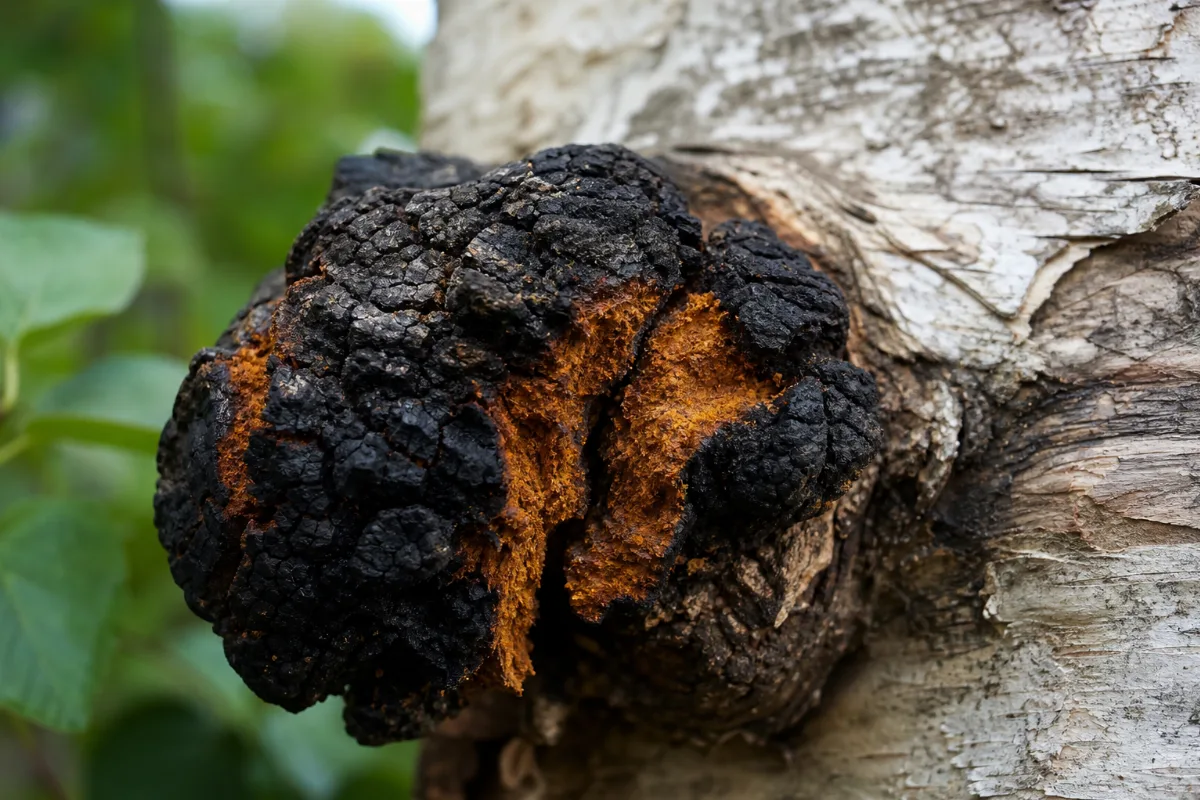
Chaga is Inonotus obliquus (Fr.) Pilát, an accepted species in the family Hymenochaetaceae. [3] MSK describes it as commonly found on birch trees in cold climates. [1] The lump sold as chaga is called a conk; MSK says the medicinal conk comprises wood from the host tree plus mycelium (the thread-like body) of the fungus. [1] A 2022 case report calls it a fungus parasitic on birch and other trees. [4]This guide gives no harvesting or identification instructions. Wild fungi can look like other species; for any wild mushroom that was eaten, call Poison Help at 1-800-222-1222 in the US.
Traditional use
Traditional use only, not proof. MSK says chaga is used as a folk remedy in Russia and other northern European countries for various ailments, including cancer. [1] It says chaga is edible but not commonly ingested because it is bitter, and that tea made from the whole conk is consumed instead. [1]What research shows
| Use | What the source found | Strength of evidence | Form and population |
|---|---|---|---|
| Any health benefit in people | Proper evidence not found. MSK states that safety and efficacy have yet to be evaluated in clinical studies. [1] We also searched PubMed for chaga human trials and found only case reports and reviews. | Insufficient evidence | Not applicable |
| Antioxidant, anti-inflammatory, immune, blood sugar and cancer effects | MSK lists effects in laboratory and animal studies, such as in mouse and cell models. [1] | Preclinical (cells or animals) | Extracts and compounds in lab models |
| Cancer | MSK describes cell-line findings for colon, lung and liver cancer cells and mouse melanoma; these are not human results. [1] | Preclinical | Cell and mouse models |
"Antioxidant" is a lab measurement. It does not show that drinking chaga tea protects the body. See chaga benefits claims checked.
Forms and why the form matters
Chaga is sold as powder, tea, extract and capsules. The case reports MSK lists involved daily powder: 4 to 5 teaspoons daily for 6 months in one woman and 10 to 15 g daily for 3 months, with vitamin C, in a man, and long-term chaga use for skin disease in a third. [1] We do not know how much oxalate other forms deliver, and the sources we read did not compare tea, extract and powder. See chaga tea, powder and extracts. A clinician decides what is right for a person; amounts here describe case reports, not advice.Conservation
MSK says natural reserves of this fungus have nearly been exhausted and that scientists are seeking cultivated substitutes for wild chaga. [1] Check how a product was sourced; see wild harvest and conservation.Official statements
The National Cancer Institute's PDQ summary (2024) says the US FDA has not approved medicinal mushrooms to treat cancer or any other medical condition. [5]Lab data and chemistry
This section is about what laboratories have measured in chaga, not about what chaga does in the body. A lab value shows a compound is there; it does not show a health effect. No open food-composition table (for example USDA FoodData Central) has an entry for chaga, so the numbers below come from research papers that we opened. The part sold as chaga is a sterile conk (also called a canker) on birch, made of host wood plus fungal tissue, not a true mushroom cap. [1][6] One industry-authored paper says that wild conks are about 10 percent fungus by that paper's own citation, and that no chaga has so far been successfully cultivated. [6] That is a claim by authors who sell chaga, and we did not check the cited source.A. What the laboratory literature reports in this species
Wikidata, which imports the LOTUS natural-products records, lists 97 compounds as found in Inonotus obliquus. [11] Of these, 64 have a ChEBI chemical-database ID and 49 are 30-carbon triterpenoid-type molecules, so triterpenoids are by far the biggest group. [11] The records in the file we used carry no paper reference, so we cannot say which studies sit behind each one. "Reported" means found in at least one study of this species, not present in every product. The table picks the groups most relevant to what is sold; IDs come from the Wikidata file unless stated.
| Compound or group | Class | Where in the conk / form | Identity (ChEBI / Wikidata) | Source |
|---|---|---|---|---|
| Inotodiol | Lanostane triterpenoid | Conk; the most abundant triterpenoid in a 2025 analysis | ChEBI 199329 / Q15634152 | [11][6] |
| Trametenolic acid | Lanostane triterpenoid | Conk | ChEBI 173148 / Q15634148 | [11][6] |
| 3beta-Hydroxylanosta-8,24-dien-21-al | Lanostane triterpenoid | Conk | ChEBI 206607 / Q77483409 | [11][6] |
| Lanosterol | Triterpenoid, sterol precursor | Conk | ChEBI 16521 / Q414996 | [11][6] |
| Inonotusols, inonotsutriols, inoterpenes, inonotusanes (named after the fungus) | Triterpenoid families, many members | Reported in the species; example Inonotusol A | ChEBI 211764 / Q77493622 (example) | [11] |
| Ergosterol and ergosterol endoperoxide | Fungal sterols | Low in the conk, high in pure lab-grown mycelium in one study | ChEBI 16933 and 65858 / Q143263 and Q5385831 | [11][6] |
| Betulin and betulinic acid | Lupane triterpenoids, abundant in birch bark | Reported in extracts of one study; not in the Wikidata list; not detected in another study; may come from the birch host | ChEBI IDs not looked up | [7][6][9] |
| Caffeic, syringic, vanillic and protocatechuic acids; protocatechualdehyde | Simple phenolic compounds | Conk | ChEBI 36281, 68329, 30816, 36062, 50205 / Q56231106, Q408428, Q419672, Q418599, Q411602 | [11] |
| 4-(3,4-Dihydroxyphenyl)but-3-en-2-one | Phenolic ketone; a compound called osmundacetone was found in the conk | Conk | ChEBI 235363 / Q105348826 | [11][6] |
| Phelligridin D and I, inonoblin C and related | Polyphenolic pyrano-isochromene-dione pigments | Reported in the species | ChEBI 226548, 209384, 206563 / Q105142160, Q77490816, Q77483351 | [11] |
| D-Mannitol and D-sorbitol | Sugar alcohols | Reported in the species | ChEBI 16899 and 17924 / Q407646 and Q245280 | [11] |
| Melanin | Dark polymer pigment, not one compound | Black outer crust; far less in mycelium or grain products | No single ID | [6] |
| Beta-glucans | Fibre-like polysaccharides | Conk; about as much in pure mycelium | Class, no single ID | [6] |
| Oxalate (oxalic acid) | Organic acid | Conk powder; the basis of the kidney reports | Not in the Wikidata list we used; ID not looked up | [2] |
On betulin: one lab separated and measured betulin and betulinic acid in a purified triterpenoid fraction of chaga, [7] while a 2025 comparison found no betulin or betulinic acid in its samples. [6] A 2023 study of lab-grown mycelium argued there is no evidence the fungus makes them itself, and that birch bark is rich in them, [9] whereas a 2025 genome paper abstract proposes the fungus has its own betulin-making pathway. [10] We read only the abstract of the last one. This is unsettled.
B. Measured values
| Measure | Value | Basis | Sample | Source |
|---|---|---|---|---|
| Inotodiol | 0.19 % (SD 0.080) | Dry weight, whole conk and one 1:1 extract, LC-DAD | 6 whole conks (Alaska, Quebec, Ontario, Finland, Heilongjiang) plus 1 commercial extract | [6] |
| Trametenolic acid | 0.09 % (SD 0.022) | Same | Same | [6] |
| 3beta-Hydroxylanosta-8,24-dien-21-al | 0.09 % (SD 0.030) | Same | Same | [6] |
| Lanosterol | 0.06 % (SD 0.017) | Same | Same | [6] |
| Beta-glucan (enzymatic assay) | 5.7 to 11.9 % | Percent of sample; drying basis not stated in the text we read | 6 whole conks; pure lab mycelium 14.4 % | [6] |
| Alpha-glucan (enzymatic assay) | Under 2 % in conks; 15.2 % in pure mycelium; 33 to 68 % in mycelium-on-grain products | Same | Same, plus commercial grain products | [6] |
| Melanin-like pigment, alkaline extract absorbance at 500 nm | 0.4768 to 0.7685 in conks; 0.0313 in pure mycelium; 0.0179 to 0.0492 in grain products | Relative reading, depends on dilution; not a mass | 6 conks; 1 mycelium; 4 grain products | [6] |
| Inotodiol in the purified triterpenoid fraction | 153.9 (inner) and 194.1 (outer) mg/g | Per g dry fraction, not per g of conk | Conk collected in Tyumen, Russia; n = 3 runs | [7] |
| Trametenolic acid in that fraction | 94.5 (inner) and 106.3 (outer) mg/g | Same | Same | [7] |
| Betulinic acid / betulin in that fraction | 8.69 and 13.6 / 8.24 and 8.79 mg/g (inner / outer) | Same | Same | [7] |
| Oxalate in chaga powder | 14.2 g per 100 g | HPLC, leftover powder from one patient | 1 product | [2] |
| Oxalate in two other chaga powders | 2.8 and 11.2 g per 100 g | As quoted by the case-report authors; method not described in the text we read | 2 products (two companies) | [2] |
| Potassium-40 radioactivity | Mean 1,641 Bq/kg (range 509 to 3,502) | Dry weight, gamma spectrometry | 52 wild conks, Yakutia, Siberia | [8] |
| Caesium-137 radioactivity | Mean 10.5 Bq/kg (range 0 to 64.2) | Dry weight, gamma spectrometry | Same 52 conks | [8] |
| Cadmium, lead, mercury, arsenic | No open measured value found | |||
| Ergothioneine, vitamin D, B vitamins, minerals | No open measured value found | |||
| Wild versus cultivated conk, side by side | No open measured value found |
Two sources disagree on betulin (see above). The oxalate figure of 14.2 g per 100 g means about 14 percent of the powder's weight. [2] The Wikidata-sourced IDs are from the file we used; we did not open each ChEBI page.
C. What the numbers do and do not mean
- Ranges move with the host tree, region, harvest, drying and extraction. The six conks in the 2025 study came from five regions on three continents, and the paper reports a spread (for example inotodiol SD 0.080 around a mean of 0.19 percent), so one product's label does not predict another's. [6]
- A compound being present does not show a health effect. Almost all the activity reports for these compounds are in cells or animals; see the table above and [1].
- "Standardised to beta-glucan" depends on the test. The enzymatic assay separates beta-glucan from grain-derived alpha-glucan; a plain total-polysaccharide or starch-based test cannot. [6]
- Fruiting body or conk versus mycelium on grain: in the 2025 study, products made from fungus grown on grain had up to 68 percent alpha-glucan, no detectable chaga triterpenoids and almost no melanin, unlike wild conks. [6] The authors sell conk products, so read this as one industry-authored study. See fruiting body versus mycelium and mycelium on grain.
- Safety numbers matter more than potency numbers here. Oxalate in powders varied several-fold between companies in one report, [2] and the measured caesium-137 in Siberian conks was low in that study, [8] but we found no open data on heavy metals. See mushroom heavy metals and contamination.
Frequently asked questions
Can chaga damage the kidneys?
Case reports say yes, through oxalate, with long-term powder use. [1][2] How common it is was not described in the sources we read.
Does chaga fight cancer?
Only in lab and animal studies. Human evidence: Proper evidence not found. [1]
Is chaga tea safer than powder?
Not shown. The sources we read did not compare forms; the reported cases involved powder. [1]
Does chaga interact with warfarin?
MSK advises asking your healthcare provider because it may increase bleeding risk; clinical relevance is not established. [1]
Is chaga a mushroom?
It is a fungus, but the sold conk contains host wood plus fungal mycelium. [1] See what are medicinal mushrooms.
More details: evidence, limits and cautions
The details behind this page: cautions, limits of the evidence and where sources disagree. Open any note to read it.
Safety in more detail
- Kidney: MSK lists oxalate nephropathy in two cases (one needing hemodialysis without recovery of function) and end-stage renal disease in a third. [1] A 2022 report describes acute oxalate nephropathy presenting as nephrotic syndrome. [4] MSK's plain-language summary says no side effects have been reported, which does not match these case reports in its own professional section. [1]
- Bleeding and blood thinners: chaga extract inhibited platelet aggregation in a mouse model and may add to anticoagulant or antiplatelet drugs; clinical relevance is not known. [1] Tell the surgical team before an operation.
- Diabetes medicines: in the lab, chaga had additive blood sugar lowering effects; clinical significance is not known. [1] Ask a pharmacist; see medicine interactions.
- Pregnancy, breastfeeding, children, allergy: not described in the sources we read. See pregnancy and breastfeeding.
- Quality: supplement contents can vary from lot to lot per the National Cancer Institute. [5] See quality testing and certifications.
References
- Memorial Sloan Kettering Cancer Center, Chaga Mushroom, About Herbs Read 2026-10-23.
- Development of End Stage Renal Disease after Long-Term Ingestion of Chaga Mushroom: Case Report and Review of Literature. J Korean Med Sci 2020 Read 2026-10-23.
- GBIF Backbone Taxonomy, Inonotus obliquus (Fr.) Pilát Read 2026-10-23.
- Chaga mushroom-induced oxalate nephropathy that clinically manifested as nephrotic syndrome: A case report. Medicine (Baltimore) 2022 Read 2026-10-23.
- National Cancer Institute, Medicinal Mushrooms (PDQ), Health Professional Version, updated November 6, 2024 Read 2026-10-23.
- Coleton W, Kreynes AE, Chilton JS, et al. Comparative Study of Chaga (Inonotus obliquus) Dietary Supplements Using Complementary Analytical Techniques. Int J Mol Sci 2025;26:2970. doi:10.3390/ijms26072970. Open access (CC BY). Authors are employed by a chaga supplier (Nammex) and a testing laboratory; no external funding. Read 2026-10-24.
- Kim J, Yang SC, Hwang AY, Cho H, Hwang KT. Composition of Triterpenoids in Inonotus obliquus and Their Anti-Proliferative Activity on Cancer Cell Lines. Molecules 2020;25:4066. doi:10.3390/molecules25184066. Open access (CC BY). Read 2026-10-24.
- Degtyarev V, Sobakin P. Accumulation and distribution of 40K in the chaga mushroom. Mycoscience 2021;62:81-86. doi:10.47371/mycosci.2020.11.004. Open access. Read 2026-10-24.
- Sulkowska-Ziaja K, Robak J, Szczepkowski A, et al. Comparison of Bioactive Secondary Metabolites and Cytotoxicity of Extracts from Inonotus obliquus Isolates from Different Host Species. Molecules 2023;28:4907. doi:10.3390/molecules28134907. Open access (CC BY). Read 2026-10-24 (lab-grown mycelium study; used only for its discussion of betulin).
- Safronov O, Bal GL, Sipari N, et al. Independent evolution of betulin biosynthesis in Inonotus obliquus. Sci Rep 2025. doi:10.1038/s41598-025-05414-1. Abstract only read 2026-10-24.
- Wikidata (CC0), Inonotus obliquus, Q1956937, compound-in-taxon statements imported from the LOTUS initiative, with chemical identifiers from Wikidata/ChEBI; local extract retrieved 2026-10-23 (docs/research/mushroom-lab-sources/lotus-chaga.json).