Fennel (Foeniculum vulgare): Uses, Evidence and Safety
Fennel fruit or seed (Foeniculum vulgare): EU regulator limits, estragole limits for children and pregnancy, and what trials found for infant colic and digestion.
Content last updated . This page has not been medically reviewed.
Safety first. Supplements can cause side effects and interact with medicines. Read mushroom safety and interactions before you use any mushroom product.
What is Fennel good for?
What the body uses it for, and how strong the evidence is. A normal job in the body is not proof that extra supplements add benefit; each card says which.
Infant colic
Preliminary or mixedSome fennel oil and extract products reduced crying in babies with colic in small trials. The trials have flaws and the EU advises against fennel medicines under 4 years, so ask a pediatrician.
Supplements: Results come from specific products; they cannot be assumed for home-made teas or other forms. Reviews call for better trials.
Mild digestive complaints (bloating, gas) in adults
Not enough evidenceEU regulators accept fennel fruit tea for mild, spasmodic stomach and gut complaints including bloating and flatulence, based on long-standing use only, not on trial results.
Supplements: No trial evidence for adults was found in the sources read; traditional use is not proof of benefit.
Adult functional dyspepsia
Not enough evidenceThe 2023 Cochrane review of non-Chinese herbal medicines for functional dyspepsia did not report fennel as a studied herb in its abstract; peppermint with caraway oil, and others, were.
Supplements: No fennel-specific evidence was found for this condition in the sources read.
Minor spasm with menstrual periods
Not enough evidenceThe EU lists fennel fruit tea for minor spasm with periods as a traditional use only, not based on trials.
Supplements: No trial evidence found in the sources read.
Expectorant in cough with a cold
Not enough evidenceThe EU lists fennel fruit tea as a traditional expectorant in cough with a cold, based on long-standing use only.
Supplements: No trial evidence found in the sources read.
Effect on gut muscle (laboratory finding)
Lab or animal research onlyThe 2003 colic trial introduction states that fennel seed oil has been shown to reduce intestinal spasms and increase small-intestine motility; this is background, not proof of benefit in people.
Supplements: Laboratory and animal findings do not show a benefit in people.
Connected topics
Open a group to see how each topic connects and how strong the evidence is.
Health goals (2)
- Digestive SupportPreliminary or mixed
Fennel products showed encouraging but flawed results for infant colic; for adult digestion the EU accepts only traditional use.
- Gut HealthPreliminary or mixed
Evidence is limited to infant colic and traditional use for bloating and gas; no trial support was found for general gut health.
Body systems (3)
- Digestive SystemPreliminary or mixed
Digestive complaints are the main use: encouraging but limited infant colic data, and traditional use for adult bloating and gas.
- Gut HealthPreliminary or mixed
Same evidence as the digestive system: limited infant colic trials and traditional use only in adults.
- Immune SystemDocumented risk
Allergic reactions to fennel can occur, with cross-reactivity to carrot-family plants and mugwort pollen.
Body parts (2)
Functional actions (1)
- Digestive SupportPreliminary or mixed
Encouraging but flawed infant colic trials; adult use is traditional only.
Conditions & symptoms (1)
- Infantile ColicPreliminary or mixed
Trials and reviews report encouraging results for some fennel oil, extract and tea products, but all have limitations, and the EU advises against fennel medicines under 4 years.
Documented risks and interactions (5)
- Estragole content and cancer-risk limits. Fennel contains estragole, which the EU committee describes as a genotoxic carcinogen in rodents (liver tumors in mice). The EU sets intake guidance values, so total estragole exposure should be considered.
- Children under 4 years. The EU says fennel medicines are not recommended under 4 years because adequate safety data are lacking; ages 4 to 12 are limited to short use and an estragole guidance value.
- Pregnancy and breastfeeding. Safety in pregnancy and breastfeeding has not been established, so the EU does not recommend use; the monograph notes trans-anethole is excreted in breast milk.
- Allergy and cross-reactivity. Allergic reactions to fennel can occur. Contraindicated with hypersensitivity to fennel, other carrot-family plants (aniseed, caraway, celery, coriander, dill), anethole, or mugwort pollen.
- Duration of use and medicine interactions. The EU says adults should not use fennel tea for more than 2 weeks and should see a doctor if symptoms persist. The monograph reports no interactions with medicines (absence of reports is not proof of safety).
Safety first: babies, pregnancy and allergy
Fennel is a common food, but the European Medicines Agency (EMA) sets limits on fennel medicines. Its herbal committee (HMPC) says use in children under 4 years is not recommended because of a lack of adequate data. [1] It also says that in the absence of sufficient data, use during pregnancy and breastfeeding is not recommended. [1] The reason for extra care is estragole, a natural compound in fennel: the monograph says estragole is considered a genotoxic carcinogen in rodents (a substance that can damage genes), with studies showing liver tumors in mice, and sets daily estragole intake limits of below 0.05 mg per person per day in pregnant and breast-feeding women and below 1.0 microgram per kg of body weight in children under 12. [1] Some parents use fennel preparations for colic; talk with a pediatrician first. Allergic reactions to fennel, affecting the skin or breathing, may occur. [1] If a baby or child seems unwell after any herbal product, call Poison Help (US) at 1-800-222-1222, or 911 in an emergency.Overview
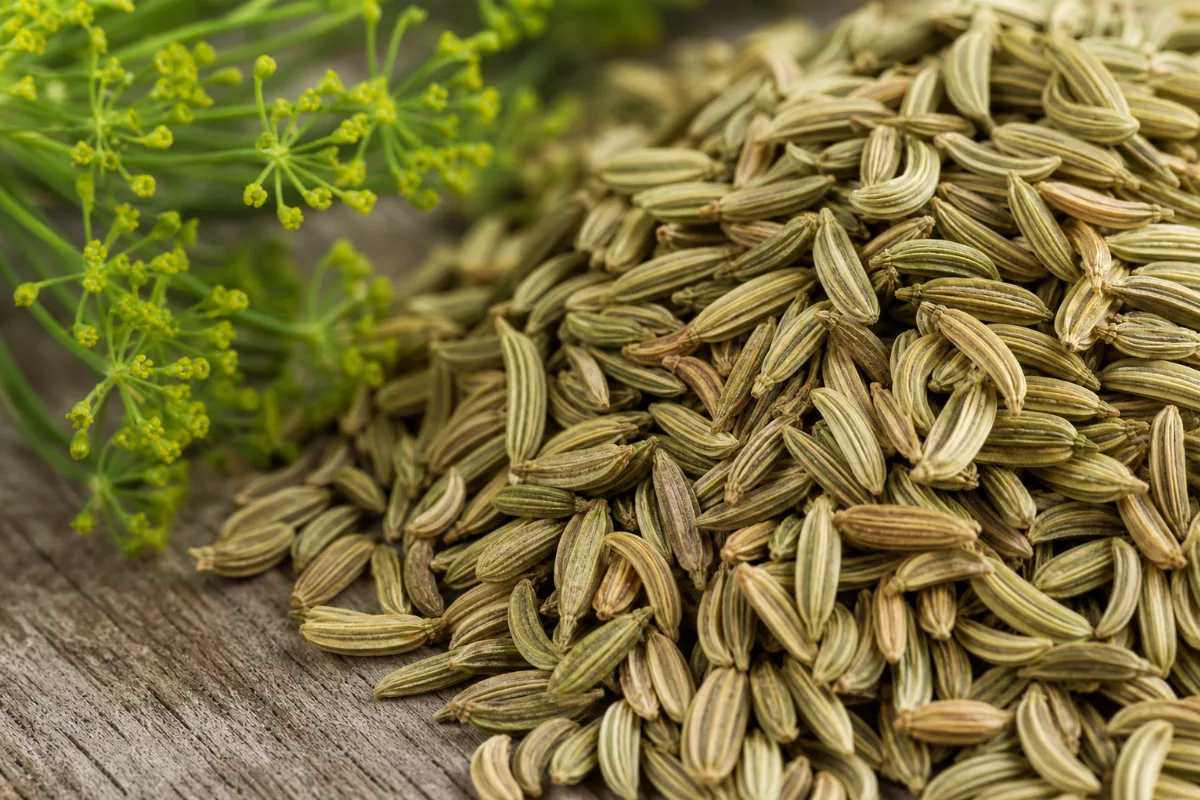
Fennel is Foeniculum vulgare Mill., a plant in the carrot family (Apiaceae), according to GBIF, which lists it as the accepted name. [2] The part used in herbal medicine is the dried fruit (fructus in the EU monographs), often sold as fennel seed. The EU has separate monographs for sweet fennel (var. dulce) and bitter fennel (var. vulgare). [1][3] Fennel tea as a drink is covered at fennel tea and blends at teas for gas and bloating. This is not star anise; see star anise.Traditional use (not proof of benefit)
The EU classifies fennel fruit uses as traditional herbal medicine: mild, spasmodic digestive complaints including bloating and flatulence, minor spasm with menstrual periods, and as an expectorant in cough with a cold. [1] The monograph states that the product is for use in specified indications exclusively based upon long-standing use, which means it is not based on clinical trial results. [1] For fennel in named traditions see Ayurvedic spices and digestive teas.What research shows
| Use | What the sources found | Strength of evidence | Form and population |
|---|---|---|---|
| Infant colic | A 2016 systematic review of three trials found preparations containing fennel oil appear effective for reducing colic, with limitations. [4] A 2011 review found some encouraging results for fennel extract, but said none of the trials was without flaws. [5] A 2003 trial of 125 infants aged 2 to 12 weeks found a fennel seed oil emulsion superior to placebo. [6] A 2017 review of herbal medicines in children found evidence of effectiveness for different fennel preparations and no serious adverse events, but few studies. [7] | Promising but limited | Fennel oil emulsion, extract, tea or compound products; infants |
| Mild digestive complaints in adults | The EU monograph accepts this as a traditional use only. [1] | Traditional use only | Herbal tea of the fruit |
| Menstrual cramps, cough | The EU monograph lists these as traditional uses. [1] | Traditional use only | Herbal tea of the fruit |
| Functional dyspepsia in adults | The 2023 Cochrane review of non-Chinese herbal medicines for functional dyspepsia lists peppermint and caraway oil, artichoke, anise and other herbs. [8] Proper evidence not found in the sources we read for fennel alone (we searched the Cochrane review, EMA documents and PubMed). | Insufficient evidence | - |
Colic trials mostly tested measured oils or products, not home-made preparations, and the results of one product do not carry over to another. The infant evidence sits alongside the EU advice against use under 4 years, so decisions about colic belong with a pediatrician.
Forms and why the form matters
The EU monograph describes fennel as a herbal tea for oral use, with a limit of 2 weeks in adults and adolescents and under 1 week for children aged 4 to 12. [1] The monograph notes that where fennel preparations are used, the total exposure to estragole should be considered. [1] Extracts, oils and products other than this tea were not described in the sources we read, so results for one form should not be assumed for another.Safety in more detail
- Allergy and cross-reactivity: the monograph lists hypersensitivity to fennel, to other Apiaceae (aniseed, caraway, celery, coriander and dill), to anethole, and to mugwort pollen (cross-reactivity with fennel) as contraindications. [1] See herbal allergy and cross-reactivity.
- Medicines: the monograph's interactions section says "None reported." [1] Other fennel and medicine interactions are not described in the sources we read. See how interactions work.
- Pregnancy and breastfeeding: not recommended in the absence of sufficient data. The monograph also says there is evidence that trans-anethole is excreted in breast milk. [1] See pregnancy and breastfeeding safety.
- Liver, kidney, bleeding and surgery: not described in the sources we read, apart from the rodent liver tumors above. Tell the surgical team about any herbal product (supplements before surgery).
- Quality: the sources we read do not discuss adulteration of fennel. For labels see quality testing and certifications.
Official statements
- EMA (EU), 2024 revisions: monographs for sweet fennel and for bitter fennel carry the same indications, age limits and cautions. [1][3]
Related pages
Frequently asked questions
Does fennel help colic?
Trials and reviews report encouraging results for some fennel products in infant colic, but the trials have limitations and the EU advises against fennel medicines under 4 years. [4][5][1] Ask a pediatrician.
Is fennel safe in pregnancy?
The EU monograph says use in pregnancy and breastfeeding is not recommended in the absence of sufficient data. [1]
What is estragole in fennel?
A natural compound the EU monograph describes as a genotoxic carcinogen in rodents, which is why it sets intake limits for children and pregnant women. [1]
Can I be allergic to fennel?
Yes. The EU monograph says skin or breathing reactions may occur, and lists cross-reactivity with mugwort pollen and with other carrot-family plants. [1]
How long can adults use fennel medicines?
The EU monograph says not for more than 2 weeks, and to see a doctor if symptoms persist. [1]
References
- European Medicines Agency, HMPC. European Union herbal monograph on Foeniculum vulgare Miller subsp. vulgare var. dulce, fructus (EMEA/HMPC/372839/2016), revision adopted 31 January 2024. Read 2026-10-23.
- GBIF Secretariat. GBIF Backbone Taxonomy species match. Names checked through the GBIF species match service. Read 2026-10-23.
- European Medicines Agency, HMPC. European Union herbal monograph on Foeniculum vulgare Miller subsp. vulgare var. vulgare, fructus (EMA/HMPC/372841/2016), revision adopted 31 January 2024. Read 2026-10-23.
- Infant Colic-What works: A Systematic Review of Interventions for Breast-fed Infants. Journal of Pediatric Gastroenterology and Nutrition, 2016. PubMed record PMID 26655941. Read 2026-10-23.
- Nutritional supplements and other complementary medicines for infantile colic: a systematic review. Pediatrics, 2011. PubMed record PMID 21444591. Read 2026-10-23.
- The effect of fennel (Foeniculum vulgare) seed oil emulsion in infantile colic: a randomized, placebo-controlled study. Alternative Therapies in Health and Medicine, 2003. PubMed record PMID 12868253. Read 2026-10-23.
- Herbal Medicines for Gastrointestinal Disorders in Children and Adolescents: A Systematic Review. Pediatrics, 2017. PubMed record PMID 28562281. Read 2026-10-23.
- Non-Chinese herbal medicines for functional dyspepsia (Cochrane review). Cochrane Database of Systematic Reviews, 2023. PubMed record PMID 37323050. Read 2026-10-23.