Pine Pollen (Pinus species): Evidence, Safety and How It Is Used
Pine pollen, collected from Pinus trees, is sold for energy and testosterone. We found no human trials, only animal and cell studies, plus allergy reports to check.
Content last updated . This page has not been medically reviewed.
Safety first. Supplements can cause side effects and interact with medicines. Read mushroom safety and interactions before you use any mushroom product.
What is Pine pollen good for?
What the body uses it for, and how strong the evidence is. A normal job in the body is not proof that extra supplements add benefit; each card says which.
Testosterone or hormone effects
Lab or animal research onlyNo human trial was found showing pine pollen changes testosterone. Rat and fish studies exist, which cannot be applied to people.
Supplements: No evidence of benefit in people.
Bone and muscle loss after testes removal (rats)
Lab or animal research onlyIn male rats whose testes were removed, the higher pine pollen amount slowed bone and calf-muscle loss over 60 days.
Supplements: Not tested in people.
Prostate enlargement markers (rats)
Lab or animal research onlyA fermented pine pollen broth reduced prostate-enlargement markers in rats given testosterone.
Supplements: Not tested in men.
Antioxidant activity (laboratory)
Lab or animal research onlyAn ethanol extract scavenged free radicals in test tubes and liver homogenate.
Supplements: No evidence that it works as an antioxidant in people.
Anti-inflammatory activity (cells)
Lab or animal research onlyThe extract lowered inflammatory signals in immune cells and joint-lining cells in the laboratory.
Supplements: No evidence of an effect on inflammation in people.
Adaptogen claim
Not enough evidencePine pollen is sold as an energy or 'adaptogen' product, but 'adaptogen' is a contested term and the sources read do not classify it as one.
Supplements: No human evidence found for energy or stress effects.
Sex change in fish
Lab or animal research onlyPine pollen in feed was linked to female-to-male sex change in young tilapia. This does not apply to people.
Supplements: Not applicable to people.
Connected topics
Open a group to see how each topic connects and how strong the evidence is.
Body systems (1)
- Immune SystemDocumented risk
Pine pollen can trigger allergic reactions in people who are sensitive to pollen. In one study of 65 pine-pollen-allergic patients, skin tests were positive to every pine pollen extract tested in 69%.
Body parts (1)
- Immune SystemDocumented risk
Pine pollen can trigger allergic reactions in people who are sensitive to pollen. In one study of 65 pine-pollen-allergic patients, skin tests were positive to every pine pollen extract tested in 69%.
Conditions & symptoms (2)
- Hay FeverDocumented risk
Pine pollen is an allergen for some pollen-allergic people; the cited study did not test supplements.
- AnaphylaxisDocumented risk
A case report describes anaphylaxis to pine nuts with antibodies that also react to pine pollen proteins. No anaphylaxis from pollen supplements was found in the sources read.
Documented risks and interactions (2)
- Allergic reactions (documented risk). Pine pollen can cause allergic reactions in people sensitive to pollen. In 65 pine-pollen-allergic patients, skin tests were positive to all pine pollen extracts tested in 69%.
- Cross-reactivity with pine nuts (documented risk). A case report found antibodies that react with both pine nut and pine pollen proteins, so sensitisation to both is possible.
Overview and the short answer
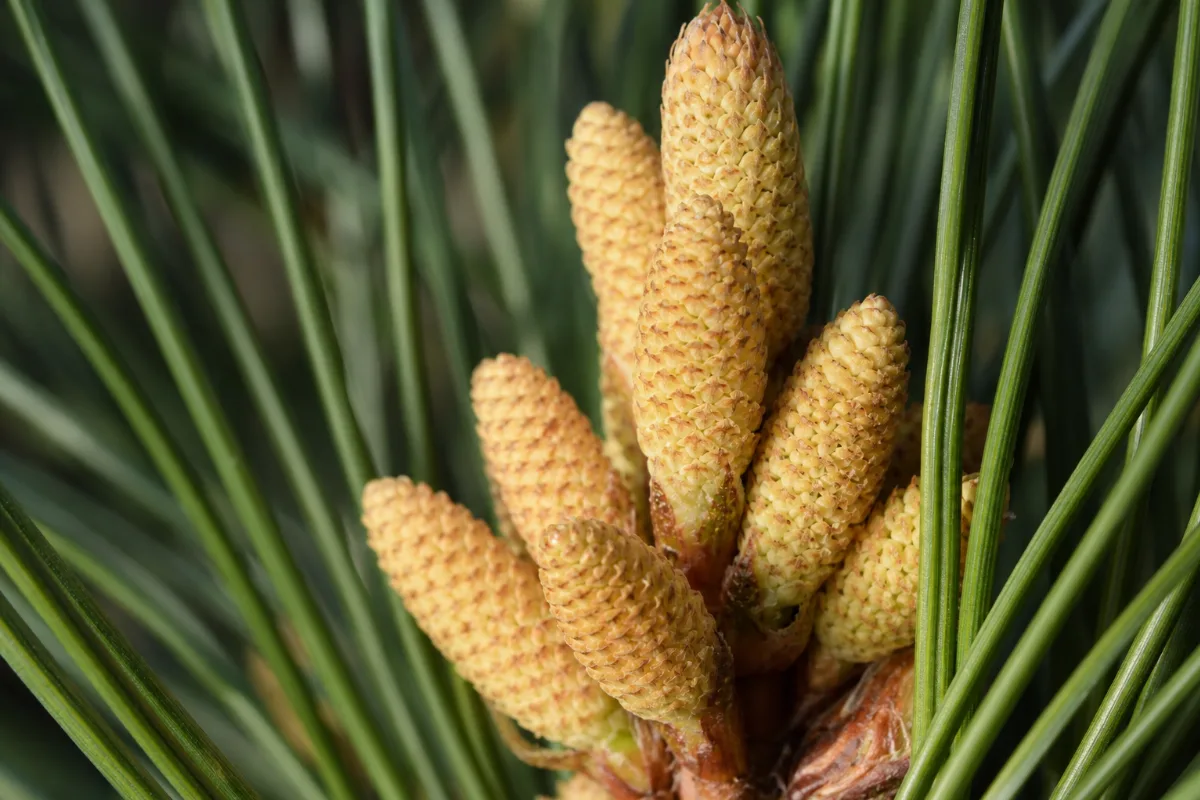
Pine pollen is the pollen of pine trees, genus Pinus (family Pinaceae). GBIF lists Pinus as an accepted genus [1], and many species exist. Studies we read named Pinus massoniana Lamb. [2] and Pinus radiata D.Don [3]; GBIF lists both as accepted [1]. Product labels often say only "pine pollen", so the species is usually unknown.
Proper evidence not found that pine pollen raises testosterone, treats low energy or acts as an adaptogen in people. We searched PubMed for pine pollen with human, patient, participant, randomized and clinical trial terms, and for pine pollen with androgen or testosterone terms. The records we read were laboratory, animal, allergy or pollen-biology studies, not trials of pollen supplements.
"Adaptogen" is a contested term [4], and the sources we read do not classify pine pollen as one. See what the word means.
Traditional use
The sources we read for this page do not describe a named tradition of pine pollen use, so we make no statement about one. Proper evidence not found.
What research shows
| Claim | What the source found | Strength of evidence | Population and form |
|---|---|---|---|
| Raises testosterone | Proper evidence not found in people. (One rat study used testosterone itself as the comparison treatment [5].) | Marketing claim | None in humans |
| Protects bone in castrated male rats | The higher amount (150 mg/kg) inhibited bone and calf-muscle loss [5] | Preclinical (animals) | Male rats, 60 days |
| Prostate | A fermented pine pollen broth reduced prostate enlargement markers in rats given testosterone [6] | Preclinical (animals) | Rats |
| Antioxidant and anti-inflammatory | An extract showed these actions in cells [7] | Preclinical (cells) | Lab cells |
| Changes sex in fish | Pine pollen in feed was linked to female-to-male sex change in tilapia [8] | Preclinical (fish); not applicable to people | Young fish |
The fish and rat results show that researchers study pine pollen's effects on hormones in animals. They are not proof that a supplement changes testosterone in a man or woman. Animal amounts per kilogram of body weight should not be converted into a human amount.
Allergy: the main documented concern
Pine pollen was long considered non-allergenic, but a study of 65 pine-pollen-allergic patients found positive skin tests to all the pine pollen extracts tested in 69% [3]. Reports also describe cross-reactivity between pine nut and pine pollen proteins, with cosensitization possible [9]. A person with pollen allergy, asthma or a pine nut allergy should ask a clinician or allergist before using any pollen product. For a severe allergic reaction (trouble breathing, swelling of the face or throat, fainting) call 911. See side effects, allergic reactions and reporting.
Safety: what is not known
- Medicines, pregnancy and breastfeeding, children, liver and kidney, bleeding and surgery: Proper evidence not found in the sources we read. That is not proof of safety. Because pollen is marketed with hormone claims, people with hormone-sensitive conditions should ask a clinician (a general precaution). Tell the surgical team about supplements (before surgery) and use interaction categories to prepare questions for a pharmacist.
- Quality. No source we read describes how pine pollen supplements are tested. See quality testing and certifications and contamination and adulteration in adaptogen products.
What a reader can do
Check the label for the species and plant part, ask a pharmacist or clinician, and be cautious about any product that promises hormone effects. A testosterone boosters claim check explains how to read such claims.
Frequently asked questions
Does pine pollen increase testosterone?
Proper evidence not found in people. The studies we read used animals or cells [5] [7].
Is pine pollen allergenic?
Yes for some people. A study found positive skin tests to all pine pollen extracts tested in 69% of 65 pollen-allergic patients [3].
Which pine species is used?
Studies cite several, such as Pinus massoniana [2]; labels often do not say.
Is pine pollen an adaptogen?
The term is contested [4] and the sources we read do not classify it that way.
Is it safe in pregnancy?
Proper evidence not found. Ask a clinician; see pregnancy and breastfeeding.
References
- GBIF Backbone Taxonomy: Pinus L. (accepted genus, Pinaceae); Pinus massoniana Lamb. and Pinus radiata D.Don (accepted species). GBIF record. Read 2026-10-22.
- Poultry science, 2021. Polysaccharides from Pinus massoniana pollen improve intestinal mucosal immunity in chickens.. Read 2026-10-22.
- Clinical and experimental allergy : journal of the British Society for Allergy and Clinical Immunology, 2009. Allergenicity and cross-reactivity of pine pollen.. Read 2026-10-22.
- Pharmaceuticals (Basel, Switzerland), 2025. Two Sides of the Same Coin for Health: Adaptogenic Botanicals as Nutraceuticals for Nutrition and Pharmaceuticals in Medicine.. Read 2026-10-22.
- Nutrients, 2025. Osteoprotective Effect of Pine Pollen in Orchidectomized Rats.. Read 2026-10-22.
- Food research international (Ottawa, Ont.), 2026. Protective effect of pine pollen fermentation broth on testosterone propionate-induced prostatic hyperplasia in rats.. Read 2026-10-22.
- Phytotherapy research : PTR, 2009. Antioxidant and antiinflammatory activity of pine pollen extract in vitro.. Read 2026-10-22.
- Biology of sex differences, 2026. Dietary pine pollen induces masculinization in Nile tilapia (Oreochromis niloticus, L. 1758) by modulating sex-biased gene expression and steroid hormone profiles.. Read 2026-10-22.
- Journal of investigational allergology & clinical immunology, 2000. Anaphylaxis to pine nuts and immunological cross-reactivity with pine pollen proteins.. Read 2026-10-22.